
Nancy Wake had spent years helping other people get out of France. In 1943, she became one of the fugitives.
By then Wake was deeply involved in the escape network commonly associated with Ian Garrow and, later, Albert Guérisse under the operational identity “Pat O’Leary.” From Marseille and other points in southern France, the network moved stranded Allied servicemen and other fugitives toward the Spanish frontier. Wake worked as a courier, used her mobility and social confidence to carry messages and people, and helped finance parts of the work with resources available through her husband, Henri Fiocca.
Then the situation changed.
German forces occupied the previously unoccupied southern zone of France in November 1942. The escape line came under heavier pressure. Infiltration, arrests and surveillance made the routes Wake had used increasingly dangerous. By early 1943, remaining in France had become a threat not only to Wake but also to the people sheltering and working with her.
She had helped build a road out. Now she had to travel it.
When the Escape Line Became the Target
Wake’s resistance work had begun well before she was personally forced to flee.
After the fall of France in 1940, she became involved in helping Allied servicemen and civilians escape from occupied territory. Australian War Memorial and UK National Archives accounts both connect her with the southern escape network that developed around Ian Garrow and later Albert Guérisse, the Belgian officer better known inside the network as Pat O’Leary.
The work depended less on dramatic raids than on movement.
A person hiding in Marseille might need civilian clothes, money, forged or borrowed identity papers, train travel, safe houses, guides and contact with people who could move them toward Perpignan or another route into the Pyrenees. A single compromised courier or address could expose an entire chain.
Wake became useful because she could travel and improvise.
Later stories emphasized her ability to pass checkpoints by projecting confidence or flirting with guards. Those anecdotes fit the methods of clandestine travel, but they also belong to the public legend that grew around her. What is not in doubt is that Wake became sufficiently exposed by 1943 that the Germans were actively interested in her and that the network judged it unsafe for her to remain.
The UK National Archives and Australian War Memorial both repeat the postwar identification of Wake as the Gestapo’s “White Mouse” and describe a five-million-franc reward associated with her capture.
Wake herself later said she did not know during the war that the Germans were calling her by that name. That is an important distinction: the nickname belongs to the historical record of how she was pursued and remembered, not necessarily to her own understanding while she was on the run.
Leaving Henri
The decision to leave France also meant leaving her husband.
Henri Fiocca had supported Wake’s resistance work and helped finance the escape-line activity. When Wake was told that she had become too vulnerable to remain, she left southern France without him.
Later versions often turn their last parting into a sharply defined cinematic scene. Wake herself supplied a memorable recollection of leaving as though she were simply going out and expecting to return.
The emotional truth is clear even if the exact words were recorded decades later: Wake left before Fiocca. She did not see him again.
Fiocca was later arrested by the Gestapo, tortured and killed in 1943 after refusing to reveal information about his wife. Wake did not discover what had happened to him until after France was liberated.
That knowledge belongs to the aftermath, not to the escape itself. The 1943 evader did not cross the Pyrenees already knowing that her husband was dead.

An Escape That Kept Failing
The number of times Wake tried to get out of France is one of the most repeated facts in her biography—and one of the least stable.
Australian official sources normally say it took six attempts before she succeeded. A recent scholarly study published in Histoire@Politique says seven.
The disagreement is not worth solving by guesswork. More important is what it tells us about the escape.
Wake did not simply leave Marseille, reach the foot of the Pyrenees and fail to climb the mountains five or six times. Her “attempts” were attempts to move through a compromised escape system. Trains were checked. Contacts disappeared. Guides became unavailable. Routes were broken. Police and German security forces were increasingly active.
A failed attempt could end hundreds of kilometres from the actual frontier. The evidence therefore supports describing “repeated attempts” rather than imposing a numbered sequence it cannot sustain.

Detained in Toulouse
At some point during this period of failed movement, Wake spent a short time in prison. The Australian War Memorial gives the broad fact: several thwarted attempts, a brief period of imprisonment, and eventual escape over the Pyrenees. Later biographical tradition supplies the details.
In those accounts Wake was arrested by Vichy or Milice authorities in Toulouse, held and interrogated for about four days, and refused to reveal the information her captors wanted. The most colorful version says Pat O’Leary intervened using a false explanation that Wake was his mistress and was hiding the affair from her husband, persuading the authorities that her evasiveness was romantic rather than political.
It is a classic Nancy Wake story—bold, comic and almost too perfectly suited to her later public persona. It may also be substantially true.
No contemporaneous arrest or interrogation file confirming the full scene was located in the reviewed sources. The detention belongs to the secure broad chronology; the exact four-day interrogation and O’Leary ruse remain later recollection.
That difference matters because Wake’s story has often been told as if every postwar anecdote were a wartime document.
The Train Story
Another famous episode comes from the repeated attempts to move south.
Specialist escape-line histories describe Wake travelling toward Perpignan with Allied evaders when warning came that German forces were preparing to search the train. Wake and others reportedly jumped from the train, reached nearby cover and came under fire as they escaped.
In one version, Wake lost a handbag containing jewelry, identity papers and even the walking boots she would have needed for the mountains. The scene appears in several later narratives, including accounts derived from Wake’s own recollections and biographies.
The event is plausible within the known collapse of the Pat Line. The escape-line network was being penetrated and its leaders were being arrested. Pat O’Leary himself was captured in Toulouse in March 1943.
But the detailed train sequence is not independently documented in the strongest official summaries. It should therefore be read as a later account of one failed stage in Wake’s escape—not as a scene whose every movement can be mapped with confidence.
The result, however, was real: the route had failed again. Wake was still in France.
The Final Route South
Eventually, the network assembled another attempt.
The broad mechanism is consistent across the best sources. Wake moved through the same clandestine world she had once operated for others: contacts, hidden accommodation, transport toward the frontier and local guides who knew how to move people across mountain terrain without using controlled border posts.
Some later sources say she travelled part of the way concealed in or on a coal truck. Others emphasize a group crossing with guides. The Institute for the Study of French-Australian Relations describes Wake crossing with six other people.
The exact vehicle sequence is less important than the structural fact. The final stage could not be done openly.
Spain under Francisco Franco was officially non-belligerent and later neutral in the European war, but people entering illegally could still face detention. The border itself was monitored. Escape-line guides therefore used mountain tracks away from official crossings, often at night and in difficult terrain.
Wake had once sent fugitives toward those routes. Now guides led her over them.
Across the Pyrenees
The Pyrenees were the physical barrier at the center of the escape.
Later accounts give the crossing a duration of about 47 hours and describe exhausting climbing, rough tracks and physical illness. The exact time is not independently established by the official records used here, so it should not be treated like a stopwatch measurement.
The essential point requires no embellishment. Wake crossed the mountain frontier on foot and reached Spain.
That was the decisive threshold. Once south of the border, she had escaped German-occupied France, but she had not yet reached Britain.
The next stage carried her through Spain toward Gibraltar, the British territory at the southern end of the Iberian Peninsula. Postwar accounts describe onward travel from Gibraltar to Britain, and the Australian War Memorial fixes her arrival in England in June 1943.
The precise day she crossed the mountains is not securely established in the sources reviewed here. A Guardian obituary places the successful escape from France in May. Taken together, the best-supported chronology is May–June 1943: flight from France in May, arrival in Britain by June.
Why June Matters
There is an institutional dating error worth correcting. A National Archives of Australia educational page says Wake left France and reached Britain in December 1943. That cannot be reconciled with the stronger documentary chronology.
The Australian War Memorial repeatedly places her arrival in England in June 1943. More decisively, Nancy Wake’s surviving Special Operations Executive personnel file at the UK National Archives shows her already undergoing British security screening in October and November 1943 and entering SOE training that winter.
She therefore could not have first reached Britain in December. June 1943 is the latest secure arrival point; the NAA December date is an institutional error.
An Evader Becomes an Agent
Reaching Britain ended one phase of Wake’s war and opened another. She did not remain safely away from occupied Europe.
After approaching the Free French and British services, Wake was eventually accepted by the Special Operations Executive’s French Section. Her personnel file survives in the UK National Archives under HS 9/1545.
The file provides a striking contrast with the legend.
Instead of a flawless superhero, it shows a recruit being scrutinized, criticized and tested. British assessors described her strengths and weaknesses, worried at times about discipline, and still concluded that she had the persistence, personality and field aptitude needed for clandestine work.
By spring 1944, she was ready to go back. On the night of 29–30 April 1944, Wake parachuted into France as part of the SOE’s Freelance circuit and began working with the Maquis in the Auvergne. The woman who had struggled repeatedly to get out of occupied France had deliberately returned to it.
What the Escape Story Really Shows
Wake’s 1943 escape is sometimes overshadowed by the more spectacular stories of her 1944 SOE service. But the earlier escape reveals something fundamental about clandestine warfare. An escape line was not a road.
It was a temporary chain of people, safe houses, transport, documents, money, timing and trust. When one piece broke, everyone behind it could be trapped.
Wake had spent years operating inside such a chain. That experience did not make her own escape easy. If anything, it showed her exactly how fragile the system was.
The broad sequence does not depend on proving whether there were six attempts or seven, whether a particular train was moving at a precise speed, or whether the final mountain crossing lasted exactly 47 hours. The important sequence is secure.
The network around Wake was being destroyed. She was becoming too exposed to remain. She left her husband, survived repeated failed movements and a period of detention, reached the Pyrenees with clandestine help, crossed into Spain, travelled through Gibraltar and arrived in Britain by June 1943.
That was not the end of Nancy Wake’s war. It was the escape that made her return possible.
Escape reconstruction
How the escape unfolded
An evidence-aware sequence of the principal stages.
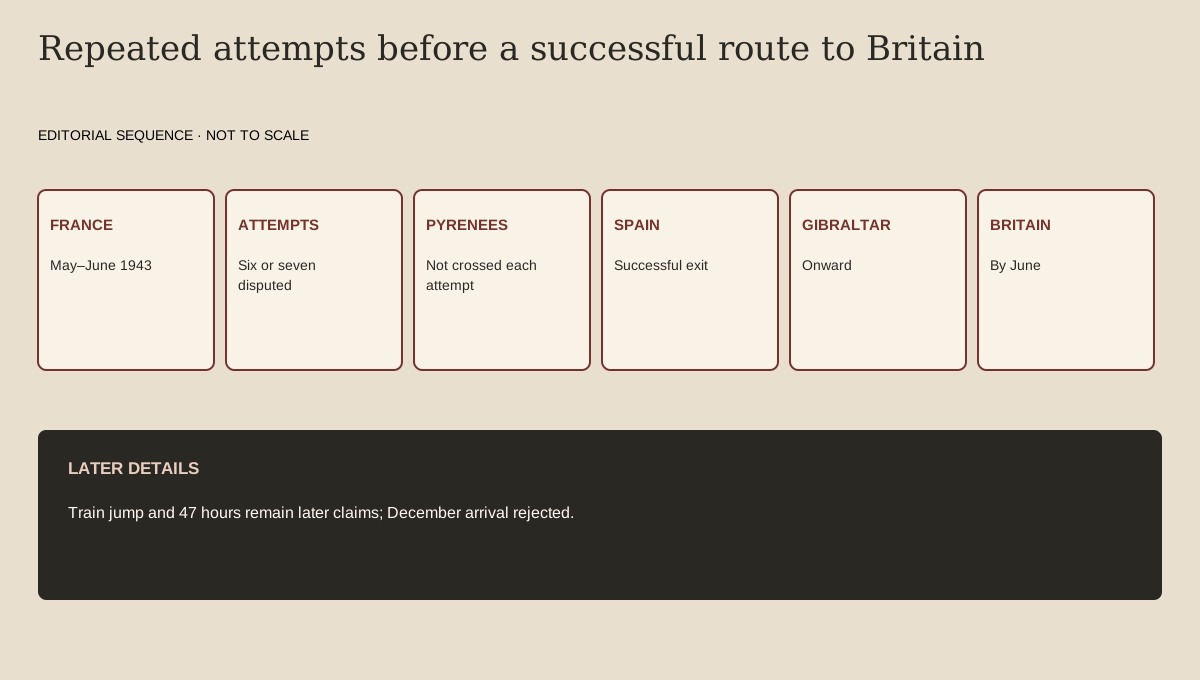
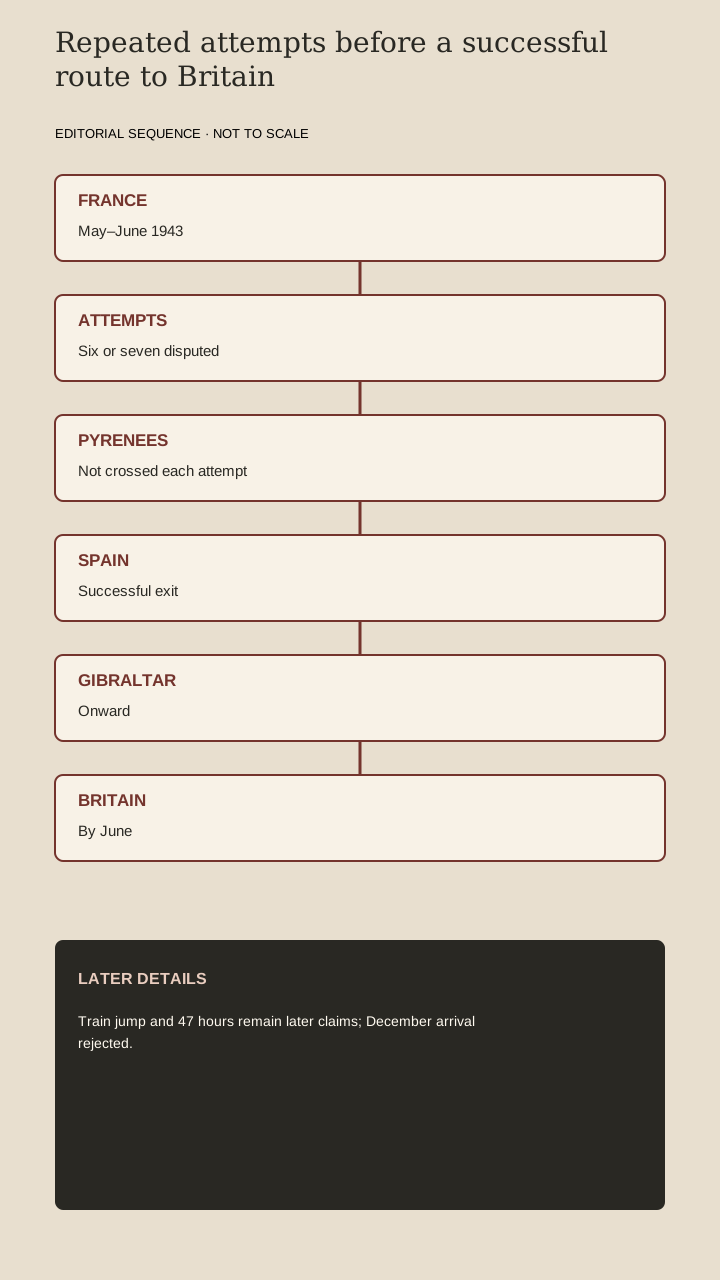
Simplified editorial reconstruction; not to scale. See adjacent text for evidence qualifications and unresolved details.
Evidence discipline
What the record supports
Status labels distinguish secure conclusions from uncertainty and rejected claims. Color is never the only signal.
DISPUTED
Nancy Wake succeeded on exactly her sixth attempt to escape France.
Australian official sources commonly state six attempts, while a recent scholarly article states seven. The exact count is not sufficiently stable to hard-lock.
Sources: SRC-002, SRC-004, SRC-006DOCUMENTED
Wake spent a brief period in prison during her escape attempts.
The Australian War Memorial explicitly states that several thwarted attempts included a brief period in prison before her successful Pyrenees crossing.
Sources: SRC-001LATER CLAIM
Wake was held for exactly four days in Toulouse and released after Pat O’Leary posed as her lover.
This detailed version appears in specialist and later biographical accounts. No contemporaneous detention record confirming the complete ruse was located in this research pass.
Sources: SRC-007, SRC-008LATER CLAIM
Wake jumped from a train under German fire during one failed escape movement.
The train episode is repeated in later escape-line histories and biographies but is not documented at the same level in the strongest official summaries.
Sources: SRC-007, SRC-010LATER CLAIM
The final Pyrenees crossing lasted exactly 47 hours.
The 47-hour figure comes from later specialist/biographical tradition. The crossing itself is secure; the precise duration is not independently established here.
Sources: SRC-007WELL-SUPPORTED
The Gestapo called Wake the White Mouse and a five-million-franc reward was associated with her capture.
Both the UK National Archives and Australian War Memorial repeat the nickname and reward. Wake later said she did not know during the war that she was being called the White Mouse.
Sources: SRC-002, SRC-003, SRC-011MYTH
Wake reached Britain in December 1943.
A National Archives of Australia educational page gives December 1943, but Australian War Memorial chronology places her arrival in June, and UK SOE records show her already in Britain for screening by October 1943.
Sources: SRC-001, SRC-003, SRC-009MYTH
Wake knew during her escape that Henri Fiocca had been killed.
Fiocca was killed later in 1943. Wake did not learn his fate until after the liberation of France.
Sources: SRC-001, SRC-002Selected chronology
Selected chronology
Wake works with resistance escape networks
Wake becomes a courier and helper in southern France, assisting Allied servicemen and other fugitives moving toward Spain.
German occupation expands into southern France
German forces occupy the previously unoccupied southern zone, increasing pressure on escape-line operations.
Pat O’Leary is arrested
Albert Guérisse, operating as Pat O’Leary, is arrested in Toulouse after the escape network is penetrated.
Wake is forced onto the escape route
With the network compromised and attention focusing on her, Wake makes repeated attempts to leave occupied France.
Successful Pyrenees crossing
Wake finally crosses from France into Spain with clandestine assistance. The exact date and exact number of prior attempts remain uncertain.
Wake reaches Britain
After travelling through Spain and Gibraltar, Wake reaches Britain.
British security screening begins
Surviving SOE personnel records show Wake in Britain undergoing security and suitability screening before field-agent training.
Wake returns to France
After SOE training, Wake parachutes back into occupied France as part of the Freelance circuit.