
Jan Baalsrud’s 1943 Escape: 63 Days Across Occupied Northern Norway
On March 30, 1943, Operation Martin collapsed inside a narrow fjord in northern Norway. German forces had found the Norwegian resistance mission’s boat, Brattholm, and the men aboard destroyed the vessel rather than surrender it intact. Eleven members of the mission would die. Jan Baalsrud was the only one who got away.
His escape lasted 63 days. It has often been remembered as a solitary contest between one injured commando and a relentless German manhunt. The documented story is more interesting: Baalsrud’s ability to keep moving mattered, but so did a widening civilian network that gave him boats, food, clothing, shelter, intelligence, improvised transport, and eventually a Sámi reindeer route into Sweden.
At a Glance
Mission: Operation Martin Red
Departure from Scotland: March 24, 1943
Mission vessel: M/K Brattholm I
Toftefjord disaster: March 30, 1943
Operation Martin men who escaped Toftefjord: Jan Baalsrud alone
Current Norwegian casualty reconstruction: Three killed or mortally wounded in the clash; eight captured and executed April 2
Escape duration: 63 days
Final destination: Sweden
Border crossing: June 1, 1943
Current Norwegian helper estimate: More than 70 women and men
Final transfer: Sámi brothers Aslak Baal and Per Thomas Baal using reindeer and pulk
Classification: Wartime escape, evasion, civilian-assisted extraction and cross-border rescue
Operation Martin Red
Baalsrud did not arrive in Norway as an isolated fugitive. He was part of a twelve-man Norwegian mission backed by Britain’s Special Operations Executive and organized through Norwegian Independent Company 1, better known as Kompani Linge.
The team left Scalloway in the Shetland Islands on March 24 aboard Brattholm. Eight men formed the vessel crew, while four comprised the operational party under Lieutenant Sigurd Eskeland. Baalsrud was one of the men intended to help train and build military resistance.
The mission is sometimes reduced to a plan to destroy Bardufoss airfield. Bardufoss mattered, but the objective was broader. Current Norwegian historical reconstruction describes Operation Martin Red as an effort to organize resistance forces in northern Troms and prepare sabotage against German installations, with Bardufoss among the major targets.
German patrol activity forced the group farther north than intended. That change increased the importance of local contacts they had not expected to use in quite the same way.
The Contact Was Gone
When Brattholm entered Toftefjord near Rebbenesøya, the mission sought a local contact who was supposed to help them enter the resistance network. He was dead.
The man approached in his place refused involvement. Suspicious of the strangers, he reported them through the local authorities. The information reached German security personnel. This was enough to compromise the mission.
The failure did not require an elaborate double agent or German penetration of the whole resistance network. A clandestine operation had arrived in the wrong place, lost the person meant to receive it, and exposed itself while trying to replace that link.
March 30: Toftefjord
On the afternoon of March 30, the German vessel R 56 entered Toftefjord. The men aboard Brattholm knew the mission had failed. They destroyed or scuttled the boat and tried to escape.
The most current Norwegian national reconstruction gives a more precise casualty sequence than many older summaries: three men were killed or mortally wounded during the clash, and eight surrendered. The captured men were taken to Tromsø, interrogated and tortured, then executed on April 2 under the brutal wartime regime applied to captured commandos. Baalsrud alone broke free of the encirclement.
That fact made him the sole survivor of the operational disaster. It did not make the next 63 days a solo journey.
Into Freezing Water
Baalsrud escaped through the water. The sea itself became the first barrier between him and German control. He reached land, encountered further danger, and got away again before crossing to Hersøy.
The cold-water survival has generated some of the story’s most dramatic retellings. The broad event is secure; the article does not need to reproduce every stroke, shot, or second from later narratives. What matters is the transition: within hours of the mission’s destruction, Baalsrud had gone from trained commando to isolated fugitive in occupied territory with no secure base, no intact operation, and no surviving team beside him.
Hersøy: The First Household
At Hersøy, Baalsrud reached an inhabited farm. The family gave him food, shelter, and dry clothing. The next stage of movement was arranged by boat.
This early assistance matters because it interrupts the later “alone for two months” image almost immediately. Baalsrud had to reach the helpers, decide whom to trust, and keep moving; civilians then supplied the things his original operation could no longer provide. The pattern repeated for the rest of the escape.
Ringvassøya
From Hersøy, Baalsrud was rowed to Ringvassøya. Current Norwegian reconstruction describes an overland stage of more than forty kilometres across difficult terrain. Even at this early point, the landscape forced him to combine his own movement with help from people who knew the islands, boats, crossings, and local risks.
The Swedish border lay roughly 120 kilometres away in a straight line. Straight-line distance was almost meaningless. Fjords, islands, mountains, weather, German occupation, and the need to avoid populated routes made the real journey longer and far less direct.
A Network Starts to Form
On Ringvassøya, Einar Sørensen and his father helped row Baalsrud across Grøtsundet. At Snarby, Alfred Lockertsen sheltered him and helped arrange a boat south through Ullsfjorden. At Kjosen, near Lyngseidet, Baalsrud obtained skis and poles.
These were not all members of one centrally directed rescue team. Many were local people solving the next immediate problem, then connecting Baalsrud to someone farther along. That relay logic is the key to understanding how the escape survived its own failures.
German Danger Without the Movie Manhunt
Near Lyngseidet, Baalsrud almost encountered a German checkpoint and turned into the mountains.
The checkpoint is important. German occupation was not an abstraction. Baalsrud moved through a region containing garrisons, patrols, security authorities, and local searches. Civilians aiding resistance could face severe punishment.
But a checkpoint is not the same thing as a continuous personalized hunt. The most recent Norwegian source criticism of German records argues that the Gestapo did not spend the next two months pursuing Baalsrud across the mountains in the manner dramatized by the 2017 film The 12th Man. German authorities appear to have believed he had died during the Toftefjord destruction. The real danger was more diffuse: he had to avoid a military occupation that could discover him at any point, while his helpers had to keep a large clandestine network from being exposed.
The Mountains Change the Escape
Avoiding the checkpoint forced Baalsrud into the Lyngen mountains. The weather deteriorated. Current Norwegian reconstruction describes a storm, whiteout, avalanche, severe exposure, snow blindness, and frostbite.
After roughly three days, he reached Furuflaten and Marius Grønvold. That arrival marks one of the most important shifts in the entire case.
Until then, civilians had repeatedly supported Baalsrud while he continued moving largely under his own power. From Furuflaten onward, his injuries increasingly meant that other people had to move him. The escape became an evacuation.
Marius Grønvold
Grønvold sheltered Baalsrud and helped create the next layer of the rescue network. Frostbite was worsening. Baalsrud could no longer simply be given food and pointed toward the next valley. Transport itself had become the problem.
Grønvold brought in other helpers and helped arrange an improvised stretcher movement. The group had to take a badly injured fugitive through an area where German troops were present, including a garrison at a local school.
The surviving reconstruction supports that risk. It does not justify an exact tactical diagram of how the stretcher passed every sentry.
Across Lyngenfjord
During the night leading into April 12, helpers rowed Baalsrud across Lyngenfjord. On the eastern side, they hid him at an abandoned farm in Revdal, inside a small shelter later remembered as Hotel Savoy. The name sounds comfortable. The reality was a cold emergency hiding place.
Baalsrud remained there for nearly two weeks while frostbite continued to deteriorate. The distance to Sweden was shrinking, but his ability to cover that distance was collapsing faster.
Building the Next Relay
Grønvold contacted former teacher Ingjald Leigland. Leigland helped extend the network toward Tromsø and Manndalen, including contact with resistance man Sverre Larsen for money and supplies. School caretaker Martin Jensen built a light ski-sled.
The object captures the transformation of the escape better than any heroic portrait. A man who had swum away from Toftefjord and crossed long stretches on foot now had to be carried and dragged through the mountains. His survival depended on engineering an evacuation around a body that could no longer do what the original plan demanded.
The Handoff That Failed
A Furuflaten group moved Baalsrud toward a rendezvous high above Revdal. The expected Manndalen team was not there. German house searches had disrupted their departure.
The Furuflaten helpers faced an impossible choice. The route back down was too difficult to repeat safely with Baalsrud, but leaving him alone in the mountains was also dangerous.
They placed him in a snow hollow beneath rock, protected him as best they could, and expected the next party to find him. They did not.
Snow Erases the Hiding Place

The Manndalen helpers searched. Snowfall had altered the landscape and covered the hide. They failed to find him. They tried again.
For roughly a week, Baalsrud remained isolated in the mountain shelter while people below knew he was somewhere above them but could not locate the exact place. On May 1, Marius Grønvold and Agnethe Lanes finally reached him and replenished his supplies. This was not the success of a perfect escape plan. It was survival through repeated recovery from failure.
More Than Seventy Helpers
Store norske leksikon’s current reconstruction states that more than 70 women and men risked life or health to help Baalsrud. The number changes the scale of the story.
The escape was not one organized convoy of seventy people. Most helpers never saw the entire route or knew every other participant. Their jobs were often narrow:
- row one crossing;
- provide one meal;
- dry clothes;
- hide him overnight;
- carry a message;
- sew or weave warm material;
- move supplies;
- search a mountain;
- build a sled;
- coordinate a handoff;
- transport him one stage farther. The network worked because no single helper had to solve all 63 days.
Manndalen
Manndalen became the center of the final Norwegian phase. Aslak Aslaksen Fossvoll was one of the local organizers. Other helpers included men recruited for mountain transport and women who supplied food, clothing, and materials.
Local history names Helene Fossvoll, who helped make warm coverings, and Eliva Fossvoll, who collected food. Agnethe Lanes had already climbed back into the mountains to help locate Baalsrud.
The civilian infrastructure deserves the same historical seriousness as Baalsrud’s individual endurance. People with families, farms, jobs, and no guarantee of protection accepted the risk of helping a hunted resistance man in an occupied country.
German Searches Still Mattered
The claim that there was no continuous Gestapo manhunt does not mean there was no German interference. A small German force conducting house searches had already disrupted a planned handoff. The region contained checkpoints and garrisons.
Local history also records an anonymous denunciation in May alleging that an “English soldier” was being hidden in the mountains and claiming knowledge of helpers. A Norwegian police official supplied an explanation that protected the network rather than exposing it.
This is a more realistic picture of clandestine danger than the film version. Discovery could come from: - a checkpoint; - a patrol; - a house search; - local rumor; - a letter; - a frightened civilian; - or one failed cover story. The network had to survive all of them.
Frostbite and the Toe Count
Baalsrud’s feet had been badly damaged by exposure. He lost most of his toes. The exact number is surprisingly difficult to state.
The current SNL biography says he decided to cut off nine toes with a pocketknife. Other Norwegian source work cites Baalsrud himself saying that one toe remained on each foot, which would mean eight lost. A local-history reconstruction describes a more complicated sequence in which gangrenous toes or parts came away at different times and Baalsrud cut others himself.
All versions agree on the central history: - frostbite was severe; - gangrene threatened him; - he performed self-amputation during the escape; - he lost most of his toes. The number belongs in the evidence register, not in the headline.
Baalsrudhula
After additional failed attempts to move east, the helpers brought Baalsrud to a more protected mountain fissure now known as Baalsrudhula. It is commonly called a cave, although local descriptions stress that it is more accurately a crack or fissure in the mountain. The distinction may sound minor. It illustrates a larger problem in famous escape stories: memorial language gradually becomes physical description.
The site is historically significant because it sheltered Baalsrud during the final waiting period. It should not be turned into an exact architectural reconstruction unless archaeological or contemporary evidence supports one.
Aslak Fossvoll’s Fate
Fossvoll survived the rescue. He was not executed by the Germans for helping Baalsrud. He died of diphtheria on July 3, 1943. Decades later, Baalsrud chose an extraordinary form of memorial association: his ashes were placed in Fossvoll’s grave.
That decision is a better ending for the helper story than an invented martyrdom. Baalsrud understood his escape as something other people had made possible.
The Sámi Border Stage
The final movement toward Sweden was handed to Aslak Baal and Per Thomas Baal, Sámi brothers with reindeer and knowledge of the border country. The transfer took roughly two days in the current Norwegian reconstruction. Baalsrud travelled by pulk rather than finishing the journey as a lone skier.
That detail matters because it preserves the changing physical reality of the escape. By late May, heroism did not look like walking unaided. It looked like surviving long enough to be carried by the next people in the chain.
June 1, 1943
Baalsrud crossed into Sweden on June 1. Sixty-three days had passed since the destruction of Brattholm. Sweden was neutral, and crossing the border ended the immediate danger of German occupation. It did not end the medical consequences.
Baalsrud spent roughly two months in hospital and convalescence. Swedish doctors managed to save his legs without further amputation. By autumn he returned to Britain and later resumed service.
Did He Walk 200 Kilometres Alone?
No. The modern commemorative route associated with Baalsrud is about 200 kilometres and follows large sections of the historical escape corridor. That is not the same as saying Baalsrud personally walked 200 kilometres. His movements included: - swimming; - rowing; - walking; - skiing; - being carried; - being dragged on improvised sleds; - boat crossings; - and reindeer transport.
The route is best understood as a chain of movements through an Arctic landscape, not as one continuous endurance hike.
The Story That Became a Legend
Baalsrud’s escape entered international memory through David Howarth’s 1955 book We Die Alone. Norway’s 1957 film Ni liv / Nine Lives made the story part of national wartime culture. Those works preserved Baalsrud’s endurance and the help he received. They also contributed to the natural process by which a complex clandestine event becomes a cleaner narrative.
Over time: - dates simplify; - helpers merge; - distances become totals; - one dangerous German checkpoint becomes “the Germans were always one ridge behind”; - physical details harden into precise numbers. The historian’s job is not to strip away wonder. It is to keep the wonder attached to evidence.
The 12th Man and Kurt Stage
The 2017 film The 12th Man uses Gestapo officer Kurt Stage as a persistent antagonist. That narrative creates tension and gives the audience a face for German pursuit. It is not the strongest reconstruction of what happened. Norwegian source criticism based on German records argues that authorities believed Baalsrud had died after Toftefjord and did not launch the sustained pursuit shown in the film.
German forces remained dangerous. Baalsrud and his helpers still had to avoid occupation checkpoints, local searches, garrisons, and discovery. The difference is historical scale. The real story is less:
one Gestapo officer following one commando across Norway
and more:
one wounded fugitive passing through a hostile occupied landscape while a civilian network tried to keep him invisible.
Evidence, Myth and What the Sources Support
Was Operation Martin only a mission to destroy Bardufoss airfield?
MYTH
Bardufoss was an important sabotage target, but current Norwegian scholarship describes the operation more broadly as an effort to organize military resistance and prepare sabotage throughout northern Troms.
Did the local reception plan fail before the Germans arrived?
DOCUMENTED
Yes. The intended contact was dead, and a replacement contact refused involvement and reported suspicious strangers through local authorities.
Were all eleven of Baalsrud’s comrades captured and then executed?
MYTH
The current Norwegian reconstruction states that three were killed or mortally wounded during the Toftefjord clash and eight were captured. The eight prisoners were executed on April 2.
Was Baalsrud the only Operation Martin man to escape?
DOCUMENTED
Yes.
Did Baalsrud complete the 63-day journey alone?
MYTH
No. He moved independently during important early stages, but more than seventy civilians are credited in the current Norwegian reconstruction with helping him through shelter, transport, food, clothing, intelligence, search, medical support, and final border movement.
Did Baalsrud walk approximately 200 kilometres by himself?
MYTH
The modern commemorative route is around 200 kilometres, but the historical journey combined walking, skiing, boats, stretcher and sled transport, and reindeer/pulk movement.
Was there a continuous German manhunt led by Kurt Stage?
MYTH
That is a major element of the 2017 film. German archival interpretation cited by Norwegian historians does not support a sustained personalized pursuit. German checkpoints, garrisons and localized searches were nevertheless real dangers.
Did German house searches affect the rescue?
DOCUMENTED
Yes. Current Norwegian reconstruction says a local German search operation disrupted a planned Manndalen handoff.
Did Baalsrud cut off exactly nine toes?
DISPUTED
The current SNL biography says nine, while other Norwegian source work cites Baalsrud as saying one toe remained on each foot and local history describes a more complicated sequence. The secure statement is that frostbite cost him most of his toes and that he performed self-amputation during the escape.
Was Baalsrudhula literally a conventional cave?
LATER CLAIM
The memorial name is established, but local descriptions identify the hiding place more precisely as a mountain fissure or crack.
Was Aslak Fossvoll executed for helping Baalsrud?
MYTH
No. He died from diphtheria in July 1943.
Did Baalsrud reach Sweden entirely under his own power?
MYTH
The final border stage was carried out with Sámi assistance from Aslak and Per Thomas Baal using reindeer and a pulk.
Why the Escape Worked
Baalsrud survived the destruction of Operation Martin because he managed to break away when the rest of the mission was destroyed or captured. He survived the first days because he could still swim, walk, ski, hide, choose whom to trust, and keep moving. He survived the middle of the route because civilians repeatedly supplied the things an isolated fugitive lacked. He survived after his body began failing because the escape changed form.
A resistance network turned his journey into a relay: - houses; - boats; - messages; - food; - sleds; - mountain searches; - hidden shelters; - Sámi reindeer transport. The most accurate version of the story therefore does not diminish Baalsrud. It enlarges the cast.
Documentary reconstruction
A widening civilian relay became the escape mechanism
A case-local visual focused on the historical question that the surviving evidence can answer.
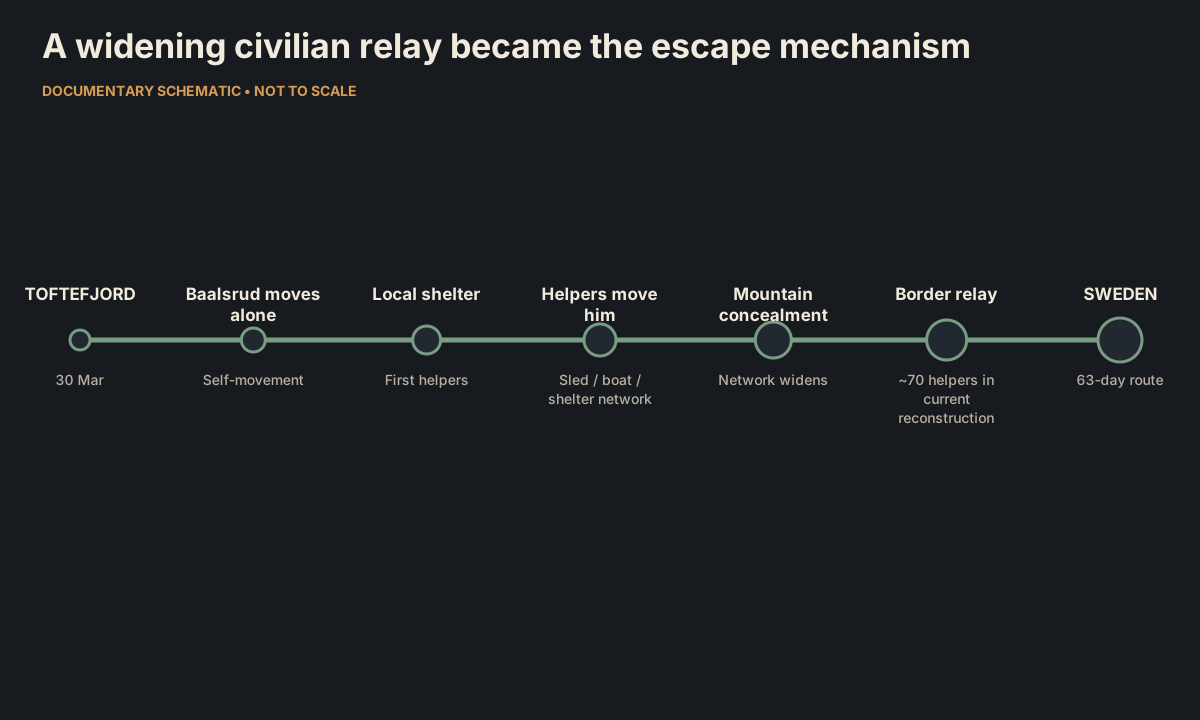
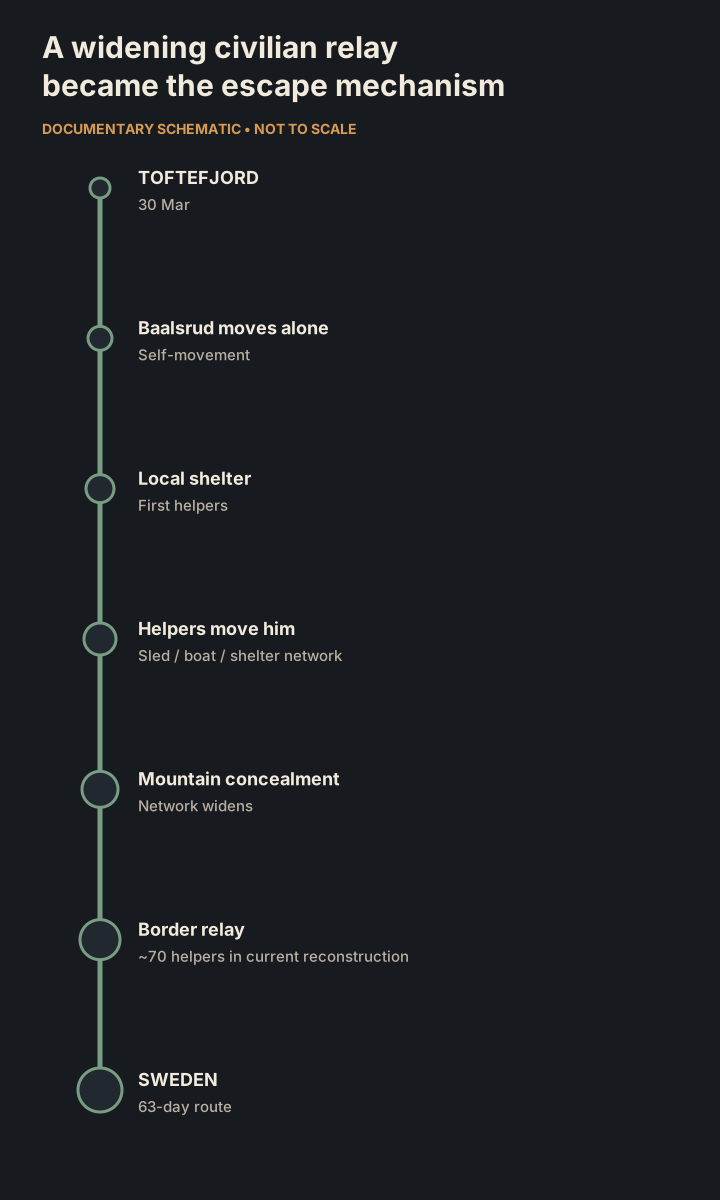
Simplified documentary reconstruction; not to scale. Evidence qualifications are written directly into the visual and explained in the adjacent text.
Evidence discipline
What the record supports
Status labels distinguish secure conclusions from uncertainty and rejected claims. Color is never the only signal.
MYTH
Operation Martin Red was only a mission to destroy Bardufoss airfield.
Bardufoss was an important sabotage objective, but current Norwegian scholarship describes the mission more broadly as organizing resistance and preparing sabotage across northern Troms.
Sources: SRC-002DOCUMENTED
The mission was compromised after the intended local contact proved unavailable and a replacement contact reported the strangers.
Current Norwegian historical reconstruction gives this contact failure and reporting chain as the trigger for German attention.
Sources: SRC-002, SRC-011MYTH
All eleven of Baalsrud's comrades were captured and then executed.
The current SNL reconstruction states that three were killed or mortally wounded in the Toftefjord clash and eight surrendered; those eight were later executed.
Sources: SRC-002DOCUMENTED
Baalsrud was the only Operation Martin participant to escape Toftefjord.
Norwegian historical sources consistently identify Baalsrud as the sole man to evade the German action.
Sources: SRC-001, SRC-002, SRC-011MYTH
Baalsrud completed the 63-day journey alone.
Current Norwegian reconstruction credits more than seventy women and men with assistance ranging from boats and shelter to search, sled transport and the final Sámi border transfer.
Sources: SRC-002, SRC-003, SRC-004MYTH
Baalsrud walked approximately 200 kilometres entirely under his own power.
The modern memorial route is approximately 200 km and follows much of the historical corridor, but the actual escape included swimming, boats, walking, skiing, stretcher/sled transport and reindeer/pulk movement.
Sources: SRC-002, SRC-003MYTH
A continuous German manhunt personally led by Kurt Stage pursued Baalsrud for 63 days.
The 2017 film dramatizes a persistent Gestapo pursuit. German archival interpretation cited by Norwegian source critics indicates authorities believed Baalsrud had died after Toftefjord and did not conduct the film's sustained personal manhunt.
Sources: SRC-005, SRC-006, SRC-010MYTH
German occupation forces posed no danger after Toftefjord because they believed Baalsrud was dead.
Checkpoints, garrisons and localized house searches remained real, and German search activity directly disrupted at least one planned civilian handoff.
Sources: SRC-002, SRC-004, SRC-005DISPUTED
Baalsrud cut off exactly nine toes himself in one episode.
Current SNL says nine, while other Norwegian source work cites Baalsrud as saying one toe remained on each foot and local history describes toe loss and self-amputation occurring in a more complicated sequence.
Sources: SRC-002, SRC-004, SRC-007WELL-SUPPORTED
Severe frostbite caused Baalsrud to lose most of his toes and perform self-amputation during the escape.
Norwegian national, local and retrospective sources agree on severe frostbite, gangrenous injury and self-amputation even though the exact count and sequence vary.
Sources: SRC-002, SRC-004, SRC-007, SRC-011LATER CLAIM
Baalsrudhula was a conventional deep cave.
The memorial name is established, but local descriptions characterize the shelter more precisely as a fissure or crack in the mountain.
Sources: SRC-003MYTH
Aslak Fossvoll was executed by the Germans for helping Baalsrud.
Local history records that Fossvoll survived the rescue and died of diphtheria on July 3, 1943.
Sources: SRC-004MYTH
The final crossing into Sweden was completed by Baalsrud alone on skis.
The final stage depended on Aslak and Per Thomas Baal and reindeer/pulk transport.
Sources: SRC-002, SRC-003, SRC-011UNKNOWN
The exact local path of every stage of Baalsrud's 63-day escape can be reconstructed with GPS-level certainty.
The broad sequence and major shelters are well-supported, while precise paths, some timing and survival microdetails derive from retrospective testimony and commemorative route reconstruction.
Sources: SRC-001, SRC-002, SRC-003, SRC-011, SRC-012