
On 28 January 1980, six U.S. diplomats who had spent almost three months hidden in Tehran entered Mehrabad Airport carrying Canadian passports and posing as members of a film crew. Two CIA officers accompanied them. Their supposed production, Argo, existed only as a cover, but the passports were genuine Canadian government documents and the months of sanctuary behind them were real.
The extraction was the final phase of an operation that had begun when the six escaped capture during the seizure of the U.S. Embassy on 4 November 1979. Canada then supplied what no short-term cover could replace: secure diplomatic homes, political protection, documents, local knowledge, and time. The CIA later added the external identity that could explain why the group was in Iran at all.
That combination is the key to understanding the Canadian Caper. It was neither a CIA rescue with Canada serving as scenery nor a purely Canadian operation to which the CIA later attached itself. Canadian sanctuary and American intelligence support solved different parts of the same problem.
Historical context
The extraction belongs within the Iranian Revolution and Iran hostage crisis.
Mohammad Reza Shah Pahlavi left Iran in January 1979 amid revolutionary upheaval. Ayatollah Ruhollah Khomeini returned from exile soon afterward, and authority fragmented among revolutionary institutions, political factions, clerical networks, armed groups, and the provisional government.
The United States carried significant historical baggage in Iran. American and British intelligence had helped remove Prime Minister Mohammad Mosaddeq in 1953, after which the Shah's monarchy became a close U.S. partner. Washington supported the Shah politically and militarily for decades. In October 1979 the United States admitted the exiled Shah for medical treatment, intensifying fears among Iranian revolutionaries that Washington might again intervene in Iranian politics.
On 4 November 1979, Iranian student militants seized the U.S. Embassy in Tehran. The hostage crisis ultimately left 52 Americans captive for 444 days, until 20 January 1981.
The Canadian Caper concerned six other U.S. personnel who escaped the immediate seizure. They were not prisoners, but their continued presence in Tehran created an increasingly dangerous problem: as militants reconstructed embassy records and counted personnel, the missing Americans could become identifiable targets.
The six Americans
The extracted group consisted of:
- Robert G. Anders — senior consular officer.
- Mark J. Lijek — consular officer.
- Cora Amburn-Lijek — consular staff member.
- Joseph D. Stafford — consular officer.
- Kathleen F. Stafford — consular staff member.
- Henry Lee Schatz — agricultural attaché.
Five escaped from the consular area in closely connected movement during the embassy seizure. Schatz escaped separately and initially received help through Swedish diplomatic personnel.
They were diplomats and embassy staff, not trained clandestine operators. That fact shaped the eventual solution. Their cover identities had to be simple, mutually reinforcing, and sustainable by people who had spent weeks in hiding rather than years practicing clandestine tradecraft.
The Canadian sanctuary
Robert Anders knew John Sheardown, Canada's senior immigration officer in Tehran. Within days of the embassy seizure, Anders telephoned him and asked whether the group could be sheltered.
Sheardown took the request to Ambassador Kenneth Taylor. Taylor agreed and sought approval from Ottawa. Prime Minister Joe Clark and External Affairs Minister Flora MacDonald accepted the risks.
The five Americans then split between two Canadian households:
- Joseph and Kathleen Stafford stayed with Ken and Pat Taylor.
- Robert Anders, Mark Lijek, and Cora Lijek stayed with John and Zena Sheardown.
- Lee Schatz later joined the Sheardown household after his separate period of Swedish diplomatic shelter.
This household split is historically important. The 2012 film largely collapses the Canadians into Taylor's residence and omits John and Zena Sheardown. The actual operation depended heavily on the Sheardowns, whose home sheltered four of the six for much of the concealment period.
The Canadian chancery was considered too exposed for long-term hiding. Private diplomatic residences offered more plausible daily cover and fewer reasons for outsiders to enter.
Selected chronology
Selected chronology
U.S. Embassy seized
Iranian student militants seize the U.S. Embassy compound in Tehran. Six American personnel evade capture.
Anders contacts John Sheardown
Within days of the takeover, Robert Anders asks Canadian immigration officer John Sheardown for refuge for the five Americans hiding together.
Five enter Canadian sanctuary
Anders and the Lijeks stay with John and Zena Sheardown; Joseph and Kathleen Stafford stay with Ken and Pat Taylor.
Lee Schatz joins the Canadian group
After separate Swedish diplomatic shelter, Schatz is transferred into Canadian protection and stays with the Sheardowns.
The secret becomes harder to contain
Journalists begin deducing that Americans escaped the embassy seizure and may be protected by Canada, increasing pressure for an extraction plan.
Canada and CIA prepare cover identities
Canada authorizes genuine passports under cover identities while CIA technical specialists develop Studio Six and the Argo film cover.
Carter gives final approval
President Jimmy Carter gives final authorization for the CIA extraction mission.
Mendez and Johnson enter Tehran
The two CIA extraction officers arrive under film-production cover and join the Canadian-American operation.
CIA cable confirms next-day plan
A declassified CIA cable records the operations plan for a 28 January exfiltration from Mehrabad Airport.
The Canadian Six leave Iran
The six diplomats and their CIA escorts pass airport controls, board Swissair, and depart Iranian airspace.
Canadian role becomes public
Press reporting reveals that Canada sheltered and helped extract the six, producing a major wave of public gratitude in the United States.
CIA participation is publicly disclosed
The CIA reveals its previously secret operational role during its fiftieth-anniversary period.
CIA identifies Ed Johnson
CIA publicly identifies the second Tehran extraction officer previously known as Julio.
The secret becomes an operation
Sheltering six missing Americans was initially a humanitarian decision. It gradually became a covert diplomatic operation.
Taylor still had to run the Canadian mission during a revolutionary crisis. Embassy staff managed normal diplomatic responsibilities while protecting an extraordinary secret. Ottawa restricted knowledge. Sensitive reporting moved between Tehran, Ottawa, and Washington. The Canadians also began considering how the embassy itself might eventually close without exposing the houseguests.
The danger was not only Iranian detection. The mystery of the missing Americans attracted journalists.
Jean Pelletier of the Montreal newspaper La Presse independently concluded that some U.S. personnel had escaped the takeover and were likely under Canadian protection. He withheld publication while the six remained in danger. Other reporters were asking similar questions.
The longer the six stayed hidden, the greater the chance that the secret would cease being containable. By late December 1979 and early January 1980, Canada and the United States needed an extraction plan.
Why the cover needed more than passports
The central challenge was not simply producing documents.
Six apparent Canadians had to explain why they were in revolutionary Iran in the first place. A passport can establish a claimed identity, but it does not create a believable travel purpose.
Several cover ideas were considered. The eventual film concept worked because a foreign movie crew could plausibly consist of unusual personalities traveling together, scouting locations, carrying artwork and production material, and moving through places that ordinary tourists might avoid.
The cover also had to withstand external verification.
The CIA therefore did not merely print business cards. It created Studio Six Productions in Los Angeles. The office could receive telephone calls. Trade advertising and promotional material made the company visible. The production had a script, concept art, and a project title.
The film was called Argo.

Material evidence
Tools of Escape
The objects used in an escape reveal how a plan worked under constraint.
- 01Made sustained hiding possible without using the exposed Canadian chancery.
Canadian diplomatic residences
Private homes of Ken and Pat Taylor and John and Zena Sheardown provided the principal long-term concealment.
- 02Provided a strong legal-document foundation for the group's declared nationality and identities.
Genuine Canadian passports under cover identities
Canada supplied authentic passport documents carrying fictitious identities approved for the extraction.
- 03Provided external verification for the film-crew story.
Studio Six Productions
A functioning fictitious Hollywood production company with telephone presence, publicity, and business materials.
- 04Made the cover tangible without requiring the six to invent an entire production from nothing.
Argo script and concept materials
Science-fiction production material adapted from an abandoned Lord of Light film project and used as evidence of a plausible location-scouting production.
- 05Linked technical preparation outside Iran to the Canadian mission on the ground.
Canadian diplomatic pouch
Sensitive supporting materials were moved into Tehran through protected Canadian diplomatic channels.
- 06Allowed success to depend on appearing routine rather than physically defeating security.
Scheduled Swissair flight
The operation used ordinary international air travel rather than a clandestine border crossing or military extraction.
The strange reality behind the fake film
The Hollywood cover was fictional, but parts of its creative material already existed.
The operation reused a screenplay and visual material derived from an abandoned attempt to adapt Roger Zelazny's science-fiction novel Lord of Light. Artist Jack Kirby had produced elaborate concept artwork for that earlier project.
CIA contractor and makeup artist John Chambers, known for his work on Planet of the Apes, helped Mendez establish the Hollywood side of the cover.
That history made Argo look more substantial. A suspicious caller could reach a real office. The “production” possessed artwork and paperwork that had the density of an actual film project because some of it had once been intended for one.
For the six diplomats, this external infrastructure mattered more than acting ability. They needed only to inhabit roles consistent with a production that could survive basic checking.
Canada supplied genuine passports
One of the most consequential Canadian contributions was the passport package.
The six did not leave Iran with ordinary CIA-forged Canadian passports. Canada authorized the issuance of genuine Canadian passport documents carrying fictitious identities.
This distinction matters historically and operationally. A genuine document issued by a real government had a fundamentally different evidentiary status from a fabricated booklet.
The supporting Iranian travel history still had to be created. Entry information, visas, stamps, dates, and supporting papers needed to make the cover identities appear to have entered Iran legitimately.
Canadian diplomat Roger Lucy noticed a date problem in the prepared Iranian documentation. It was corrected before the extraction.
The resulting identity package was therefore hybrid:
real Canadian passport documents + invented personal identities + fabricated Iranian travel history + externally supported Studio Six commercial cover.
That combination was stronger than any one element alone.
Problem → response
Escape was a sequence of problems
Each response solved a practical obstacle while often creating the next one.
- 01→
Obstacle
Hostage-taking after the embassy seizure
Most U.S. personnel at the embassy were captured, and any missing Americans risked becoming additional hostages if found.
Response
The six dispersed into temporary hiding and later into allied diplomatic sanctuary.
- 02→
Obstacle
Long-term concealment
Six Americans could not remain indefinitely in improvised urban hiding while the hostage crisis continued.
Response
Canada split the group between private diplomatic residences and restricted knowledge of their presence.
- 03→
Obstacle
Growing press knowledge
Journalists began deducing that Americans were missing and that Canada might be hiding them.
Response
Publication was delayed while Canada and the United States accelerated extraction planning.
- 04→
Obstacle
Need for credible identities
The six needed both convincing travel documents and a plausible reason for being in Iran.
Response
Canada supplied genuine passports while CIA built a supported film-production cover and related travel documentation.
- 05→
Obstacle
Document-date error
Canadian diplomatic personnel identified an error in prepared Iranian travel-document dates.
Response
The supporting documentation was corrected before departure.
- 06→
Obstacle
Ordinary airport scrutiny
The group had to pass airline and immigration controls while maintaining identities unfamiliar to them.
Response
The six rehearsed a coherent film-crew cover and traveled with Mendez and Johnson as production colleagues.
- 07→
Obstacle
Flight delay
A mechanical delay extended the period the group had to remain inside Mehrabad Airport.
Response
They maintained the cover until the Swissair flight was ready to depart.
Two CIA officers entered Tehran
Tony Mendez became the public face of the CIA role after the operation was declassified in 1997. His memoir and later Argo made him far more famous.
He was not the only CIA extraction officer in Tehran.
The second officer was long identified publicly only by the cover name “Julio.” In September 2023, the CIA revealed that he was Ed Johnson.
Johnson had relevant language and field experience and worked alongside Mendez on the final preparation and departure. Restoring him to the history changes the familiar image of one CIA officer joining six diplomats.
The field extraction group consisted of two CIA officers and six U.S. diplomats, operating through Canadian diplomatic infrastructure.
Documentary reconstruction
Three parallel preparations, one departure
A case-local visual focused on the spatial, mechanical or evidentiary relationship established by the surviving record.
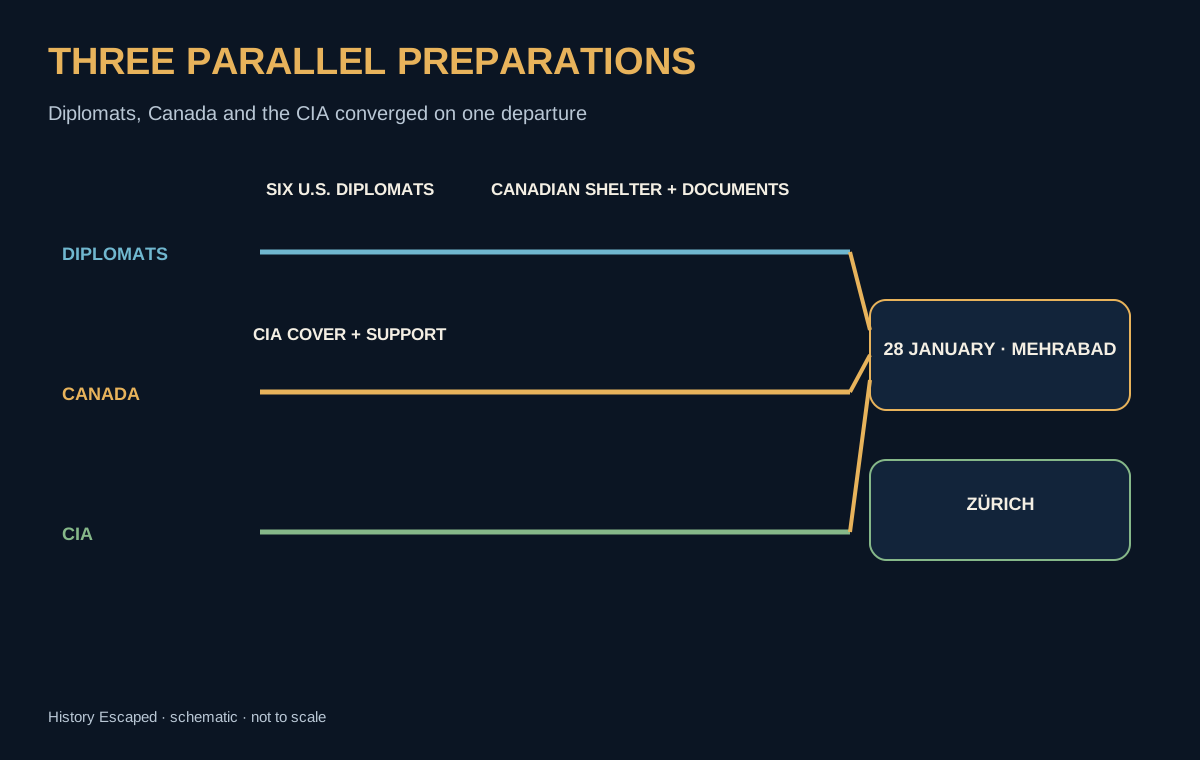
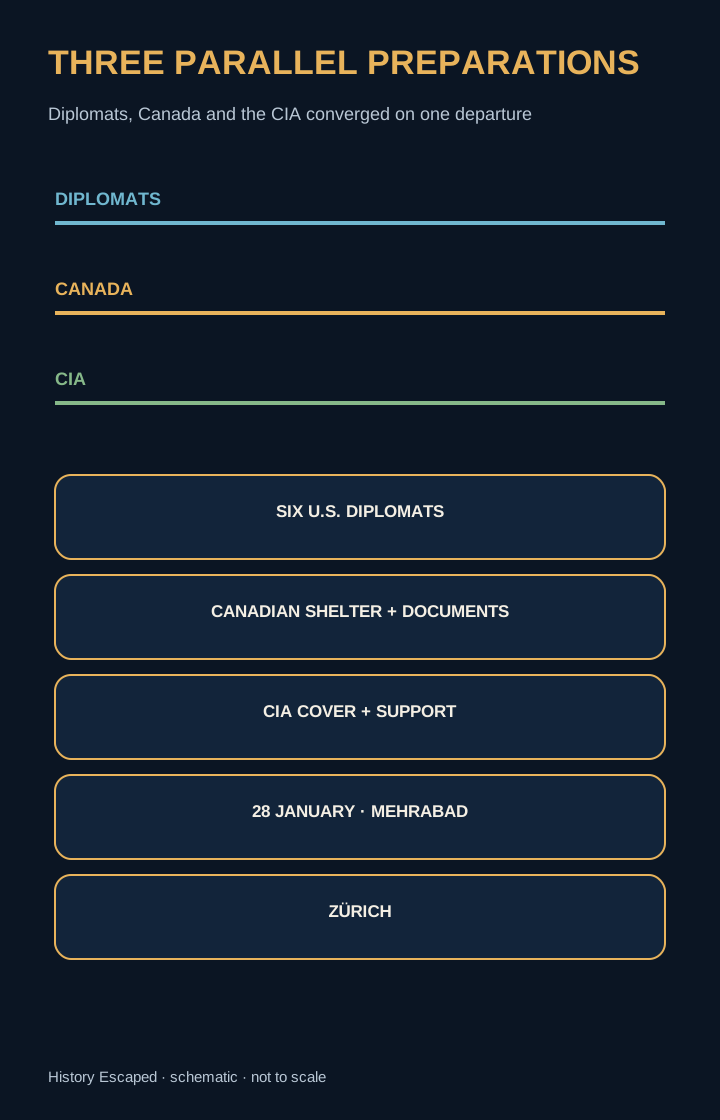
Simplified editorial reconstruction based on the cited historical record; not to scale. Uncertainty is stated directly in the visual and adjacent text.
January 1980
By January the concealment phase was becoming increasingly fragile.
The Canadian embassy was being wound down. The houseguests had been hidden for weeks. Media interest was rising. Calls and other signs suggested that the secret might not remain secure indefinitely.
President Jimmy Carter gave final approval for the CIA extraction mission on 23 January 1980.
Mendez and Johnson arrived in Tehran on 25 January using film-production cover. They joined Canadian personnel and the six houseguests, completed the remaining documentation, and prepared the group for the identities they would use at the airport.
The cover did not require elaborate improvisational theater. It required consistency: names, occupations, passports, production material, clothing, travel history, and answers had to tell the same story.
The extraction-date conflict
A current Government of Canada history page places the Swissair departure on 27 January 1980. The strongest evidence supports 28 January.
A declassified CIA cable dated 27 January 1980 begins by identifying the material as the operations plan for 28 January exfiltration of the houseguests from Mehrabad. The fact that the document was created before the planned operation makes it especially strong chronology evidence.
Current CIA and U.S. State Department museum histories also identify 28 January as the extraction date.
The strongest evidence therefore supports:
28 January 1980 — documented controlling date for the airport extraction.
The Canadian government's 27 January date is preserved in the evidence section as an institutional discrepancy rather than silently discarded.

The final accounting
Outcome
U.S. diplomats extracted
All six members of the Canadian Six left Iran successfully.
CIA field officers returned safely
Tony Mendez and Ed Johnson also departed Iran successfully.
Canadian sanctuary compromised before extraction
The six were not discovered in Canadian diplomatic protection before the departure operation.
CIA role initially public
No. Canada's role became public immediately after the extraction; CIA operational involvement remained secret until 1997.
Mehrabad Airport
The group traveled to Mehrabad Airport as a film crew.
The historical sequence is less cinematic than Argo and, for that reason, more revealing about the actual operation. The six needed to look routine.
They checked in for Swissair. They passed ordinary documentation and immigration procedures. Revolutionary Guards were present in the airport environment, and any inconsistency could have exposed the cover. A mechanical problem delayed the flight and extended the amount of time the group had to remain inside the terminal.
The operation remained vulnerable until departure.
What the evidence does not support is the movie's escalating airport climax. There is no strong documentation for Iranian officials reconstructing images of the six at the last moment, forcing a dramatic telephone verification of Studio Six, or pursuing the Swissair aircraft down the runway in vehicles.
Those sequences are dramatic inventions. The real operation succeeded because nothing visibly extraordinary happened.
The aircraft departed for Zürich. Once it cleared Iranian airspace, the six were no longer potential hostages inside the revolutionary crisis.
After Iran
The six moved through U.S. arrangements in Europe and returned to the United States.
Once they were safe, the Canadian role became public almost immediately. American reaction was extraordinary. Canadian flags and “Thank You Canada” messages appeared across the United States. Kenneth Taylor became internationally famous, and Canadian embassy personnel were widely honored.
That public story was intentionally incomplete.
The CIA role remained classified because the Iran hostage crisis itself continued. Publicly identifying an American intelligence operation inside Tehran could have complicated negotiations and endangered the 52 hostages still held.
In 1997, the CIA publicly disclosed Mendez's operational role during its fiftieth-anniversary period. The second CIA officer remained unnamed for another quarter century.
In 2023, the CIA identified Ed Johnson. The history of the Canadian Caper therefore changed as classified information became public.
Evidence discipline
What the record supports
Status labels distinguish secure conclusions from uncertainty and rejected claims. Color is never the only signal.
DISPUTED
The Canadian Six were extracted from Tehran on 27 January 1980.
The current Government of Canada history page gives 27 January. A declassified CIA cable dated 27 January explicitly describes the operations plan for a 28 January exfiltration, and current CIA and U.S. State Department museum accounts also give 28 January. The balance of evidence supports 28 January as the better-supported date.
Sources: SRC-001, SRC-002, SRC-003, SRC-004MYTH
The Canadian Caper was solely a CIA rescue operation.
Canada provided months of sanctuary, political authorization, genuine passports, diplomatic support, and local infrastructure. CIA supplied the film cover, technical expertise, and field extraction officers. The operation was joint.
Sources: SRC-001, SRC-002, SRC-004, SRC-005, SRC-009MYTH
Canada carried out the entire extraction without a significant CIA role.
CIA created and supported the Studio Six and Argo cover, supplied technical expertise, and sent Mendez and Johnson into Tehran to prepare and escort the six.
Sources: SRC-002, SRC-005, SRC-006MYTH
Tony Mendez was the only CIA extraction officer in Tehran.
A second CIA officer accompanied Mendez. CIA publicly identified him as Ed Johnson in 2023 after decades of anonymity under the name Julio.
Sources: SRC-002, SRC-005MYTH
All six Americans hid at Ambassador Ken Taylor's residence.
Joseph and Kathleen Stafford stayed with the Taylors. Anders, Mark and Cora Lijek, and later Lee Schatz stayed with John and Zena Sheardown.
Sources: SRC-001, SRC-004MYTH
The six escaped with ordinary counterfeit Canadian passports.
Canada issued genuine Canadian passport documents containing cover identities. The supporting travel history and Iranian documentation contained fabricated information.
Sources: SRC-001, SRC-002, SRC-005MYTH
The Argo film project was invented entirely from scratch by CIA.
Studio Six was a CIA-created cover company, but the operation reused a screenplay and Jack Kirby concept art from an abandoned effort to adapt Roger Zelazny's Lord of Light.
Sources: SRC-002, SRC-006MYTH
Iranian forces chased the departing Swissair aircraft down the runway.
Official and declassified accounts document routine processing, the risk of scrutiny, and a mechanical flight delay, but no runway vehicle chase of the kind depicted in the 2012 film.
Sources: SRC-001, SRC-002, SRC-003MYTH
The CIA deliberately let Canada take undeserved public credit for an operation Canada barely helped conduct.
CIA's role was classified, but Canada's contribution was substantive and indispensable. Later disclosure added CIA activity to the public story rather than invalidating the Canadian sanctuary and diplomatic operation.
Sources: SRC-001, SRC-002, SRC-009, SRC-010Who deserves the credit?
The Canada-versus-CIA argument asks the wrong question. Canada and the CIA solved different parts of the same problem.
Canada supplied
- long-term sanctuary;
- diplomatic residences;
- political authorization;
- genuine passport documents;
- local embassy infrastructure;
- diplomatic channels and pouch;
- practical knowledge of Tehran;
- airport-procedure observation;
- embassy drawdown planning;
- a sovereign national identity around which the cover could be built.
CIA supplied
- the Studio Six commercial cover;
- the Argo film concept;
- Hollywood production infrastructure;
- document and authentication expertise;
- disguise and cover expertise;
- Mendez and Johnson as field extraction officers;
- the final exfiltration plan and escort.
Neither list makes the other dispensable.
The six could not have lived for months inside a CIA movie cover without Canadian sanctuary. Genuine Canadian passports alone did not explain why six Canadians were in Tehran. The film cover would have been much weaker without Canadian state documents and a Canadian diplomatic mission able to support it locally.
The operation worked because sanctuary and exfiltration were integrated.
What Argo changed
Ben Affleck's 2012 film accurately preserves the extraordinary central premise: the fake film existed, Studio Six existed, Tony Mendez went into Tehran, the six used Canadian identities, and they left Iran by commercial aircraft. Its most important changes involve emphasis and suspense.
The film minimizes the long Canadian concealment phase. It omits John and Zena Sheardown, whose home sheltered four of the six. It concentrates the CIA field role on Mendez, whereas Ed Johnson was also part of the Tehran extraction team. It makes the final airport sequence dramatically more dangerous than the surviving official and declassified record supports.
Former President Jimmy Carter later argued that the film understated Canada's contribution and singled out Ken Taylor as the central on-the-ground figure during the long concealment phase. Carter's oft-repeated percentage estimate should be treated as opinion, not a measurable historical allocation of credit.
The deeper correction is not that “Canada did everything.” It is that the actual operation was joint.
Why the Canadian Caper worked
The operation solved a chain of distinct problems.
1. Escape the embassy seizure
The six avoided capture because they were not trapped with the personnel who became hostages.
2. Avoid becoming fugitives in the open
Temporary hiding and then Canadian sanctuary prevented them from being exposed while the crisis stabilized.
3. Sustain concealment
Two Canadian diplomatic households supported the group for weeks while Ottawa restricted knowledge and the embassy maintained ordinary operations.
4. Create identities strong enough for routine inspection
Canada supplied genuine passports. CIA and Canadian personnel built the supporting travel history.
5. Give the identities a reason to exist
Studio Six and Argo explained why a group of supposed Canadians would have entered Iran together.
6. Put experienced officers beside the six
Mendez and Johnson could help keep the group coherent during the departure.
7. Use the ordinary transportation system
The final move was not a secret border crossing or military rescue. It was scheduled civilian air travel.
That is the operation's defining feature. Months of clandestine preparation existed so the last step could look completely ordinary.