
Ronnie Biggs spent only about fifteen months of a thirty-year sentence in custody before the event that made him more famous than his role in the Great Train Robbery. On 8 July 1965, during afternoon exercise at Wandsworth Prison in London, outside accomplices brought a specially prepared furniture van alongside the prison perimeter. Ladders went over the wall. Biggs and three other prisoners climbed out while men in the yard obstructed officers trying to stop them.
The escape itself lasted minutes. Its consequences lasted almost thirty-six years.
Biggs moved through continental Europe, then Australia, and eventually Brazil. British efforts to force his return foundered on changing extradition and deportation rules, while his life in Rio turned him into a highly public fugitive. In 2001, after years of resisting involuntary return, he chose to fly back to Britain knowing he would be arrested and returned to prison.
That long aftermath is part of the case, but the event at its center remains Wandsworth: a coordinated outside-assisted prison escape whose success transformed a convicted robber into an international fugitive.
At a Glance
- Escape: 8 July 1965
- Prison: HM Prison Wandsworth, London
- Sentence: 30 years for his part in the 1963 Great Train Robbery
- Time served before escape: about 15 months
- Other prisoners who escaped: three
- Immediate method: outside accomplices placed ladders over the perimeter wall from a specially positioned furniture van
- Later route: continental Europe → Australia → Brazil
- Brazil: Biggs settled in Rio de Janeiro around 1970
- Voluntary return to Britain: 7 May 2001
- Final release: compassionate release in August 2009
From the Great Train Robbery to Wandsworth
Biggs was one of the men convicted for the robbery of the Glasgow-to-London Royal Mail train on 8 August 1963. The gang stopped the train in Buckinghamshire and stole roughly £2.5–£2.6 million in cash, an enormous sum at the time. Train driver Jack Mills was seriously assaulted during the robbery.
Biggs’s role was not that of sole organizer or mastermind. He became involved through other members of the gang and helped recruit a retired railwayman whom the robbers hoped could move the train. The National Archives and British Transport Police records place him among the men identified through the investigation that followed.
After his trial in April 1964, Biggs received a thirty-year prison sentence. The sentences imposed on several of the Great Train Robbers were deliberately severe; contemporary reporting described seven thirty-year terms. Biggs was transferred to Wandsworth after his appeal failed.
The sentence is important to the escape story because later celebrity narratives sometimes make his flight seem detached from the violent robbery that put him in prison. He was not an untried prisoner or a man fleeing a short sentence. He was a convicted participant in a major robbery, only a small fraction of the way into a three-decade term.
8 July 1965
The strongest reconstruction of the escape comes from reporting published the next morning, when the Guardian reproduced the Home Office account and interviewed witnesses around Wandsworth.
Shortly after 3 p.m., prisoners were exercising in the yard. Outside the wall, accomplices had brought a furniture van into position. A man appeared above the wall and threw down a rope ladder and a tubular steel ladder. Biggs and three other prisoners—Robert Anderson, Eric Flower, and Patrick Doyle, also known as Anthony Jenkins—made for them.
Prison officers tried to stop the four men. According to the Home Office statement, other prisoners in the exercise yard physically obstructed the officers. The four escapees reached the top of the wall before reinforcements could regain control.
On the outside, the furniture van formed part of the extraction. Contemporary reporting said the men dropped from the wall onto the roof of the van and passed through an opening into its interior before transferring to getaway vehicles. Police later found clothing and a loaded shotgun in the van, and a nearby witness reported seeing an armed masked man during the operation.
The available sources disagree over the wall’s exact height. The report published on 9 July described it as about twenty feet; later retellings commonly give twenty-five or thirty feet. The difference does not alter the mechanism, and a precise measurement is unnecessary to understand the escape.
Nor should the episode be reduced to Biggs alone. Four prisoners escaped, outside accomplices organized the equipment and vehicles, and prisoners who remained inside helped prevent officers from intervening. Biggs became the famous name attached to the breakout because of what happened afterward.
Out of Britain
The immediate hiding and travel phase was designed to put distance between Biggs and British police quickly.
Later accounts describe him crossing the Channel to Belgium and moving on to Paris. There he underwent plastic surgery intended to make him harder to recognize and obtained false identity documents. His family later joined him on the continent for part of the flight.
By the end of 1965, Biggs had reached Australia. He initially lived in Adelaide under an assumed identity, working in ordinary jobs and later reuniting with his wife Charmian and their children. He subsequently moved to Melbourne as the risk of identification increased.
This period is sometimes compressed into a single sentence—“he fled to Australia”—but it represents the second stage of the Wandsworth escape. The prison wall had been crossed in minutes; durable freedom required false names, new documents, separation from known associates, and movement through countries where police were trying to locate him.
By 1969, Australian reporting and police attention made his position unsafe. Biggs left Australia, traveled via Panama, and reached Brazil around 1970. His family did not all follow him.
Why Brazil became different
Brazil changed the character of the escape.
In Australia and Europe, Biggs had survived mainly by concealment and movement. In Rio de Janeiro he eventually became a publicly known fugitive whose return depended not simply on finding him, but on whether British and Brazilian law allowed him to be removed.
When Scotland Yard detective Jack Slipper reached Rio in 1974, the United Kingdom and Brazil did not have an extradition treaty in force. Biggs also had a Brazilian partner, Raimunda de Castro, who was pregnant with his child. Brazilian protections involving the parent of a Brazilian child complicated attempts to deport him even when extradition itself was unavailable.
Those two issues are often collapsed into the claim that Biggs “could not be extradited because he had a Brazilian son.” The reality was more layered. The absence of an extradition treaty was one problem; Brazilian rules restricting deportation of a parent of a Brazilian child were another.
By the 1990s, the treaty situation had changed. Britain and Brazil signed an extradition treaty in 1995, and both countries completed the steps needed to bring it into force. Britain then sought Biggs’s extradition.
The new treaty did not end the case. In November 1997, Brazil’s Supreme Federal Tribunal unanimously rejected the British request. Reuters reported that the court held that, under Brazilian limitation rules, Biggs’s robbery and prison-escape offenses had become time-barred after more than twenty years. He therefore remained in Brazil despite a formal treaty framework that had not existed when British detectives first found him there.
A fugitive who no longer had to hide
Biggs’s public life in Rio became one of the strangest consequences of the Wandsworth escape. He gave interviews, sold memorabilia, entertained visitors, and traded on his reputation. His notoriety made him a celebrity in a way that most escaped prisoners never become.
That fame can distort the historical balance. The decades in Rio generated music, press stories, photographs, and anecdotes, but none of them changed the legal fact that he remained unlawfully at large from a British prison sentence.
A 1981 kidnapping demonstrated the same point from another direction. Private adventurers abducted Biggs from Brazil and carried him toward Barbados in an effort to force a return to British custody. The attempt failed amid legal problems over extradition from Barbados, and he returned to Brazil.
The episode was spectacular, but it was not another escape from lawful custody in the same sense as Wandsworth. It belonged to the continuing international struggle over whether anyone could compel Biggs to return.
Choosing to come back
By 2001, Biggs’s situation had changed again. He had suffered serious strokes, had difficulty speaking, and was in poor health. After decades of resisting return, he informed British police that he wanted to come back to Britain.
A private aircraft financed by the Sun newspaper carried him from Brazil. On 7 May 2001 it landed at RAF Northolt, west of London. Biggs knew that entering British jurisdiction would expose him immediately to arrest.
Police boarded the aircraft and executed the outstanding warrant for being unlawfully at large. Within hours he appeared before a west London court and was returned to prison to continue the sentence interrupted in 1965. Contemporary reports described roughly twenty-eight years of the thirty-year term as still outstanding.
His return was therefore not extradition and not a negotiated cancellation of the sentence. It was voluntary re-entry followed by arrest.
That distinction provides the clean ending to the Wandsworth escape. Biggs had spent decades exploiting geography, false identities, family status, and gaps or limits in extradition law. In 2001 he removed the final obstacle himself by coming back.
Prison again
Biggs was initially sent to Belmarsh and later held in facilities better suited to his declining health. His attempts to reduce or end the remaining sentence produced further legal and political debate.
In 2009, the Parole Board recommended release, but Justice Secretary Jack Straw initially refused parole. A parliamentary answer that July specifically cited the original offense, Biggs’s 1965 escape, his years avoiding extradition and recapture, and his conduct after returning to Britain.
His health then deteriorated sharply. In August 2009, Straw granted compassionate release on medical grounds after concluding that Biggs was severely ill and unlikely to improve. The decision was different from ordinary parole: it rested on his medical condition.
Biggs died in 2013.
The escape behind the legend
The Wandsworth breakout acquired a larger mythology because Biggs stayed free for so long. The prison escape, the altered appearance, Australia, Rio, failed extradition, celebrity interviews, and voluntary return became one continuous public story.
Historically, they are better understood as stages.
The first stage was a coordinated physical escape on 8 July 1965: outside accomplices, ladders over the wall, obstruction inside the exercise yard, a furniture van, and getaway cars. The second was flight and concealment across Europe and Australia. The third was legal endurance in Brazil, where locating Biggs no longer meant Britain could necessarily recover him. The final stage came in 2001, when he voluntarily placed himself back within British reach.
That sequence keeps the 1965 event where it belongs: at the center. Biggs’s later celebrity mattered because the Wandsworth escape succeeded. Without the few minutes required to get over the wall and into the waiting transport, there would have been no thirty-five-year argument over how—and whether—Britain could bring him back.
Evidence discipline
What the record supports
Status labels distinguish secure conclusions from uncertainty and rejected claims. Color is never the only signal.
DOCUMENTED
Ronnie Biggs escaped Wandsworth on 8 July 1965.
The contemporary Guardian report published 9 July describes the escape as having occurred the previous afternoon and reproduces the Home Office account. Later timelines occasionally misdate it to 7 July or even 1966.
Sources: SRC-001MYTH
Biggs escaped alone.
Three other prisoners escaped with him, and the operation also depended on outside accomplices and obstruction by prisoners who remained in the exercise yard.
Sources: SRC-001DISPUTED
The perimeter wall had one securely established exact height.
The contemporary report gives about twenty feet, while later summaries variously give twenty-five or thirty feet. The exact number is unnecessary to the reconstruction.
Sources: SRC-001, SRC-010MYTH
Brazil protected Biggs from extradition solely because he fathered a Brazilian child.
In 1974 there was no UK–Brazil extradition treaty in force, while Brazilian family protections separately complicated deportation. After a treaty framework was created, the 1997 extradition request failed because Brazil’s Supreme Federal Tribunal held the offenses time-barred.
Sources: SRC-005, SRC-006, SRC-007MYTH
Britain successfully extradited Biggs in 2001.
Biggs voluntarily returned to Britain knowing he would be arrested. Police executed the outstanding warrant after he landed.
Sources: SRC-008, SRC-009MYTH
The celebrity-fugitive years were the escape itself.
They were the long aftermath of the 8 July 1965 prison breakout. The case identity remains the Wandsworth escape and its consequences.
Sources: SRC-001, SRC-005, SRC-009Documentary reconstruction
Breakout, international movement and legal reach
A case-local editorial visual separates the documented sequence from uncertainty without implying exact modern geography or operational detail.
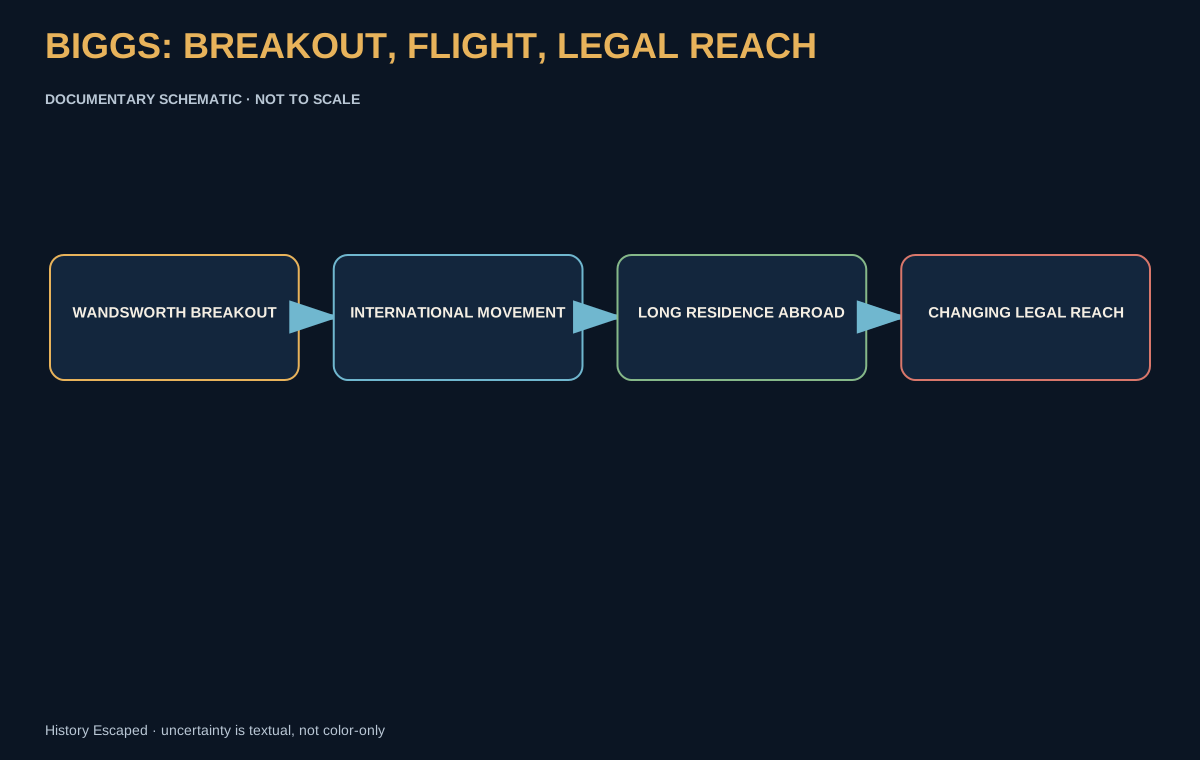
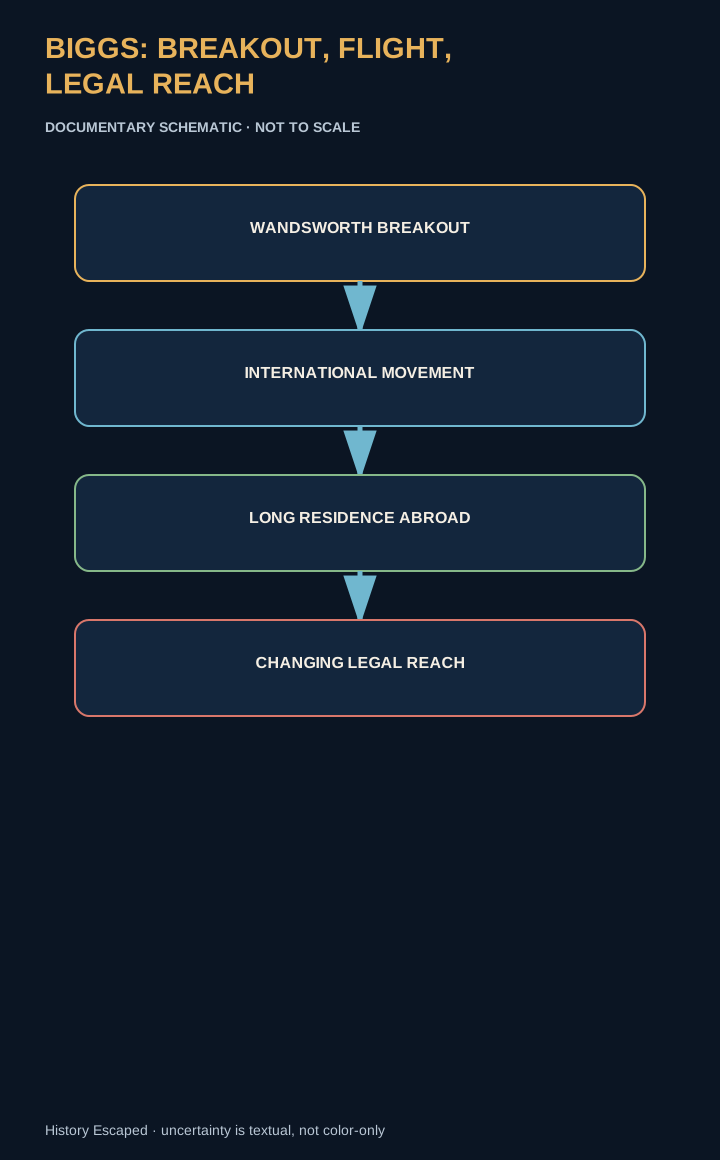
Simplified editorial reconstruction based on the cited historical record; not to scale. Uncertainty is stated directly in the visual and adjacent text.

