
On the night of January 9, 1879, roughly 130 Northern Cheyenne men, women and children broke from a barracks at Fort Robinson in northwestern Nebraska. They had been imprisoned after trying to return from Indian Territory to their northern homelands, and federal authorities were attempting to force them south again by withholding food, fuel and eventually water.
The breakout did not produce one clean escape column. Families and armed defenders scattered almost immediately under pursuit. Over the following days, many were killed, many more were recaptured, and a small number—including Morning Star, also known as Dull Knife—evaded direct recapture.
At a Glance
Breakout: January 9, 1879 Main pursuit: January 9–22, 1879 Place: Fort Robinson and surrounding White River / Antelope Creek country, Nebraska People originally confined: 149 People who broke from the barracks: About 130 Army-board final accounting of original 149: 64 killed, 78 captured/in confinement, 7 unaccounted for Final Antelope Creek count: Disputed — Army board 32 present / 26 dead or mortally wounded; later summaries often 37 present / 28 dead / 9 survivors Known direct evasion: Morning Star (Dull Knife), Pawnee Woman and Bull Hump reached the Pine Ridge area Classification: Mass breakout and Indigenous resistance to forced removal Presentation: Sensitive
The Story Begins South of Fort Robinson
The Northern Cheyenne had not chosen to settle in Indian Territory. In 1877, federal policy forced more than 900 Northern Cheyennes from their northern Plains homelands to the south. The exact count varies by source, but the scale does not: an entire community was displaced into an environment where food was inadequate, disease spread and dozens died.
Northern Cheyenne leaders repeatedly asked to return north. Federal officials refused.
September 1878: Going Home Without Permission
In September 1878, more than 300 Northern Cheyennes left the Darlington agency and started north. The movement was led by men remembered in English-language sources as Little Wolf and Morning Star, the latter also widely known as Dull Knife. Their goal was not Fort Robinson. It was the northern country from which their people had been removed.
The northward movement was also violent. Some Northern Cheyenne men killed settlers, raided property and committed sexual violence in Kansas. Modern Northern Cheyenne historian Gerry Robinson has addressed that history directly rather than denying it.
Those crimes must remain visible. They do not make every woman, child and elderly person travelling with the party a participant in those acts, and they do not erase the federal removal policy that produced the exodus.
Little Wolf and Morning Star Split
The northern party eventually divided. Little Wolf’s group continued north and avoided the Fort Robinson imprisonment. Morning Star’s group was intercepted by the Army in Nebraska.
That distinction matters because the two leaders are frequently paired in famous photographs and later accounts. Little Wolf belonged to the larger 1878 Northern Cheyenne Exodus, but he was not present at the January 1879 Fort Robinson breakout.
One Hundred Forty-Nine at Fort Robinson
On October 24, 1878, the Army took Morning Star’s group into custody. The Fort Robinson population is best established as 149 men, women and children. That number appears in Nebraska historical interpretation and in the Army inquiry reconstructed by modern scholarship. They were housed in a barracks at Fort Robinson.
At first, captivity was comparatively loose. People could leave the barracks under guard or within controlled limits, and the prisoners were subject to roll calls rather than total lockup at every hour. That arrangement did not last.
What They Wanted
Morning Star and other Northern Cheyenne leaders wanted to stay in the northern country. They asked to remain near relatives and allies rather than return to Indian Territory. The federal government insisted that they go south.
The dispute was therefore not about whether the prisoners would walk politely from one building to another. It was about whether the United States could force an Indigenous community back to a place where it had already suffered disease, deprivation and death.
January 3: The Order South
On January 3, Fort commander Captain Henry W. Wessells Jr. told the Northern Cheyenne that they would be returned to Indian Territory. They refused.
Army records later described the refusal as absolute. The Northern Cheyenne position was that death was preferable to another forced removal south. The confrontation moved from negotiation to coercion.
Selected chronology
Selected chronology
Northern Cheyenne forced south
More than 900 Northern Cheyennes are removed from their northern homelands to Indian Territory.
Northward exodus begins
More than 300 Northern Cheyennes leave the Darlington agency to return north.
Little Wolf and Morning Star groups separate
Little Wolf continues north while Morning Star's group remains on the route that leads to capture in Nebraska.
Morning Star's group taken into custody
Army forces intercept the group and bring 149 men, women and children to Fort Robinson.
Comparatively loose barracks confinement
The Northern Cheyenne are held at Fort Robinson while leaders seek permission to remain in the north.
Return south ordered
Wessells informs the prisoners that they must return to Indian Territory; the Northern Cheyenne refuse.
Coercive deprivation
Food, fuel/heat and eventually water are withheld in an effort to compel compliance with removal south.
Fort Robinson breakout
About 130 Northern Cheyenne men, women and children break from the barracks late at night and disperse under Army fire and pursuit.
Dispersed winter pursuit
Army troops pursue fragmented Northern Cheyenne groups through the White River country; people are killed, wounded, recaptured or remain hidden.
Crook orders an inquiry
General George Crook orders a board to investigate the capture, confinement, breakout, pursuit and recapture.
Antelope Creek final action
The last major concentrated group is surrounded; contemporary and later sources disagree over the exact number present and killed.
Army board of inquiry meets
The board takes testimony and produces the contemporary 64 killed / 78 captured / 7 unaccounted accounting of the original 149.
Women and children transferred to Pine Ridge
A documented group of 33 women and 22 children from the captured survivors is escorted to the Pine Ridge area.
Morning Star's family reaches Oglala protection
Morning Star, Pawnee Woman and Bull Hump survive their separate evasion and reach the Pine Ridge area.
Spiritual Run, memorialization and healing trail
Northern Cheyenne communities continue commemorating the event, including the Fort Robinson Outbreak Spiritual Run and current healing-trail work.
Food, Fuel and Water
Over the next several days, the Army withheld basic necessities. Sources differ slightly over which restriction began on which date, but the pattern is not disputed: food and fuel were cut, heat was denied, and water was eventually withheld. The policy was intended to force compliance.
Modern Northern Cheyenne accounts preserve memories of people scraping frost or ice for moisture inside or around the barracks. Clothing was inadequate for the Nebraska winter, and some official correspondence described the prisoners as poorly clothed or “in rags.” This was the immediate condition from which the breakout emerged.
The Army Later Investigated the Coercion
After the deaths that followed, the Army convened a board of inquiry. The board did not ultimately punish the officers responsible. Yet its own discussion recognized how severe the deprivation policy had become and how predictable a violent response could be.
That matters because the characterization of the barracks conditions is not merely a later moral judgment. The Army’s own investigation wrestled with whether the pressure had crossed into treatment analogous to torture.
Why 149 Did Not Break Out
The most common numerical mistake is simple: 149 prisoners = 149 escapees.
That is not correct. Before January 9, the Army removed or separately held several people, including the younger leader Wild Hog and Old Crow, along with associated family members or detainees. Modern tribal and historical reporting therefore commonly places the actual breakout at:
about 130 people. The two numbers belong to different stages.
Wild Hog Was a Leader—But Not of the Barracks Breakout
Wild Hog played an important political role at Fort Robinson. He spoke for the prisoners and refused the order to return south.
But he was in separate custody when the main barracks group broke out. That distinction helps explain why a count of roughly 130 escapees can coexist with 149 people originally confined. It also prevents a familiar narrative error in which every prominent Northern Cheyenne leader is placed physically at every stage.
Material evidence
Tools of Escape
The objects used in an escape reveal how a plan worked under constraint.
- 01Essential
Collective refusal
Northern Cheyenne leaders and families refused federal orders to return to Indian Territory despite escalating coercion.
- 02High
Concealed and reassembled weapons
Some weapon parts had survived disarmament and were reassembled before the breakout, allowing armed men to resist while families fled.
- 03Essential
Family-group movement
Escape was organized around the survival of families as well as armed resistance, which shaped the speed, fragmentation and outcomes of the breakout.
- 04High
Broken winter terrain
Bluffs, ravines and creek country provided temporary concealment but also exposed fugitives to severe cold and separation.
- 05High
Oglala refuge network
The Pine Ridge / Red Cloud community provided a northern refuge for Morning Star's family and some captured survivors.
The Weapons
The Northern Cheyenne had been disarmed when captured. Some weapons or firearm parts had escaped detection. Army testimony and later scholarship indicate that concealed pieces were reassembled before the night of January 9.
That evidence shows planning and expectation of armed resistance. It does not require an inventory of hidden weapons or a tactical reconstruction of the barracks. The historically important fact is that some men were prepared to fight while families attempted to get away.
January 9
The breakout began late on January 9, generally reconstructed as close to 10 p.m. People surged from the barracks into the winter night. Armed Northern Cheyenne men fought soldiers while women and children moved with the fleeing groups.
The Army opened fire and pursued. Within a short time, the event stopped being one large breakout and became many smaller survival problems.
A Family Breakout
The escape party was not composed only of warriors. Modern tribal reconstructions describe women and children as making up a large share—roughly two-thirds in some accounts—of those who left the barracks. That demographic fact changes how the pursuit must be understood.
Some Northern Cheyenne men fought as a rear guard. At the same time, parents, children and other family members were trying to cross frozen ground and river country after days of deprivation.
Problem → response
Escape was a sequence of problems
Each response solved a practical obstacle while often creating the next one.
- 01→
Obstacle
Federal forced-removal policy
The United States government refused the Northern Cheyenne demand to remain in the north and ordered Fort Robinson prisoners returned to Indian Territory.
Response
The prisoners collectively refused, even after the Army escalated pressure.
- 02→
Obstacle
Deliberate deprivation
Food, fuel/heat and eventually water were withheld in winter conditions to compel compliance.
Response
The Northern Cheyenne maintained their refusal and prepared to break confinement.
- 03→
Obstacle
Military confinement and disarmament
The Fort Robinson barracks and guard force limited movement and had disarmed the prisoners after capture.
Response
Some weapon parts remained concealed and a mass breakout was attempted rather than accepting return south.
- 04→
Obstacle
Family composition
The escape included many women and children, limiting speed and exposing families to pursuit and winter conditions.
Response
Armed men resisted while groups fragmented and sought concealment.
- 05→
Obstacle
Immediate Army pursuit
Troops pursued fugitives from the first night and repeatedly surrounded smaller groups.
Response
Some groups fought; others hid or attempted to reach Pine Ridge and other refuge.
- 06→
Obstacle
Winter exposure
January weather, poor clothing and prior deprivation made prolonged evasion physically dangerous.
Response
Survivors used broken terrain, temporary hiding places and movement toward allied communities where possible.
The White River Bluffs
Fugitives moved toward the White River and nearby bluffs. Troops followed.
Some people were killed quickly. Others were captured, wounded or separated from relatives. Small groups hid in ravines, creek beds and broken ground. The terrain gave temporary concealment, but the winter also threatened people with exposure.
This is why a tactical “escape route” graphic would be misleading. There was no single route after the first phase.
The First Night and Early Recaptures
History Nebraska records at least 26 Northern Cheyenne warriors killed during the first night’s fighting and about 80 women and children recaptured. Other reconstructions distribute some early casualties differently. Rather than make one early-night number the master total, the page should treat it as a source-specific stage count and use the later Army-board accounting for the original 149-person custody group. The broad outcome is not disputed: the majority of the breakout party were killed or brought back into custody.
What Happened to the Dead
The record contains another disturbing element. Testimony gathered during the Army inquiry described some Northern Cheyenne bodies being mutilated or scalped after death by civilians. The page does not need graphic detail to make the historical point. The violence continued beyond the moment a person was killed, and that evidence complicates sanitized descriptions of a routine “recapture operation.”
Documentary reconstruction
Coercion, breakout and dispersed outcomes
A case-local editorial visual separates the documented sequence from uncertainty without implying exact modern geography or operational detail.
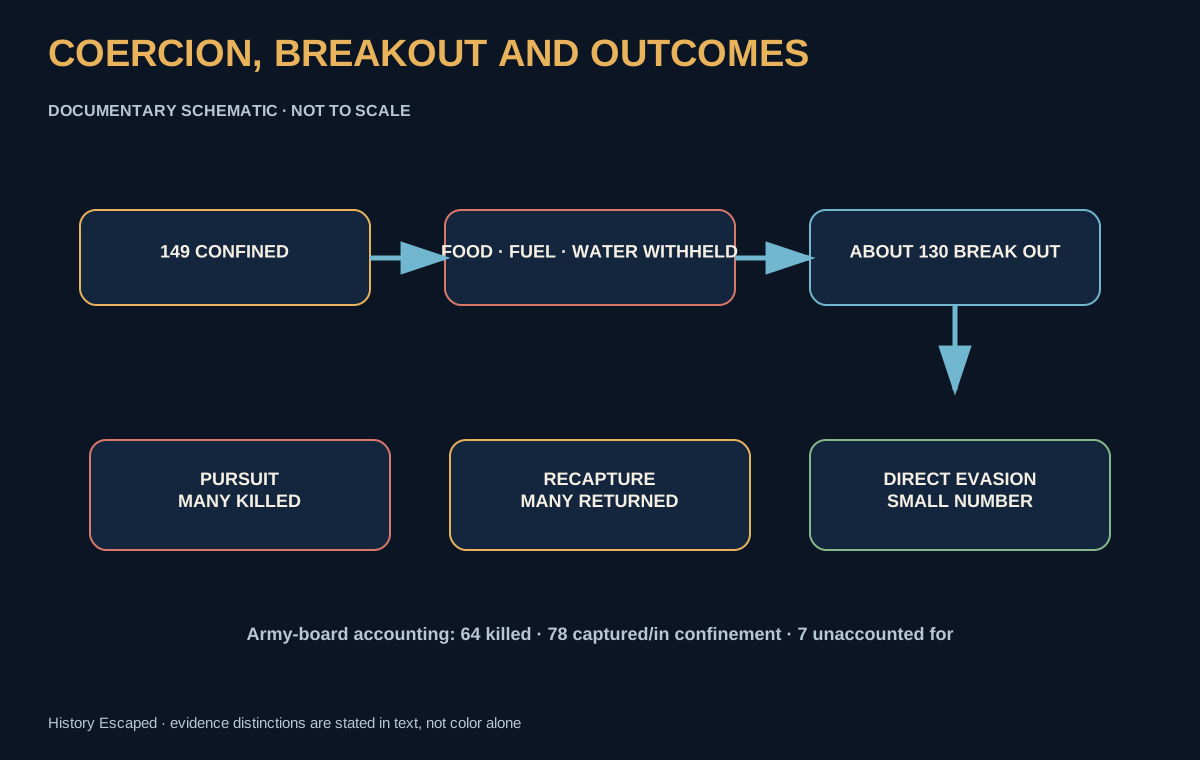
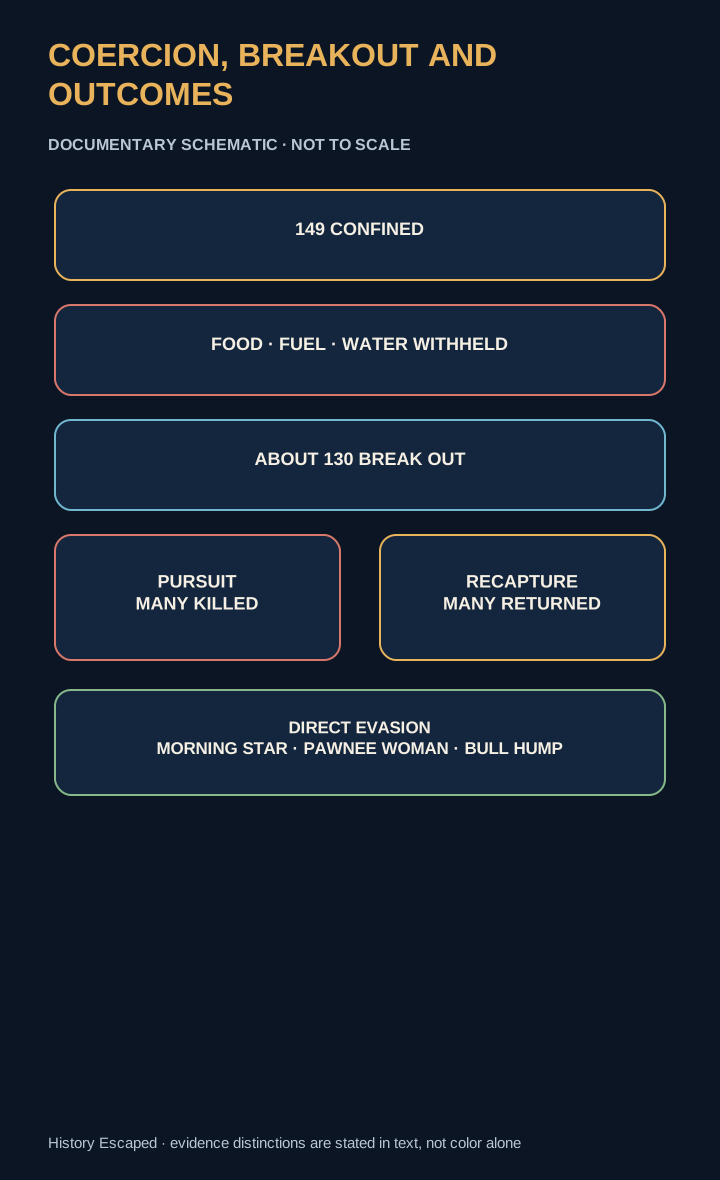
Simplified editorial reconstruction based on the cited historical record; not to scale. Uncertainty is stated directly in the visual and adjacent text.
Morning Star Did Not Stay With the Main Pursuit
Morning Star’s own escape followed a different path. Jerome Greene’s reconstruction shows that Morning Star, his wife Pawnee Woman, and their son Bull Hump hid near Fort Robinson rather than moving continuously with the largest pursued group. They remained concealed for roughly ten days. Around January 19, they began working their way toward the Pine Ridge area. They survived.
A Family Separated
One of Morning Star’s daughters was wounded and separated from the immediate family group during the breakout. She survived and later rejoined them. Her story is a reminder that “escaped,” “captured,” “missing” and “survived” were not fixed labels applied once on January 10. People moved between conditions: - hidden; - wounded; - recaptured; - transferred; - released; - reunited. That instability is one reason a single survivor total can mislead.
January 22: Antelope Creek
The last major concentrated group was surrounded near Antelope Creek on January 22. This is where the sources produce a second major count conflict. The 1879 Army board counted 32 people in the final position and recorded 26 dead or mortally wounded there. Later summaries commonly describe 37 people, of whom 28 died and nine survived.
Both sets of figures have substantial circulation. Neither should be silently substituted for the other.
The Antelope Creek Count Problem
The Army-board version is closer to the event and has the advantage of contemporary administrative accounting. Later historians may be incorporating people categorized differently, wounded people who died later, or individuals moving between nearby positions. The evidence is not strong enough to produce one artificially exact master count. The page should say:
Army board: 32 present / 26 dead or mortally wounded. Later summary tradition: 37 present / 28 dead / 9 survivors. Then stop.
The Final Accounting of the Original 149
The 1879 Army board ultimately accounted for the original Fort Robinson custody population as: 64 killed
78 captured or in confinement 7 unaccounted for
Those numbers total 149. This is the cleanest whole-group accounting available from the contemporary inquiry. It is not the same thing as a breakout-success table.
The final accounting
Outcome
Original Fort Robinson custody population
The Army board's base population for final accounting.
Killed in Army-board final accounting
The board's final tally for deaths among the original 149.
Captured / in confinement in Army-board final accounting
The board's final custody tally among the original 149.
Unaccounted for in Army-board final accounting
Administrative status only; not equivalent to seven confirmed permanent escape survivors.
Seven “Unaccounted” Does Not Mean Seven Successful Escapees
The word matters. The board did not write: seven permanently escaped.
It used an administrative category for people not accounted for in the final custody/death tally available to it. Some people later known to have survived direct pursuit complicate the snapshot further. The correct conclusion is: A small number successfully evaded immediate recapture, but the board’s seven “unaccounted for” should not be treated as a verified survivor count.
Where Did Captured Survivors Go?
Not all captured survivors were sent straight back to Indian Territory. Leiker and Powers record that by January 31, 33 women and 22 children—55 people—were escorted to the Pine Ridge area. Other captives followed different paths.
Wild Hog and other men became entangled in legal proceedings connected to killings during the Kansas portion of the exodus. Some people later returned south; others eventually became part of northern communities. There was no single post-breakout destination.
The Army Investigates Itself
General George Crook ordered a board of inquiry before the final pursuit had fully concluded. The board examined: - capture; - confinement; - disarmament; - deprivation; - breakout; - pursuit; - killing; - and recapture. Its record is indispensable because it preserves testimony close to the event. It also came from the institution whose conduct it was examining.
Evidence discipline
What the record supports
Status labels distinguish secure conclusions from uncertainty and rejected claims. Color is never the only signal.
MYTH
All 149 Northern Cheyennes confined at Fort Robinson broke out on January 9.
149 is the original custody population. Leaders and associated detainees had been separated before the breakout; modern tribal and scholarly reconstructions place the barracks escape at about 130.
Sources: SRC-002, SRC-004, SRC-005MYTH
The Fort Robinson breakout was a warrior-only military sortie.
The escaping population included large numbers of women and children as well as armed men.
Sources: SRC-002, SRC-004, SRC-005MYTH
Little Wolf led the Fort Robinson breakout alongside Morning Star.
Little Wolf's group had separated from Morning Star's group before the Fort Robinson capture and continued north.
Sources: SRC-004, SRC-006, SRC-008DOCUMENTED
The Army deliberately withheld food, fuel/heat and water to force the prisoners to accept return south.
The Army inquiry and modern institutional histories establish deprivation as a coercive policy rather than an accidental supply failure.
Sources: SRC-001, SRC-002, SRC-005, SRC-007MYTH
The breakout was wholly spontaneous and unplanned.
Concealed weapon parts were reassembled and armed resistance accompanied the family flight, although exact tactical planning should not be over-reconstructed.
Sources: SRC-005, SRC-008MYTH
Morning Star led one compact breakout group continuously to the January 22 Antelope Creek action.
Morning Star, Pawnee Woman and Bull Hump hid near Fort Robinson and followed a separate evasion route toward Pine Ridge.
Sources: SRC-005, SRC-006DISPUTED
Exactly 37 Northern Cheyennes were at the final Antelope Creek position.
Later summaries commonly use 37 with 28 dead and 9 survivors, while the 1879 Army board counted 32 and recorded 26 dead or mortally wounded.
Sources: SRC-004, SRC-005, SRC-007, SRC-008MYTH
The Army board's seven unaccounted people were seven confirmed successful escape survivors.
Unaccounted was an administrative category. It did not establish survival, permanent evasion or a single common outcome.
Sources: SRC-005, SRC-006, SRC-007MYTH
All captured survivors were immediately sent back to Indian Territory.
Survivors followed different custody and transfer paths. One documented January 31 transfer sent 33 women and 22 children to the Pine Ridge area.
Sources: SRC-006MYTH
The Army inquiry punished the officers responsible for the deprivation policy.
The board criticized aspects of the treatment and recognized the foreseeability of violent resistance but did not impose meaningful punitive accountability.
Sources: SRC-005, SRC-007MYTH
Cheyenne Outbreak is the only accepted name for the event.
Outbreak, Breakout, Tragedy and Massacre all appear in historical or commemorative use, and Northern Cheyenne community remembrance still uses Outbreak in the Spiritual Run.
Sources: SRC-003, SRC-012, SRC-013MYTH
The Fort Robinson breakout by itself directly created the Northern Cheyenne Reservation.
The breakout and wider exodus contributed to political pressure for a northern homeland, but federal recognition developed through a broader sequence of events.
Sources: SRC-001, SRC-004, SRC-006What the Inquiry Did—and Did Not—Do
The board criticized aspects of the coercive policy and recognized that violent resistance could have been anticipated. It did not recommend serious punishment of the officers involved. Modern historian Jerome Greene argues that this outcome reflected the limits of an inquiry operating inside the military hierarchy. The board is therefore both: - a crucial primary source; - and an imperfect vehicle for assigning responsibility.
Outbreak, Breakout or Massacre?
Older military and regional histories often used Cheyenne Outbreak. Many modern interpreters prefer breakout, which describes people escaping custody without framing them as a disorder erupting from nowhere. The word massacre appears in Northern Cheyenne memory and modern historical interpretation because of the scale and character of the killing that followed. At the same time, the Northern Cheyenne community’s annual commemorative event continues to use Outbreak in the name of its Spiritual Run. There is no need to force one community of memory into another’s vocabulary.
What Changed
Fort Robinson did not instantly end the federal attempt to control where Northern Cheyenne people could live. But the broader exodus and the violence at Fort Robinson helped demonstrate the failure of the policy that had forced the Northern Cheyenne south. Over time, federal authorities recognized a permanent Northern Cheyenne homeland in the north, centered on the Tongue River country in Montana. The breakout was one part of that political change, not the sole cause.
The Story Is Still Being Walked
Northern Cheyenne remembrance did not end when Army reports were filed. The Fort Robinson Outbreak Spiritual Run has carried the history across generations. More recently, Northern Cheyenne institutions and partners have developed plans for a Northern Cheyenne Breakout / Healing Trail connecting historic sites and tribal interpretation.
The National Park Service describes the work as a collaboration with Chief Dull Knife College and Northern Cheyenne partners. That matters because the event is no longer being interpreted only from the perspective of the fort that confined people.
Evidence, Myth and What the Sources Support
Did 149 Northern Cheyennes break out of Fort Robinson?
MYTH
About 149 people were originally confined. Roughly 130 remained in the main barracks group and broke out on January 9 after leaders and others had been separated.
Were all of the escapees warriors?
MYTH
No. The breakout included women and children as well as armed men.
Was Little Wolf a leader of the Fort Robinson breakout?
MYTH Little Wolf led part of the larger 1878 Northern Cheyenne Exodus but had separated from Morning Star’s group before the Fort Robinson capture.
Did the Army deliberately withhold food, heat and water?
DOCUMENTED
Yes. The deprivation was used to force acceptance of a return to Indian Territory.
Was the breakout an entirely spontaneous panic?
MYTH
Some concealed weapon parts had survived disarmament and were reassembled. The escape included organized armed resistance, although the precise tactical planning should not be overstated.
Did Morning Star lead one large escape group all the way to Antelope Creek?
MYTH Morning Star, Pawnee Woman and Bull Hump hid near the fort and later made a separate movement toward Pine Ridge.
Were exactly 37 people surrounded at Antelope Creek?
DISPUTED Later summaries commonly give 37, but the 1879 Army board counted 32 and recorded 26 dead or mortally wounded there.
Were exactly seven people successful escape survivors?
MYTH
The Army board listed seven of the original 149 as unaccounted for. That is not the same as seven confirmed permanent escapees.
Were all captured survivors sent back to Oklahoma?
MYTH
No. Captured survivors followed different paths; one documented transfer included 55 women and children sent to the Pine Ridge area.
Did the Army inquiry punish Wessells and other officers?
MYTH The board criticized aspects of the deprivation policy but did not impose the kind of institutional accountability that later readers might expect.
Is “Cheyenne Outbreak” the only accepted name?
MYTH
Breakout, Outbreak, Tragedy and Massacre all appear in historical and commemorative use. Northern Cheyenne remembrance still uses “Outbreak” in the Spiritual Run.
Why the Breakout Matters
The physical escape began inside a barracks, but the historical problem was larger than the building. The Northern Cheyenne were being told where they were permitted to exist. They had already been removed from their northern homeland, had returned without federal permission, had been captured and were being coerced into going south again. The breakout was a refusal of that control.
Most of the people who left the barracks did not win lasting freedom that night. Many were killed. Many were recaptured. Yet the event became part of a broader struggle that forced the United States to confront the failure of its removal policy and helped preserve a Northern Cheyenne future in the north.