
On the afternoon of 4 July 1868, a routine work day at the government detention settlement at Waitangi on Wharekauri changed in little more than an hour.
Māori exiles working around the redoubt moved into position near the stores. At about 2:30 p.m., according to the resident magistrate’s report, a signal was given. Guards were seized, the armoury was broken open, rifles and ammunition were distributed, government officials and local men were bound, and armed parties moved toward the vessels in Waitangi Bay.
By the end of the rising, 298 people—163 men, 64 women and 71 children—had boarded the schooner Rifleman. Only three men and one woman from the detained community remained behind.
The operation would return Te Kooti Arikirangi Te Tūruki and the whakarau, the exiles who followed him, to the East Coast of the North Island. It would also become the beginning of a new war.
To understand the escape, however, the later war has to be held back for a moment. The July breakout was first an escape from political detention.
At a Glance
- Breakout: 4 July 1868
- Departure from Waitangi Bay: 5 July 1868
- Place of detention: Waitangi, Wharekauri (Chatham Island)
- People leaving: 298
- Breakdown: 163 men, 64 women, 71 children
- Left behind: 3 men and 1 woman
- Vessel seized: schooner Rifleman
- Main method: coordinated seizure of redoubt, armoury and supply vessel
- Fatalities during seizure: one guard, Michael Hartnett
- Landfall: Whareongaonga, south of Tūranganui/Poverty Bay, most securely dated here to 10 July 1868
- Outcome: successful mass return to the North Island followed by confrontation with colonial authorities
Why Te Kooti was on Wharekauri
Te Kooti was not sent to the Chatham Islands after a normal criminal trial.
He was a Rongowhakaata man from the Tūranganui region on the East Coast. During the fighting at Waerenga-a-Hika in 1865 he had been associated with the government side, but accusations arose that he had also assisted Pai Mārire opponents. He was arrested, released after an initial inquiry, accused again, and detained.
In June 1866 he was transported to Wharekauri with Māori taken during the East Coast conflicts. No ordinary trial established the charge against him.
That legal history is no longer merely a modern inference. In later Treaty proceedings, the Crown accepted that its failure to try Te Kooti before detaining him on the Chatham Islands breached Treaty principles.
The wider detained community was more complicated. Some men had been captured in conflict. Family members were also present. By the time of the escape, women and children formed nearly half of the 298 people who would leave on the Rifleman.
That is why calling the group “298 prisoners of war” or “298 convicts” is misleading. They were a detained and exiled community.
An island prison without ordinary prison walls
The detention settlement at Waitangi did not resemble a modern penitentiary.
The exiles lived in a controlled settlement under guard and were required to work. They built shelter, cultivated food, carried supplies, and performed other tasks. A redoubt, armoury and gaol formed the security center, but the prisoners also moved through work areas as part of daily routine.
That arrangement created both control and vulnerability.
The government relied on geographical isolation. Wharekauri lay far from the North Island. Even if detainees could overpower a guard, the sea still remained between them and home.
The settlement therefore did not need to keep every person locked behind a cell door every hour. Escape required something larger than opening a cell.
It required a ship.
Te Kooti becomes a religious leader
During exile Te Kooti became seriously ill and experienced visions that changed his position among the other detainees.
He developed a religious movement drawing heavily on biblical texts and Māori spiritual and political experience. Exodus became an especially powerful framework: a people held away from their land, a divinely guided deliverance, and a return.
The faith later became known as Ringatū, the Upraised Hand.
Colonial officials watched this development with suspicion. Their reports describe Te Kooti holding religious services and make allegations that he used phosphorus from matches to create signs during worship. Te Kooti denied some accusations about his practices, and the official descriptions need to be read as observations filtered through hostile administrators rather than neutral accounts of Ringatū belief.
What the records establish clearly is that his influence grew.
By June 1868 Resident Magistrate W. E. Thomas separated Te Kooti from the main body of detainees and prohibited him from holding services with them.
It did not remove his authority. Thomas later wrote that the other prisoners showed strong sympathy for Te Kooti and that he appeared to exercise substantial influence over them.
Evidence that an escape was being prepared
The July uprising did not emerge from nowhere. After the escape, Thomas reported that letters in Te Kooti’s hand had been found containing instructions to seize a vessel—the St Kilda or another available ship.
The opportunity arrived on 3 July.
The government supply schooner Rifleman entered Waitangi Bay carrying stores. Another vessel, the Florence, was also in harbor.
The next day was wet. That weather helped make the prisoners’ behavior look ordinary.
Selected chronology
Selected chronology
Te Kooti is deported to Wharekauri
After accusations of aiding Pai Mārire opponents, Te Kooti is transported to the Chatham Islands without an ordinary trial.
Religious leadership grows in exile
Following illness and visions, Te Kooti develops the religious ideas that become Ringatū and gains increasing authority among the whakarau.
Te Kooti is separated from the other detainees
Resident Magistrate Thomas reports separating Te Kooti and forbidding further religious intercourse with the main body of prisoners.
Rifleman arrives with stores
The government supply schooner enters Waitangi Bay, providing the vessel the escape plan requires.
The mass breakout begins
Prisoners overpower guards, seize the redoubt and armoury and begin taking control of vessels in the harbour.
298 people are aboard Rifleman
Within roughly seventy minutes of the outbreak, the entire escape party is aboard, but contrary wind prevents a clean departure that evening.
Rifleman clears Waitangi Bay
At about 10 a.m. the schooner gets underway in light wind and gradually sails away from Wharekauri.
Landfall at Whareongaonga
The surviving evidence places landfall on 10 July, supported by Te Ara and a near-contemporary mate-based report. A dedicated NZHistory page instead gives evening 9 July.
Government demands surrender of weapons
Emissaries sent by Reginald Biggs tell the returned exiles to surrender their arms and await the government's decision. Te Kooti refuses and says the group wishes to move inland.
Armed conflict begins
Government and allied Māori forces clash with Te Kooti's group at Pāparatū, beginning the conflict that follows the escape.
The work detail
Saturday firewood work was routine.
Thomas reported that on the morning of 4 July the prisoners volunteered for their usual firewood duties with unusual eagerness. Some carried wood into the redoubt. A large group gathered near a store close to the redoubt while supposedly waiting for a boat connected with unloading the Rifleman.
The key detail is not that guards carelessly opened one magical door. The detention system itself depended on prisoners entering work spaces and handling supplies.
The escape plan turned routine access into a coordinated position. At about 2:30 p.m., Thomas believed, the signal was given.
The redoubt falls
Four constables and a civilian inside the guard area were attacked almost simultaneously. Michael Hartnett resisted.
Multiple witness statements agree that he was struck with a tomahawk. Thomas’s report identifies the attacker as Tamihana Teketeke.
Hartnett died. Other detainees broke into the magazine and began distributing rifles, ammunition, bayonets and equipment.
Thomas learned what was happening and moved toward the redoubt. He told the armed men to put down their weapons.
They seized him instead. He was thrown down, tied at the hands and legs, and later moved to the gaol near the beach.
His report is understandably fearful and hostile, but one detail matters precisely because it comes from him: while he expected to be killed, several prisoners assured him that he would not be harmed if he remained quiet and that what they wanted was the vessel.
The uprising involved lethal violence. It was not indiscriminate killing.
Taking the ships
While the redoubt was being secured, another armed group gained control of the Rifleman. Women and children began moving down toward the beach and boarding.
A separate party of eight armed men took possession of the Florence. According to the primary report, they ordered its master and four-man crew to bring the vessel alongside the Rifleman, then sent them ashore.
Later retellings sometimes describe elaborate measures to disable the second vessel so that it could not pursue.
The contemporary report is more limited. It establishes temporary seizure and control of the Florence, not every later mechanical detail.
That distinction is worth preserving.
Material evidence
Tools of Escape
The objects used in an escape reveal how a plan worked under constraint.
- 01The escape exploited the operating routine of the detention settlement.
Routine firewood and supply work
Ordinary access around the redoubt and stores allowed detainees to assemble without immediately revealing the uprising.
- 02Turned a detained population into an armed group before local authorities could reorganize.
Redoubt armoury
Once the central position fell, firearms, ammunition, bayonets and equipment could be distributed among the escapees.
- 03Solved the decisive geographic obstacle: open sea between Wharekauri and the mainland.
Rifleman
Government supply schooner seized in Waitangi Bay and used to transport the entire escape community to the North Island.
- 04Allowed the escapees to use a seaworthy vessel without depending entirely on their own crew organization.
Ship's crew
The existing Pākehā crew was compelled to navigate the schooner during the passage.
- 05Supported a mass escape involving almost 300 people rather than a short flight by a few armed men.
Provisions and government funds
Food, stores, weapons and £397 8s 2d from the government safe were taken before departure.
Money, weapons and provisions
Getting onto a ship was not enough.
A vessel carrying nearly 300 people needed provisions. A group expecting pursuit needed weapons. The escapees therefore took more than the schooner.
Thomas reported that the prisoners:
- emptied the armoury;
- took ammunition and military equipment;
- seized supplies;
- entered settler houses for useful property;
- opened the government safe.
The safe contained £397 8 shillings 2 pence.
These actions were coercive and involved property taken from the government and local residents. They also reveal the scale of the escape.
This was not a few fugitives slipping onto a boat. It was the removal of an entire community from an island detention system.
Seventy minutes
Thomas estimated that from the beginning of the uprising to the point when all the escapees were aboard the Rifleman, only about one hour and ten minutes passed. That is one of the strongest operational facts in the record.
Within roughly seventy minutes, the escapees had:
- neutralized the central guard;
- taken the arms;
- restrained officials and local men;
- secured the ship;
- moved women and children to the beach;
- taken provisions and money;
- boarded nearly 300 people.
The escape was coordinated enough to move a large noncombatant population, not merely the armed men who took the redoubt. But boarding was not the same as leaving.
The wind stops the first departure
By evening on 4 July the Rifleman attempted to get underway. It could not clear the bay.
Thomas watched the vessel move out and return. With the prisoners still offshore, local Europeans and Māori at Waitangi considered whether the ship might come back ashore.
The escape therefore remained unresolved through the night. On the morning of 5 July, at about 10 a.m., the schooner got underway in light wind.
Even then progress was slow. Thomas’s watchers saw it struggling through the day before finally disappearing from view.
This distinction matters.
4 July was the successful seizure.
5 July was the successful maritime departure.
Problem → response
Escape was a sequence of problems
Each response solved a practical obstacle while often creating the next one.
- 01→
Obstacle
Island isolation
Even successful departure from the detention settlement meant nothing without transport across open sea.
Response
The escape was timed around the presence of the government supply schooner Rifleman.
- 02→
Obstacle
Armed guard and central redoubt
Weapons and official control were concentrated in the redoubt.
Response
The escapees used simultaneous action during routine work to neutralize guards and seize the armoury.
- 03→
Obstacle
Large noncombatant group
The escape community included 64 women and 71 children, making a stealthy individual-style escape impossible.
Response
The operation rapidly moved the whole group to the beach and vessel before a defensive response could form.
- 04→
Obstacle
Second vessel in harbour
The Florence could potentially complicate control of Waitangi Bay or provide transport to others.
Response
An armed party temporarily seized it and ordered its crew to bring it alongside the Rifleman before being sent ashore.
- 05→
Obstacle
Contrary wind
The Rifleman could not clear the bay immediately on 4 July and remained vulnerable overnight.
Response
The escape party waited aboard until the schooner could get underway the following morning.
- 06→
Obstacle
Need for experienced navigation
A mass sea passage required skilled sailing and knowledge of the vessel.
Response
The Rifleman's existing crew was compelled to navigate toward the North Island.
- 07→
Obstacle
Political status after landing
Returning to the North Island did not resolve the exiles' relationship with the colonial government.
Response
Te Kooti refused to surrender the group's arms and attempted to move inland; government pursuit followed.
The crew under compulsion
The Rifleman needed experienced sailors. The Pākehā crew remained aboard and were ordered to sail the escape party back toward the North Island.
Later histories say Te Kooti guaranteed that the crew would survive if they navigated the vessel and that the ship would be returned once the exiles were ashore. Near-contemporary reporting makes the coercion clear: the mate understood that refusal could lead to violence.
Both points can be true. The crew was compelled to participate, and most of its members survived.
This is not a voluntary charter.
The voyage
The passage from Wharekauri to the East Coast took several days and was slowed by difficult winds.
Te Kooti’s religious understanding of the escape shaped how the journey was remembered. The Rifleman became an ark of deliverance within a biblical framework of exile and return.
The most disturbing episode occurred at sea.
A Māori-language newspaper account published only weeks later and attributed to the ship’s mate says that an elderly rangatira was thrown overboard after the vessel encountered difficult winds. The report preserves uncertainty over the man’s name.
Judith Binney’s later biography identifies him as Te Wārihi Pōtini, Te Kooti’s uncle, and says that greenstone and other treasured objects were also cast into the sea. Later accounts explain the killing through Te Kooti’s belief that Te Wārihi was a spy and through a religious demand for a sacrifice.
The death should be reported without spectacle. A man was killed during the escape.
The exact religious and political reasoning reaches us through sources with different perspectives.
Documentary reconstruction
Waitangi, the Rifleman and Whareongaonga
A case-local visual focused on the spatial, mechanical or evidentiary relationship established by the surviving record.
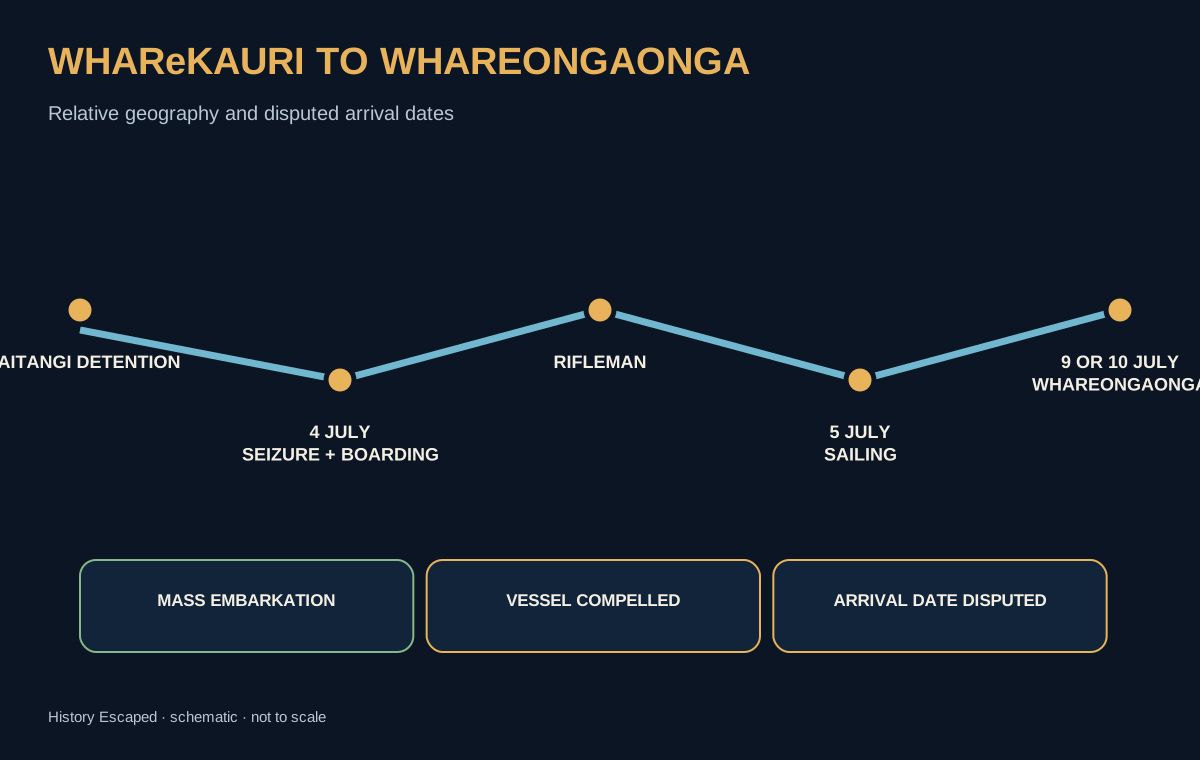
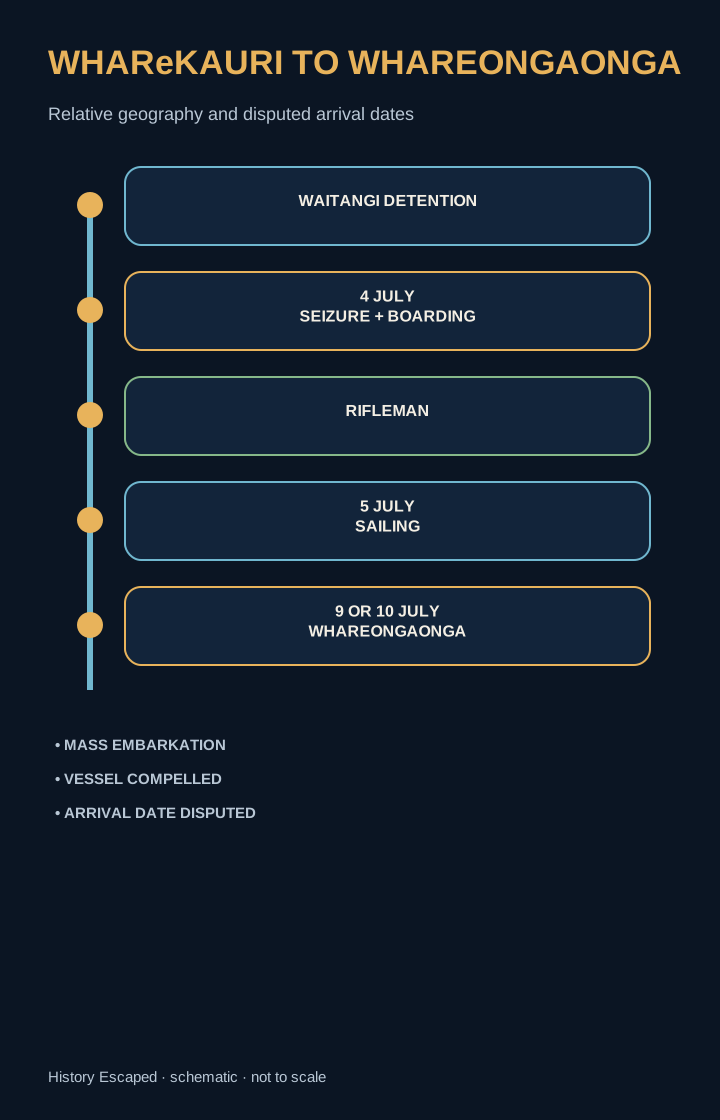
Simplified editorial reconstruction based on the cited historical record; not to scale. Uncertainty is stated directly in the visual and adjacent text.
Whareongaonga
The Rifleman eventually reached Whareongaonga, a secluded landing place south of Tūranganui/Poverty Bay. Even here, the date requires qualification.
Judith Binney’s Dictionary of New Zealand Biography essay gives the evening of 10 July 1868. A Māori-language report published in August 1868, drawing on the ship’s mate, also gives Friday the 10th.
A dedicated NZHistory page for the Rifleman, however, gives the evening of 9 July.
The difference may reflect arrival offshore versus completed landfall, later calendar reconstruction, or a simple institutional inconsistency. The surviving sources do not establish which explanation is correct.
The balance of evidence favors 10 July because the date appears in a near-contemporary report and in Binney’s modern biographical reconstruction. The 9 July variant remains part of the evidence.
The crew is released
At Whareongaonga the escapees unloaded the vessel. Later historical accounts record that Te Kooti paid the crew £6 each and gave the mate a letter stating that the sailors had acted under compulsion and should not be blamed for carrying the exiles to the mainland.
The gesture did not erase the ship seizure. It clarified the end of it.
The crew regained control of the Rifleman once the escapees and supplies were ashore.
Thanksgiving and Ringatū
At Whareongaonga the return acquired a formal religious meaning.
Binney records that Te Kooti ordered a pig and a fowl killed in thanksgiving. He instructed his followers that they would no longer kneel in prayer but would raise a hand in homage to God.
The gesture became associated with the name Ringatū — the Upraised Hand. The escape therefore cannot be reconstructed only as logistics.
For Te Kooti and many of the whakarau, political captivity, spiritual revelation and physical deliverance were intertwined. Their return was not simply a change of location.
It confirmed a religious story about bondage and restoration.
The final accounting
Outcome
People who escaped or departed
Contemporary official breakdown: 163 men, 64 women and 71 children.
Members of detained community left behind
Three men and one woman remained on Wharekauri.
Guard killed during breakout
Michael Hartnett was killed during the seizure.
Successful return to North Island
The escape party reached Whareongaonga and was not immediately returned to detention.
Immediate political resolution
None. Government demands for disarmament were rejected and armed conflict followed within days.
The government demands the weapons
The escape was complete in one sense. The exiles were back on the North Island.
Their political status was not resolved.
On 12 July, Resident Magistrate Reginald Biggs sent Māori emissaries to Whareongaonga. Te Kooti and the whakarau were told to surrender their weapons and wait for the government to determine what would happen to them.
They refused. Te Kooti said that they wanted to go inland peacefully.
The refusal made sense from within the experience of the exiles: surrendering weapons meant once again trusting a government that had detained Te Kooti without trial and had kept the group on Wharekauri for years. From the government’s perspective, nearly 300 escaped detainees had returned armed after killing a guard, seizing public weapons and commandeering a ship.
Those positions collided almost immediately.
The escape becomes a war
The government decided that Te Kooti’s group could not simply travel inland armed. The whakarau left Whareongaonga and moved toward the interior.
Government and allied Māori forces pursued them. Fighting began at Pāparatū on 20 July 1868.
The conflict then widened dramatically. Te Kooti defeated several pursuing forces. In November his followers attacked Matawhero, killing Māori and Pākehā men, women and children. Government and allied Māori forces in turn conducted a prolonged pursuit, including campaigns in which captured members of Te Kooti’s forces were summarily killed.
Those events shaped Te Kooti’s reputation for generations. They should not be used to rewrite the cause of the July escape.
The people aboard the Rifleman were not sailing from Wharekauri because a November raid had already happened. They were leaving detention.
Evidence discipline
What the record supports
Status labels distinguish secure conclusions from uncertainty and rejected claims. Color is never the only signal.
DOCUMENTED
About 300 prisoners escaped from Wharekauri.
The rounded statement is broadly correct but the contemporary official report is more precise: 298 people left—163 men, 64 women and 71 children—and four members of the detained community remained behind.
Sources: SRC-003MYTH
All 298 escapees were convicted prisoners.
Te Kooti himself was held without an ordinary trial, and the departing population included 64 women and 71 children. Legal status varied across the wider exiled community.
Sources: SRC-003, SRC-005, SRC-009MYTH
The 4 July takeover was bloodless.
Constable Michael Hartnett was killed during the seizure, and contemporary testimony identifies Tamihana Teketeke as the assailant. Other people were threatened or fired upon but survived.
Sources: SRC-003, SRC-001MYTH
The Rifleman sailed away immediately after the redoubt fell on 4 July.
Thomas's contemporary report says wind prevented the schooner from clearing the bay that evening. It got underway at about 10 a.m. on 5 July.
Sources: SRC-003DISPUTED
The Rifleman reached Whareongaonga on an undisputed date.
Te Ara and a near-contemporary Waka Māori account give 10 July; a dedicated NZHistory *Rifleman* page gives the evening of 9 July. The balance of evidence favors 10 July, while the one-day conflict remains unresolved.
Sources: SRC-002, SRC-004, SRC-006MYTH
The Pākehā crew voluntarily carried Te Kooti back to the North Island.
The crew navigated under coercion. Later accounts record that they were paid and given a letter of exoneration once the escapees were safely ashore, but that does not make the original ship seizure voluntary.
Sources: SRC-004, SRC-006, SRC-001MYTH
Te Wārihi Pōtini's death at sea is a late invented legend with no contemporary basis.
A Māori-language newspaper account published in August 1868 and attributed to the ship's mate already records an elderly rangatira being thrown overboard, although naming and interpretation vary. Binney's later biography identifies him as Te Wārihi Pōtini.
Sources: SRC-004, SRC-002UNKNOWN
Te Kooti's July escape proves that he had already planned the later Matawhero killings.
The secure post-landing record shows Te Kooti initially saying that the group wanted to move inland and be left alone while refusing disarmament. The later November attacks cannot be projected backward as the documented purpose of the July escape.
Sources: SRC-002, SRC-013MYTH
Te Kooti received a criminal trial before being transported to the Chatham Islands.
He was deported without an ordinary trial. In later Treaty proceedings the Crown accepted that its failure to try Te Kooti before Chatham Islands detention breached Treaty principles.
Sources: SRC-005, SRC-009MYTH
Every member of the detained community followed Te Kooti.
The contemporary report records three men and one woman left behind. The surviving evidence reviewed here does not establish each person's reason for remaining.
Sources: SRC-003Was the detention legal?
Te Kooti’s repeated requests for a trial were ignored.
Modern Treaty history gives that fact additional weight. In proceedings concerning Te Whānau a Te Kooti and Tūranga claims, the Crown accepted that the failure to try Te Kooti before his detention on the Chatham Islands breached Treaty principles.
That acknowledgment does not convert every aspect of the 1868 uprising into lawful conduct.
Hartnett was killed. Officials were forcibly detained. Property, weapons and money were taken. A civilian ship was commandeered. Te Wārihi Pōtini died during the voyage.
Historical explanation does not require choosing between the injustice of detention and the violence of escape. Both belong in the record.
Four people remained
The most easily overlooked number in the contemporary report is not 298. It is four.
Thomas recorded that three men and one woman from the detained group stayed behind. That detail matters because “mass escape” can sound as if every person automatically followed Te Kooti.
They did not. The surviving evidence does not securely establish every individual reason for remaining.
But the number demonstrates agency and difference inside the detained community. Te Kooti’s leadership was powerful.
It was not literally universal.
Why the escape succeeded
The breakout worked because several systems failed at once.
The detention regime relied on routine labor
Prisoners could enter areas around the redoubt and stores as part of ordinary work.
The guard force was vulnerable to simultaneous action
A coordinated rush neutralized the central guards before a wider response could organize.
The armoury was inside the system they seized
Once the redoubt fell, the escapees gained firearms and ammunition.
A government supply ship was already in the harbor
The hardest problem in an island escape—transport—arrived as part of the detention system’s own logistics.
The group acted fast
Thomas’s seventy-minute estimate shows that the takeover and boarding happened before a coherent island defense could form.
The escape included the whole social community
Women and children were moved as part of the operation rather than being left to trigger an immediate division between fighters and families.
The crew could navigate the vessel
The escapees did not need to master every aspect of schooner navigation themselves because the ship’s crew was compelled to sail.
Geography delayed pursuit
Once the Rifleman was clear of Wharekauri, local authorities had no immediate means of putting the 298 back in custody.
What the escape does not prove
The documentary record supports an extraordinary amount of detail. It still does not support every later story.
It does not prove that every exile willingly supported Te Kooti. It does not prove that every person on the island had been illegally detained under exactly the same circumstances as Te Kooti.
It does not prove that the July escape was conceived from the beginning as a plan to attack Poverty Bay civilians. It does not make the 9/10 July landing conflict disappear.
It does not justify treating Ringatū belief as trickery simply because colonial officials described it that way. And it does not make the operation bloodless.
The strongest history is the one that can hold all of those facts together.
Why this mass escape matters
The Chatham Islands escape is one of the rare historical cases in which a politically detained community seized the infrastructure of its own confinement and transported nearly everyone—including families—hundreds of kilometers across open sea. Its mechanics are documented by the very officials who failed to stop it.
Its meaning is preserved in a different tradition: Te Kooti and the whakarau understood deliverance through scripture, exile, whenua and the new Ringatū faith. The two bodies of evidence do not always speak the same language.
That is precisely why the case deserves careful reconstruction. On 4 July 1868, the redoubt and ship were seized.
On 5 July, the Rifleman finally sailed free of Wharekauri. By 10 July, under the best-supported chronology, 298 people were back on the East Coast.
The detention had ended. The conflict over what their return meant had only begun.