
Solomon Northup’s Rescue from Slavery: How a Letter Brought a Free Man Home
On January 3, 1853, two white men crossed a Louisiana cotton field toward an enslaved man known locally as Platt. One was the sheriff of Avoyelles Parish. The other had travelled from New York carrying affidavits, a governor's commission, and evidence that “Platt” was actually Solomon Northup—a free New Yorker who had disappeared nearly twelve years earlier.
Northup did not run from Edwin Epps's plantation that morning. He was recovered from it through a rescue built from secret communication, documentary proof, interstate law, local legal help, and the determination of people who still knew who he was.
At a Glance
Kidnapped: 1841
Kidnapping location: Washington, D.C.
Transported south as: Plat Hamilton
Years wrongfully enslaved: Nearly twelve years, across 1841–1853
Decisive message: Samuel Bass's August 15, 1852 letter to William Perry or Cephas Parker
New York agent: Henry B. Northup
Governor: Washington Hunt
Physical extraction from Epps plantation: January 3, 1853
Formal legal surrender in Marksville: January 4, 1853
Return to Sandy Hill: January 21, 1853
Family reunion in Glens Falls: The following morning
Classification: Legal rescue / extraction of a kidnapped free citizen
A Free Man Before the Kidnapping
Solomon Northup's legal status before 1841 is the foundation of the entire case. He was not born enslaved and later manumitted. He was a free Black citizen of New York with a wife, children, work, community ties, and a documented family history.
Northup married Anne Hampton in 1828. They raised three children—Elizabeth, Margaret, and Alonzo—and lived in communities including Fort Edward, Kingsbury, and Saratoga Springs. He worked at several trades and was also an accomplished violinist, a skill that sometimes brought him paid musical work.
That ordinary freedom was precisely what made the kidnapping so consequential. The slave system did not merely confine Northup's body; it erased the legal identity by which people in New York knew him.
The Trip to Washington
In the spring of 1841, Northup met two men he later identified as Merrill Brown and Abram Hamilton. They offered him temporary employment as a musician and persuaded him to travel with them, ultimately reaching Washington, D.C.
Northup's memoir records that he obtained papers showing his free status before continuing to the capital. He then became seriously ill, lost consciousness, and awakened chained in a slave pen.
The kidnapping itself is secure. The exact mechanism is not.
Northup suspected that Brown and Hamilton were connected to what happened, but his account did not establish precisely who caused his illness, whether the men personally administered a drug, or at what moment he passed into the control of slave trader James H. Burch. Later retellings often fill that gap with certainty the surviving evidence does not provide.
“I Am a Free Man”
Northup tried to tell his captors who he was. His memoir describes the result as a severe beating and a warning never to repeat his claim of freedom. The episode taught him a brutal fact about the system into which he had been forced: possessing a legal right meant little when the people controlling his body could prevent him from producing the evidence.
The problem was not that Northup had forgotten his identity. The problem was that the system around him assigned legal force to another identity and punished him for contradicting it. That replacement identity soon entered a federal record.
Plat Hamilton on the Brig Orleans
The National Archives preserves the slave manifest for the brig Orleans, which transported enslaved people from Richmond to New Orleans in the spring of 1841. The document lists 41 people. On line 33 appears:
Plat Hamilton.
That was Solomon Northup. The manifest is one of the strongest pieces of evidence outside his memoir because it records the bureaucratic transformation itself. A free New Yorker disappeared from the legal record available to the people around him, while a man called Plat Hamilton was certified for transport through the domestic slave trade.
The false name did more than conceal a kidnapping. It made later rescue harder because anyone searching for Solomon Northup would not find that name on the plantation where he eventually lived.
A Letter From the Brig
Northup attempted to break the isolation almost immediately. A sailor named John Manning helped him obtain what he needed to write a letter during the voyage south. Northup addressed it to Henry B. Northup in Sandy Hill, New York, explaining that he had been kidnapped and was being carried away.
Henry later swore that he received the letter, postmarked New Orleans. It was devastatingly incomplete.
Solomon did not yet know where in the South he would be taken. Henry knew that a free man from his community had been kidnapped, but he did not know where to look. The original letter was later lost or mislaid, and for more than a decade the trail went cold.
That first letter matters because it changes the rescue story. Samuel Bass did not create Northup's first attempt to communicate with home. What Bass eventually supplied was something the 1841 message lacked: a usable geographic path.
Nearly Twelve Years Under Another Name
Northup was sold in Louisiana and passed through several enslavers before spending most of his captivity on Edwin Epps's property in the Red River region. His 1853 memoir gives a detailed account of labor, violence, plantation life, sales, relationships among enslaved people, and the constant calculation required to survive. Those years cannot be reduced to a waiting period before rescue.
They also explain why Northup did not simply announce his identity to every person he met. He had already been violently punished for insisting that he was free. A failed disclosure could bring surveillance, sale farther away, or physical punishment while doing nothing to put proof in his hands.
Northup's legal identity survived in New York. In Louisiana, almost no one knew it existed.
Samuel Bass
In 1852, Canadian carpenter Samuel Bass came to work on Epps's property. Bass spoke openly against slavery. Northup listened before deciding whether those opinions could be trusted.
Eventually he disclosed the truth: his name was Solomon Northup, he had been born free in New York, he had a wife and children, and he had been kidnapped. Bass agreed to help.
This was not yet a rescue. It was the moment Northup finally found a person in Louisiana who could carry his identity outside the plantation system without exposing it immediately to Epps.
Writing in Secret
Northup and Bass arranged private meetings away from the main house. Northup supplied names of people in Saratoga who might still remember him.
Bass wrote several letters. The most important was addressed to William Perry or Cephas Parker and dated August 15, 1852.
It stated that Solomon Northup had been born free and was now held as a slave near Marksville in Avoyelles Parish. It described his kidnapping in Washington and asked that proof of his freedom be obtained. Bass also made clear that helping him was dangerous.
The letter did not need to contain every fact about twelve years of captivity. It needed to get three things right: Solomon's true name, people in New York who could verify it, and a location narrow enough to make recovery possible.
From Marksville to Saratoga
The letter reached Saratoga in early September. Parker and Perry sent it to Anne Northup in Glens Falls. The Northup children reacted immediately, and the family turned to Henry B. Northup in nearby Sandy Hill.
Henry had known Solomon for years. The shared surname reflected an older history: Henry belonged to the family associated with the people who had once enslaved Solomon's father, Mintus, before Mintus lived as a free man. Henry was not the owner arriving to reclaim human property. He was a lawyer helping a man he knew to prove a freedom that had existed before the kidnapping.
The Law That Made State Action Possible
Henry searched New York law and found a statute passed on May 14, 1840. Its purpose was unusually specific. If a free New York citizen had been kidnapped or was wrongfully held as a slave in another state or territory, the governor could act to restore that person to liberty and return the citizen to New York.
The governor could appoint an agent, provide credentials, authorize legal proceedings, and fund necessary expenses. Northup's case fit the statute almost exactly. But Henry still needed evidence.
Proving Solomon Existed
Anne Northup submitted a sworn memorial to Governor Washington Hunt. People from the community supplied affidavits. They testified that Solomon had been known in New York from childhood, that his parents were free, that he had married Anne, that he had lived as a free citizen, and that he had disappeared around 1841.
The documents did something the enslaving system in Louisiana had prevented Solomon from doing himself. They reconstructed his legal identity. The man called Platt on Bayou Bœuf could now be connected to a known New York citizen whose family and neighbors were willing to swear that he had never been legally enslaved.
Governor Hunt Appoints an Agent
On November 23, 1852, Governor Washington Hunt appointed Henry B. Northup an official agent of New York.
The commission authorized him to gather evidence, retain counsel, institute proceedings, and take whatever lawful measures were likely to restore Solomon Northup and return him to the state. That appointment transformed a family search into an interstate legal intervention.
Henry was no longer only a private lawyer looking for a missing acquaintance. He travelled with documentary authority from the government of the state whose citizen had been kidnapped.
South Again
Henry left Sandy Hill on December 14. He travelled through Washington, D.C., seeking letters and contacts that could help in Louisiana. His route eventually turned toward the Red River and Avoyelles Parish rather than relying solely on New Orleans.
He reached Marksville on January 1, 1853. The letter had told him the region. It had not told him the plantation. And the people around Bayou Bœuf did not know anyone named Solomon Northup.
They knew a man called Platt.
John P. Waddill Solves the Local Problem
Henry retained Marksville attorney John P. Waddill.
Waddill helped translate the clues into local knowledge. A conversation about politics and abolitionism brought one name to mind: Samuel Bass, a Canadian carpenter known locally for his antislavery views.
Bass had worked on Bayou Bœuf. That coincidence was too strong to ignore. Henry and Waddill went looking for him.
Bass Gives the Last Piece
Bass was cautious when Henry first questioned him. Then Henry explained why he had come. Bass acknowledged writing the August letter and supplied the fact Henry still needed most: The man called Platt was Solomon Northup.
He was held by Edwin Epps. Bass described the plantation's location near Bayou Bœuf and helped Henry understand how to reach it. The communication chain was complete. Northup had managed to get a message out.
New York had sent legal authority back. Now the two ends of the chain had met in Louisiana.
A Rescue That Needed a Sheriff

Henry and Waddill prepared legal papers in Avoyelles Parish. The objective was not to ask Epps politely whether he was willing to let Solomon go. It was to place the dispute over Solomon's status inside a legal process backed by a parish sheriff and by the documentary evidence Henry had carried south. There was urgency.
Rumor had begun to spread in Marksville that the New Yorker staying with a lawyer might be looking for someone enslaved by Epps. Henry's advisers feared that advance warning could allow Solomon to be hidden.
After midnight, the required judicial paperwork was completed. Henry and the sheriff headed for Bayou Bœuf.
January 3: “Do You Know That Man?”
They found the enslaved workers in a cotton field. The sheriff asked for the man called Platt.
Before Solomon could speak freely with Henry, the sheriff tested his identity against facts known from New York. Solomon gave his real name. He identified his wife and children and answered questions that connected him to the affidavits.
Then he recognized Henry. For nearly twelve years, the identity “Solomon Northup” had survived largely in memory and in the lives of people hundreds of miles away. Now the man carrying the proof was standing in the field.
Leaving Epps’s Plantation
The legal papers were served. Epps protested.
Northup's memoir says Epps demanded to know who had written the letter and threatened the unknown helper. He also said that advance warning would have allowed him to hide Solomon from the sheriff.
The threat explains why secrecy had mattered so much. Yet the sheriff was already there. Northup got into the carriage with Henry and left the plantation on January 3, 1853. That was the physical extraction.
It was not the final legal formality.
January 4: The Surrender Record
The following day, the parties met in Marksville. Henry produced: - the governor's commission; - affidavits; - proof of Solomon's New York identity; - and the results of the sheriff's identification. Epps's lawyer advised him that contesting the case would be futile.
A formal instrument was drawn up and entered into the parish record. It stated that Edwin Epps surrendered Solomon Northup to Henry B. Northup, acting as New York's agent, after being satisfied that Solomon was entitled to freedom. The document is dated:
January 4, 1853.
The distinction between January 3 and January 4 is not pedantry. It shows how the rescue worked.
On January 3, the state agent and sheriff removed Solomon from Epps's physical control. On January 4, the legal record formally acknowledged that Epps's claim could not stand.
Epps Did Not Give Solomon His Freedom
The language of the surrender document can sound strange to modern readers because it speaks of Epps “giving” and “surrendering” Northup. The document also states the underlying fact clearly: Solomon was a free citizen of New York who had been kidnapped and sold into slavery. Epps was not granting liberty to a person he legitimately owned. He was abandoning a wrongful claim after proof showed that the man he held had never lawfully been a slave.
That is why “restored to freedom” is more accurate than “manumitted.”
The Journey North Still Required Papers
Henry and Solomon left Marksville and travelled toward New Orleans. On January 7, New Orleans recorder Théodore Genois issued a certificate describing Solomon and affirming that evidence of his freedom had been produced. The document requested that authorities allow him to pass unmolested on the journey north. The need for that paper is revealing.
Northup had just survived a legal process proving that he was free. Yet while travelling through slave states, he could still be challenged by officials who saw a Black man moving with a white man and presumed a relationship of ownership. At Charleston, that almost happened.
“I Have No Servant”
A customs officer asked Henry why he had not registered Solomon as his servant. Henry rejected the premise.
Solomon was not his servant. He was a free citizen of New York whom Henry, as New York's agent, was accompanying home from slavery. They were eventually allowed to continue.
The episode shows why the word extraction is useful. Recovery required more than getting past Epps's gate. Henry had to carry Solomon through a legal geography in which freedom could still be questioned at the next checkpoint.
Back Through Washington
The pair reached Washington on January 17. Northup could have continued directly home.
Instead, he tried to prosecute James H. Burch, the slave trader who had confined and sold him in 1841.
Burch was arrested. The hearing produced one of the bitterest contrasts in the story.
White witnesses could testify that Solomon had been free in New York. The defense admitted that Burch had placed him in the slave pen in 1841.
But when Solomon himself was offered as a witness, the court rejected his testimony because he was Black. His free citizenship was not disputed. His voice was still legally excluded. Burch was discharged.
Rescue Was Not Justice
Northup later pursued other legal avenues against people connected with the kidnapping. Those efforts did not produce the accountability he sought. The rescue therefore had two different outcomes. It succeeded in restoring Solomon Northup to his family and recognized legal status.
It failed to make the people responsible for stealing nearly twelve years of his life answer proportionately for what they had done. That distinction belongs in the story because it prevents the return home from becoming an artificially complete resolution.
January 21: Sandy Hill
Henry and Solomon left Washington on January 20. They travelled through Philadelphia, New York, and Albany and reached Sandy Hill during the night of January 21. The next morning Solomon went to Glens Falls. His family had changed while he was gone.
Margaret, seven years old when he disappeared, was now an adult and a mother. At first she did not recognize him. Her child had been named Solomon Northup Staunton.
Home
Anne came from the hotel where she worked. Elizabeth was there. Alonzo was away in another part of the state.
Northup's memoir stops short of trying to reproduce every word spoken during the reunion. The original book instead included an engraving titled Arrival Home, and First Meeting with His Wife and Children.
That image is not a documentary record of the room or the exact gestures of the family. It is something different and still historically valuable: a visual published in 1853 to help contemporary readers understand that Northup's story ended not with a legal document in Louisiana, but with a family restored after almost twelve years of forced separation.
The Documents Inside the Memoir
Twelve Years a Slave appeared later in 1853. The title page described Northup as a citizen of New York who had been kidnapped in Washington in 1841 and “rescued in 1853.”
That wording is revealing. The first edition itself framed the recovery as a rescue.
The book also printed legal documents in an appendix. Readers could see:
- New York's 1840 anti-kidnapping statute;
- Anne Northup's memorial;
- affidavits from people who knew Solomon;
- Governor Hunt's commission;
- and the January 4 surrender instrument from Louisiana. Those documents make the rescue unusually reconstructable.
A Memoir With External Anchors
Northup's narrative is still a memoir written after the events, prepared for publication with David Wilson. Dialogue and remembered microdetails deserve the same source criticism applied to any retrospective account.
But the broad architecture of the story has substantial external support. The National Archives manifest places “Plat Hamilton” aboard the brig Orleans in 1841. The appendix preserves official documents created during the 1852–1853 rescue. Contemporary newspaper coverage records the Washington proceedings.
Later scholarship has added context on the kidnapping of free Black Americans and the domestic slave trade. The evidence does not remove every uncertainty. It makes the central history extraordinarily difficult to dismiss.
Evidence, Myth and What the Sources Support
Was Solomon Northup born enslaved?
MYTH
No. Multiple affidavits reproduced with his narrative establish that Northup and his parents were recognized as free people in New York.
Was he kidnapped in Washington in 1841?
DOCUMENTED
Northup's testimony, the later legal papers, institutional histories, and the slave manifest support the kidnapping and illegal sale into slavery.
Did Brown and Hamilton definitely drug him themselves?
UNKNOWN
Northup became severely ill and later awoke imprisoned, but he could not securely establish who caused the illness or precisely how Brown and Hamilton participated in the transfer to Burch.
Is Plat Hamilton on the brig Orleans manifest Solomon Northup?
DOCUMENTED
The National Archives identifies the man recorded on line 33 as Solomon Northup under the false slave-trade name Plat Hamilton.
Was Samuel Bass's 1852 letter the first message Northup sent north?
MYTH
No. Northup had sent an earlier letter from the brig Orleans in 1841 with help from sailor John Manning. That message reported the kidnapping but did not provide an actionable final location.
Did Samuel Bass personally travel north and bring rescuers back?
MYTH
Bass remained in Louisiana. He wrote the letters that allowed Northup's family and Henry B. Northup to activate the rescue.
Did Henry B. Northup buy Solomon from Epps?
MYTH
No. Henry travelled as an official New York agent carrying proof that Solomon was already a free citizen wrongfully held as a slave.
Did Solomon escape from Epps's plantation on January 3?
MYTH
He left the plantation with Henry B. Northup and the Avoyelles Parish sheriff after legal papers were served and his identity was verified.
Was Northup rescued on January 3 or January 4, 1853?
DISPUTED
Both dates describe real stages. January 3 was the physical removal from Epps's plantation. January 4 was the formal recorded surrender in Marksville. The most accurate chronology preserves both.
Was Northup enslaved for exactly twelve complete years?
MYTH
The title Twelve Years a Slave is historically authentic, but the interval from spring 1841 to January 1853 was somewhat less than twelve full calendar years. His wrongful enslavement extended across twelve calendar years.
Did Epps legally create Northup's freedom by signing the surrender?
MYTH
The rescue documents treated Northup as a free New York citizen who had been kidnapped. Epps relinquished a wrongful claim after proof of Northup's status was produced.
Was James H. Burch convicted for kidnapping Northup?
MYTH
No. Burch was arrested, but Northup's own testimony was excluded because he was Black, and Burch was discharged.
Why the Rescue Worked
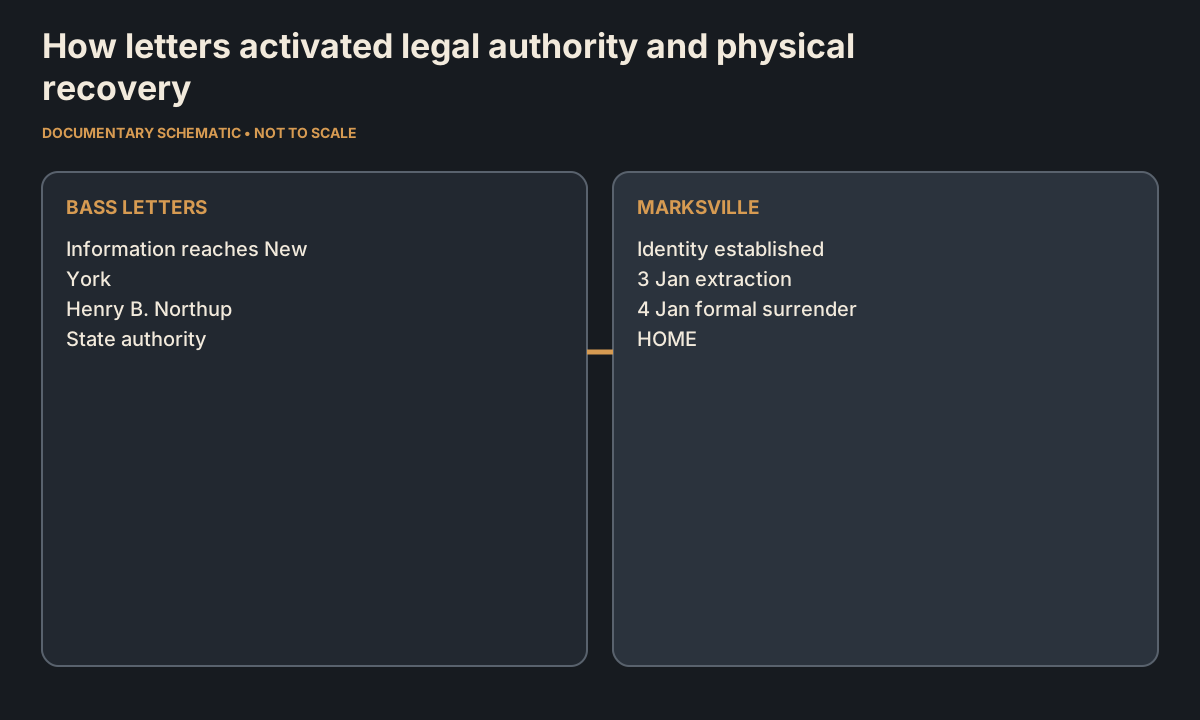
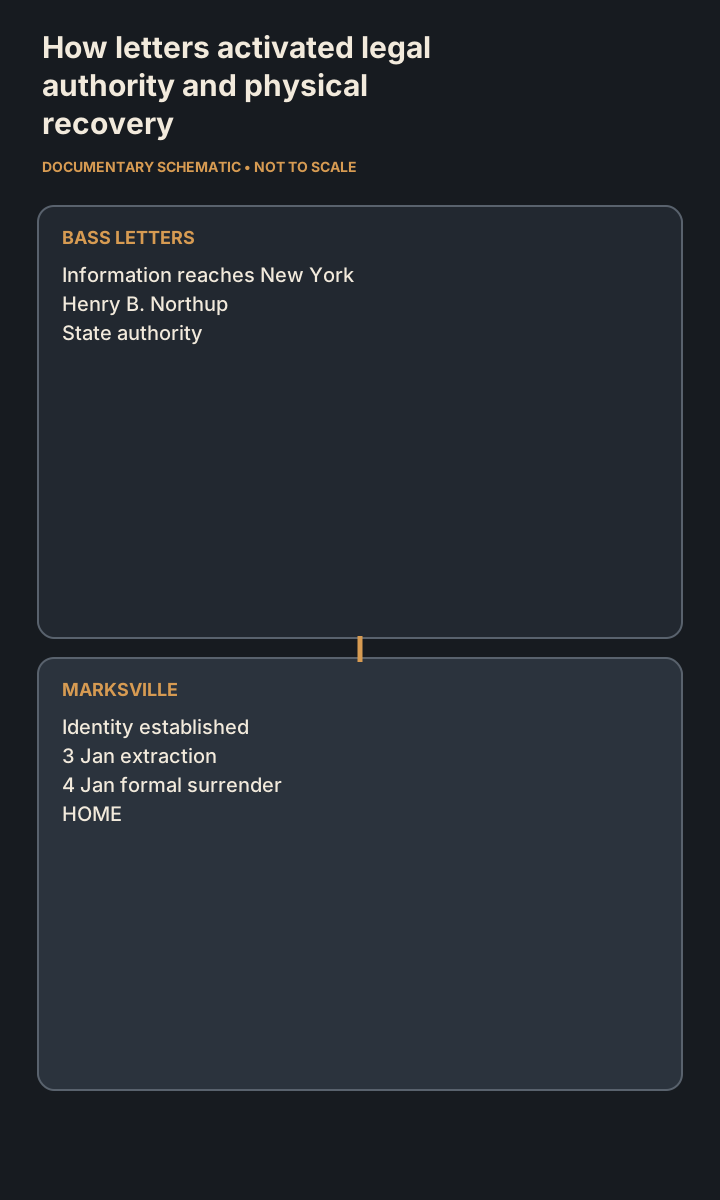
Northup's first message told New York that he had been kidnapped but not where he would end up. For eleven more years, the system kept his true identity geographically isolated. Bass's letter changed that by attaching the name Solomon Northup to Marksville and Avoyelles Parish. Anne and the family moved the information to Henry.
Community affidavits proved that Solomon was a free New Yorker. An 1840 state law gave the governor power to act. Governor Hunt converted that proof into an official commission. Henry carried the commission south.
Waddill converted an unfamiliar region into local knowledge. Bass identified Epps and the man called Platt. A judge and sheriff converted the documentary claim into physical custody. The January 4 record converted the recovery into a formal legal surrender.
The rescue succeeded because information, identity, law, and local enforcement finally converged around the same person.
Documentary reconstruction
How letters activated legal authority and physical recovery
A case-local visual focused on the historical question that the surviving evidence can answer.
Simplified documentary reconstruction; not to scale. Evidence qualifications are written directly into the visual and explained in the adjacent text.
Evidence discipline
What the record supports
Status labels distinguish secure conclusions from uncertainty and rejected claims. Color is never the only signal.
DOCUMENTED
Solomon Northup was born free rather than manumitted after enslavement.
The 1852 affidavits and governor's commission explicitly establish Northup as a free citizen of New York before the 1841 kidnapping.
Sources: SRC-001, SRC-002DOCUMENTED
Northup was kidnapped in Washington in 1841 and sold into slavery.
Northup's narrative, the legal recovery papers, the National Archives manifest, and institutional histories support the kidnapping and wrongful sale.
Sources: SRC-001, SRC-002, SRC-003, SRC-005UNKNOWN
Merrill Brown and Abram Hamilton definitely drugged Northup themselves.
Northup remembered becoming severely ill and later waking in chains but did not securely establish who caused the illness or the exact mechanism by which he was transferred to Burch.
Sources: SRC-001, SRC-010DOCUMENTED
The Plat Hamilton listed on the brig Orleans manifest is Solomon Northup.
The National Archives identifies Northup on line 33 of the 1841 manifest under the false name Plat Hamilton.
Sources: SRC-003MYTH
Samuel Bass's 1852 letter was Northup's first attempt to communicate with New York.
Northup had already sent an 1841 letter from the southbound journey with sailor John Manning's help; it reported the kidnapping but lacked an actionable final location.
Sources: SRC-001, SRC-002MYTH
Samuel Bass personally travelled north and returned with Northup's rescuers.
Bass remained in Louisiana. His decisive role was writing the letters and later identifying Epps's plantation to Henry B. Northup.
Sources: SRC-001MYTH
Henry B. Northup purchased Solomon's freedom from Edwin Epps.
Henry acted under a New York state commission proving Solomon was already a free citizen wrongfully held as a slave. No purchase or manumission created Northup's freedom.
Sources: SRC-001, SRC-002MYTH
Solomon Northup escaped from Epps's plantation by running away on January 3, 1853.
Henry B. Northup and the parish sheriff reached the plantation under legal process, verified Solomon's identity, served papers, and removed him by carriage.
Sources: SRC-001DISPUTED
January 3 and January 4 are competing dates for the same single recovery event.
They mark different stages: January 3 was physical removal from Epps's plantation; January 4 was the formal recorded surrender in Marksville.
Sources: SRC-001, SRC-002MYTH
Northup was enslaved for exactly twelve complete calendar years.
The memoir's title is historically authentic, but the period from spring 1841 to January 1853 was somewhat less than twelve full years while extending across twelve calendar years.
Sources: SRC-001, SRC-003MYTH
Edwin Epps granted Northup freedom in 1853.
The legal papers treated Northup as a free New York citizen who had been kidnapped. Epps formally relinquished a wrongful claim after evidence of that preexisting status was produced.
Sources: SRC-002MYTH
James H. Burch was convicted for kidnapping Northup.
Burch was arrested and examined, but Northup's testimony was excluded because he was Black and Burch was discharged.
Sources: SRC-001, SRC-007