
The most famous version of Coacoochee’s escape from Fort Marion asks the reader to imagine an almost impossible opening. A narrow aperture sat high in the wall. Coacoochee and another prisoner supposedly reduced their bodies for days, climbed to the opening, forced themselves through the stone passage and lowered themselves toward the ditch on a rope made from sleeping bags.
Parts of that story are older and better supported than others. What happened on the night of 29 November 1837 was certainly an escape. The evidence for every inch of the celebrated squeeze is much less certain.
At a Glance
- Date: Night of 29 November 1837
- Place: Fort Marion, now Castillo de San Marcos, St. Augustine, Florida
- Central escapee: Coacoochee, also known in U.S. records as Wild Cat
- Immediate companion in Coacoochee’s account: Talmus Hadjo
- Best contemporary escape count: 20 prisoners, including two women
- Named women: Aoh-op-ho-yuy and Apas-e-ay
- Context: Second Seminole War and U.S. forced-removal policy
- Secure mechanism: A barred opening was breached and a line was used to descend into the ditch
- Major uncertainty: The exact room, aperture dimensions and famous weight-loss mechanics are not fully settled
Capture Under a Flag of Truce
Coacoochee was already an important Seminole resistance leader when U.S. forces captured him in October 1837.
The Second Seminole War had begun amid the federal government’s attempt to remove Seminole communities from Florida to Indian Territory west of the Mississippi. By 1837, General Thomas Jesup had become increasingly willing to use seizure during negotiations as a military tool.
Coacoochee’s father, Emathla—often called King Philip in U.S. sources—had already been captured. U.S. forces then used negotiations to bring other leaders within reach.
On 21 October, Coacoochee, Osceola and others came into a negotiation process under a flag of truce. They were seized.
The tactic drew criticism even among Americans who wanted the war ended. For Seminole people, it became another example of why U.S. promises could not safely be trusted.
Fort Marion
The prisoners were taken to St. Augustine and confined inside the massive coquina fortress then called Fort Marion by the U.S. Army.
Today it is again known as Castillo de San Marcos. National Park Service history says more than 230 Seminole prisoners were held there during November and December 1837. They were not all warriors. The confined population included leaders, fighters, women, children and relatives.
They were kept under guard in rooms on the west side and southwest corner of the fort. Limited exercise in the courtyard was permitted, but the prisoners could not pass the sally port.
Illness spread through the crowded captive population. Osceola became seriously sick. Coacoochee did not intend to remain.
The Escape Count
One of the first evidence problems is numerical. A U.S. Army report written on 30 November 1837, the day after the escape, said twenty Indian prisoners had escaped, including two women.
That is the strongest near-contemporary administrative count. The National Park Service uses the same number and identifies the women as Aoh-op-ho-yuy and Apas-e-ay.
A current Seminole Tribal Historic Preservation Office timeline gives a different figure, stating that Coacoochee and twenty-eight warriors escaped. The conflict is worth preserving rather than hiding. Twenty is the best documented immediate count, but the historical record does not provide a clean, universally agreed roster of everyone who made it out.
Coacoochee’s Own Story
Years later, Coacoochee described his escape in an account preserved by Army officer and historian John T. Sprague.
Sprague published it in 1848. In that narrative, the escape becomes intensely personal. Coacoochee describes himself and Talmus Hadjo confined in a small room with a high opening admitting the only light.
They decided they would either escape or die trying. The account says they began cutting the forage bags used for sleeping and turning the material into rope.
They studied the opening. They studied the moon. They prepared their bodies.
The Famous Weight-Loss Story
The best-known detail is the claim that Coacoochee made himself small enough to fit through the opening. His later account says the prisoners obtained roots under the pretense of illness and used a regimen for several days while waiting for a sufficiently dark night.
Later retellings describe this simply as starving himself for five days. That wording is too absolute.
The several-day body-reduction story comes from Coacoochee’s later testimony. It is not independently recorded in the next-day Army report.
That does not make it false. It makes it a later first-person claim, which is a different kind of evidence from a contemporary inspection report.
What the Army Found
The military report after the escape is less dramatic and more important. It described an aperture closed by iron bars.
One bar had been removed. The report also said the prisoners had descended into the ditch using a line fastened to the remaining bar.
Those observations strongly support the basic window-or-aperture route. They also support some kind of rope or line. They do not prove every later detail about how the prisoners reached the opening, how much weight they lost, who passed through first or how twenty people moved through the space without detection.
How Narrow Was the Opening?
This is where the legend becomes difficult to turn into architecture. Later descriptions often give an opening only about eight or nine inches wide between bars, set roughly eighteen feet above the floor.
If those measurements are applied literally to a modern adult body, the escape can appear physically impossible. But the precise historical problem is not that simple.
Modern historians and Seminole interpreters have questioned which room was actually used. More than one southwest room has been proposed. The shape of the opening, the position of bars and later changes to the fort complicate efforts to measure the 1837 escape with a modern ruler.
The National Park Service now states plainly that the mechanics remain debated. A useful reconstruction therefore stops before claiming that a particular present-day slit is unquestionably the opening every escapee used.
Talmus Hadjo
Coacoochee’s account gives Talmus Hadjo a central role. Coacoochee said he climbed first, using his companion’s shoulders and improvised holds in the masonry to reach the opening. He secured the rope and lowered himself outside.
Then he waited. Talmus tried to follow.
According to the later story, Talmus got his head through but could not force his body farther. Coacoochee whispered for him to expel his breath and try again.
Talmus finally broke through and fell. Coacoochee thought for a moment that his companion had died.
This is one of the most vivid passages in the narrative. It is also a detail that comes from Coacoochee’s retrospective account rather than the immediate Army inspection.
The Other Eighteen
The difference between the personal account and the Army count creates another major question. Coacoochee’s preserved narrative follows himself and Talmus Hadjo.
The Army said twenty prisoners had escaped. How did the other eighteen fit into the sequence?
The evidence does not answer cleanly. Later historians have proposed that all or most used the same opening. Some accounts include Black Seminole leader John Cavallo, also known as John Horse, among the escapees, and Kenneth W. Porter argued that he probably participated.
The National Park Service names two women. Yet no secure twenty-person room-by-room order survives. A reconstruction that shows twenty figures squeezing through one aperture in a known sequence would therefore go beyond the evidence.
Could They Have Walked Out?
Because of the physical doubts, other theories have developed. Perhaps a door was left open.
Perhaps a guard deliberately or accidentally allowed the escape. Perhaps a bribe or sympathetic soldier played a part.
Current Seminole historical interpretation acknowledges these possibilities. None has the same immediate documentary support as the Army report describing the removed bar and descent line. The alternatives therefore remain possibilities, not replacements established by stronger evidence.
Into the Ditch
Whatever the exact sequence, the prisoners were outside the fortress before the escape was discovered. Coacoochee’s account says Talmus had injured his leg badly in the fall.
Coacoochee carried him to scrub near St. Augustine as daylight approached.
He then caught a mule in a nearby field and made a bridle from his sash so Talmus could ride. They moved toward the St. Johns River.
After a day they abandoned the animal because they feared it would make their trail easier to follow. The two continued through hammock country on foot.
Five Days Back to the Resistance
Coacoochee said he and Talmus survived for about five days on roots and berries before reaching his band near the headwaters of the Tomoka River. That route carries the same evidentiary status as the rest of his later narrative.
It is a powerful first-person reconstruction preserved relatively close to the war. It is not a GPS trace.
The secure historical result is simpler: Coacoochee escaped St. Augustine, avoided immediate recapture and returned to active Seminole resistance.
The Escape Reaches the War
U.S. officers understood the significance quickly.
Lieutenant John Pickell, whose 1836–37 journals preserve contemporary military reactions, believed Coacoochee’s escape would hurt efforts to end the conflict. Less than a month later, that fear had substance.
On 25 December 1837, U.S. forces under Zachary Taylor attacked a large Seminole and Miccosukee position near Lake Okeechobee.
Florida State Parks identifies Coacoochee among the principal Indigenous leaders there alongside Arpiucki, Halpatter Tustenuggee and Holata Micco. The U.S. Army suffered heavy casualties in the assault.
The Seminole and Miccosukee force ultimately withdrew, but it was not destroyed. Coacoochee was back in the war.
Did His Escape Prolong the War?
Later historians have sometimes credited the Fort Marion escape with prolonging Seminole resistance for years. There is a strong case that Coacoochee’s return mattered.
He was young, influential and militarily capable at a time when U.S. forces had removed or confined several major leaders. His reappearance could also reassure Seminole fighters who might otherwise have suspected that his capture reflected some private agreement with the Americans.
But wars do not continue because of one person alone. Arpiucki, Halpatter Tustenuggee, Holata Micco, Black Seminole allies and many other communities continued resistance for their own reasons.
The escape strengthened that resistance. It did not single-handedly create it.
What Happened to Those Left Behind
The breakout also changed U.S. treatment of the prisoners who remained.
Authorities no longer trusted Fort Marion to hold the most important captives close to the Florida theater. Osceola and more than two hundred others were transferred to Fort Moultrie in South Carolina.
Osceola was already dangerously ill. He died there on 30 January 1838. The contrast became part of the escape’s memory: Coacoochee returned to the field, while Osceola never returned to Florida alive.
A Story Coacoochee Himself Shaped
The Fort Marion escape survived not only because U.S. soldiers recorded the embarrassment.
Coacoochee told the story himself. That matters.
His narrative preserves fear, calculation, physical struggle and his determination to rejoin his people. It also means historians have to distinguish memory from inspection.
The next-day Army report gives us the removed bar and the line into the ditch. Coacoochee gives us the roots, moon, rope, torn skin, falling companion, mule and five-day journey.
The fort today gives us an architectural problem that is not completely solved. The most defensible history keeps all three together.
Coacoochee escaped Fort Marion. The opening was breached.
A line reached the ditch. Beyond that, the famous narrow-window story remains not a myth to discard, but evidence to question.
Evidence discipline
What the record supports
Status labels distinguish secure conclusions from uncertainty and rejected claims. Color is never the only signal.
MYTH
Coacoochee’s Fort Marion escape is only a later legend with no contemporary military evidence.
A U.S. Army report written the next day documents the escape and describes a removed iron bar and line descent into the ditch.
Sources: SRC-004, SRC-006UNKNOWN
The exact present-day casemate used in the escape is securely identified.
Modern NPS and Seminole historical interpretation treat the exact room as unresolved; multiple southwest rooms have been proposed.
Sources: SRC-001, SRC-004DISPUTED
The opening was certainly eight inches wide in the exact configuration used in 1837.
Later measurements and descriptions commonly give eight or nine inches, but uncertainty over room identification, bar configuration and later alterations makes exact historic dimensions insecure.
Sources: SRC-004, SRC-006MYTH
Coacoochee independently documented a five-day starvation regimen in a contemporary 1837 record.
The body-reduction / roots story comes from his later retrospective account, not the next-day Army report.
Sources: SRC-005, SRC-007MYTH
A rope or line descent is only part of later folklore.
The immediate Army report itself says a line was fastened to the remaining bar and used to descend into the ditch.
Sources: SRC-004, SRC-006DISPUTED
Exactly twenty people escaped and there is no conflicting count.
Twenty, including two women, is the strongest contemporary Army count and the figure used by NPS, while a current Seminole Tribal Historic Preservation timeline states that Coacoochee and twenty-eight warriors escaped.
Sources: SRC-002, SRC-003, SRC-004MYTH
Coacoochee’s later narrative explains the movement of all twenty escapees.
The preserved narrative focuses on Coacoochee and Talmus Hadjo and does not provide a complete full-group sequence or roster.
Sources: SRC-005, SRC-007UNKNOWN
A bribed guard or open door is proven to have been the real escape method.
Those are later alternative theories raised by modern interpreters. They do not currently have stronger direct evidence than the contemporary aperture-and-line report.
Sources: SRC-004MYTH
Coacoochee’s escape by itself caused the Second Seminole War to continue for four more years.
His return strengthened resistance and was immediately significant, but the war continued through the actions of multiple Seminole, Miccosukee and Black Seminole leaders and communities.
Sources: SRC-001, SRC-008, SRC-009Documentary reconstruction
Sources and the escape mechanism
A case-local editorial visual separates the documented sequence from uncertainty without implying exact modern geography or operational detail.
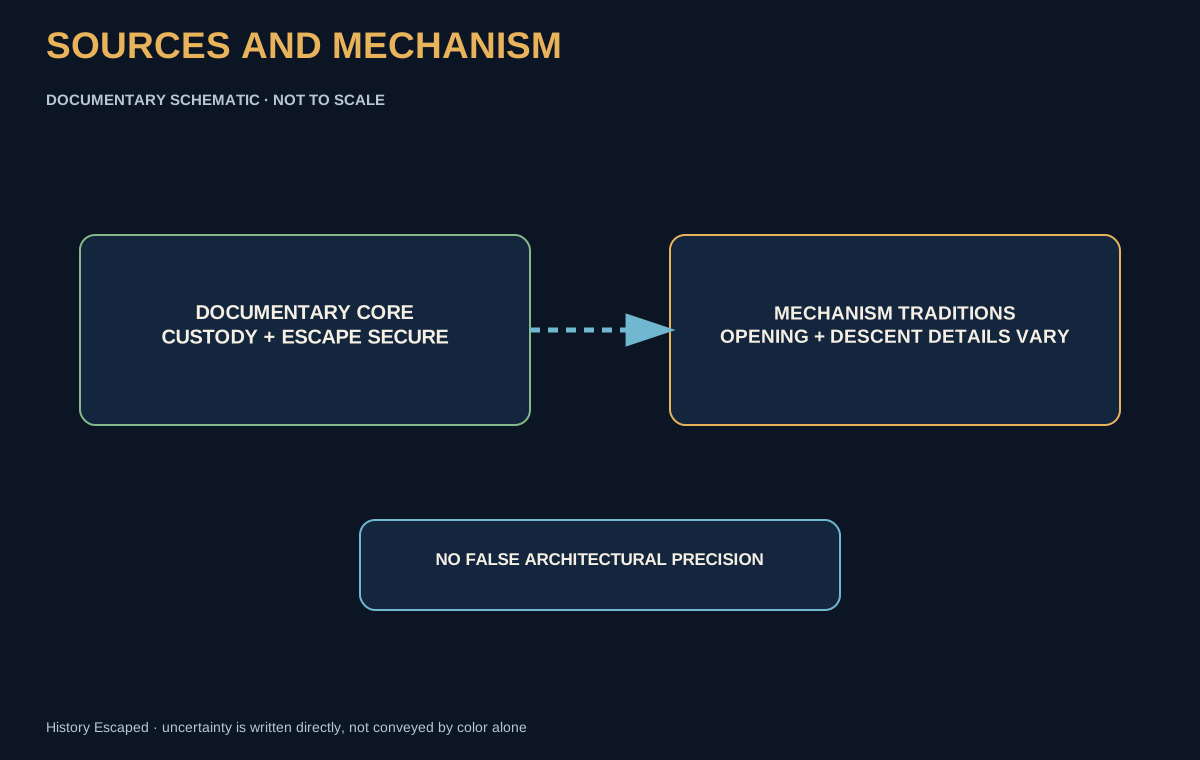
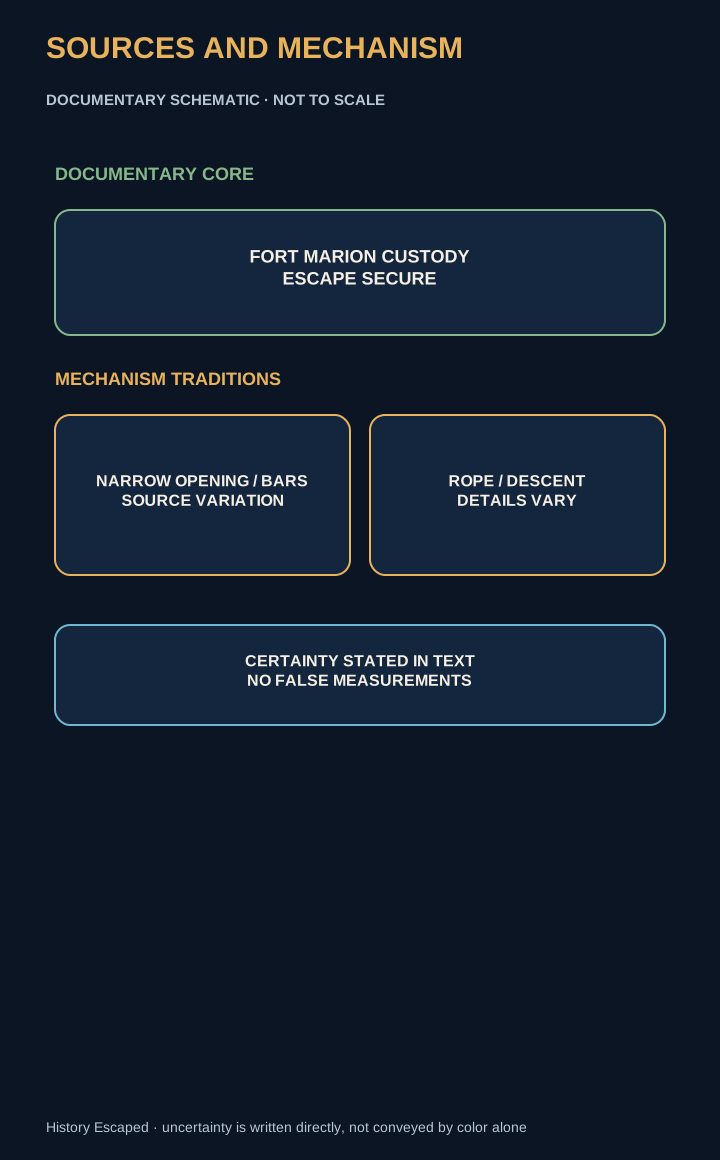
Simplified editorial reconstruction based on the cited historical record; not to scale. Uncertainty is stated directly in the visual and adjacent text.
