
Standing Bear’s northward journey in 1879 began as an act of refusal. Two years earlier, the United States had forced the Ponca from their Nebraska homeland to Indian Territory despite a congressional appropriation that had conditioned removal on the tribe’s consent. By the winter of 1878–79, illness and death had transformed that coerced relocation into what Standing Bear described as captivity.
His son had died there. Standing Bear later told Thomas Henry Tibbles that the young man had asked to be buried in the country where he had been born, and Standing Bear had promised to carry his remains home. That promise was real and well attested, but it was not the only reason for leaving. In federal court, Standing Bear also said he was trying to save his surviving wife and child, find a place where they could live by their own labor, and return to land he still regarded as home.
At a Glance
- What happened: Standing Bear and a small Ponca party left Indian Territory without federal permission and traveled north toward Nebraska.
- Departure: The night of January 2, 1879.
- Best-supported travel-party count: 30 people, including Standing Bear.
- Immediate destination reached: The Omaha Reservation in Nebraska, where relatives offered assistance and land to cultivate.
- What stopped them: Federal officials ordered the group detained and returned to Indian Territory; Army troops took them to Fort Omaha.
- How they became free: Twenty-six named petitioners sought a writ of habeas corpus. Judge Elmer S. Dundy ruled on May 12 that the federal government lacked lawful authority to force them back.
- Why it matters: The case established that an Indian was a “person” for purposes of the federal habeas corpus law. It did not make all Native Americans United States citizens.
A homeland the government had promised to protect
The Ponca’s loss of freedom did not begin with Standing Bear’s arrest in 1879. A treaty in 1858 reserved land along the Niobrara River for the Ponca and included a federal promise to protect them there. A second treaty in 1865 adjusted the reservation while expressly referring to the return of Ponca burial grounds and cornfields. Then, in the 1868 Fort Laramie treaty with the Sioux, the United States included the Ponca reservation within a much larger tract without Ponca consultation or consent.
Congress addressed removal in an 1876 Indian appropriation act. Judge Dundy later emphasized a critical phrase in that statute: the secretary of the interior could spend money to remove the Ponca to Indian Territory with the consent of the tribe. The Ponca did not give that consent. Nevertheless, federal policy shifted from proposing relocation to enforcing it, and in 1877 the Ponca were compelled south.
The removal carried its own losses. Standing Bear’s family was among those who suffered deaths, and conditions in Indian Territory brought further disease and deprivation. The surviving records do not support one neat percentage for the mortality. Standing Bear testified in 1879 that 158 Poncas had died during the period he was there, while surviving printed versions disagree about the population denominator used to frame that figure. The scale of loss is clear; a precise percentage is less secure than many later summaries suggest.
Standing Bear’s own description of his position was unusually direct. In an April 1879 interview translated by W. W. Hamilton, he said, “I was not a free man.” He explained that he had been taken by force from his country and regarded himself as a prisoner. By midwinter, he had decided that remaining could be no safer than trying to leave.
Thirty people turn north
Standing Bear’s April account gives unusually specific evidence for the beginning of the journey. He said he took 30 people, seven of them already very sick, and that they slipped away on the night of January 2. He and Buffalo Chip had ten dollars each. The party had three covered wagons and a light spring wagon, a small amount of rations, and no permission from the federal authorities to leave.
That near-contemporary account matters because later retellings often give a much larger number. A 1965 Smithsonian Bureau of American Ethnology bulletin, for example, says 66 people set out. Yet Standing Bear repeatedly gave the number as 30, his courtroom testimony says 30 came away with him, and Indian agent Jacob Vore telegraphed on March 4 that the Poncas had “just arrived, thirty in number.” Those independent, near-contemporary statements make 30 the strongest count for the northbound party.
Another number in Standing Bear’s testimony has sometimes contributed to the confusion. Asked how many people were in his own band in Indian Territory when he left, he answered about 50; when immediately asked how many came away with him to the Omaha reservation, he answered 30. The larger figure describes the community from which the travelers came, not the travel party itself.
The journey was an escape from imposed residence, but it was not a clean dash from one secured enclosure to another. Standing Bear said the party survived on its remaining money for roughly twenty days and afterward depended on food given by people encountered along the way. He also said he changed course because he expected federal pursuit. The surviving evidence supports the broad northward movement and its endpoints far better than it supports a day-by-day route, so later map-like reconstructions should not be mistaken for a documented track.
The famous burial story belongs inside that broader purpose. In his April interview, Standing Bear said his dying son had asked for his bones to be carried back and buried where he had been born. Standing Bear’s wife separately spoke of trying to fulfill the same request. In court, Standing Bear also testified that he wanted to save his surviving wife and child, recover a place to work, and live on or near the land from which he had been removed. The journey carried his son’s remains, but it was also an attempt to get a living family out of a place Standing Bear believed was killing them.
The Omaha Reservation: refuge, then restraint
A contemporaneous federal telegram fixes the party’s arrival more precisely than Standing Bear’s own later estimate of “about the middle of March.” On March 4, Omaha Indian agent Jacob Vore reported that 30 Poncas had just arrived. He also reported that he had them arrested, although he had no place in which to confine them and they had promised to remain while he awaited instructions.
The Omaha were close relatives of the Ponca, and Standing Bear said they offered practical help: land, seed, tools, and the possibility of planting a crop. His party had not yet reached the old Ponca land along the Niobrara, but the Omaha reservation offered a place to recover and work. Some members of the group were still too sick to do so.
Washington treated their arrival as an unauthorized departure that had to be reversed. On March 7, Secretary of the Interior Carl Schurz asked the War Department to provide a guard to return the Poncas to Indian Territory. The request moved through the military chain of command, and on March 19 the Department of the Platte directed Fort Omaha to send an officer and guard.
Lieutenant William L. Carpenter later recorded that on March 23 he arrested “a band of twenty-nine Ponca Indians, under Standing Bear” at the Omaha Agency and took them to Fort Omaha. That count does not match the 30 reported on arrival. Standing Bear’s earlier account also says one woman was too sick to move when the party was ordered away from the Omaha reservation, which offers a plausible reason for a changed headcount without proving exactly how Carpenter counted Standing Bear himself. The discrepancy should remain visible rather than be repaired by assumption.
From physical flight to legal escape
At Fort Omaha, the group was again under federal control and faced forced return south. General George Crook was the officer legally responsible for their custody, but later accounts and the case record show that he was not personally committed to the policy he had been ordered to enforce. Journalist Thomas Henry Tibbles publicized the Poncas’ situation, and Omaha attorneys Andrew J. Poppleton and John L. Webster agreed to challenge the detention.
The lawyers did not ask the court to decide the entire history of federal Indian policy. They sought a writ of habeas corpus, the legal mechanism for testing whether a person was being held lawfully. The surviving court file names Standing Bear and 25 others as relators: 26 petitioners, not 30. Children and other members of the travel party were not necessarily represented as individually named petitioners, which is why the travel-party count and legal-party count must not be treated as competing answers to the same question.
The petition was presented on April 8. The government’s return acknowledged that Crook held the Poncas pursuant to orders intended to send them back to Indian Territory. The central legal fight therefore reached beyond whether the arrest had happened. It asked whether federal officials had lawful authority to keep these people in custody for that purpose and whether the petitioners could invoke habeas corpus at all.
The hearing took place May 1 and 2. Standing Bear testified through interpreters about the removal, conditions in Indian Territory, his reasons for leaving, and his intention to support himself. The official reporter later summarized his position as a decision to leave permanently and return to his old home rather than submit to forced residence in Indian Territory.
A celebrated version of Standing Bear’s closing courtroom address describes him extending his hand and comparing the color of his skin with the common color of human blood. The episode has become central to his public memory and appears in later institutional accounts. The exact wording, however, is not preserved in the formal trial material reproduced in the 1880 Tibbles volume. It is more responsible to treat the familiar quotation as a later-transmitted version of his address rather than as a stenographic transcript.
What Judge Dundy actually decided
On May 12, 1879, Judge Elmer S. Dundy ordered the petitioners discharged. His first conclusion was the one that became famous: an Indian is a “person” within the meaning of the federal laws governing habeas corpus and therefore may seek the writ when held under color of federal authority or in violation of federal law.
The decision went further. Dundy held that Crook had custody of the relators under color of federal authority, that no lawful authority existed to force them back to Indian Territory as ordered, and that Native people possessed a right of expatriation. He distinguished the government’s power to remove unauthorized people from an Indian reservation from any supposed power to transport them wherever federal officials chose. If the military removed the Poncas from the Omaha reservation, Dundy reasoned, it had to deliver them to civil authorities for lawful proceedings rather than simply carry them back south.
The ruling was important, but some later shorthand makes it broader than it was. Dundy did not declare all Native Americans citizens of the United States. The opinion concerned personhood under habeas law, the legality of these petitioners’ detention, and a theory of individual expatriation from tribal relations. Federal citizenship for Native Americans remained a separate and contested legal question.
There is also a limitation in the reasoning that deserves attention. Dundy repeatedly described the petitioners’ wish to sever tribal relations and become self-supporting in the language of nineteenth-century “civilization.” The judgment protected them against forced removal, but it did so partly through an assimilationist legal framework that treated separation from tribal political life as evidence supporting individual liberty. The case was a major protection against arbitrary detention without being a modern statement of tribal sovereignty.
Federal officials initially sought review. The published Federal Cases report notes that Justice Samuel F. Miller refused to hear the government’s appeal because the released petitioners were not present and no security had been taken to ensure their appearance. The result was that Dundy’s order remained undisturbed without a higher court deciding the merits.
The count problem
The simplest version of this history often says that Standing Bear escaped with “30 followers,” was arrested with the same group, and won freedom for all of them. The primary record is more exact and more complicated.
Thirty is the best-supported number for the party that left Indian Territory and reached the Omaha Agency. Carpenter recorded 29 in the band he arrested on March 23. The habeas petition named 26 relators. A witness at the hearing offered yet another approximate number, while much later publications repeated 66. These figures answer different questions, and some also reflect genuine disagreement in the sources.
The same caution applies to mortality during removal. The 158 deaths Standing Bear described in court are well attested, but the denominator varies across printed versions and later summaries. The published Federal Cases opinion says 581 had gone from the Dakota reservation to Indian Territory; the 1880 Tibbles printing of the opinion gives 710 at the same point, while other later editions and summaries use still other totals. Converting those figures into a confident single percentage hides a source problem that the surviving record does not resolve cleanly.
Home after the judgment
The legal ruling did not instantly restore everything the Ponca had lost. Standing Bear and his companions were free from the order that would have forced them back to Indian Territory, but their former land base had been disrupted and the Ponca people had been divided by removal. Standing Bear nevertheless continued north and fulfilled the promise to bury his son in the Ponca homeland.
The case also became part of a wider national argument over the treatment of the Ponca. Standing Bear traveled and spoke publicly after 1879, while federal inquiries and political pressure led to partial restoration of land for the northern Ponca. The community did not simply return to the world that existed before 1877; removal had produced deaths, dispossession, and a lasting geographic division.
Standing Bear’s 1879 journey deserves to be remembered as an escape in its own right because the legal landmark followed from a physical refusal to remain where the government had placed him. Thirty people left without permission. They reached relatives in Nebraska, were detained again, and then used the federal courts to prevent another forced return. The escape was therefore neither only a burial journey nor only a courtroom story. It was a movement from coerced removal, through flight and recapture, to a legally enforceable claim to personal liberty.
Evidence discipline
What the record supports
Status labels distinguish secure conclusions from uncertainty and rejected claims. Color is never the only signal.
DOCUMENTED
Standing Bear’s northbound party numbered 30.
Standing Bear gave the number thirty in his April account and courtroom testimony, and Jacob Vore’s March 4 telegram independently reported thirty Poncas arriving.
Sources: SRC-001LATER CLAIM
Sixty-six people made the 1879 flight with Standing Bear.
The number appears in a 1965 Smithsonian Bureau of American Ethnology bulletin and later retellings, but it conflicts with Standing Bear’s near-contemporary statements and the contemporaneous federal arrival telegram.
Sources: SRC-001, SRC-007WELL-SUPPORTED
Standing Bear carried his son’s remains north because he had promised to bury him in the Ponca homeland.
Standing Bear described the promise in an April 1879 interview; his wife separately referred to the attempted burial, and Dundy’s published opinion noted that the son’s remains accompanied the return.
Sources: SRC-001, SRC-002, SRC-004, SRC-005DISPUTED
The burial promise was the only reason Standing Bear left Indian Territory.
The burial motive is well supported, but Standing Bear’s sworn testimony also emphasized saving his surviving wife and child, finding a place to work, and returning to his old land.
Sources: SRC-001MYTH
Dundy’s ruling made all Native Americans United States citizens.
The ruling recognized personhood for federal habeas corpus and invalidated the forced return of these relators. It did not confer universal U.S. citizenship.
Sources: SRC-002, SRC-006LATER CLAIM
The familiar hand-and-blood courtroom quotation is a verbatim stenographic transcript.
Later institutional and published accounts preserve versions of the speech, but the exact wording does not appear in the formal trial material reproduced in Tibbles’s 1880 account. The broad episode is part of established tradition; exact wording should not be presented as a stenographic certainty.
Sources: SRC-001, SRC-010DISPUTED
A single exact mortality percentage can be derived securely from the surviving 1879 record.
Standing Bear’s figure of 158 deaths is preserved, but the Federal Cases opinion gives a baseline of 581 while the 1880 Tibbles printing of the opinion gives 710; later summaries use additional denominators.
Sources: SRC-001, SRC-002Documentary reconstruction
Physical flight and the habeas corpus pathway
A case-local editorial visual separates the secure historical sequence from uncertainty without exposing reusable modern operational detail.
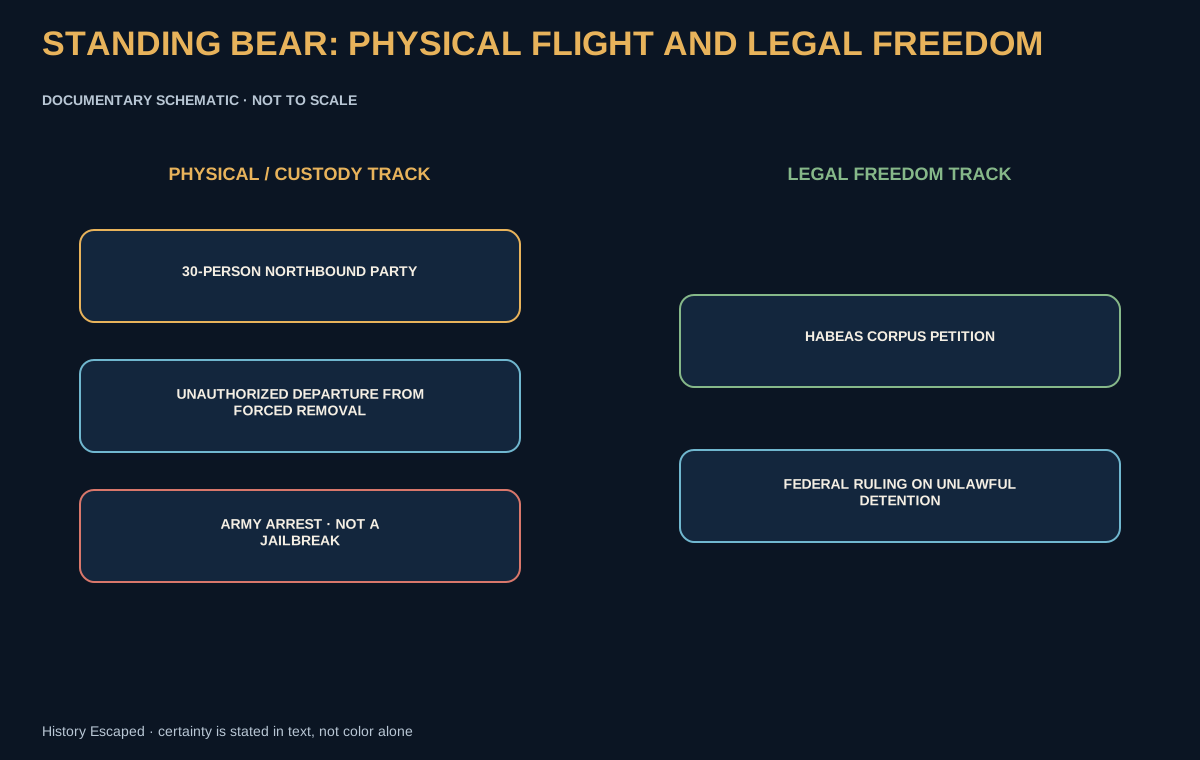
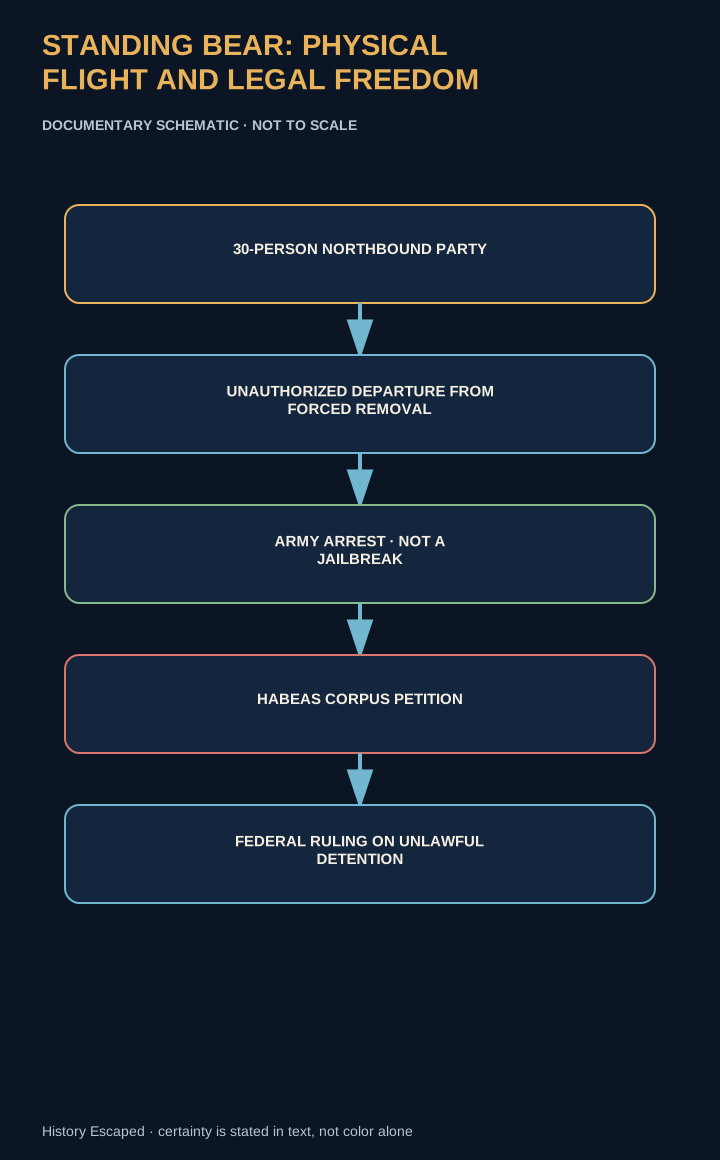
Simplified evidence-led editorial reconstruction based on the cited record; not to scale. Uncertainty is stated directly in the visual and adjacent text.
