
In September 1849, Harriet Tubman tried to escape slavery with two of her brothers. They left together. They came back together. That first failure is essential to understanding what happened next.
A short time later, Tubman left again. This time she went without them.
The exact date of the second departure is not known. Neither is the exact path she followed through Maryland and Delaware. The surviving evidence is much clearer about the first attempt than the second.
But the broad outcome is certain. By the end of 1849, Harriet Tubman had crossed into Pennsylvania and reached Philadelphia. She had taken possession of her own freedom.
The Risk of Being Sold Away
Harriet Tubman was born Araminta Ross around 1822 on Maryland’s Eastern Shore. Her parents, Ben Ross and Harriet “Rit” Green, were enslaved. Tubman grew up inside a family that slavery repeatedly threatened to break apart. It already had.
Three of her older sisters—Linah, Mariah Ritty, and Soph—were sold away from the family. Their later lives disappeared from the known record.
Tubman understood what sale could mean long before 1849. Then Edward Brodess died.
Brodess, who claimed legal ownership over Tubman, died in March 1849. His estate faced debts, and the enslaved people claimed as property by the family became vulnerable to sale.
Tubman learned that she and two of her brothers, Ben and Henry, could be sold. For enslaved people in Maryland, sale did not necessarily mean a transfer to a neighboring farm. It could mean being sent farther south, away from family, community, familiar landscape, and any realistic possibility of reunion. Tubman had reached her late twenties.
She had a husband. She had parents and siblings nearby. She also knew that none of those relationships could legally prevent a sale. She decided to leave before someone else decided where she would spend the rest of her life.
Harriet Tubman Was Married—but Still Enslaved
Around 1844, Araminta Ross married John Tubman, a free Black man. By this period she had taken the name Harriet, probably after her mother, and used Tubman as her surname. The marriage did not make her legally free. John’s free status could not cancel the status imposed on Harriet by Maryland slavery law.
That created a painful reality when she prepared to leave. Tubman’s escape would not simply mean leaving an enslaver. It would mean leaving her husband, parents, brothers, sisters, relatives, and the community in which she had grown up. Freedom lay north.
Home lay behind her. That tension would define much of Tubman’s life after 1849.
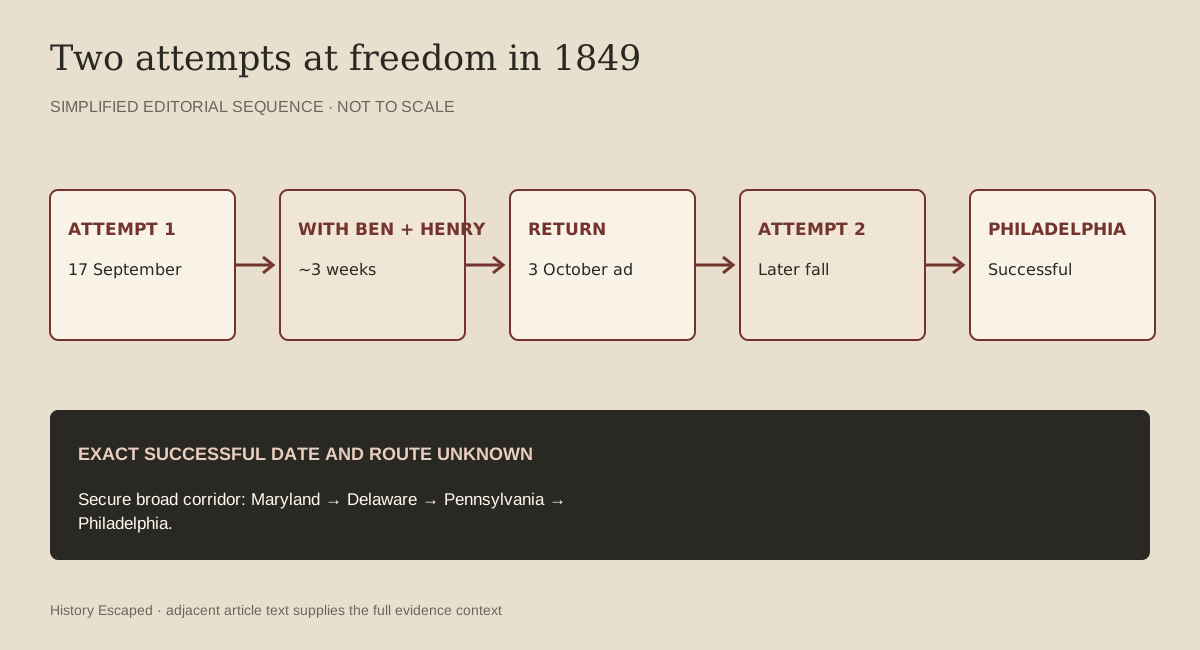
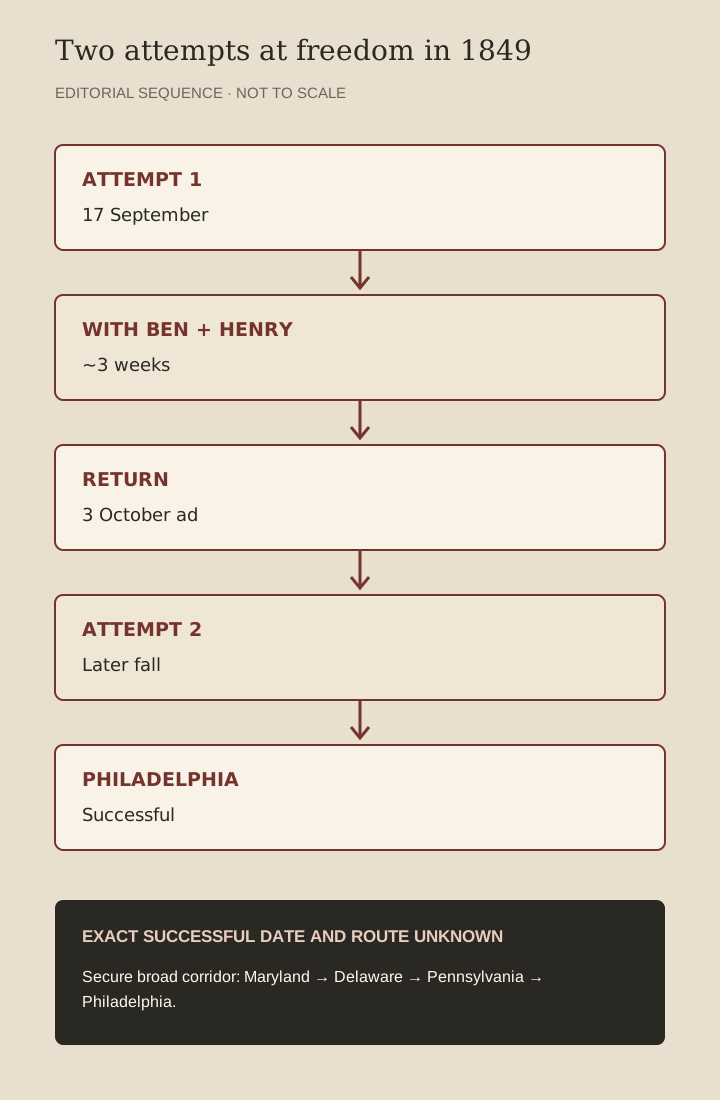
Two attempts
The September return and the later successful escape
Separating the attempts prevents a documented September departure from being mistaken for the unknown date of Tubman's successful journey.
- 01
Attempt 1
Tubman left on 17 September with Ben and Henry, remained away about three weeks in the NPS interpretation, and returned.
- 02
Evidence
The 3 October reward advertisement documents Harry, Ben and Minty and a maximum total reward of $300.
- 03
Attempt 2
Later that fall Tubman left without family companions. The precise departure date is unknown.
- 04
Broad corridor
Maryland, Delaware, Pennsylvania and Philadelphia are secure at broad scale; the exact path is not.
- 05
Meaning
Her 1849 self-emancipation was distinct from the later rescue missions for which she became famous.
Simplified editorial reconstruction based on historical sources; not to scale. The September 17 first attempt is documented, while the exact date and exact route of Tubman’s successful second escape are unknown.

September 17: The First Attempt
The first attempt began on September 17, 1849. Tubman left with brothers Ben and Henry. In the newspaper advertisement later placed for their capture, Henry was called Harry and Tubman was called Minty, the childhood nickname by which the family that enslaved her still knew her. At the time, the siblings were working around Poplar Neck in Caroline County, within the larger Eastern Shore world that connected the Ross family to farms, timber work, waterways, roads, Black communities, and neighboring households.
The three slipped away. For the first time, they were fugitives from the people claiming them as property. The danger was immediate. If caught, they could be jailed, punished, sold, or separated.
Anyone helping them could also face consequences. The safest direction was north. But knowing the direction did not make the decision easy.
Why the First Attempt Failed
National Park Service research states that the three remained away for about three weeks. During that period, Ben and Henry reconsidered. One brother was probably a new father. The farther north they went, the more permanent the separation from wives, children, parents, and familiar places could become.
Tubman wanted to continue. Her brothers did not. The later biographical tradition says they forced or pressured her to return with them. The important point is not to turn the disagreement into a judgment about courage.
Self-emancipation required people to choose between dangers that slavery itself had created. Going north risked capture and separation from family. Going back preserved immediate family ties but returned them to enslavement and the danger of sale. Ben and Henry chose to return.
Tubman returned with them. The first attempt ended where it had begun.

The Advertisement
On October 3, 1849, Eliza Ann Brodess placed an advertisement in the Cambridge Democrat. It is one of the most important surviving primary sources for Tubman’s own escape. The notice offered a total of $300 for the three freedom seekers if they were captured outside Maryland. It described:
- Harry, about nineteen;
- Ben, about twenty-five;
- Minty, about twenty-seven.
The advertisement promised $100 for each person captured outside the state and $50 for each captured within Maryland. It also instructed that they be confined in a Maryland jail. The language of the advertisement treated three human beings as recoverable property. That is precisely why the document matters.
It records not only that Tubman fled. It records the legal and economic system from which she was fleeing.
She Left Again
Returning did not change Tubman’s conclusion. She still faced the possibility of sale. A short time later, she left again. This time her brothers did not go with her.
No surviving newspaper advertisement gives the exact day. No diary records the first night. No authenticated map marks every road, creek crossing, house, and hiding place. Modern institutional histories therefore use careful language.
Tubman escaped later in the fall of 1849. The date remains unknown. That uncertainty should stay visible.
“Alone” Does Not Mean “Unaided”
Tubman’s second escape is often described as a solo journey. That is accurate in one important sense. She did not have Ben and Henry beside her. She was making the decision for herself.
But “alone” can become misleading if it is used to erase the Underground Railroad. National Park Service material describes Tubman traveling north by night, using the landscape and hiding during the day, while receiving help from conductors or allies along the route. Maryland State Archives preserves a later tradition that a local white woman helped her at an early stage.
The woman’s identity is not known. Historians have suggested Hannah Leverton or Hester Kelley, members of antislavery Quaker families living near Tubman’s community. There is not enough evidence to identify either woman as fact. The responsible reconstruction is therefore:
Tubman left without family companions. She navigated using knowledge and skills she had developed in Maryland. And at least some people along the broader Underground Railroad network helped her move toward safety.
Knowing the Landscape
Tubman had spent her life in a landscape of woods, marshes, rivers, fields, roads, and waterways. She had worked outside. Her father, Ben Ross, had worked in timber and maritime environments and had knowledge of the region. Tubman understood how to move through terrain that could appear confusing or dangerous to someone without that experience.
Night travel reduced visibility. Natural features could provide cover. The North Star provided a reliable general orientation on clear nights. But the popular image of Tubman simply looking upward and walking north can oversimplify what escape required.
Stars could indicate direction. They could not identify a safe household. They could not tell Tubman which road was watched. They could not guarantee food, shelter, or protection.
The successful journey combined individual navigation with human knowledge and assistance.
Maryland to Delaware
Tubman moved north through Maryland. The precise route is not recoverable. That matters because later Underground Railroad storytelling often fills gaps with attractive certainty. A particular house becomes “the” safe house.
A tunnel under a building becomes “the” secret passage. A quilt becomes a map. The historical evidence for Tubman’s 1849 route does not support that kind of reconstruction. What can be stated securely is that she moved north from Maryland’s Eastern Shore and through Delaware.
Delaware did not automatically mean safety. Slavery remained legal there. A person escaping Maryland could still be captured. Tubman therefore had to continue.
The Underground Railroad Was Not a Railroad
The name can create the wrong mental image. There was no single track from Dorchester County to Philadelphia. No central dispatcher knew where every freedom seeker was. The Underground Railroad was a loose term for overlapping acts of resistance and assistance.
Some people escaped almost entirely through their own navigation. Others depended heavily on organized Black vigilance networks, antislavery households, free Black communities, Quaker allies, sailors, workers, wagon drivers, and local people willing to give information or shelter. The network had to remain secret because exposure could endanger everyone involved. That secrecy is one reason Tubman’s first successful route cannot be reconstructed house by house today.
The absence of a complete itinerary is not evidence that the network did not exist. It is partly a consequence of how such a network had to operate.
Into Pennsylvania
Eventually Tubman crossed from slave territory into Pennsylvania. Years later, Sarah Bradford recorded Tubman remembering the moment. Bradford reported Tubman saying, “I looked at my hands to see if I was the same person.” The longer recollection describes the landscape appearing transformed once Tubman understood that she had crossed into a free state.
The quotation has become one of the most famous lines associated with her. It should also be sourced correctly. Tubman did not write it in a journal on the day of the escape. Bradford recorded it approximately two decades later from Tubman’s oral recollections.
That makes it valuable participant testimony. It does not make every word a contemporaneous transcript.
Philadelphia
Tubman continued to Philadelphia. National Park Service interpretation describes the journey from Maryland’s Eastern Shore as approximately 125 miles. Philadelphia had a large free Black community and an active vigilance network. There Tubman encountered people connected to the organized antislavery movement, including William Still, one of the most important Black organizers of the Underground Railroad in the city.
The exact chronology of every person Tubman met immediately after arriving should not be forced beyond the evidence. What is clear is that Philadelphia became the place where her personal self-emancipation connected with a much larger network. Tubman found work. She saved money.
She learned more about the routes and people who could move freedom seekers north. And almost immediately, she began thinking about Maryland.
Freedom Without Family
Reaching Pennsylvania solved one problem. Tubman was no longer physically under the control of the Brodess family. It did not solve the larger problem created by slavery. Her family remained behind.
Her husband remained behind. Tubman later recalled that freedom felt incomplete because the people she loved were still in Maryland. This is what separates her 1849 escape from the career that later made her famous. At first, Tubman was the person being guided toward freedom.
Soon she would become the person returning into slave territory to guide others.
The Fugitive Slave Act Changed the Meaning of “Freedom”
Tubman escaped one year before Congress passed the Fugitive Slave Act of 1850. Even before that law, the federal Fugitive Slave Act of 1793 and the Constitution’s fugitive-slave provisions gave enslavers mechanisms to pursue people across state lines. The 1850 law made the danger far greater. It strengthened federal enforcement and threatened both freedom seekers and people assisting them.
Pennsylvania was therefore not a permanent shield.
Tubman later moved people farther north, including into Canada, where U.S. slave law could not compel their return.
Her 1849 arrival in Philadelphia was freedom in a profound personal and legal sense. It was not complete security from the slave system.
She Went Back
Tubman’s successful escape could have been the end of the story. Instead, it became the beginning of another one. Between 1850 and 1860, current National Park Service research credits Tubman with approximately thirteen return trips to Maryland and personally guiding about seventy people to freedom. Many were relatives and friends.
She also gave instructions that helped dozens of others escape without her physically leading them. This later record matters because it reveals what Tubman learned in 1849. The first attempt showed how powerful family ties could be. The second showed that the route north could be survived.
Philadelphia showed that organized assistance existed. Tubman turned that experience into a system she could use for other people.
The Famous Numbers Are Often Wrong
Tubman’s fame generated mythology. Two numbers in particular are often repeated.
“$40,000 reward”
There is no strong contemporary evidence that a $40,000 bounty was ever placed on Tubman. The surviving 1849 advertisement offered at most $100 for Tubman herself as part of the $300 reward for all three siblings. Modern historian Kate Clifford Larson has traced the $40,000 story to later publicity rather than a documented antebellum reward.
“300 people personally rescued”
Older accounts often say Tubman personally led more than 300 people to freedom. Modern research is more cautious. The National Park Service currently estimates approximately:
- 13 rescue trips;
- about 70 people personally guided;
- instructions to another 50–60 people.
Those lower numbers do not make Tubman’s achievement smaller. They make it historical.
What We Do Not Know About the Successful Escape
The gaps deserve their own list. We do not know:
- the exact date Tubman left on the successful second attempt;
- every road or path she followed;
- every place she slept;
- every person who helped;
- the identity of the local white woman remembered in later tradition;
- the exact sequence of every safe location;
- the precise day she entered Philadelphia.
This case therefore should not receive a route map pretending otherwise. The visual should show an approximate northward corridor. That is enough.
What We Do Know
Tubman faced sale. She tried to leave with her brothers. They returned. A reward advertisement documented the attempt.
Tubman left again. She made the second decision alone. She moved through Maryland and Delaware. She crossed into Pennsylvania.
She reached Philadelphia. She found work and allies. Then she went back for other people. The first escape attempt ended because slavery had made leaving family almost as painful as remaining enslaved.
The second succeeded because Tubman decided that the danger of staying had become greater than the danger of going.
Evidence discipline
What the record supports
Status labels distinguish secure conclusions from uncertainty and rejected claims. Color is never the only signal.
DOCUMENTED
Harriet Tubman's first 1849 escape attempt began on September 17.
The surviving October 3 runaway advertisement describes Minty, Ben, and Harry as having left on Monday the 17th of the previous month.
Sources: SRC-003, SRC-013MYTH
September 17, 1849 was the date of Tubman's successful escape to Pennsylvania.
September 17 marks the first attempt with her brothers, which ended in return. The exact date of the successful second departure is unknown.
Sources: SRC-001, SRC-002, SRC-003MYTH
Tubman successfully escaped with Ben and Henry in 1849.
They accompanied her on the first attempt but returned. Tubman's successful 1849 journey occurred later without them.
Sources: SRC-001, SRC-002MYTH
Tubman's successful escape was completely unaided.
Tubman traveled without family companions, but institutional accounts describe Underground Railroad assistance and later tradition remembers a local helper.
Sources: SRC-005, SRC-007, SRC-011MYTH
The exact route of Tubman's 1849 escape is known.
The broad movement through Maryland and Delaware to Pennsylvania is supported, but the exact itinerary and full list of safe locations are not recoverable.
Sources: SRC-001, SRC-005, SRC-011UNKNOWN
A specific Quaker woman can be definitively identified as Tubman's first helper.
Later tradition records a local white woman helping Tubman. Hannah Leverton and Hester Kelley have been proposed, but Maryland archival research treats the identification as speculation.
Sources: SRC-005WELL-SUPPORTED
Tubman used the North Star as part of her northward navigation.
Maryland archival interpretation preserves this detail in the escape tradition, but the star should not be presented as a substitute for the larger landscape knowledge and human assistance required.
Sources: SRC-005MYTH
Underground Railroad quilt codes guided Tubman's 1849 escape.
The National Park Service states that no documented first-hand evidence establishes the famous quilt-code system.
Sources: SRC-011MYTH
A $40,000 bounty was placed on Harriet Tubman.
No contemporary evidence supports the famous figure. The surviving 1849 advertisement offered up to $100 for Tubman individually; modern scholarship traces the much larger bounty story to later publicity.
Sources: SRC-003, SRC-014MYTH
Tubman personally led 300 people to freedom.
Current National Park Service research estimates about seventy people personally guided over approximately thirteen trips, plus guidance to another fifty to sixty people.
Sources: SRC-001, SRC-012MYTH
Tubman was completely safe from re-enslavement once she reached Pennsylvania.
Federal fugitive-slave law continued to threaten freedom seekers in free states, and the Fugitive Slave Act of 1850 soon strengthened enforcement.
Sources: SRC-001, SRC-011Evidence, Myth and Source Differences
Did Harriet Tubman escape slavery in 1849?
DOCUMENTED Yes.
The first attempt is directly documented by the October 1849 runaway advertisement. Institutional histories and later participant testimony document the successful second escape to Pennsylvania.
Did she escape on September 17, 1849?
DOCUMENTED — FIRST ATTEMPT ONLY
September 17 was the beginning of the first escape attempt with Ben and Henry. That attempt ended when the siblings returned. The exact date of Tubman’s successful second escape is unknown.
Did she escape with her brothers?
YES—ON THE FIRST ATTEMPT
Ben and Henry left with Tubman in September. They returned. Tubman’s successful attempt occurred later without them.
Did her brothers simply “lose their nerve”?
WELL-SUPPORTED — WITH CONTEXT
They feared capture and separation from their own families. One brother may have recently become a father.
Their decision should be understood within the family pressures created by slavery rather than reduced to cowardice.
Did Tubman escape completely by herself?
DOCUMENTED — WITH QUALIFICATION
She made the successful journey without her brothers or other family companions. Institutional histories also describe assistance from Underground Railroad conductors and a local helper. Her exact support network in 1849 is not fully documented.
Did she follow one known Underground Railroad route all the way to Philadelphia?
UNKNOWN
The broad route through Maryland and Delaware into Pennsylvania is supported. The exact path is not.
Did Tubman use the North Star?
WELL-SUPPORTED IN LATER BIOGRAPHICAL TRADITION
Maryland archival interpretation identifies the North Star as part of her navigation. It should be presented as one orientation tool, not a complete route-finding system.
Did a Quaker woman help Tubman?
LATER CLAIM
Later biographical tradition includes assistance from a local white woman. Hannah Leverton and Hester Kelley have been suggested, but neither identification is proven.
Did the Underground Railroad use secret quilt codes to guide Tubman?
MYTH / UNSUPPORTED
The National Park Service states that no documented first-hand evidence establishes the famous Underground Railroad quilt code. Do not place quilt symbols on the route graphic.
Was there a $40,000 reward for Tubman?
MYTH
No contemporary evidence supports that figure. The known 1849 advertisement offered $100 for Tubman if captured outside Maryland.
Did Tubman personally rescue 300 people?
MYTH / LATER EXAGGERATION
Current NPS research estimates about 70 people personally led to freedom during roughly 13 trips, with guidance to an additional 50–60.
Was Tubman completely safe once she entered Pennsylvania?
DOCUMENTED — CONTINUING DANGER
Pennsylvania prohibited slavery, but federal fugitive-slave law still threatened people who had escaped slavery. The 1850 Fugitive Slave Act soon made that danger substantially greater.
Problem → response
Escape was a sequence of problems
Each response solved a practical obstacle while often creating the next one.
- 01→
Obstacle
Threat of sale
Brodess's death increased the risk that Tubman and her brothers would be sold, potentially separating them permanently from family.
Response
Tubman chose self-emancipation before a sale could determine her future.
- 02→
Obstacle
Family separation
Continuing north meant leaving spouses, parents, children, siblings, and community behind.
Response
The first attempt ended when Tubman's brothers returned; Tubman later made the second attempt without them.
- 03→
Obstacle
Capture and reward notices
Enslavers used newspaper descriptions and financial rewards to encourage capture.
Response
Tubman moved clandestinely and avoided capture.
- 04→
Obstacle
No single marked route
The Underground Railroad was a dispersed and secret network rather than a fixed transportation line.
Response
Tubman combined her own navigation with information and assistance from people along the route.
- 05→
Obstacle
Delaware remained a slave state
Crossing from Maryland into Delaware did not create legal freedom.
Response
Tubman continued north until she entered Pennsylvania.
- 06→
Obstacle
Federal fugitive-slave law
Crossing into a free state did not eliminate the legal power claimed by enslavers to recover people who escaped slavery.
Response
Tubman entered abolitionist and vigilance networks and later used routes extending farther north.
Why the Escape Worked
The first group wanted freedom. Family ties pulled two members back. Tubman returned. The danger of sale remained.
She left again. Moving openly invited capture. She traveled clandestinely. Daylight increased exposure.
She used darkness and concealment. The route north was not precisely marked. She used landscape knowledge, celestial orientation, and human information. Maryland was not safe.
She continued through Delaware. Delaware was not free territory. She continued into Pennsylvania. Pennsylvania gave her legal and physical distance from Maryland slavery.
But freedom without family was incomplete. So Tubman transformed a successful escape route into something more difficult: a route she would repeatedly travel in reverse.
Selected chronology
Selected chronology
Araminta Ross is born enslaved
Tubman is born on Maryland's Eastern Shore to Ben Ross and Harriet 'Rit' Green.
Marriage to John Tubman
Araminta marries free Black man John Tubman and is known as Harriet Tubman, but remains legally enslaved.
Edward Brodess dies
His death and estate debts increase the threat that Tubman and other enslaved family members will be sold.
First escape attempt begins
Tubman leaves with her brothers Ben and Henry.
Runaway advertisement published
Eliza Ann Brodess advertises a maximum $300 reward for the three freedom seekers, identifying Tubman as Minty and Henry as Harry.
Tubman escapes again
After the first attempt ends in return, Tubman leaves a second time without her brothers. The exact date is unknown.
Tubman crosses into Pennsylvania
Traveling through Maryland and Delaware, Tubman reaches free-state territory.
Tubman reaches Philadelphia
She finds work and begins forming relationships with Black and white abolitionists and Underground Railroad organizers.
Fugitive Slave Act of 1850
The stronger federal fugitive-slave law increases the danger faced by freedom seekers and people assisting them.
Tubman repeatedly returns to Maryland
Current NPS research credits Tubman with about thirteen rescue trips and personally guiding about seventy people to freedom.
Bradford publishes Tubman's early biography
Sarah Hopkins Bradford publishes Scenes in the Life of Harriet Tubman, preserving important oral recollections of Tubman's life and self-emancipation.