George and Rebecca Latimer escaped slavery together in October 1842. They reached Boston together. What happened next split their flight into two very different struggles for freedom.
George was recognized, arrested, and held in Boston while his enslaver, James B. Gray of Norfolk, tried to force his return to Virginia. Rebecca, who was pregnant and was herself claimed as enslaved by Mary D. Sayer, avoided capture and remained hidden with help from Boston abolitionists.
For roughly a month, George’s body became the center of a legal and political contest. Black Bostonians attempted to prevent his removal, abolitionists challenged his detention in court, crowds surrounded the courthouse and jail, newspapers made the case a statewide cause, and Gray ultimately accepted money in exchange for relinquishing his claim.
The escape therefore did not end when the Latimers crossed into a free state. Their story shows how fugitive-slave law could recreate coercive custody in the North—and how Rebecca’s continued concealment and Boston’s organized resistance produced a radically different outcome from the return Gray sought.
At a Glance
- Freedom seekers: George Latimer and Rebecca Smith Latimer
- Status in Virginia: both enslaved
- Marriage: February 1842
- Escape from Norfolk: 4 October 1842 in the strongest near-contemporary account
- Broad route: Norfolk → Maryland → Philadelphia → Boston
- Boston arrival: 7 October 1842
- George’s alias: Albert Mason
- George arrested: 18 October in the National Park Service chronology; nineteenth-century accounts vary by a day or two
- Rebecca: remained beyond custody in an abolitionist safe house while separately advertised for capture
- George’s confinement: Police Court custody, then Leverett Street Jail
- Freedom secured: $400 agreement on 17 November; discharge followed on 18 November
- Legislative aftermath: Massachusetts enacted the Personal Liberty Act on 24 March 1843
Two enslaved people leave Norfolk
George Latimer had tried to escape before. Around 1840, he reached Baltimore before being captured and returned to slavery.
By 1842 he was held by James B. Gray, a Norfolk shopkeeper. Rebecca Smith, whom George married in February of that year, was enslaved separately. A runaway notice later printed in the Latimer Journal and North Star named her claimant as Mary D. Sayer.
Rebecca was pregnant when they decided to leave.
An account George gave shortly after reaching Boston says that he and Rebecca started on 4 October 1842. Years later he remembered leaving in September. The October date deserves greater weight because it comes from evidence much closer to the event and matches the detailed modern National Park Service reconstruction.
They concealed themselves aboard a northbound vessel, spending hours in darkness on the ballast. Later recollections place them moving through Maryland, including Frenchtown, then toward Philadelphia.
The best-known part of the journey involved appearance and social assumptions. George had a light complexion and travelled publicly as a white gentleman while Rebecca presented herself as his servant. After reaching territory where they expected greater safety, they could again travel openly as husband and wife.
The disguise should not obscure Rebecca’s role. She was not a free companion helping an enslaved husband flee. She was escaping her own enslavement while pregnant.
Boston was not legal safety
The Latimers reached Boston on 7 October and made contact with abolitionists. George began using the name Albert Mason.
Within days, William Carpenter, who knew George from Norfolk and had connections to Gray, recognized him. Gray came north.
Police seized George in Dock Square. The National Park Service dates the arrest to 18 October, relying on contemporary Boston newspaper reporting. Other nineteenth-century narratives place the arrest on the 19th or sometimes describe the public case beginning on the 20th. The distinction matters for audit purposes, but not for the larger sequence: less than two weeks after arriving in Boston, George was back in involuntary custody.
Rebecca was not taken with him.
Her ability to remain free created the central asymmetry of the case. A Norfolk advertisement offered fifty dollars for her return and described her as likely to seek a free state. In Boston she disappeared into an abolitionist support network and was reported to be staying at a friendly house on High Street.
Her exact hiding place is not securely known. Later writers have identified abolitionists living on High Street who may have sheltered her, but there is not enough evidence to assign Rebecca to a specific household as fact.
A criminal accusation and a fugitive-slave claim
George’s arrest initially involved an accusation that he had stolen money or goods from Gray’s Norfolk store.
Abolitionists, particularly Black Bostonians, regarded the accusation as a device for getting George into police custody. A later Norfolk committee defending Gray insisted that the theft allegation had genuine evidentiary support and denied that it had been manufactured.
The criminal allegation was never resolved in a way that justifies either side’s strongest claim. It should therefore be treated as DISPUTED.
What is clear is that the legal basis of George’s detention quickly centered on his status as an alleged fugitive from slavery.
The governing federal law was the Fugitive Slave Act of 1793. Earlier in 1842, the United States Supreme Court’s decision in Prigg v. Pennsylvania had strengthened federal control over fugitive-slave rendition while also creating room for states to refuse the use of their own officials in enforcing the federal system.
That conflict between federal power and state participation would become the lasting constitutional consequence of the Latimer case.
Custody at Leverett Street
George’s treatment in Boston exposed how uncertain fugitive custody could be in a state where much of the public opposed slavery.
A habeas corpus hearing disclosed two asserted bases for holding him: the local warrant connected to the criminal accusation and the jailer’s claimed role as Gray’s agent holding George as an enslaved fugitive. The Massachusetts justices declined to settle every issue but held that he was legally in the custody of Gray’s agent.
On 20 October, a crowd of more than 300 Black abolitionists gathered around the Police Court in an effort to prevent George’s removal. Police used another exit and transferred him toward Leverett Street Jail. People followed, and several men and women were arrested during confrontations with officers.
This direct Black resistance is crucial to the story. The Latimer affair is sometimes summarized as a campaign led by prominent white abolitionist lawyers and reformers. They mattered, but organized Black Bostonians were among the first people to confront the attempted rendition physically.
George’s lawyers pursued writs of habeas corpus and personal replevin. The courts did not give him the jury determination his defenders wanted. Judge Joseph Story’s federal proceeding allowed Gray time to produce evidence for his claim and ordered that George remain in Gray’s custody while preventing his immediate removal from Massachusetts.
For George, arrival in a free state had produced a new form of captivity inside a municipal jail.
Rebecca remains outside the jail
While legal arguments focused on George, Rebecca’s situation was quieter and potentially just as dangerous.
Mary D. Sayer’s advertisement described Rebecca in detail, noted her pregnancy, and warned others not to shelter or transport her. Rebecca therefore remained a separate target for recapture.
She was never taken into the custody that trapped George.
The National Park Service reports that Sayer abandoned the claim against Rebecca after seeing the uproar created by George’s case. The exact moment and legal form of that abandonment are not as well documented as the negotiations over George.
That difference in the records is itself revealing. George generated court filings, jail records, newspaper reports and competing legal pamphlets because authorities caught him. Rebecca’s success depended on staying out of those records.
Boston turns one prisoner into a statewide cause
George’s detention generated repeated meetings, legal challenges and public demonstrations.
On 30 October, abolitionists assembled at Faneuil Hall. Black speakers and organizers, including Charles Lenox Remond and Frederick Douglass, participated in the broader agitation. The Latimer Journal and North Star began publication in November specifically to organize public resistance to the case.
The journal did not pretend to be neutral. It was an abolitionist campaign newspaper created to prevent George’s return and to attack Massachusetts participation in slave-catching.
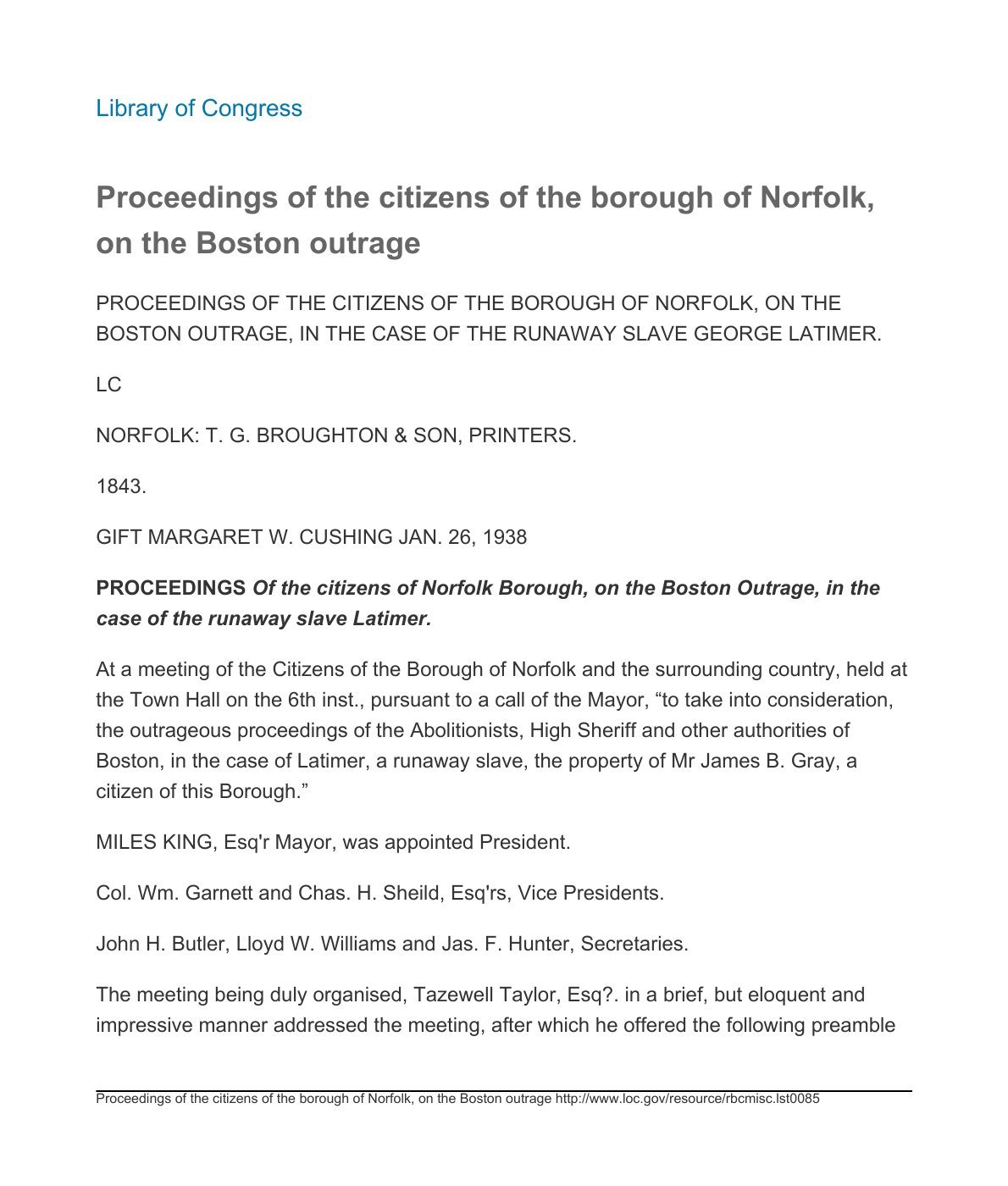
The opposite source tradition was equally political. In Virginia, Norfolk citizens later issued a lengthy report condemning Boston’s resistance as an attack on constitutional slaveholders’ rights. Their 1843 pamphlet is valuable because it preserves legal documents and a pro-slavery reconstruction of the custody battle, but its purpose was advocacy.
Reading the two traditions against each other produces a stronger history than accepting either voice alone.
Why George was not sent back
By mid-November the custody arrangement was becoming unstable.
The sheriff and jailer faced sustained public pressure. Lawyers representing people arrested in the earlier confrontation obtained an order requiring George’s appearance as a witness. Officials were increasingly unwilling to keep using the public jail as Gray’s private place of detention.
The 1843 Norfolk report acknowledged the practical problem from the opposite political perspective: once the sheriff ordered George removed from the jail, Gray’s representatives believed there was no realistic secure place in Boston where they could hold him without provoking a rescue attempt or larger confrontation.
Negotiations over a purchase followed.
The amount settled at $400. Sources from the period identify Reverend Nathaniel Colver in connection with the payment, while George much later credited Reverend Caldwell and the Tremont Temple Baptist community. The later memory may reflect fundraising or institutional involvement, but the identity of the individual who physically completed the transaction should not be flattened into a single uncontested name.
The most secure chronology places the agreement and payment on the evening of 17 November, followed by George’s discharge on 18 November.
A Norfolk committee later stated that Gray had executed a deed of emancipation dated 7 November. That document date sits awkwardly beside the later negotiations and physical custody. The practical endpoint is therefore best stated as 17–18 November: Gray’s claim was bought off, and George left custody as a free man.
Freedom purchased under pressure
Calling the $400 transaction a simple purchase risks hiding what forced it to happen.
Gray did not voluntarily emancipate George as an act of benevolence. The legal campaign, the sheriff’s position, the jailer’s reluctance, the threat of direct rescue, Black community mobilization and abolitionist fundraising had made continued custody increasingly difficult.
Nor was purchase universally accepted among antislavery activists. Paying an enslaver for a human being could appear to recognize the property claim abolitionists rejected.
The final transaction was a compromise inside a system the protesters considered illegitimate.
George himself had made his position clear while still confined: he refused to consent to return to Norfolk. The case ended not because a court ruled slavery invalid, but because a coordinated public campaign changed the practical cost of enforcing Gray’s claim.
From the Latimer case to the Latimer Law
The political campaign continued after George left the jail.
Organizers circulated what became known as the Great Massachusetts Petition. Tens of thousands of signatures demanded that Massachusetts officials and public property no longer be used to seize or detain people claimed as fugitives from slavery.
On 24 March 1843, Massachusetts enacted An Act further to protect Personal Liberty, commonly associated with Latimer’s case.
The law barred state judges and justices of the peace from granting fugitive-slave certificates under the 1793 federal law. It also prohibited Massachusetts sheriffs, constables, jailers and other state officers from arresting or detaining someone merely because the person was claimed as a fugitive slave, and barred the use of state and local public buildings for that detention.
The statute did not abolish federal fugitive-slave law. It withdrew Massachusetts machinery from part of its enforcement.
That distinction matters. George’s own confinement had demonstrated exactly what state participation could mean: a person who had escaped slavery in Virginia was held in a Boston jail for the benefit of a private claimant.
What the evidence supports
George and Rebecca Latimer escaped Norfolk together in October 1842. Both were enslaved. Rebecca was pregnant.
Their broad route through Maryland and Philadelphia to Boston is well supported, as is the disguise in which light-skinned George travelled as a white gentleman and Rebecca as his servant.
After reaching Boston, their experiences diverged. George was recognized and seized. Rebecca remained hidden and avoided recapture.
George’s custody was contested through law, public protest, attempted direct intervention and political organizing. The larceny accusation used around the time of his arrest remains disputed rather than proven or safely dismissible as fiction. The federal fugitive claim, however, clearly became the basis on which Gray tried to take him back to Virginia.
By 17–18 November, sustained pressure had made continued detention so difficult that Gray’s side accepted $400 and relinquished the claim.
Rebecca’s claimant abandoned the attempt to recover her as well.
The Latimers’ escape therefore had two endings. One was personal: a married couple who had fled slavery remained together in freedom rather than being forced back to Norfolk. The other was political: Massachusetts responded to George’s use of its jail system by passing a law designed to prevent the same kind of state-assisted fugitive detention from happening again.
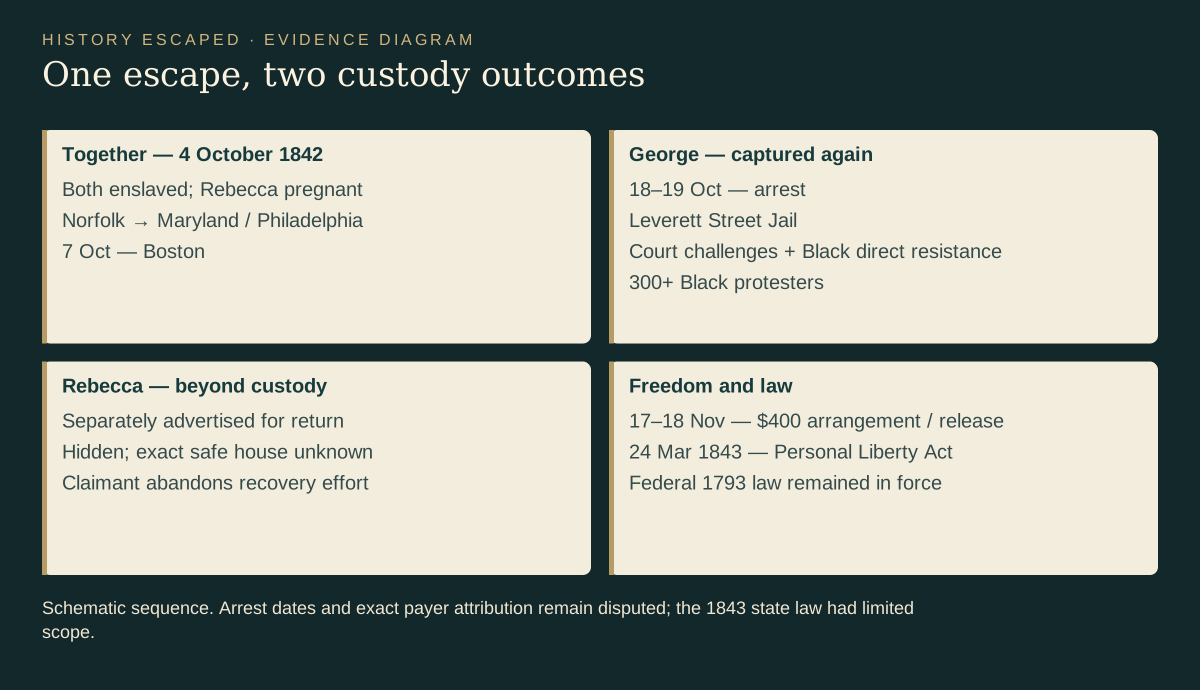
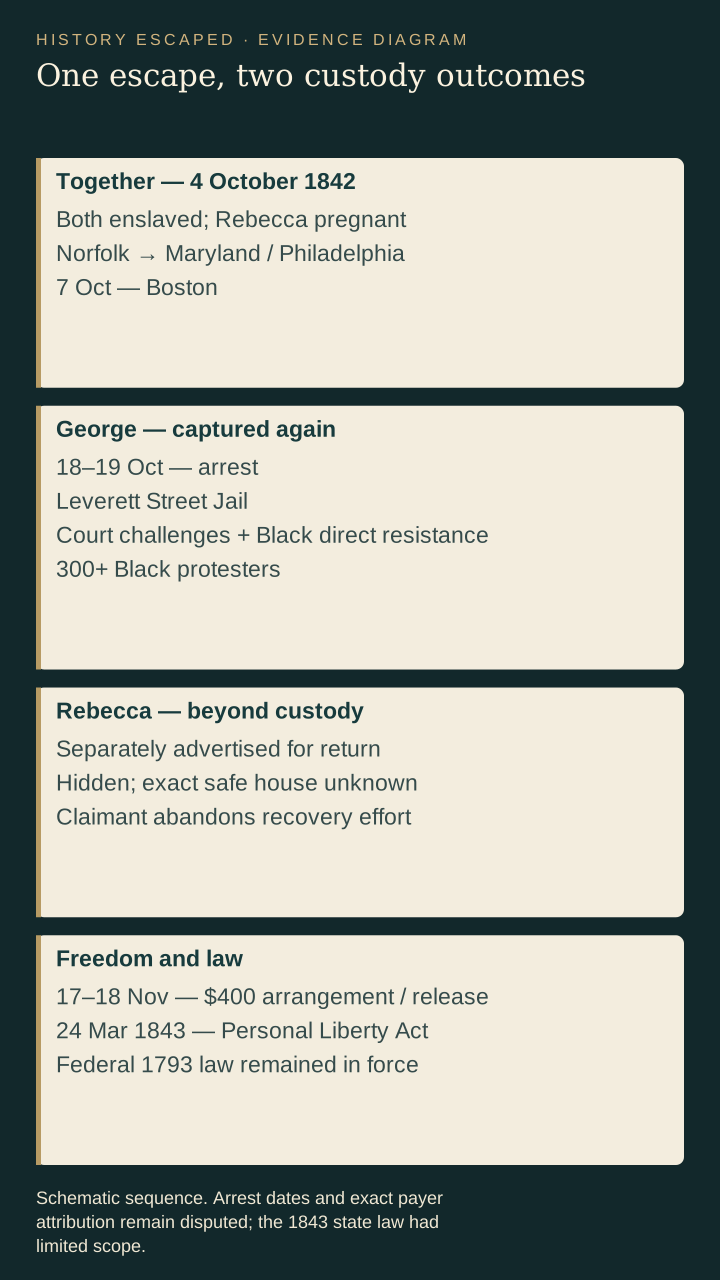
Evidence diagram
One escape, two custody outcomes
Schematic sequence. Arrest dates and exact payer attribution remain disputed; the 1843 state law had limited scope.
- 01
Leave Norfolk together
George and Rebecca concealed themselves aboard a northbound vessel and left Norfolk while Rebecca was pregnant. WELL-SUPPORTED. Sources: SRC-001, SRC-004.
- 02
Travel under an imposed racial disguise
George later recalled travelling publicly as a white gentleman while Rebecca presented herself as his servant until the pair reached safer territory. LATER CLAIM. Sources: SRC-001, SRC-004.
- 03
Reach Boston
The Latimers arrived in Boston and connected with abolitionists; George used the alias Albert Mason. WELL-SUPPORTED. Sources: SRC-001.
- 04
Survive asymmetric recapture
George was recognized and arrested while Rebecca avoided capture and remained hidden within an abolitionist support network. DOCUMENTED. Sources: SRC-001, SRC-002.
- 05
Resist fugitive custody
Black Bostonians, lawyers and abolitionist organizers used direct protest, legal challenges, publicity and political pressure to prevent George’s removal. DOCUMENTED. Sources: SRC-001, SRC-002, SRC-005.
- 06
End Gray’s claim
With public jail custody becoming untenable, Gray’s side accepted $400 on 17 November and George was discharged the following day. WELL-SUPPORTED. Sources: SRC-001, SRC-002, SRC-003.
Schematic sequence. Arrest dates and exact payer attribution remain disputed; the 1843 state law had limited scope.
Selected chronology
Selected chronology
George and Rebecca marry
The couple married in Norfolk while both remained enslaved.
Escape from Norfolk
George and Rebecca began their escape by concealing themselves aboard a northbound vessel.
Arrival in Boston
They reached Boston and made contact with abolitionists.
George arrested
NPS dates the arrest to 18 October from Boston reporting; the later Norfolk reconstruction says Gray saw and arrested George on the 19th.
Black Bostonians attempt to block removal
More than 300 Black abolitionists gathered around the court; George was moved to Leverett Street Jail and several protesters were arrested.
Faneuil Hall Latimer meeting
Abolitionists organized publicly against George’s rendition and for broader protections against slave-catching.
George’s freedom secured
Gray’s side accepted $400 as continued jail custody became impractical; George was discharged from custody.
Massachusetts Personal Liberty Act
Massachusetts barred state officers and public facilities from participating in specified fugitive-slave detention under the 1793 federal law.
Evidence discipline
What the record supports
Status labels distinguish secure conclusions from uncertainty and rejected claims. Color is never the only signal.
MYTH
George escaped alone and Rebecca merely joined him as a free wife.
Rebecca was herself enslaved, separately advertised for return by Mary D. Sayer, and escaped while pregnant.
Sources: SRC-001, SRC-004DISPUTED
The escape began on an uncontested exact date.
A near-contemporary 1842 account gives 4 October. George’s much later autobiographical recollection says September. The preferred date is 4 October, with the memory conflict preserved.
Sources: SRC-001, SRC-004DISPUTED
The larceny allegation against George was definitively proven or definitively fabricated.
Black abolitionists treated it as a pretext for seizure; Gray’s lawyer and the Norfolk committee defended it as genuine. The criminal allegation was not resolved in a way that supports either categorical claim.
Sources: SRC-001, SRC-002DISPUTED
George’s arrest has one uncontested date.
NPS, using contemporary Boston newspaper reporting, gives 18 October. The 1843 Norfolk reconstruction says Gray arrested him on the 19th; some later summaries use the 20th.
Sources: SRC-001, SRC-002MYTH
A court ruling declared George free.
The courts repeatedly left him in custody under Gray’s claim. Freedom resulted from an increasingly untenable custody situation and a $400 settlement relinquishing the claim.
Sources: SRC-001, SRC-002, SRC-003DISPUTED
The identity of the minister who secured the final $400 payment is uncontested.
Multiple 1842 sources identify Reverend Nathaniel Colver, while George later credited Reverend Caldwell and Tremont Temple fundraising. The later recollection may preserve a broader fundraising role rather than the final payor.
Sources: SRC-001, SRC-004MYTH
The 1843 Latimer Law ended federal fugitive-slave enforcement in Massachusetts.
The statute restricted participation by Massachusetts judges, officers and public facilities; it did not repeal the federal Fugitive Slave Act.
Sources: SRC-006, SRC-007