
On 18 September 1867, a police van left the Manchester magistrates’ court carrying a large group of prisoners toward the city gaol on Hyde Road. Two of them mattered especially to the Irish Republican Brotherhood: Thomas J. Kelly and Timothy Deasy, Irish-American veterans of the American Civil War who had become senior figures in the Fenian movement. Before the van reached the prison, an armed rescue party stopped it beneath a railway arch on Hyde Road.
The rescue worked. Kelly and Deasy got free and were never recaptured. But Police Sergeant Charles Brett, locked inside the van with the prisoners, was fatally shot during the attempt to open it. That death turned a successful political extraction into a murder prosecution, a diplomatic issue and one of the most enduring episodes in nineteenth-century Irish nationalist memory.
Later labels make the history deceptively simple. British newspapers called the attack an “outrage”; Irish nationalists memorialized three executed defendants as the “Manchester Martyrs.” Neither label resolves the hardest question in the evidence: who fired the shot that killed Brett, and with what immediate intention?
At a Glance
Date: 18 September 1867
Place: Hyde Road, Manchester, beneath a railway arch on the route to Manchester City Gaol at Belle Vue
Prisoners freed: Thomas J. Kelly and Timothy Deasy
Fatality: Police Sergeant Charles Brett
Immediate result: Kelly and Deasy escaped custody and were never recaptured
Capital case: Five men were convicted of Brett’s murder and sentenced to death; one was pardoned, one was reprieved, and three were executed
Central uncertainty: The surviving record does not establish the fatal shooter beyond reasonable historical dispute
Why Kelly and Deasy were being moved
The Manchester rescue belonged to a wider crisis within Fenianism in 1867. The Irish Republican Brotherhood sought an independent Irish republic and maintained important networks among Irish communities in Britain and the United States. An attempted rising in Ireland that March had failed, and the movement was trying to recover from arrests, informers, organizational division and the loss of momentum.
Kelly had emerged as the IRB’s chief executive after James Stephens lost authority. Manchester, with a large Irish population and a developed Fenian network, became important to efforts to rebuild the organization in Britain. Deasy, another Irish-American Civil War veteran and Fenian officer, worked alongside him.
Manchester police arrested Kelly and Deasy on 11 September. Their importance was not immediately understood, but they were soon identified. A week later, after another appearance before the city magistrates, they were among prisoners ordered back into custody.
The van’s destination matters because later accounts sometimes place the journey on the way to New Bailey Prison in Salford. Contemporary reporting described the prisoners as being taken to the city gaol, and Manchester City Council identifies Belle Vue Prison on Hyde Road as Manchester Borough Gaol or Manchester City Gaol. New Bailey became central later: it was where William Allen, Michael Larkin and Michael O’Brien were executed. The rescue itself was on the route to Belle Vue.
The attack under the railway arch
Authorities knew that Kelly and Deasy were unusual prisoners and took additional precautions, but not enough to defeat an organized armed attack. Contemporary accounts describe roughly a dozen police involved in escorting the van, including Brett inside it; the officers outside were not equipped to meet a group carrying pistols. Estimates of the rescue party vary. A contemporary report transmitted by the United States legation put the number at about fifty, while later historical accounts commonly describe about forty.
The attackers stopped the van beneath the Hyde Road railway arch, drove back the police escort and tried to force the vehicle open. Firearms were discharged during the confrontation. Some contemporary accounts describe repeated attempts at the door, roof and lock before the prisoners could be reached.
Brett was inside the van with access to the keys. During the effort to open it, a shot fired into the door or lock area struck him in the head and killed him. A woman prisoner inside obtained the keys and passed them out, allowing Kelly and Deasy to be released.
That broad sequence is well supported. The familiar finer-grained version—in which a named man deliberately fires through the keyhole at the precise instant Brett looks through it—is much less secure.
Who fired the fatal shot?
Contemporary prosecution-era reporting pointed strongly toward William Allen. Reports enclosed in American diplomatic correspondence described witnesses who said they saw Allen firing at the van and identified him as the man who fired into it. In the atmosphere immediately after the attack, that became a powerful part of the public case against him.
Later Fenian recollections shifted responsibility. John Devoy named Peter Rice as the person who killed Brett, and later writers repeated that attribution. Yet another retrospective tradition associated with Ricard O’Sullivan Burke said that one of the three men eventually executed had fired the shot, which conflicts with the Rice account. Modern scholarship that compares these traditions therefore has good reason to leave the shooter unresolved.
Intent is also difficult to recover. One police-witness interpretation later reported in historical writing held that the shot was aimed at the lock rather than at Brett. That would fit the rescuers’ immediate need to open the van, but it cannot establish the shooter’s state of mind. Brett was killed by gunfire during an armed extraction; describing his death as a proven deliberate execution or as a proven accident goes further than the surviving evidence safely allows.
The distinction matters because later political narratives often depend on certainty. A nationalist account can reduce Brett’s death to an unintended mishap and move immediately to the executions. A hostile account can reduce the rescuers to murderers and make Kelly and Deasy almost incidental. The evidence supports a narrower conclusion: the rescue was deliberately armed, Brett died because of it, and individual responsibility for the fatal shot remains disputed.
Kelly and Deasy disappear
Once the van was opened, the operation achieved its primary purpose. Kelly and Deasy were removed from custody, and pursuit began almost at once. Police arrested numerous men in the immediate chase and in raids that followed, while reports and rumors about the fugitives multiplied.
The exact post-rescue route is harder to establish than the fact of escape. Contemporary police reports followed supposed sightings and imagined routes through Manchester, Salford and Liverpool. Later Fenian memoirs supplied more elaborate accounts of safe houses, overland movement and concealment aboard a ship. Those recollections are historically valuable, but they were written decades later and should not be mistaken for contemporary verification of every step.
What is secure is the outcome. Kelly and Deasy were never recaptured. Both eventually reached the United States, turning the Manchester operation into one of the rare unambiguous tactical successes of the Fenian movement in Britain.
Arrests and the murder case
The successful extraction was followed by an extensive crackdown. Counts vary because sources are describing different stages: contemporary reporting listed nearly thirty arrests very early, later accounts describe around fifty in custody within several days, and still other totals include broader sweeps or people ultimately brought before legal proceedings. Those figures should not be treated as competing answers to a single question.
Five defendants became the center of the capital case: William Philip Allen, Michael Larkin, Michael O’Brien, Thomas Maguire and Edward O’Meagher Condon. O’Brien was tried under the name William Gould; Condon under Edward Shore. The official legal return later reproduced by Parliament records all five as convicted of the murder of Charles Brett and sentenced to death.
The case did not require the state to prove that each defendant personally fired the fatal bullet. The prosecution treated the armed rescue as a common enterprise in which participants could be held responsible for a killing committed in carrying it out. That made the reliability of identification and proof of participation especially important.
The trial unfolded amid intense public anger over Brett’s death and widespread fear of Fenian violence. Contemporary and later critics questioned witness identifications, the speed of proceedings and the atmosphere surrounding the defendants. Those concerns do not by themselves prove that every conviction was wrongful. One later official action, however, demonstrated that the process had produced at least one conviction the government itself could no longer defend.
Maguire’s pardon and Condon’s reprieve
Thomas Maguire, a Royal Marine, was convicted with the other four and sentenced to death. On 12 November, Queen Victoria granted him an unconditional pardon. Home Office correspondence reproduced in the parliamentary return explained that a further inquiry, undertaken at the request of the judges and attorney general, had found good grounds to believe that Maguire’s defence was true.
That was more than an act of general mercy. It meant the government had concluded that the case against one condemned man was unreliable enough to justify a free pardon. The reversal does not establish the innocence of Allen, Larkin or O’Brien, but it is powerful evidence against treating every prosecution identification as equally dependable.
Condon’s case was different. He acknowledged American citizenship and appealed for United States intervention. American minister Charles Francis Adams reviewed the trial evidence and wrote that Condon appeared to have been present and actively involved in the attack, but without firearms and with no weapon other than stones. Adams decided to make a representation on his behalf; by 22 November he had learned that a reprieve had already been determined. Later United States diplomatic records credited Adams’s interposition with the commutation of Condon’s sentence to life imprisonment.
The two outcomes therefore should not be merged. Maguire received an unconditional pardon because official review found substantive reason to believe his defence. Condon remained convicted, but escaped execution through reprieve and commutation amid diplomatic intervention.
The executions at New Bailey
Allen, Larkin and O’Brien remained under sentence of death. On 23 November 1867 they were publicly hanged at New Bailey Prison in Salford. Their executions followed weeks of petitions, public debate, tightened security and arguments over whether the killing in Manchester should be treated principally as ordinary murder, political violence or a consequence of an armed rescue whose fatal shot could not be individually fixed with certainty.
The executions gave the Fenian movement something the failed rising earlier that year had not: a durable story of sacrifice. Allen, Larkin and O’Brien became known in Irish nationalist memory as the Manchester Martyrs. Processions and commemorations spread, and T. D. Sullivan’s “God Save Ireland” became one of the best-known songs associated with the episode.
That memorial culture was political, not neutral. It emphasized the condemned men’s patriotism, courage and treatment by the British state; over time it could minimize Brett’s death and the fact that the rescue party had used firearms. British establishment narratives often did the inverse, foregrounding the killing and public-order threat while treating Irish political grievances and doubts about the prosecution as secondary.
The history is more durable when neither shorthand controls it. Kelly and Deasy were deliberately freed in a planned armed operation. Charles Brett was killed while performing his duty inside the van. Five men were condemned for murder, yet the government pardoned one after concluding that his defence had credible support, and the identity of the fatal shooter remains contested across contemporary testimony and later recollection. Three executions then transformed an escape operation into a political memory that lasted far longer than the minutes beneath the Hyde Road railway arch.
Evidence discipline
What the record supports
Status labels distinguish secure conclusions from uncertainty and rejected claims. Color is never the only signal.
WELL-SUPPORTED
The prison van was bound for Manchester City Gaol at Belle Vue, not New Bailey Prison in Salford.
Contemporary reporting described the destination as the city gaol, History Ireland identifies it as the city jail on Hyde Road, and Manchester City Council identifies Belle Vue Prison as Manchester Borough/City Gaol on Hyde Road. W. J. Lowe's later article instead says New Bailey; that later location is not adopted.
Sources: SRC-002, SRC-005, SRC-006, SRC-007DISPUTED
William Philip Allen fired the shot that killed Sergeant Brett.
Contemporary witnesses and prosecution-era reporting strongly pointed toward Allen, but later Fenian recollections attributed the fatal shot to Peter Rice and other retrospective testimony conflicts with that account. The evidence used here does not establish a definitive shooter.
Sources: SRC-002, SRC-009UNKNOWN
The fatal shot was deliberately aimed at Sergeant Brett.
Later accounts report a police-witness view that the shot was intended to force the lock, but the shooter's immediate intent cannot be securely recovered. Brett's death occurred during a deliberately armed rescue, but neither deliberate personal targeting nor accident is treated as proven.
Sources: SRC-008, SRC-009LATER CLAIM
Peter Rice fired the fatal shot.
John Devoy and later nationalist/historical accounts named Peter Rice. The attribution emerged retrospectively and conflicts with contemporary evidence pointing to Allen and with another later Burke tradition.
Sources: SRC-009DISPUTED
Thomas Maguire participated in the rescue.
Maguire was convicted with the other capital defendants, but an official post-trial inquiry found good grounds to believe his defence was true and he received an unconditional pardon.
Sources: SRC-001LATER CLAIM
Later detailed stories establish Kelly's exact route out of Britain.
John Denvir gave a detailed 1910 account of concealment and departure from Liverpool, but the account was written decades after the event. The durable outcome—Kelly's escape and later presence in the United States—is better supported than every step of the route.
Sources: SRC-006, SRC-008, SRC-010Documentary reconstruction
Rescue sequence, disputed shot and legal outcomes
A case-local editorial visual separates the documented sequence from uncertainty without implying exact modern geography or operational detail.
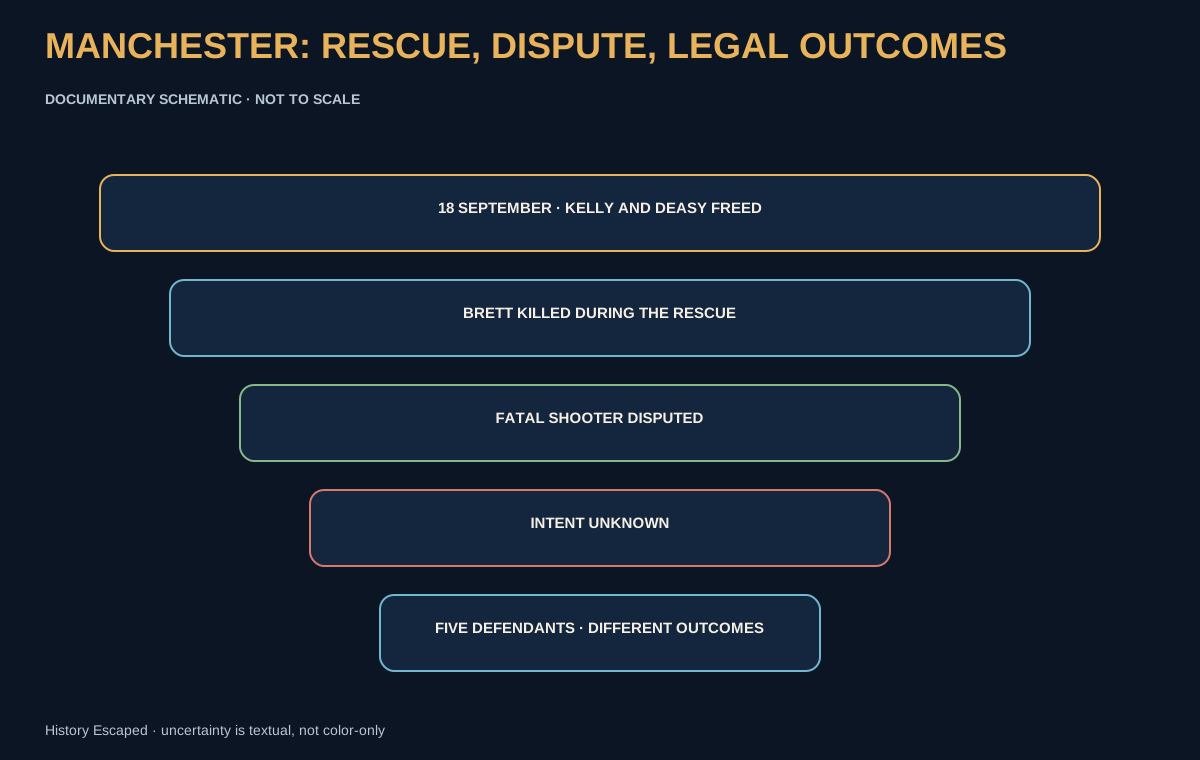
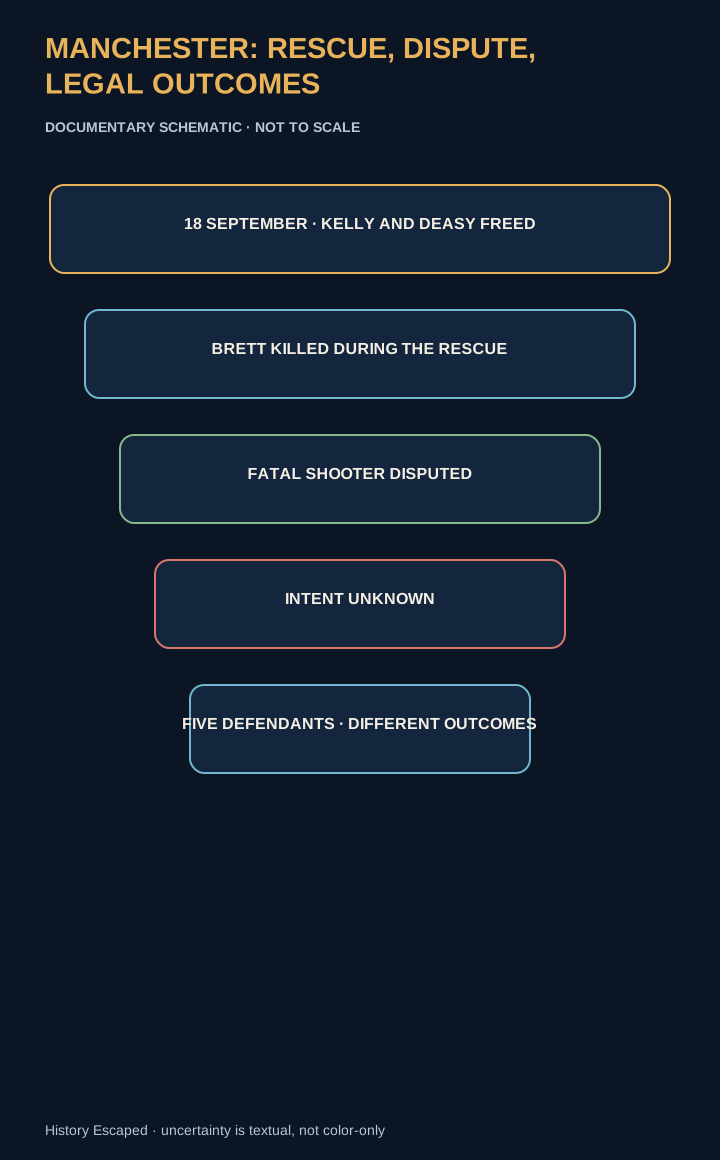
Simplified editorial reconstruction based on the cited historical record; not to scale. Uncertainty is stated directly in the visual and adjacent text.
