
The most secure line in John Boyle O’Reilly’s escape story is not one of its dramatic later scenes. It is an official notice.
The Western Australian Police Gazette recorded that imperial convict No. 9843, John B. O’Reilly, had “absconded from Convict Road Party, Bunbury” on 18 February 1869. That date anchors the escape. What followed is harder to reduce to a single clean narrative. O’Reilly depended on sympathetic civilians, missed the ship that was supposed to carry him away, hid while a search tightened around the district, and eventually escaped the colony aboard an American whaler.
The final transfer at sea is where the evidence becomes untidy. O’Reilly’s own published recollection says the Gazelle saw his small boat and picked him up. A later history of the Catalpa expedition says another bark, Clarice, picked him up first. A newly accessioned Fremantle Prison scan of a statement attributed to Gazelle first mate Fred Hussey also places Clarice between the escape boat and Gazelle.
The central fact is firm: O’Reilly got out of Western Australia aboard Gazelle. The exact last handoff is not.
A military Fenian sent to the other side of the world
O’Reilly was not transported to Western Australia for an ordinary civilian crime. He had joined the British Army’s 10th Hussars while involved in the Fenian movement, the revolutionary network that sought to end British rule in Ireland. His task included recruiting soldiers into the organization. Arrested in 1866, he was court-martialled in Dublin. A death sentence was commuted, and the surviving official absconder notice later recorded his punishment as twenty years’ penal servitude.
After imprisonment in Britain, O’Reilly sailed for Western Australia aboard the Hougoumont, the last convict transport sent to the Australian colonies. It reached Fremantle on 10 January 1868 carrying ordinary convicts as well as sixty-two Fenian prisoners.
O’Reilly spent only a short period at Fremantle before being transferred south to the Bunbury district. There he joined a road-building party. His literacy and conduct gave him unusual mobility within the convict system: later accounts describe him working as a party constable and handling clerical tasks and messages. Those privileges did not make him free, but they created opportunities that a prisoner under close cellular confinement would not have had.
They also brought him into contact with people prepared to help.
Material evidence
Tools of Escape
The objects used in an escape reveal how a plan worked under constraint.
- 01Later-recollected concealment detail
Freeman’s shoes
A later sanctioned narrative says O’Reilly obtained ordinary shoes because convict footwear could leave a recognizable track.
- 02Maritime access
Small boat
Small boats were essential to the failed Vigilant rendezvous and the later offshore escape attempt.
- 03Final escape vessel
Gazelle
The American whaling bark Gazelle was the vessel aboard which O’Reilly ultimately left Western Australia.
Why Bunbury created an opening
Two names recur across the evidence: Father Patrick McCabe, the Catholic priest serving the Bunbury district, and James Maguire, an Irish settler. The State Library of Western Australia holds an authenticated manuscript book of O’Reilly’s poems dedicated to McCabe, a tangible remnant of the relationship. Later narratives and current Fremantle Prison research identify McCabe and Maguire as the core civilian organizers of the escape.
Their problem was larger than getting O’Reilly away from a work party.
Western Australia was a remote colony. Once the alarm was raised, roads, settlements, ports, and coastal traffic could be watched. An escape on land merely changed the kind of confinement. O’Reilly needed a ship whose captain was willing to take a wanted imperial convict away from British jurisdiction.
The seasonal presence of American whalers offered an answer.
According to the account published in James Jeffrey Roche’s 1891 biography—based on a narrative first published with O’Reilly’s sanction in 1881—Maguire made arrangements with Captain Baker of the American bark Vigilant. The plan was for O’Reilly to leave the road party and meet helpers who would take him toward the coast. Vigilant would then carry him away.
This was the first plan. It did not work.
Escape sequence
Two maritime attempts, one disputed transfer
The official absconding date begins the operation; it is not the date of the successful pickup.
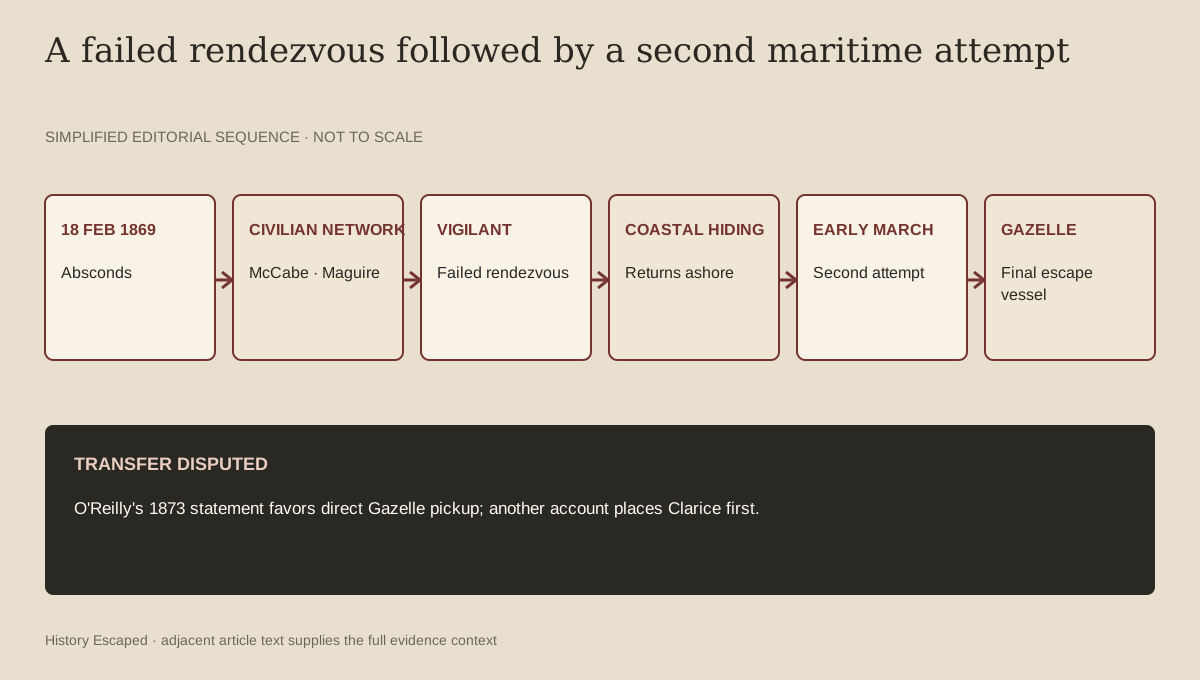
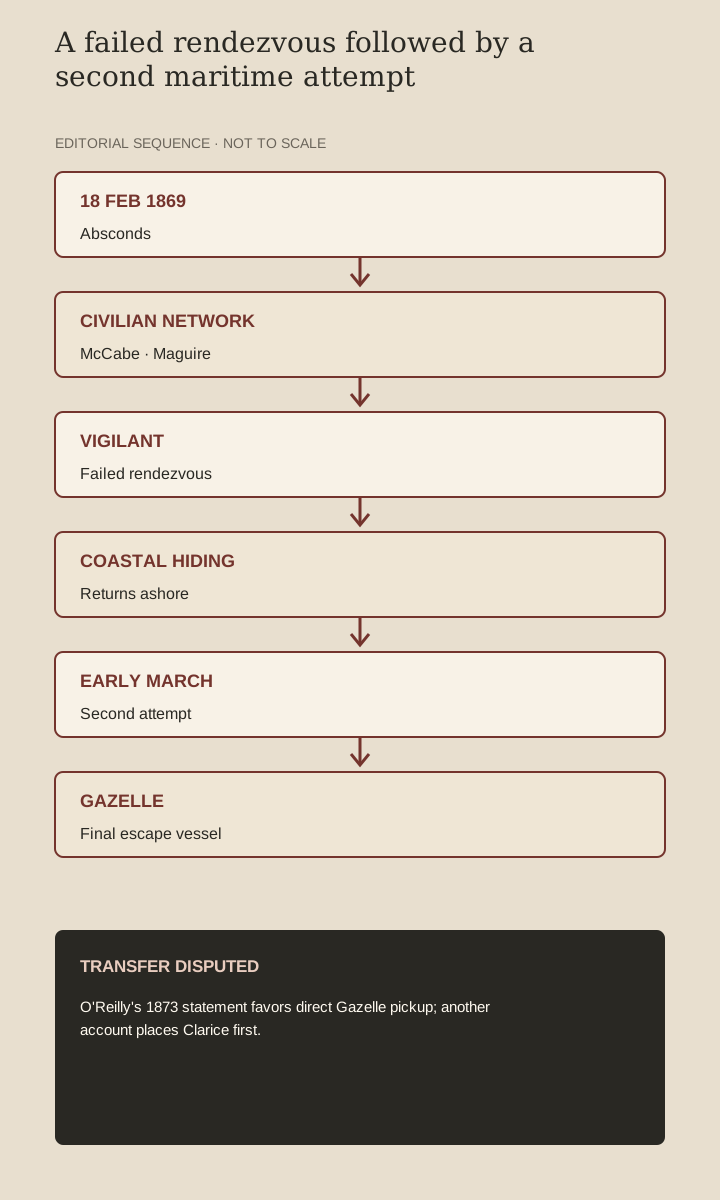
Simplified editorial sequence; not to scale. Sources disagree over whether O’Reilly boarded Gazelle directly or transferred first through Clarice.
The escape begins: 18 February
Later retellings add memorable details to O’Reilly’s departure: a pair of ordinary shoes intended to disguise the tracks left by convict footwear, a prearranged whistle, horses waiting in the dark, and helpers attempting to obscure the number of people traveling together.
Those details are valuable, but they come from a story published years after the event. The contemporary fact is simpler and stronger. The official notice says O’Reilly absconded from the Bunbury convict road party on 18 February 1869.
That distinction matters because some later summaries have treated 18 February as the day he boarded Gazelle. It was the start of the escape, not securely the end.
The sanctioned later account places Maguire among the men who met O’Reilly and moved him toward the coast. The group then used a small boat to go out in search of Vigilant.
They found the ship. The ship did not take him.
The whaler that sailed past
Roche’s account describes O’Reilly and his companions signaling Vigilant from their boat while the bark remained offshore. They hailed it and raised a white shirt on an oar. The vessel continued on.
The exact dialogue and distances belong to a late narrative and should not be treated like an official log. But the failure of the Vigilant plan is supported by multiple independent later sources. The 2026 Fremantle Prison record of Fred Hussey’s statement begins from the same premise: Captain Baker of Vigilant had agreed to take O’Reilly but did not.
That failure transformed the escape.
O’Reilly had now openly absconded, his planned ship was gone, and he had to return to the same coast from which he had been trying to disappear. Current Fremantle Prison research says police and Aboriginal trackers searched for him while he hid in the dunes north of Bunbury. Roche’s later narrative likewise describes a period of concealment, with Maguire eventually returning to continue the effort.
The escape was no longer a single dash from work party to ship. It became a waiting operation.
Hiding while the plan was rebuilt
This phase explains why the civilian network mattered as much as any physical tool.
A boat could get O’Reilly offshore, but only if a vessel was waiting. A horse could move him away from the work party, but only if people knew where to take him. Once Vigilant failed, concealment, supplies, information, and another willing captain became the decisive resources.
McCabe and Maguire continued working on a second passage. Later accounts identify Captain David R. Gifford’s Gazelle, another American whaler, as the vessel that eventually carried O’Reilly away. Fremantle Prison’s current collection record says McCabe secured the arrangement for £10; that payment appears in later tradition rather than a surviving contract, so it should not be treated as more certain than the evidence allows.
By early March, O’Reilly went back to sea.
The Western Australian heritage inventory and Fremantle Prison’s 2026 collection record date the successful offshore pickup to 2 March 1869. That date is better suited to the final escape than the frequently repeated 18 February date, but it too comes from later historical reconstruction rather than the contemporary absconder notice.
And then the sources split.
Gazelle, Clarice, and the disputed final transfer
O’Reilly himself published a short account in the dedication to his 1873 Songs from the Southern Seas and Other Poems. He wrote that he left the Western Australian coast in a small boat without a sail and was seen from the masthead of Gazelle, commanded by Captain Gifford. In his telling, Gazelle picked him up and treated him kindly during a seven-month whaling cruise.
It is an important source because the escapee himself published it only four years after the event. It is also extremely compressed. O’Reilly was writing a dedication, not a forensic chronology.
Roche’s biography preserves the same broad direct-pickup story. Other evidence gives a different sequence.
Zephaniah Walter Pease’s 1897 The Catalpa Expedition says that on the final attempt O’Reilly was first picked up by the bark Clarice and then transferred to Gazelle. More importantly, a handwritten statement attributed to Fred Hussey, identified by Fremantle Prison as Gazelle’s first mate, also says Captain Gifford acted after seeing O’Reilly go aboard Clarice. According to that statement, Gifford lowered a boat and brought O’Reilly across to Gazelle.
The Hussey document does not solve every problem. It is undated on the Collections WA record, contains additional claims that do not neatly match the standard narrative, and survives in Fremantle as a digital scan while the physical document remains in the United States. It is participant testimony, but it is still later testimony that must be weighed rather than automatically accepted.
The surviving evidence supports a deliberately modest reconstruction:
O’Reilly ultimately left Western Australia aboard Gazelle. Whether he boarded Gazelle directly from his escape boat or first went aboard Clarice remains disputed.
That is less cinematic than choosing one version. It is more historically defensible.
Getting aboard a whaler was not yet the same as reaching freedom
Escape stories often end at the perimeter. O’Reilly’s did not have a conventional perimeter.
Once aboard Gazelle, he had escaped immediate colonial custody, but he was still on a long voyage in waters where British officials might try to reclaim him. Later accounts describe an episode at Rodrigues in the Indian Ocean in which members of the Gazelle crew helped prevent his recapture. The details come primarily from recollection and sympathetic biography, so they should not be narrated with invented precision.
O’Reilly’s own 1873 account supplies a firmer personal claim: he remained with Gazelle for roughly seven months and said Gifford later lent him twenty guineas to help him continue toward America.
His route thereafter involved further ship transfers. The Australian Dictionary of Biography records his arrival in Philadelphia on 23 November 1869. He settled in the United States and eventually built a public career in Boston as a journalist, editor, poet, lecturer, and political voice in Irish-American life.
By then, an escape that began at a remote road party in Western Australia had carried him across oceans.
The Catalpa confusion
O’Reilly’s name is also inseparable from one of the most famous Fenian rescues in Australian history: the Catalpa rescue of 1876.
That can create a simple but important misconception. O’Reilly did not escape aboard Catalpa.
His own escape occurred in 1869 and ended with his departure aboard Gazelle. Years later, from the United States, his experience of Western Australia and knowledge of the prison system helped inform a plan to free six remaining Fenian prisoners. The American vessel Catalpa sailed to Western Australia for that separate operation.
The two stories belong together historically, but they are not the same escape.
Problem → response
Escape was a sequence of problems
Each response solved a practical obstacle while often creating the next one.
- 01→
Obstacle
Geographic isolation
Absconding from the road party did not itself produce freedom; O’Reilly still had to leave a remote British colony surrounded by ocean and authorities.
Response
McCabe and Maguire’s network sought an outbound American whaler that could carry him beyond colonial jurisdiction.
- 02→
Obstacle
Failed first ship rendezvous
The intended escape vessel, Vigilant, did not take O’Reilly aboard when he and his helpers went out to meet it.
Response
The party returned to shore, concealed O’Reilly, and sought a second maritime opportunity.
- 03→
Obstacle
Active search
Police and Aboriginal trackers were reported to be searching for O’Reilly after his absconding.
Response
He remained hidden near the coast while supporters supplied him and negotiated another passage.
- 04→
Obstacle
Uncertain cooperation at sea
Later testimony indicates that willingness among whaling captains could change and that the final transfer was not as straightforward as later legend suggests.
Response
A second offshore attempt ultimately placed O’Reilly aboard Gazelle, although the role of Clarice remains disputed.
Why the escape worked
O’Reilly’s flight succeeded because several advantages overlapped.
First, his road-party assignment gave him more movement and contact than close prison confinement would have allowed. Second, he had trusted civilians willing to risk involvement—most importantly McCabe and Maguire. Third, the presence of American whalers created a route beyond the colony that local authorities could not completely control. Fourth, the network survived failure. When Vigilant did not take him, the helpers did not abandon the effort; they concealed O’Reilly and pursued another ship.
That resilience may be the most important feature of the case.
The escape was not a perfect plan executed once. It was a plan that failed at its most important moment and was rebuilt while the escapee was already a fugitive.
Evidence discipline
What the record supports
Status labels distinguish secure conclusions from uncertainty and rejected claims. Color is never the only signal.
DOCUMENTED
O’Reilly absconded from the Bunbury convict road party on 18 February 1869.
The official Western Australian Police Gazette absconder notice, reproduced in the 1891 biography, gives this date and identifies O’Reilly as convict No. 9843.
Sources: SRC-001WELL-SUPPORTED
Father Patrick McCabe and James Maguire were central helpers in the escape.
Their roles recur across the sanctioned late nineteenth-century narrative, current Fremantle Prison collection context, the State Library of Western Australia, and the state heritage inventory.
Sources: SRC-003, SRC-004, SRC-008, SRC-009WELL-SUPPORTED
Vigilant was intended to carry O’Reilly away but the first maritime rendezvous failed.
Roche’s sanctioned narrative, the Hussey letter, and Pease’s later account agree on the failed Vigilant plan even though they differ on later details.
Sources: SRC-003, SRC-004, SRC-005DISPUTED
O’Reilly boarded Gazelle directly from the small boat used in his final escape attempt.
O’Reilly’s own 1873 dedication and Roche’s biography present a simplified direct-Gazelle pickup. Pease’s 1897 account says Clarice picked O’Reilly up first, and a participant letter attributed to Gazelle first mate Fred Hussey likewise says O’Reilly boarded Clarice before being transferred to Gazelle.
Sources: SRC-002, SRC-003, SRC-004, SRC-005DISPUTED
O’Reilly boarded Gazelle on 18 February 1869.
The secure contemporary record uses 18 February for O’Reilly’s absconding from the road party, not for his boarding of Gazelle. Current Fremantle Prison and Western Australian heritage records instead date the successful offshore pickup to 2 March. The Australian Dictionary of Biography compresses the chronology and gives 18 February as the Gazelle boarding date.
Sources: SRC-001, SRC-004, SRC-006, SRC-008MYTH
Catalpa carried John Boyle O’Reilly to freedom.
O’Reilly escaped in 1869 aboard Gazelle. He later helped plan the separate Catalpa expedition of 1876, which rescued six other Fenian prisoners.
Sources: SRC-002, SRC-006, SRC-007, SRC-009UNKNOWN
The exact route, pickup position, and minute-by-minute sequence of the final coastal escape can be reconstructed precisely.
Later narratives supply vivid route and distance details, but the surviving evidence is not consistent enough to justify a precise modern map or timed reconstruction.
Sources: SRC-003, SRC-004, SRC-005, SRC-008What the evidence supports
Several points can be stated with high confidence.
O’Reilly was convict No. 9843. He had been transported to Western Australia after a military Fenian conviction. He was assigned to the Bunbury district. The official record says he absconded from a convict road party on 18 February 1869. McCabe and Maguire were central helpers. Vigilant was the intended first escape vessel and failed to take him. O’Reilly eventually escaped aboard Gazelle and reached the United States.
Other details deserve more caution.
The exact course taken through the Bunbury district, the precise distances offshore, and the minute-by-minute sequence are products of later accounts rather than a contemporary operational record. The successful pickup is currently dated by Western Australian institutional sources to 2 March, but older secondary sources vary. Most importantly, the final transfer may have involved Clarice before Gazelle.
The uncertainty does not weaken the story. It shows how historical reconstruction actually works: the broad escape can be securely established even when one famous scene cannot.
Selected chronology
Selected chronology
Sentence recorded
After a military conviction connected to Fenian organizing, O’Reilly’s death sentence was commuted; the later official absconder notice recorded a twenty-year penal sentence dated 9 July.
Hougoumont reaches Western Australia
O’Reilly arrived at Fremantle aboard the Hougoumont with other Fenian prisoners and was subsequently sent to the Bunbury district.
Transferred to the Bunbury road party
After a short period at Fremantle, O’Reilly was placed with a road-building party near Bunbury and was trusted with constable and clerical duties.
O’Reilly absconds
The official Western Australian absconder notice records that O’Reilly escaped from the Bunbury convict road party on this date.
The Vigilant plan fails
O’Reilly and his helpers attempted to rendezvous with the whaler Vigilant, but the vessel did not take him aboard. He returned to shore and remained hidden while another plan was made.
Successful offshore escape
Fremantle Prison’s 2026 collection record and the Western Australian heritage inventory date the successful pickup to 2 March. O’Reilly ultimately went aboard Gazelle; whether Clarice served as an intermediary remains disputed.
Arrival in Philadelphia
After a long maritime journey and onward transfers, O’Reilly reached Philadelphia and soon settled in the United States.
The Catalpa rescue
O’Reilly later helped develop the plan that sent Catalpa to Western Australia to rescue six other Fenian prisoners. Catalpa was not the vessel of O’Reilly’s own escape.
Aftermath
O’Reilly never returned to custody in Western Australia. In Boston he became closely associated with The Pilot, a major Catholic newspaper, and developed a literary reputation. His 1879 novel Moondyne drew on Western Australian convict settings and themes, though it is fiction rather than a disguised factual account of his own escape.
His Western Australian experience also had a practical afterlife. The 1876 Catalpa expedition turned an individual escape route into a larger rescue operation, using an American vessel to remove Fenian prisoners from the colony.
That later operation is the natural companion to O’Reilly’s 1869 escape, but the earlier event has a distinct mechanism: a road-party absconding, a civilian support network, a failed first rendezvous, a period of hiding, and a disputed final transfer that still ended with one uncontested result. John Boyle O’Reilly got out.