
The Amistad story is often remembered as a courtroom drama, but it began with self-liberation at sea. Fifty-three Africans who had been kidnapped, trafficked across the Atlantic and illegally sold in Cuba seized the ship carrying them toward continued enslavement and tried to take themselves home. Their later victory in an American court mattered because it protected freedom they had already tried to recover themselves.
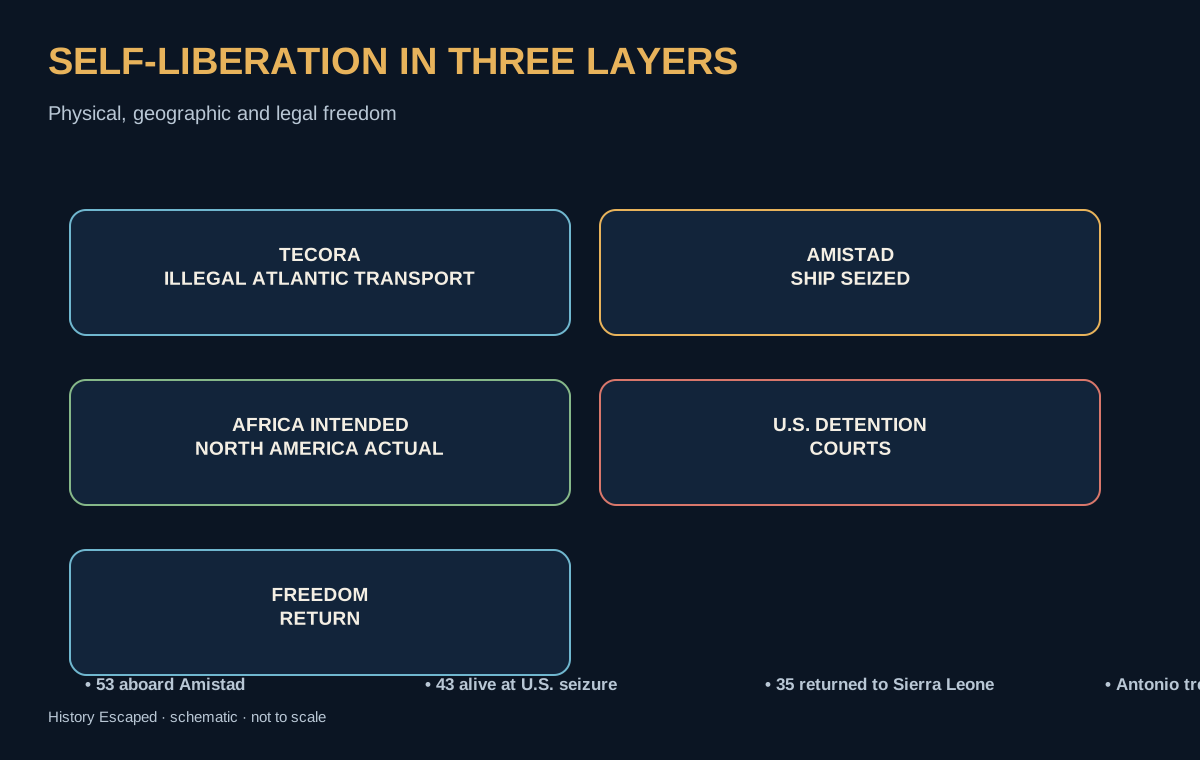
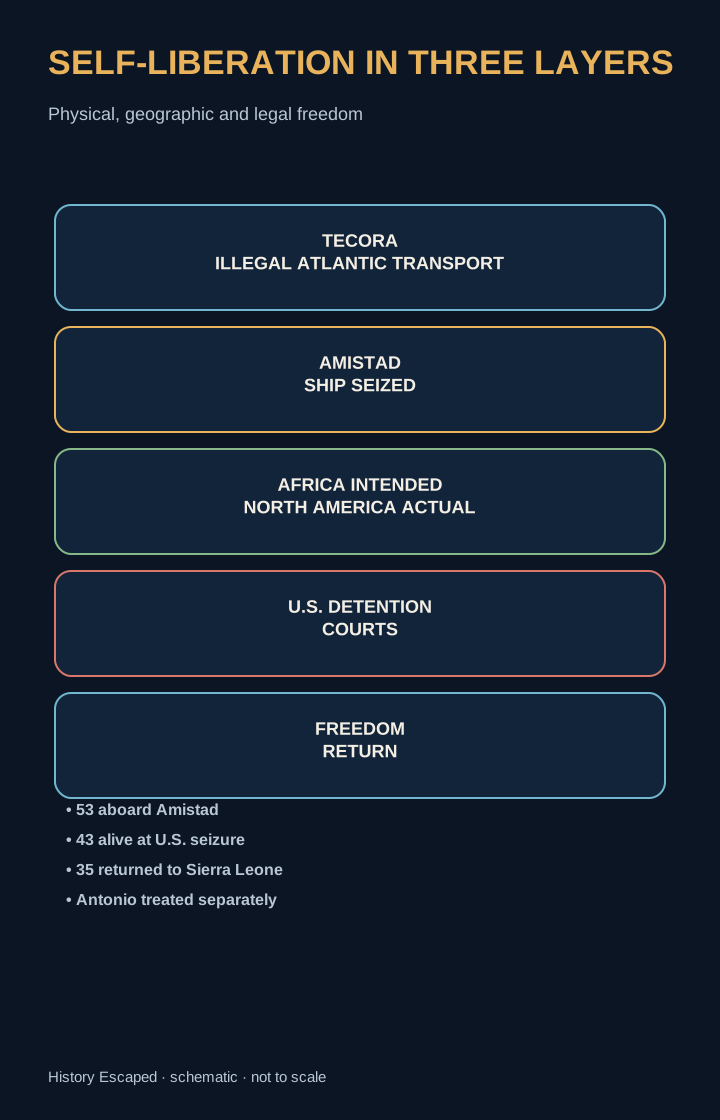
The seizure of the schooner succeeded, but the return to Africa did not. The surviving Spanish navigators secretly redirected the vessel toward North America, where U.S. authorities took control, imprisoned the Africans and forced a second struggle over whether people who had already liberated themselves could be legally returned to slavery. The case therefore contains three distinct problems: physical control aboard ship, geographic control of the route, and legal control over human status.
At a Glance
- Shipboard revolt: early July 1839
- Ship seized: Spanish schooner Amistad
- Transatlantic slave ship: Tecora / Teçora, not the Amistad
- Africans placed aboard at Havana: 53
- Separate enslaved person aboard: Antonio
- Principal revolt leader: Sengbe Pieh, known in U.S. sources as Joseph Cinqué
- Intended destination after seizure: Africa
- U.S. seizure: late August 1839 near Culloden Point, Long Island
- Captives arriving in New Haven: 43 in Yale's archival reconstruction
- Lead defense attorney: Roger Sherman Baldwin
- Critical interpreter: James Benjamin Covey
- Supreme Court decision: 9 March 1841
- Returned to Sierra Leone: 35
- Outcome: shipboard self-liberation, U.S. recapture and detention, legal victory, privately funded return home
The first ship was not the Amistad
The fifty-three Africans aboard the Amistad had not crossed the Atlantic on that schooner. They had already endured a transatlantic voyage aboard the Tecora, a vessel operating in the illegal slave trade between West Africa and Cuba. The distinction matters because the two ships represented different stages of the trafficking system.
The Tecora carried captives across the Middle Passage, while the Amistad was a smaller Spanish schooner used for coastal transport inside Cuba. It was on this second vessel—after kidnapping, forced movement to the coast, Atlantic transport, sale and fraudulent documentation—that the group found an opportunity to resist successfully. Sending the Amistad from Africa to Havana collapses the most important geographic correction in the case.
Illegal enslavement was disguised on paper
Spain continued to permit slavery in Cuba in 1839, but it had prohibited the transatlantic importation of newly enslaved Africans. Illegal importation nevertheless continued through smuggling, bribery and false documentation. Ruiz and Montes needed the people they purchased to appear on paper as lawful Cuban slaves rather than recent arrivals from Africa.
The Africans' lawyers later attacked that documentary fiction directly. If the papers were genuine, Spain's treaty arguments for restoration might have had force; if the papers were fraudulent, the supposed owners had never acquired legal title. The courtroom dispute therefore depended on reconstructing an African and Atlantic history that preceded every American legal filing.
The captives came from communities, not a blank map
Most of the surviving captives were from Mende country in the region associated with present-day Sierra Leone, although it is safer to call the whole group the Amistad Africans than to impose one ethnic label on every individual. Their later testimony described villages, kin, capture, forced movement and the coastal slave-trading complex at Lomboko. Those recollections established that the captives had lives and social identities before the Atlantic slave trade tried to turn them into commodities.
Modern scholarship has emphasized that the revolt had African origins as well as Atlantic consequences. The captives had endured stages of captivity together and could communicate across shared linguistic and social worlds. Their coordinated action aboard the schooner was therefore not an isolated burst of violence but a collective response rooted in relationships and knowledge formed before Cuba.
Fifty-three were placed aboard
The Supreme Court record describes José Ruiz as claiming forty-nine Africans and Pedro Montes four, producing the central total of fifty-three. Those claims rested on papers that represented the captives as lawfully enslaved in Cuba. The legal case would later show why those papers could not establish valid ownership.
Captain Ramón Ferrer also had an enslaved Black person named Antonio aboard. Antonio was not part of the fifty-three recent African captives, and the courts treated his legal status differently. Keeping Antonio outside the 53 count is essential because his separate treatment demonstrates how narrow the eventual freedom ruling actually was.
The voyage left Havana in late June
The Supreme Court reporter gives 27 June 1839 as the schooner's departure from Havana, while Yale's archival summary uses June 28. The difference is small, so late June or 27–28 June is more defensible than forcing false precision. The destination was Puerto Príncipe, now Camagüey, not Africa.
The Africans had already survived one illegal Atlantic crossing and a fraudulent sale. The coastal voyage threatened to move them farther into Cuba, away from the port through which they had arrived and deeper into an established slave society. Within days, they interrupted that movement themselves.
The revolt is dated July 1 or July 2
National Archives educational material dates the seizure to July 1, while the Second Circuit's historical timeline uses July 2. The secure point is that the revolt occurred in the opening days of July, shortly after departure from Havana. Sengbe Pieh—called Joseph Cinqué in U.S. records—emerged as the principal leader.
The captives freed themselves and overthrew the ship's command. Captain Ferrer and the cook were killed during the fighting, while Ruiz and Montes survived. The violence should be acknowledged plainly but not rendered as spectacle, because the historical question is how people subjected to illegal enslavement recovered control of their own movement.
Selected chronology
Selected chronology
Kidnapping and trafficking
Africans from the Sierra Leone region are seized and drawn into the illegal transatlantic slave trade.
Tecora crosses the Atlantic
The captives are transported from West Africa to Havana aboard the Tecora/Teçora.
Sale in Havana
The captives are sold under papers that disguise their recent African origin.
Amistad leaves Havana
The Supreme Court record gives June 27; Yale's summary gives June 28.
Africans seize the Amistad
NARA uses July 1; the Second Circuit timeline uses July 2.
Attempted return to Africa
The Africans order Ruiz and Montes east; the Spaniards redirect the ship at night.
Washington takes control
The court record, Yale and Second Circuit use August 26; some NARA summaries use August 24.
Criminal charges dismissed
Federal criminal jurisdiction fails; civil/admiralty detention continues.
James Covey deposition
Covey's interpretation helps establish recent African origin and illegal trafficking.
District court rejects slave-property claims
Judson finds the Africans free but orders presidential transport to Africa.
John Quincy Adams argues
Adams joins Baldwin at the Supreme Court stage.
Supreme Court declares the Africans free
Justice Story rejects the Spanish property claims and orders discharge.
Farmington
The freed Africans live in Farmington while raising money to return.
Thirty-five sail aboard the Gentleman
Thirty-five survivors and American missionaries leave New York for Sierra Leone.
Return to Sierra Leone
The return party reaches Sierra Leone roughly two months later.
Why Ruiz and Montes were kept alive
The Africans did not know how to navigate a schooner across the Atlantic, while Ruiz and Montes did. The captives therefore kept the two purchasers alive and ordered them to steer east toward Africa. This was a practical solution to a problem that the physical takeover of the ship could not solve.
The decision created a new vulnerability. The captives controlled the deck and could compel visible action, but the men at the navigation instruments possessed technical knowledge the Africans did not. Freedom aboard the vessel remained dependent on people whose interests were directly opposed to theirs.
By day east, by night somewhere else
Court records and later reconstructions describe Ruiz and Montes steering in the demanded direction when the captives could watch the sun, then altering course at night. The result was a long, irregular movement through the Atlantic and along the North American coast rather than a return to Africa. The schooner became a space in which physical control and navigational control belonged to different groups.
For roughly two months, the Africans attempted to reverse the geography of enslavement without the knowledge needed to plot an oceanic route. The Spaniards exploited that asymmetry until the ship reached waters near Long Island. The attempted geographic escape failed not because the captives changed their goal, but because they could not independently command the route.
The group changed before reaching the United States
Yale's archival reconstruction identifies forty-three captives arriving in New Haven after the U.S. seizure, meaning the original group had already suffered losses. Later records show additional deaths before the return voyage. The exact assignment of every death to revolt, Atlantic drift, jail or later residence requires a named-person audit beyond the secure aggregate figures.
The strongest public-facing count sequence is therefore 53, 43 and 35. Fifty-three recent African captives entered the Amistad voyage, forty-three reached New Haven custody in Yale's reconstruction, and thirty-five later sailed back to Sierra Leone. That sequence is more accurate than implying one unchanged group passed through every stage.
Material evidence
Tools of Escape
The objects used in an escape reveal how a plan worked under constraint.
- 01Shared experience and communication helped make coordinated resistance possible.
Collective solidarity
The captives had endured kidnapping, confinement and the Atlantic passage together.
- 02Those conditions helped make revolt physically possible.
Shipboard access and broken restraints
The coastal schooner created opportunities for movement and communication.
- 03The same dependency enabled covert redirection.
Navigation held by Ruiz and Montes
The Africans retained the Spanish purchasers because they needed navigators.
- 04Their biographies became legal evidence capable of defeating fraudulent papers.
James Covey's interpretation
Covey's Mende enabled detailed communication between captives and lawyers.
- 05The network sustained the litigation and later private return.
Abolitionist legal and fundraising network
Baldwin, Tappan and others organized defense, publicity, education and fundraising.
Culloden Point ended the shipboard phase
By late August, the Amistad reached eastern Long Island, where some Africans went ashore near Culloden Point to obtain water and provisions. The U.S. brig Washington, commanded by Lieutenant Thomas R. Gedney while on Coast Survey duty, encountered the schooner and took control. The Africans' physical command of the ship ended there.
The date is disputed in modern official summaries. The Supreme Court record, Yale and the Second Circuit timeline use August 26, while several National Archives educational pages use August 24. Because the primary appellate record supports August 26, that date should lead the chronology while the discrepancy remains visible in the evidence section.
Gedney did not simply rescue them
Gedney brought the vessel into Connecticut and filed a salvage claim. Salvage law allowed people who preserved ship or cargo from loss to claim part of its value, so the filing did not begin from a humanitarian recognition that the Africans were free. It helped transform the schooner, its cargo and the people aboard into competing objects of legal claims.
This is why the U.S. seizure should not be described as a straightforward rescue. The Africans had already liberated themselves physically and were now reimprisoned under American authority. Their next problem was proving that U.S. law could not legitimately convert them back into the property Ruiz and Montes claimed.
Murder and piracy did not decide their fate
Early proceedings included accusations of murder and piracy arising from the deaths aboard the Amistad. Those charges did not produce a full federal murder trial ending in acquittal. The federal courts concluded that they lacked criminal jurisdiction over acts alleged to have occurred on a foreign vessel at sea.
The Africans nevertheless remained in custody because admiralty, treaty, salvage and property claims continued. The famous Supreme Court litigation was therefore not principally a criminal appeal. It was a civil and admiralty fight over whether the Africans were people entitled to liberty or property subject to restoration.
The captives became parties in their own case
Ruiz and Montes claimed human property, Spain invoked treaty obligations, and Gedney pursued salvage. The Africans responded through counsel by filing their own legal claims and denying that they were slaves at all. The National Archives preserves a plea asserting that they had been born free, seized in Africa and transported illegally.
That procedural step matters because it restores agency inside the legal story. The captives were not silent objects being fought over by Spain, abolitionists and the United States. They entered the case as people asserting a history and status fundamentally incompatible with the property papers used against them.
Problem → response
Escape was a sequence of problems
Each response solved a practical obstacle while often creating the next one.
- 01→
Obstacle
Fraudulent Cuban slave documents
Official-looking papers described the recent Africans as lawful Cuban slaves.
Response
The defense used testimony and Spanish anti-slave-trade law to expose the false premise.
- 02→
Obstacle
Lack of navigational expertise
The captives could not independently navigate across the Atlantic.
Response
They compelled Ruiz and Montes to steer, creating both a route home and a vulnerability.
- 03→
Obstacle
U.S. seizure and imprisonment
The Washington took control and U.S. officials jailed the survivors.
Response
The Africans entered the litigation as parties asserting freedom.
- 04→
Obstacle
Competing property and salvage claims
Ruiz, Montes, Spain, Gedney and cargo owners asserted different legal claims.
Response
The defense separated lawful ship/cargo claims from the invalid human-property claims.
- 05→
Obstacle
Van Buren administration restoration policy
The executive branch supported Spain and prepared for removal.
Response
The defense kept the issue before the judiciary through appeal.
- 06→
Obstacle
No government-funded return after victory
The Court freed the Africans but did not finance their return.
Response
The freed Africans and supporters raised private funds.
Language was the largest evidentiary obstacle
At first, the attorneys could not communicate with their clients in enough detail to reconstruct the kidnapping, Lomboko, the Atlantic passage and the fraudulent Havana sale. The Spanish claimants possessed official-looking documents, while the Africans possessed memories that American lawyers could not yet understand. Without translation, the papers had an enormous practical advantage.
Yale professor Josiah Willard Gibbs tried to identify the language by learning number words and repeating them along waterfronts in search of someone who recognized them. The search eventually led to James Benjamin Covey, a young African sailor who spoke Mende. His role turned the captives' biographies into evidence the court could hear.

James Covey made their histories legible
Covey translated conversations about villages, capture, Lomboko, the Atlantic voyage and arrival in Havana. His work helped show that the captives were recent Africans rather than Cuban-born or long-established slaves. The evidence attacked the Spanish paperwork at its foundation.
Yale's archival account also emphasizes the consistency of stories collected from captives questioned separately. Their accounts described compatible places, routes and experiences, strengthening the claim that they had recently endured the same trafficking system. Translation did not invent their freedom case; it made the captives' own histories legally legible.
The Van Buren administration backed Spain
The U.S. executive branch did not enter the dispute as a neutral defender of freedom. Spanish diplomats demanded restoration of the vessel, cargo and people as Spanish property, and President Martin Van Buren's administration supported that position. Diplomatic concerns and domestic proslavery politics both shaped the administration's approach.
The support went beyond written argument. Before the district court announced its ruling, the administration prepared the U.S. vessel Grampus so the Africans could be removed quickly if Judge Andrew Judson ruled for Spain. The plan demonstrates how close a legal defeat could have come to renewed forced transport.
Documentary reconstruction
From shipboard liberation to legal freedom
A case-local visual focused on the spatial, mechanical or evidentiary relationship established by the surviving record.
Simplified editorial reconstruction based on the cited historical record; not to scale. Uncertainty is stated directly in the visual and adjacent text.
Andrew Judson produced an incomplete victory
Judson's history gave abolitionists little reason to expect sympathy, but the evidence that the captives were recently imported Africans was difficult to overcome. Spanish law undermined the purported ownership claims, so the district court rejected Ruiz and Montes's title. On the central question of whether the fifty-three could be treated as their lawful slaves, the Africans won.
The victory was incomplete because Judson also ordered presidential transport to Africa under an 1819 federal statute. That order treated return as a government-controlled removal rather than a choice by free people. The United States appealed, carrying the fight forward even after the human-property claims had failed.
Antonio shows the limits of the victory
Antonio's case makes the legal boundaries unusually clear. He was not one of the fifty-three recent African arrivals, and the lower court accepted the claim that he was lawfully enslaved under Cuban law. It ordered him restored to Ferrer's representatives.
The federal appeal did not overturn that part of the decree, and Antonio was not freed by the same reasoning that freed the Amistad Africans. National Archives scholarship later records that he escaped and reached Canada. His story is a direct warning against saying the courts had declared slavery itself illegal.
The circuit court affirmed and the government appealed again
The federal circuit court affirmed the central lower-court result, but the Van Buren administration continued the appeal to the Supreme Court. By then the Africans had spent well over a year in U.S. custody. The original self-liberation at sea had taken hours; defending that freedom in law required months of confinement.
Public fascination grew while the captives remained imprisoned. Visitors paid to see them, artists drew them, and racial pseudo-scientific observers measured them. Public visibility could generate abolitionist support, but it did not amount to autonomy.
Their portraits are evidence and political objects
William H. Townsend drew individual captives in 1839, and Nathaniel Jocelyn painted Cinqué from life before John Sartain produced a mezzotint based on the portrait. Black abolitionist Robert Purvis commissioned Jocelyn's portrait in part to counter degrading racial representations. The resulting image is a valuable likeness and a political intervention at the same time.
That distinction matters for interpretation. A portrait of Cinqué is not a neutral photograph of an isolated historical subject; it participated in a public struggle over whether he would be represented as a criminal, a racial stereotype or a dignified political actor. The image is historically useful precisely because that history can be explained.
The final accounting
Outcome
African captives placed aboard the Amistad
The central group claimed by Ruiz and Montes.
Arrived in New Haven custody
Yale's archival account identifies forty-three surviving captives arriving in New Haven.
Returned to Sierra Leone aboard the Gentleman
The surviving return party sailed in late November 1841.
Legally declared slave property of Ruiz and Montes
The federal courts rejected their ownership claims.
Supreme Court abolition of slavery
The Court resolved these captives' status and did not invalidate slavery as an institution.
Antonio included in the freed group of 53
Antonio was legally distinct and later escaped separately.
John Quincy Adams came late
Popular retellings often make John Quincy Adams the decisive lawyer from the beginning, but Roger Sherman Baldwin and other attorneys had already developed the case for more than a year before Adams joined the Supreme Court phase. Baldwin built the core legal argument, Covey made direct client communication possible, and the Africans themselves supplied the facts that destroyed the Spanish narrative. Lewis Tappan and other abolitionists sustained the organization around the case.
Adams's prestige and rhetoric mattered at the final appellate stage. He spoke on February 24 and March 1, 1841, attacking the administration's position through natural-rights language and the Declaration of Independence. His role was important without being solitary or foundational.
The Supreme Court's reasoning was narrower than Adams's rhetoric
Justice Joseph Story focused on whether Ruiz and Montes possessed lawful property rights that the United States was required to restore under treaty. The evidence showed that the Africans had been kidnapped and imported into Cuba illegally after Spain had restricted that trade. Without lawful title, the treaty could not turn them into recoverable merchandise.
Story also rejected the attempt to characterize the Africans as pirates or robbers simply because they had used force to recover liberty from illegal enslavement. That reasoning connected the courtroom to the shipboard escape. Their resistance did not create lawful ownership in the people they had overpowered.
March 9, 1841
The Supreme Court delivered its decision on March 9 and affirmed the essential result: the Africans were free. The Court also rejected the district court's government-controlled transport order. They were to be discharged from judicial custody rather than handed to the executive for compulsory removal.
This changed the meaning of a return to Africa. The Africans were no longer people whom the government could ship away under a statutory scheme; they were free people entitled to choose where they would go. The legal rescue was complete only when the courts stopped treating their future movement as something to be decided by owners or officials.
Evidence discipline
What the record supports
Status labels distinguish secure conclusions from uncertainty and rejected claims. Color is never the only signal.
MYTH
The Amistad carried the captives from Africa to Cuba.
The transatlantic voyage was aboard the Tecora/Teçora. The Amistad was the Cuban coastal schooner seized afterward.
Sources: SRC-007, SRC-020MYTH
All 53 were established Cuban slaves.
Their papers were fraudulent; they were recent African arrivals illegally imported under Spanish law.
Sources: SRC-004, SRC-007MYTH
The Supreme Court freed them because slavery was unconstitutional.
The Court freed these Africans because they had been kidnapped and illegally imported, leaving Ruiz and Montes without valid title.
Sources: SRC-003, SRC-004, SRC-005MYTH
John Quincy Adams single-handedly won the case.
Baldwin and other lawyers built the case for more than a year; Covey's interpretation and the Africans' testimony were indispensable.
Sources: SRC-001, SRC-002, SRC-007, SRC-014MYTH
The Africans were passive while abolitionists rescued them.
They seized the ship, asserted freedom in court, testified and participated in fundraising for the return voyage.
Sources: SRC-002, SRC-003, SRC-007, SRC-012MYTH
They were tried for murder in the United States and acquitted.
The criminal charges were dismissed for lack of federal jurisdiction; the prolonged litigation was primarily civil/admiralty.
Sources: SRC-001, SRC-002DISPUTED
The U.S. seizure date is uncontested.
The Supreme Court record, Yale and Second Circuit use August 26; some NARA summaries use August 24. The primary court record favors August 26.
Sources: SRC-001, SRC-004, SRC-007, SRC-009, SRC-011DISPUTED
The revolt date is uncontested.
NARA educational material uses July 1 while the Second Circuit timeline uses July 2.
Sources: SRC-001, SRC-009MYTH
All 53 survived until the Supreme Court decision.
Yale records forty-three arriving in New Haven and thirty-five later sailing home.
Sources: SRC-003, SRC-007, SRC-015MYTH
Antonio was one of the 53 illegally imported Africans whose freedom the Supreme Court recognized.
Antonio was legally separate and the lower court ordered him returned to Ferrer's heirs. He later escaped.
Sources: SRC-002, SRC-004MYTH
The Supreme Court ordered and funded the return voyage.
The Court discharged the Africans; their voyage was privately financed.
Sources: SRC-003, SRC-004, SRC-007MYTH
The legal victory abolished slavery in the United States.
The ruling was case-specific and did not invalidate slavery.
Sources: SRC-003, SRC-004MYTH
The familiar portraits of Cinqué are neutral documentary photographs.
They are period prints and portraits produced within abolitionist and commercial visual culture.
Sources: SRC-006, SRC-019The ruling did not abolish slavery
The decision must not be presented as a general constitutional attack on slavery. The Court recognized slave property where lawfully valid law created it, and Antonio's different treatment illustrates that limitation inside the same litigation. The Amistad Africans won because Ruiz and Montes could not establish lawful ownership of people who had been illegally imported.
The victory was therefore both substantial and narrow. It prevented fraudulent Spanish documents from converting kidnapped Africans into lawful property, but it did not free enslaved people generally in the United States. That distinction is essential for an accurate explanation of the case's legacy.
Freedom did not solve the problem of getting home
After the Supreme Court decision, the freed Africans moved to Farmington, Connecticut. The federal government did not fund a return voyage, and the Supreme Court had specifically rejected the lower court's compelled-transport mechanism. The practical task of reaching Sierra Leone therefore remained unsolved.
The Africans and their supporters raised money through public appearances and donations. Cinqué and others spoke, demonstrated their progress in English and helped generate support for the voyage. Legal freedom restored control over their destination, but money and transportation were still required to make that choice real.
Thirty-five survivors remained for the return voyage
By late 1841, thirty-five survivors were prepared to return. Yale records one death by drowning in Farmington after the Supreme Court victory, while other losses had occurred earlier. The aggregate progression from 53 to 43 to 35 should remain visible because it demonstrates that the group experienced mortality across multiple stages.
The Gentleman carried the thirty-five from New York in late November 1841 with American missionaries. The voyage was privately financed rather than ordered by the Supreme Court or paid for by the federal government. They reached Sierra Leone in early 1842.
Return did not restore everything that had been lost
The phrase “returned home” can make the conclusion sound cleaner than it was. Years had passed since kidnapping, families had been disrupted, and communities had changed under the continuing pressure of slave raiding and political conflict. A voyage back restored freedom of movement, not the world that had existed before capture.
Margru's later life shows how the story continued beyond the return voyage. She returned to Sierra Leone and later came back to the United States for education, including study at Oberlin. The survivors remained historical actors with lives that continued across the Atlantic rather than symbols frozen at the moment of the Supreme Court decision.
Self-liberation came before legal rescue
Calling the Amistad case a legal rescue is useful only if the sequence remains clear. The Africans did not wait for American abolitionists to initiate their freedom; they broke physical control aboard the schooner, demanded a return to Africa and spent weeks trying to force the vessel toward home. Legal allies became necessary only after U.S. authorities reimprisoned them.
The abolitionist network did not create the self-liberation. It helped prevent Spain and the United States from reversing it. That framing gives proper weight to Baldwin, Adams, Tappan and Covey without turning the Africans into passive beneficiaries of their work.
Why this belongs in escape history
The case contains three forms of escape. The first was escape from physical confinement aboard the Amistad, the second was an attempted geographic escape back across the Atlantic, and the third was escape from legal re-enslavement after U.S. authorities took control. Each stage required a different solution.
The first stage succeeded immediately, the second was defeated by navigational deception, and the third succeeded after prolonged litigation and detention. The Supreme Court did not give the Amistad Africans an original freedom. It ultimately refused to let governments and slaveholders legally take away the freedom they had already fought to recover.