
Ellen and William Craft’s Escape from Slavery: Four Days Hiding in Plain Sight
On Christmas morning in 1848, Ellen and William Craft saw Philadelphia ahead of them. Four days earlier, they had been enslaved in Macon, Georgia.
They had not reached Pennsylvania by hiding in a wagon, traveling through forests at night, or moving from one secret room to another. For most of the journey they had done the opposite.
They bought tickets. They boarded trains. They took steamers. They stayed in public accommodations.
They passed through ticket offices and sat beside strangers.
Their protection was not invisibility. It was a story that the slaveholding South had been trained to believe.
Ellen Craft, whose mother was enslaved and whose father was a white enslaver, had a complexion light enough that strangers could read her as white. She cut her hair and dressed as a young man. She became "Mr. William Johnson," an ailing white traveler heading north for medical treatment.
William, her husband, traveled beside her in the role that made Ellen's performance socially intelligible: the enslaved attendant of a white southern man. It was an escape built from race, gender, class, disability and slavery's own assumptions. Every part of the disguise solved a problem. And every new station threatened to create another.
Why ordinary escape was so difficult
The Crafts were not imprisoned behind a single wall. The system holding them was geographical, legal and social.
They lived in Georgia, hundreds of miles from the nearest free state. Roads, railroads, ports and towns throughout the South were embedded in a society that policed Black movement and treated enslaved people as property. A Black traveler moving north without a white person able to claim lawful control could invite questions immediately.
That made long-distance travel dangerous. It also created the weakness the Crafts intended to exploit. White enslavers moved through the same transportation network with enslaved servants. A young white man purchasing a first-class ticket did not look like a freedom seeker.
A Black man carrying luggage for that traveler did not look like a husband escaping beside his wife. The plan was therefore not to avoid slavery's public spaces. It was to enter them in the roles slavery expected.
The plan depended on Ellen being seen incorrectly
William later wrote that the central idea came from Ellen's appearance. She could be read as white. But passing as white was only the first layer.
A white woman traveling openly with a Black man could attract a very different kind of scrutiny. Their escape required Ellen to be read not only as white, but as male—and not simply as any man. She had to appear to belong to the class of people who could plausibly travel through slaveholding states with an enslaved attendant.
So Ellen became an affluent young southern gentleman. The role reversed the couple's real relationship in the eyes of every stranger they met. William, the husband, had to perform submission to his wife. Ellen, an enslaved woman under Georgia law, had to perform ownership of him.
The deception worked because the society around them already supplied the script.
Escape sequence
A disguise system and a four-day public route
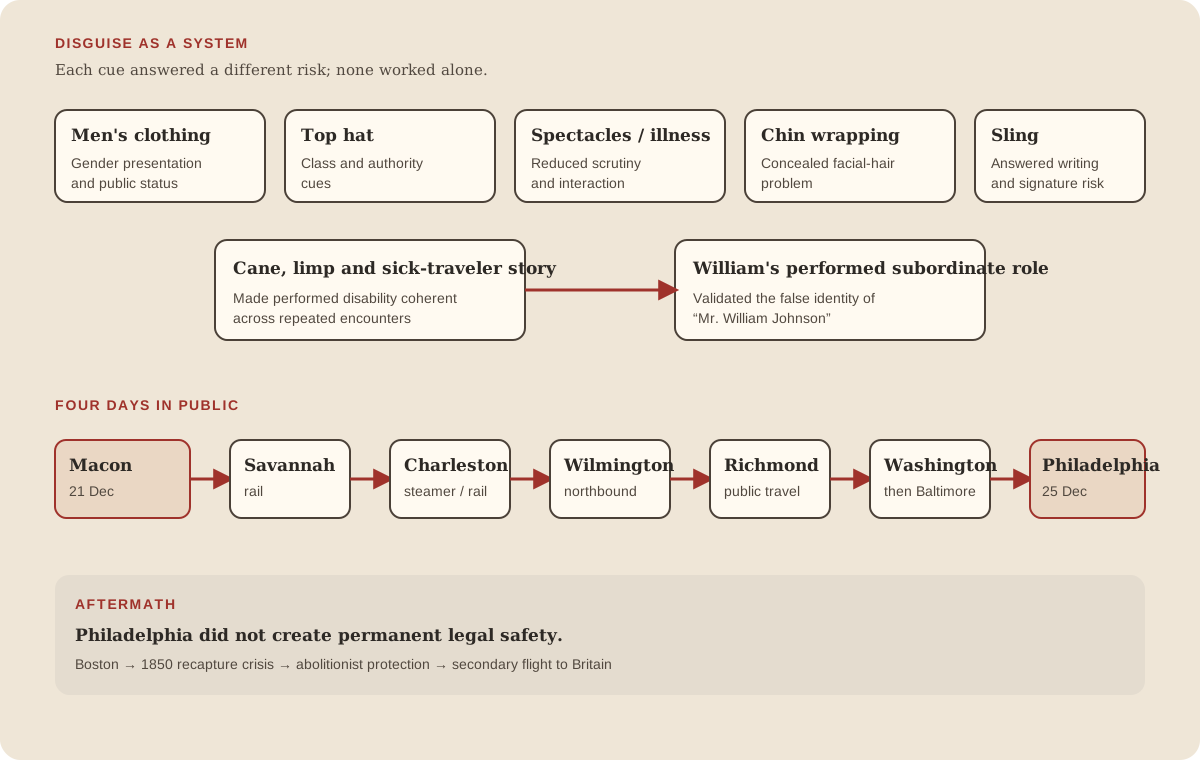
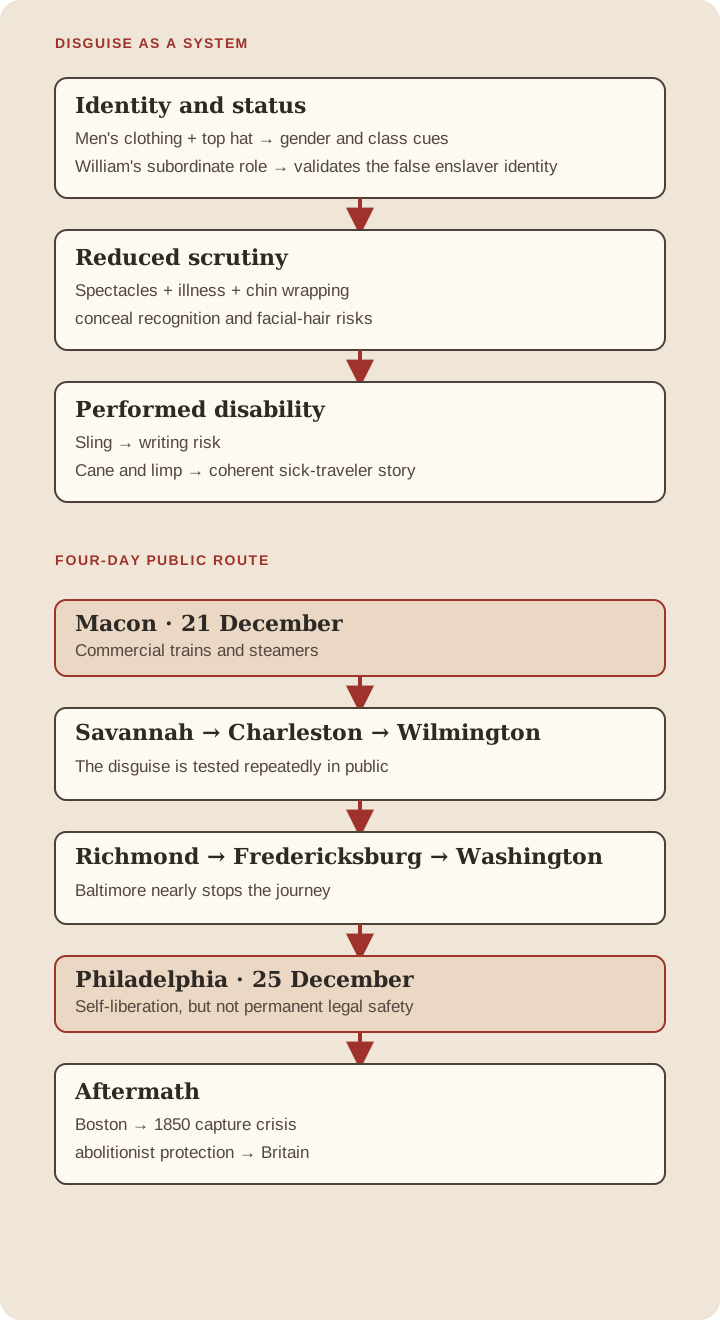
The escape depended on overlapping signals of race, gender, class, illness and disability, reinforced by William's performed subordinate role.
- 01
Identity
Ellen appeared as the white male enslaver “Mr. William Johnson.”
- 02
Scrutiny
Illness, spectacles and chin wrapping reduced specific recognition risks.
- 03
Writing
The sling helped answer the danger of signatures and literacy.
- 04
Validation
William's performed role reinforced the false social relationship.
- 05
Journey
They travelled openly from Macon to Philadelphia over four days.
Simplified editorial explanation of how the combined cues worked; not an exact costume reconstruction. The route uses ordinary commercial transport and the 1860 image omits important elements described in the memoir.

The disguise was a system, not a costume
The famous image of Ellen in men's clothing can make the escape look simpler than it was. The clothing alone would not have solved the hardest problems.
William obtained pieces of the disguise without drawing attention to one unusual purchase. Ellen's hair was cut. She wore men's clothing, a top hat and green spectacles.
Then the couple added illness.
A wrapping around Ellen's lower face helped conceal the absence of facial hair. A cane and limp made the young traveler appear physically weak. She could pretend not to hear well, reducing conversation with strangers.
Most important, her right arm was placed in a sling. Ellen could not write. That was dangerous because white male travelers could be expected to sign hotel registers, ticket documents or other papers. A supposedly injured right hand converted illiteracy from a potential giveaway into part of the character.
The fictional "Mr. Johnson" was not merely a man in different clothes.
He was an invalid gentleman whose condition explained why he talked less, moved differently, covered part of his face and needed help with writing.

The Christmas holiday bought time
Before leaving, both Crafts obtained permission to be absent for several days. That detail was operationally important. If they simply vanished during an ordinary work week, their enslavers could begin searching almost immediately. The holiday period created a delay.
For a four-day journey, even a short delay in recognizing the escape could be decisive. On the morning of December 21, 1848, Ellen and William did not walk to the Macon station together as husband and wife. They approached separately. Their marriage could not be visible.
By the time they entered the transportation system, the performance had begun.
Macon to Savannah: the first test
Ellen purchased the tickets in the role of Mr. Johnson.
William occupied the place assigned to the enslaved attendant. The train carried them roughly two hundred miles toward Savannah. Almost immediately, the plan ran into the danger no costume could eliminate: people who already knew them.
William saw the cabinetmaker for whom he worked board the train before departure. The man did not remain aboard, but his appearance was enough to create alarm.
Ellen faced an even closer test.
A man identified in their later account as Mr. Cray, who knew her enslaver and had known Ellen for years, sat near her.
The disguise now had to defeat familiarity, not simply strangers. Ellen relied on the sick-traveler performance. Rather than risk a sustained conversation, she behaved as though she could not hear well. The journey continued.
That first encounter established the operating logic they would use repeatedly: when conversation threatened the disguise, illness reduced the amount Ellen had to say.
Savannah to Charleston: performing mastery at close range
The Crafts reached Savannah and boarded the General Clinch for Charleston. A steamship created a different kind of danger from a train. Passengers could spend hours together. Meals brought strangers into conversation.
People noticed one another.
Ellen went to bed early, consistent with the persona of an invalid traveler. William, treated according to the racial hierarchy they were exploiting, did not share the same accommodations.
At breakfast, Ellen found herself in close company with white passengers. One was a slave dealer.
He treated "Mr. Johnson" as a fellow member of the slaveholding order and warned that taking an enslaved man north created the risk that the man might escape.
Then he tried to buy William. The moment exposed the moral distortion at the center of the disguise. The Crafts had designed the performance so that strangers would treat Ellen as a person with the power to sell her own husband. She refused.
The stranger saw a white enslaver making a property decision. The Crafts knew they were protecting a marriage.
Charleston creates a problem the sling was designed to solve
Charleston forced the couple to change their expected route. They had hoped to travel north by steamer, but that option was unavailable, so they turned toward a route through Wilmington, North Carolina. At the ticket office, Ellen faced one of the most dangerous bureaucratic moments of the escape. An official wanted a signature.
A white male traveler who could not write risked attracting suspicion. For Ellen, the problem was sharper: under slavery, she had been denied literacy, and the disguise required her to inhabit a social class in which literacy was expected.
The sling now did its second job. Ellen could ask someone else to write because her right arm appeared injured. The official initially refused. The plan could have stalled there.
Then another traveler intervened and signed. The Crafts continued north.
The episode shows why the disguise worked as a system. The sling was not decoration. It solved a predictable administrative risk.
Wilmington, Richmond, Fredericksburg, Washington
From Wilmington, the Crafts moved north through a succession of trains and steamers. They traveled to Richmond. From Richmond they went toward Fredericksburg. They then continued by water to Washington.
Every transfer created another point at which tickets could be questioned or identities examined. Yet public transportation also gave the couple an advantage. The more convincingly they occupied ordinary passenger roles, the less extraordinary they appeared. Their method required them to move openly enough to look normal.
They were not trying to erase themselves from the transportation network. They were trying to make the network classify them incorrectly. By December 24, that strategy had carried them to Baltimore. There, it almost failed.
Baltimore: the escape comes down to ownership papers
Baltimore was the final major barrier before Pennsylvania. The problem was not Ellen's clothing. It was William.
Rail officials were concerned about carrying an enslaved person north without proof that the accompanying white traveler had the right to control him. If the supposed enslaved man escaped and another person later proved legal ownership, the railroad could face consequences.
The official therefore wanted proof. Ellen had none.
There was no legitimate document showing that Mr. William Johnson owned William Craft because Mr. Johnson did not exist.
The couple had successfully navigated race. They had successfully navigated gender. They had successfully navigated literacy. Now the legal fiction of ownership itself was being tested.
The train was preparing to leave. According to the Crafts' later narrative, a conductor who had seen the pair traveling together helped persuade the official that the situation was legitimate. Eventually they were allowed to board. The last major checkpoint had accepted the illusion.
Christmas morning in Philadelphia
On December 25, 1848, the Crafts reached Philadelphia. The date became one of the defining images of their story: Christmas morning and self-liberation arriving together. But it is important not to turn Pennsylvania into a magical legal boundary. The Crafts had escaped from the direct control of their Georgia enslavers and reached a state where slavery did not operate as it did in Georgia.
That did not mean federal law guaranteed their safety. Federal fugitive-slave legislation already allowed enslavers to pursue people who had escaped across state lines. Philadelphia was freedom in the immediate, human sense that the Crafts were no longer being controlled by the people who had claimed ownership of them. It was not yet permanent legal security.
The couple went to an abolitionist boarding house and Ellen removed the disguise. The reversal must have been striking to those meeting them. The young white gentleman disappeared. In his place stood Ellen Craft.
The Underground Railroad came after the public journey
The Crafts are rightly part of Underground Railroad history. But the phrase can obscure what made their first four days unusual. They did not move from Macon to Philadelphia through a continuous chain of clandestine safe houses. They traveled mostly on ordinary commercial transportation.
The essential escape mechanism was hiding in plain sight. Only after reaching Pennsylvania did organized abolitionist assistance become central.
The Crafts were exhausted. They stayed with Barkley Ivens and his family while recovering, and members of the household helped them begin learning to read and write.
A few weeks later they continued to Boston. There they joined a powerful Black abolitionist community and became public witnesses against slavery. That publicity made their story famous. It also made them easy to identify.
Boston did not make them untouchable
William worked as a cabinetmaker. Ellen worked as a seamstress. They spoke publicly about slavery and their escape. For a time, Boston appeared to offer something close to security.
Then Congress passed the Fugitive Slave Act of 1850.
The law did not invent the federal power to pursue people who had escaped slavery. An earlier federal statute already existed.
What the 1850 act did was strengthen enforcement dramatically.
Federal commissioners gained broad authority. Marshals faced penalties for failing to execute warrants. People accused of escaping slavery could not testify in their own defense in proceedings under the act. Those who obstructed capture or knowingly aided fugitives faced substantial criminal and civil penalties.
The law transformed the political atmosphere of northern cities. For Ellen and William Craft, the danger soon became personal.
Slave catchers come to Boston
In October 1850, Willis Hughes and John Knight arrived from Georgia seeking to return the Crafts to slavery. A federal warrant was issued. The escape that had apparently ended in Philadelphia was suddenly active again. Boston abolitionists mobilized.
Ellen and William were moved and protected separately at different points. George and Susan Hillard helped shelter Ellen. William was protected through networks centered on Black abolitionists including Lewis Hayden.
Crowds and vigilance groups watched the men pursuing them. The confrontation revealed the difference between personal freedom and enforceable security. The Crafts had built lives in Boston. Under the federal law, men from Georgia could still arrive and attempt to convert them back into legally recognized property.
The capture effort failed. But its failure did not mean the danger had disappeared.
A second escape: out of the United States
After the immediate pursuers left Boston, Ellen and William made another decision. They would leave the country. Before their departure, Theodore Parker performed a new marriage ceremony for them under Massachusetts law. The gesture carried special meaning.
Under slavery, their original union existed under a legal system that could separate them by sale. Now a free-state ceremony recognized them as spouses under law. Their route out of the United States carried them through northern ports and British North America before they finally obtained passage to Liverpool. In Britain, they built a family, studied, taught, worked and continued speaking against slavery.
In 1860 they published the book that became the foundation for almost every later reconstruction of their escape: Running a Thousand Miles for Freedom; Or, The Escape of William and Ellen Craft from Slavery.
Evidence discipline
What the record supports
Status labels distinguish secure conclusions from uncertainty and rejected claims. Color is never the only signal.
WELL-SUPPORTED
Ellen Craft simply dressed as a white man.
The disguise was more than men's clothing. It combined racial passing, male presentation, an upper-class enslaver role and performed disability. The sling, face wrapping, spectacles, cane, limp and feigned hearing problems each solved a different risk.
Sources: SRC-001, SRC-002, SRC-005, SRC-012MYTH
The famous 1860 image shows exactly how Ellen looked throughout the escape.
The 1860 frontispiece is a valuable historical image, but NPS explicitly notes that it does not show the bandage running from Ellen's chin toward her hat. Scholarship likewise notes that the engraving omits important layers of the disability disguise. It should not be treated as a literal escape-day photograph.
Sources: SRC-005, SRC-012, SRC-015MYTH
The Crafts escaped through a chain of secret Underground Railroad safe houses from Georgia to Pennsylvania.
Their initial four-day self-liberation relied primarily on public trains, steamers, hotels and ticket offices. Abolitionist safe houses and organized protection became important after they reached Pennsylvania and later Boston. The story belongs to Underground Railroad history, but its first phase worked by hiding in plain sight.
Sources: SRC-001, SRC-002, SRC-007, SRC-010MYTH
Reaching Philadelphia permanently ended the legal danger of recapture.
Pennsylvania was a free state, but federal fugitive-slave law predated 1850. The Fugitive Slave Act of 1850 then greatly expanded enforcement and helped trigger the later attempt to seize the Crafts in Boston.
Sources: SRC-002, SRC-008, SRC-009MYTH
William was merely a passive companion in Ellen's disguise plan.
Their 1860 narrative presents William as conceiving the central plan, purchasing disguise items, helping prepare Ellen's appearance, funding travel from earnings he had retained, navigating the route and performing the enslaved attendant role. The escape depended on coordinated action by both.
Sources: SRC-001, SRC-002, SRC-004, SRC-007UNKNOWN
The exact 1860 narrative should be read as a stenographic record of everything said and felt during the 1848 journey.
It is the indispensable first-person account but was published twelve years after the escape for an abolitionist readership. Precise dialogue and recollected internal reactions should be attributed to the memoir rather than treated as independently recorded contemporary transcripts.
Sources: SRC-001, SRC-011, SRC-014What the famous picture gets wrong
The best-known historical image of Ellen's disguise comes from that 1860 book. It is invaluable. It is also incomplete. The engraving shows Ellen in male clothing, top hat, spectacles and sling.
It does not show every element used during the escape. The National Park Service specifically warns that the chin-to-head bandage described in the narrative is absent from the image. Modern scholarship has emphasized the same problem: the frontispiece makes the disguise cleaner and more legible than the layered illness performance the Crafts described. That matters for visual reconstruction.
The engraving is useful historical evidence of how the Crafts were represented, but it is not a documentary likeness of Ellen exactly as she appeared during the escape. Its interpretive character needs to remain explicit.
The memoir is indispensable—and still a memoir
The Crafts' 1860 narrative is the controlling first-person source. It gives the route. It explains the disguise. It records the signature problem, the Baltimore challenge and many of the conversations that shaped the journey.
Without it, the escape could not be reconstructed at this depth. But the book was published twelve years after the event. It was also an abolitionist text designed to persuade readers about the cruelty and absurdity of slavery. That does not make it unreliable.
It means the evidence should be handled as what it is: recollection shaped into a public narrative. Exact conversations should be attributed to the Crafts rather than presented as if a reporter had transcribed them in real time. The broad operational sequence is strongly corroborated by institutional and scholarly research. The sentence-by-sentence dialogue belongs to the memoir.
Why their escape worked
The Crafts did not defeat slavery by finding a hole in a fence. They found a hole in its assumptions. The same society that restricted Black movement allowed white enslavers extraordinary freedom of movement. The same society that denied Ellen literacy assumed a white gentleman would be literate.
The sling solved that contradiction. The same racial order that endangered William also made his presence beside a white-appearing traveler seem ordinary. The same gender expectations that made Ellen's disguise risky also made strangers less likely to imagine that the sick young man beside them was an enslaved woman. Their strategy turned oppression into camouflage.
That is why the escape remains so powerful to reconstruct. William and Ellen Craft traveled through a system built to control them. For four days, the system kept looking directly at them. And seeing exactly what they needed it to see.
Selected chronology
Four days north—and the danger that followed
The Crafts leave Macon
Ellen travels as the fictional white male enslaver 'Mr. William Johnson'; William travels as his enslaved attendant.
Macon to Savannah
They travel approximately 200 miles by rail, surviving encounters with people who knew them.
Savannah to Charleston
They travel aboard the General Clinch; Ellen's identity is tested through close social contact and a slave dealer tries to buy William from the supposed enslaver.
Charleston ticket-office obstacle
A request for Ellen to sign threatens the disguise; her sling and the intervention of another traveler allow the journey to continue.
North through Wilmington and Virginia
The Crafts continue by train and steamer through Wilmington, Richmond, Fredericksburg and Washington.
Baltimore nearly stops them
Officials demand proof of ownership before allowing William to travel farther north. The couple eventually receives permission to board.
Philadelphia
The Crafts arrive in Pennsylvania and make contact with abolitionists.
The Fugitive Slave Act is strengthened
Federal law expands the machinery available to claimants seeking to seize people alleged to have escaped slavery and penalizes those who obstruct or shelter them.
Warrants are sought in Boston
Willis Hughes and John Knight seek to seize the Crafts on behalf of Georgia enslavers, triggering several days of abolitionist protection and resistance.
The Crafts prepare to leave Boston
Theodore Parker remarries them under Massachusetts law before their departure toward Britain.
Running a Thousand Miles for Freedom
The Crafts publish their account of the escape and the later pursuit.