
The Pearl was built to move cargo through shallow Chesapeake waters. On the night of April 15, 1848, it carried something the law of Washington treated as cargo and the people aboard understood as themselves. Seventy-seven enslaved men, women, and children slipped away from homes, workplaces, and hired-out positions in the national capital and made their way toward a secluded wharf on the Potomac.
They were not all strangers. Families were aboard. Six Edmonson siblings came together. Members of Daniel and Mary Bell's family came after years of courtroom attempts to protect rights they believed had already been promised to them.
A teenage girl named Ellen Stewart had already spent months avoiding capture after fleeing the household of former first lady Dolley Madison. The plan was enormous.
One small sailing vessel would carry them out of Washington, south down the Potomac, then north through Chesapeake Bay to Frenchtown near the head of the bay. Friends would meet them there and move them toward Philadelphia.
It was the largest recorded single escape attempt from slavery in United States history. It failed less than two days after departure. But it did not fail because the people aboard lacked a plan. It failed because sailing against a slave system required them to defeat geography, wind, information, and pursuit at the same time.
The plan began with families, not a schooner
The Pearl story is often introduced through Daniel Drayton. That makes sense from the surviving documents. Drayton later published a detailed memoir. He was prosecuted.
He spent more than four years in Washington jail. His face appears at the front of the book. But the escape did not originate simply because a white sailor decided to rescue seventy-seven strangers. It grew out of Black Washington.
Daniel Bell was a free Black blacksmith associated with the Washington Navy Yard. His wife Mary and much of their family remained legally vulnerable to enslavement and sale. For years, the Bells had used courts and legal documents to fight for freedom. They were not people who suddenly discovered resistance in April 1848.
They had been fighting through the law. When the law failed them, another option became urgent.
Daniel Bell had already tried the courtroom
The Bell family story helps explain why the escape became so large. Mary Bell's freedom status had been tied to earlier manumission arrangements. The family spent years contesting claims that kept Mary and the children enslaved. Court cases accumulated.
Money disappeared into litigation. The danger of sale remained. By 1848, the legal route had produced too little security. Daniel Bell turned toward Washington's antislavery network.
The original maritime idea centered on getting his family out. Then word spread. A family rescue became a mass escape.

Washington's Black community made scale possible
The District of Columbia contained one of the country's most important free Black communities. Free and enslaved people worked beside one another. They attended churches. They lived near relatives separated by legal status.
Some people were hired out and moved through the city with a degree of daily mobility even though the law still treated them as property. That environment created risk for slaveholders. It also created communication. Daniel Bell and Samuel Edmonson are identified by modern research as important Black organizers.
Paul Jennings is closely connected to the plan too. Jennings had once been enslaved by James and Dolley Madison. By 1848 he was working for Senator Daniel Webster under an arrangement that had secured his own freedom. He did not board the Pearl.
Evidence for exactly what he did before departure is less direct than for Bell or Edmonson. But multiple modern institutional histories place him inside the organizing network. The distinction matters. The evidence supports describing him as likely involved; it does not preserve a meeting transcript.

William Chaplin connected the network to a mariner
The Black organizing network needed a vessel. That meant finding people who understood Chesapeake transportation and were willing to violate the slave system in practical, dangerous ways. Antislavery activist William Chaplin helped connect the organizers to Daniel Drayton. Drayton had experience.
In 1847 he had already helped a Black family leave Washington by water and reach Frenchtown. That success made him useful. It also gave people in Washington reason to believe that the same route could work again.
Drayton needed a ship
Drayton did not own the Pearl. He met Edward Sayres, who operated the small bay schooner, and offered him one hundred dollars to charter the vessel for a trip to Washington and back to Frenchtown. Drayton later described their division of responsibility clearly. Sayres controlled the ship as master.
Drayton controlled what he called the freight side of the charter—the passenger operation. This distinction matters because later summaries sometimes call Drayton the captain or owner of the Pearl. He was the principal transport organizer. Sayres was the vessel's owner/master.
Chester English knew even less
The third white crewman was Chester English, a young sailor and cook. Drayton's memoir says English originally believed they were going to Washington for ship timber. Only after arriving in the capital was he told enough to understand that Black passengers would be coming aboard. That limited knowledge was intentional.
A clandestine operation becomes weaker every time another person learns every part of it. The Pearl network was not perfectly compartmentalized. But it did not disclose the full passenger list or organizing structure to everyone who touched the plan.
The ship approached Washington looking like business
The Pearl entered the Potomac from Chesapeake Bay. On the way upstream, Drayton stopped at a place he called Machudock and bought about twenty cords of wood. The cargo served as cover. A bay schooner entering Washington with wood looked ordinary.
A bay schooner arriving empty and waiting for dozens of enslaved people did not. The vessel reached Washington on Thursday, April 13. Two days remained before the departure.
The wharf was chosen because it could hide movement
Drayton called the boarding place White-house Wharf. Modern National Park Service and White House Historical Association accounts place the departure along the secluded southwest waterfront near Seventh Street. The naming is less important than the physical logic. The wharf was relatively isolated.
A high riverbank helped screen it. Open fields separated parts of the waterfront from denser city activity. There were fewer nearby buildings than at busier commercial landings. Darkness could do the rest.
The passengers had to solve an extraordinary problem: seventy-seven people had to arrive without creating the kind of public movement that would expose the plan before the schooner left.
They began arriving after dark
On Saturday evening, April 15, the freedom seekers moved toward the water. Drayton later remembered people crossing the fields and boarding quietly. The hold filled. The group included adults, teenagers, children, and infants.
National Archives research gives a remarkable breakdown:
38 men and boys
26 women and girls
13 small children or infants
This was not a raiding party. It was a moving community. That made the plan harder. It also explains the reason people accepted the risk.
Many were trying to keep families together before sale separated them permanently.
Six Edmonson siblings were aboard
The Edmonson family became the most famous passenger group after the recapture. Samuel Edmonson was involved in organizing. He boarded with five siblings. Among them were Mary and Emily, who would later become nationally visible abolitionist figures.
Their parents' family situation reflected a common cruelty of slavery. Their father was free. Their mother was enslaved. Under the law governing hereditary status, the children inherited their mother's enslaved condition.
The siblings worked in and around Washington while their labor benefited an enslaver. The Pearl offered something the law refused them: the possibility of leaving together.
Ellen Stewart had already escaped once
Another passenger connected the Pearl directly to presidential history. Ellen Stewart had been enslaved by Dolley Madison. She was about fifteen. Before the Pearl attempt, she had already fled rather than face sale and reportedly remained hidden for months.
Paul Jennings had known the Madison household intimately. Modern Montpelier and White House historical research suggests he may have helped Ellen during that earlier period and may have been involved in placing her within the Pearl network. Again, the exact secret conversation cannot be reconstructed. What can be said is stronger:
Ellen's decision to board the Pearl was not her first act of self-emancipation. It was the next stage of one already underway.
A larger group made the operation stronger and weaker
Seventy-seven people gave the attempt historical scale. They also created vulnerabilities. Seventy-seven absences could be noticed. Seventy-seven people had relatives, employers, enslavers, neighbors, and routes to the wharf.
Seventy-seven people required food. They filled space. They made secrecy more difficult. Drayton had not even known the final number in advance.
His arrangement was essentially that anyone who reached the vessel before the departure deadline would be taken. The plan grew because the demand for escape exceeded the capacity originally imagined.
After ten o'clock, the Pearl moved
Sometime after ten on Saturday night, the crew cast off. Then the environment immediately refused to cooperate. There was almost no wind. A sailing vessel cannot flee quickly when the air is still.
The crew used the small boat to help turn the schooner's head. The tide was running up the river. The Pearl dropped down only a short distance before it had to anchor. The largest recorded mass escape attempt in American slavery had left the wharf.
It had not yet escaped Washington's immediate reach.
The first lost hours mattered
By daylight, wind returned. The Pearl began moving down the Potomac. Its route can confuse modern readers because freedom lay north but the vessel sailed south. Washington sits upriver.
To reach the free-state network by water, the schooner first had to travel downstream to the mouth of the Potomac. Then it would turn north through Chesapeake Bay. The planned water destination was Frenchtown, Maryland, near the head of the Chesapeake. Friends would meet the group there and move them toward Philadelphia.
So the route was:
Washington → down the Potomac → up Chesapeake Bay → Frenchtown → overland toward Philadelphia
The water route avoided a long overland flight through slaveholding territory. Its weakness was that wind controlled the timetable.
In Washington, the absence became impossible to hide
By Sunday, slaveholders knew people were missing. The exact path by which they learned enough to organize a pursuit is one of the most disputed parts of the story. Drayton later described an unnamed Black hackman who had supposedly helped people reach the vessel and then informed enslavers. Other traditions identify Anthony Blow.
Many accounts name Judson Diggs. Even the stories about Diggs disagree. One version turns the betrayal into a dispute over money. Another makes it personal and links him romantically to Emily Edmonson.
The evidence does not justify choosing a cinematic betrayer simply because one story is memorable. The secure fact is this: enough information reached Washington's enslavers for them to understand that a large group had left by schooner down the Potomac. That was enough to organize pursuit.
The Salem was faster because it did not need wind
A small steamer named Salem was made available. An armed group of roughly thirty to thirty-five men boarded. The exact count varies across accounts. Drayton said thirty-five.
Modern NPS summaries use figures in the low thirties. The difference does not alter the tactical situation. The Pearl was a sailing vessel carrying seventy-seven unarmed freedom seekers. The Salem was a steam vessel carrying an armed pursuit force.
One depended on wind. The other could chase through the same river system on mechanical power.
The wind that helped them leave became the wind that stopped them
By the time the Pearl approached Point Lookout, the problem changed. The Potomac opens into Chesapeake Bay. To continue the original plan, Sayres needed to turn the schooner north. But the wind had hauled to the north and strengthened.
That meant the vessel would have to beat directly against the wind to climb the bay. Drayton understood what delay meant. Every hour increased the chance of pursuit. He proposed a radical alternative.
Go to sea. Instead of fighting north through Chesapeake Bay, sail out past the capes and reach the Delaware from the Atlantic side.
Why they did not take the ocean route
The idea sounds obvious in hindsight. It was not safe. The Pearl was a bay-craft. Its shallow draft and design suited protected coastal and bay waters.
Drayton himself later agreed that Sayres was correct that the vessel was not fit for an outside sea passage. There was another issue. The charter was for Frenchtown. Sayres refused the ocean route.
The decision has sometimes been treated as a missed opportunity. It was also a realistic assessment of a vessel carrying dozens of people who could not afford to founder offshore. The escape had reached a place where every available option was dangerous.
Cornfield Harbor was safety from weather—and danger from pursuit
Unable to go north, the Pearl sought shelter. At about nine on Sunday evening, it anchored in Cornfield Harbor near Point Lookout. This was normal behavior for bay vessels facing contrary winds. That normal harbor use became the trap.
The passengers and crew had spent the previous night awake. They were exhausted. They had traveled roughly 140 river miles from Washington according to Drayton. They stopped.
The Salem kept searching.
The pursuers almost missed them
Drayton later wrote that the Salem reached the mouth of the Potomac without finding the Pearl and nearly turned back. The steamer's operators did not want to continue farther into Chesapeake Bay under conditions that could affect insurance or safety. Then they checked Cornfield Harbor. The ordinary refuge became the final search location.
At about two in the morning on Monday, April 17, the pursuit found the schooner.
The passengers asked whether they should fight
Drayton's first-person account preserves one of the most revealing moments of the capture. Black men came to the cabin and asked whether they should resist. Drayton said no. They had no weapons.
The pursuers were numerous and armed. The result of a fight was unlikely to be freedom. It was likely to be death on the deck of a trapped vessel. The decision not to fight should not be mistaken for passivity.
The passengers had already left slavery together. Now they faced an armed force they could not realistically defeat. The escape ended because the tactical balance had collapsed.
April 17 was the capture date
Shorter retellings sometimes blur the chronology. Drayton's memoir gives the sequence clearly. The Pearl anchored at Cornfield Harbor around nine on Sunday evening. The Salem found it around two the next morning.
That was Monday, April 17. The vessels did not immediately reappear at the Washington wharf. The captors crossed toward Piney Point. The steamer obtained fuel in the Coan River area.
Around noon on Monday, it began the tow toward Washington. The return to the capital came on Tuesday, April 18. That distinction matters because it reconstructs how much time the escape actually had.
The return was designed to display control
Before the final entry into Washington, the captives were bound. Drayton and Sayres were tied. The Black passengers were restrained in pairs in his account. The captors could have treated the return as a quiet transfer.
Instead, the spectacle became public. Crowds gathered. At Alexandria and then Washington, people came to see. The national capital watched the consequences of an attempted mass self-emancipation move through its streets.
The crowd threatened the white crew
Drayton feared lynching. His memoir describes escalating threats as he and Sayres were marched from the waterfront. The public rage did not mean the Black passengers were safe. Their danger took another form.
For the freedom seekers, recapture meant legal reclassification back into ownership, punishment, sale, and family separation. For Drayton and Sayres, the immediate threat included mob violence and prosecution. The two dangers met at the same wharf.
The most devastating punishment was sale
Many enslavers responded by selling the people who had tried to escape. Sale farther south was one of slavery's most powerful forms of punishment. It removed people from the community that had made the Pearl possible. It separated families.
It made another escape more difficult. It converted an attempt to move north into forced movement south. The National Park Service and National Archives both emphasize that many Pearl participants were sent into the Deep South. New Orleans became the destination associated most strongly with their forced sale.
The Bell family was broken again
Daniel Bell had entered the plan because legal uncertainty threatened his family. The recapture made that threat immediate. Records reconstructed through National Archives court material show Bell pleading as family members were being carried away. He was free.
His wife Mary had a contested claim to freedom. That did not prevent slave traders from controlling the movement of the family. Bell and allies managed to save some relatives. Others were sold to Louisiana and Mississippi.
The failed escape therefore did exactly what the family had been trying to prevent: it gave the slave system an opportunity to scatter them.
Mary and Emily Edmonson became the public faces
Mary and Emily Edmonson were taken south. Their youth and vulnerability drew abolitionist attention. Fundraising led by antislavery supporters, including the circle around Henry Ward Beecher, eventually purchased their freedom. They did not disappear from the story after being freed.
They became speakers. They attended antislavery events. By 1850 they appeared in the famous Cazenovia Fugitive Slave Law Convention photographic record with Frederick Douglass and other activists. The failed escape had made them symbols.
But they had boarded the Pearl before anyone knew their names nationally. Their political visibility came after their own decision to leave slavery.
Ellen Stewart's story also continued
Ellen Stewart was recaptured. Dolley Madison did not simply restore her to the old household. She was sold into the slave trade. Modern Montpelier research traces abolitionist efforts that eventually purchased Ellen and helped her move to Boston.
That outcome is crucial because it shows why a simple number like “77 recaptured” is not enough. The capture was collective. The aftermath was individual. Each person entered a different chain of sale, retention, purchase, re-escape, manumission, or continued bondage.
Alfred Pope shows another path
Alfred Pope was one of the seventy-seven. He was enslaved by South Carolina congressman John Carter. After the Pearl attempt, Carter sent Pope south for a time but later brought him back to Washington. Pope eventually received freedom under Carter's will.
He later built a life in Washington. His case is another warning against flattening the aftermath. “Most were sold south” is true. It is not the same as “every person had the same outcome.”
The riot moved the story into national politics
The Pearl did not produce only legal punishment. It produced a political explosion. Washington's antislavery National Era, edited by Gamaliel Bailey, became a target of mob anger. Library of Congress history notes that a proslavery mob stoned the office and held staff under threat for days.
President James K. Polk recorded the unrest in his diary.
Members of Congress raised the violence and the slavery issue on the floor. The failed escape had become a national argument because it happened where Congress could not pretend the issue was geographically distant.
Frederick Douglass understood the contradiction
Frederick Douglass wrote about the Pearl in The North Star. The timing gave abolitionists a powerful rhetorical contrast. Washington politicians had been celebrating the 1848 revolution in France and the language of republican freedom. At the same time, seventy-seven people had tried to leave slavery from the capital of the American republic.
The irony did not require invention. The city itself supplied it.
Drayton and Sayres were prosecuted
The government did not treat the white crew simply as ordinary transporters. Prosecutors tried to make the operation into serious criminal wrongdoing. Drayton faced a complicated series of proceedings that initially included larceny theories. The legal argument mattered.
If he had “stolen” enslaved people for his own gain, prosecutors could seek much more severe punishment. His defense emphasized that the passengers wanted freedom for themselves. Eventually the larceny approach failed, but transport-related convictions and fines left Drayton and Sayres imprisoned because they could not pay. They remained in Washington jail for more than four years.
Chester English was not treated the same way
Chester English had not been brought into the original plan on the same terms. Drayton and Sayres told authorities that he had not known the true purpose of the voyage when he left with them. He was released earlier. This difference matters because “the Pearl crew” can sound like three equal conspirators.
They were not. Drayton was deeply committed to the transport plan. Sayres knowingly accepted the charter. English was brought into the secret late.
The 1852 pardon closed only the crew's legal chapter
By 1852, Massachusetts senator Charles Sumner was among those pressing for clemency. President Millard Fillmore ultimately pardoned Drayton and Sayres. They had spent more than four years in confinement. Their release did not reverse the consequences for the seventy-seven.
Many families had already been separated. Some participants remained enslaved. Some had been moved hundreds of miles from Washington. The criminal case ended.
The human aftermath did not.
Did the Pearl end the slave trade in Washington?
It helped make the issue harder to ignore. That is different from saying it single-handedly caused reform. In 1850, the Compromise of 1850 prohibited the slave trade in the District of Columbia. It did not abolish slavery in Washington.
Enslavement remained legal there until 1862. The Pearl affair belonged to the chain of events and political arguments that made the capital's slave market increasingly indefensible to antislavery Northerners. But history becomes weaker when one dramatic event is made to cause everything that follows. The Pearl was a flashpoint.
It was not the only cause.
Why the escape failed
The simplest explanation is bad weather. It is not enough. The escape failed because several vulnerabilities aligned. The group was enormous.
The departure wind was weak. The tide slowed the first hours. The mass absence became known in Washington. The pursuers had a steam vessel.
The Pearl depended on sail. The north wind then blocked the exact direction the schooner needed to travel up Chesapeake Bay. The vessel was too lightly built for the offshore alternative Drayton proposed. The forced anchorage gave the pursuit one final place to search.
Every factor mattered. Remove one and the outcome might change.
What the Pearl proved even in failure
The most important fact is not that seventy-seven people were caught. It is that seventy-seven people coordinated a departure from the capital of a slaveholding republic. They included families. They included children.
They came from different enslavers. They used a network that crossed racial and legal boundaries. The scale showed that slavery in Washington was not stable simply because the law protected it. The people held inside it were planning against it.
The route itself reveals the problem
The Pearl had to sail south to go north. That geographic fact captures the whole operation. Freedom was not a straight line. The passengers had to move through slaveholding waters before they could reach a transfer point linked to Philadelphia.
Their route depended on a machine built for commerce. It depended on a river used by slaveholders. It depended on a bay whose wind could reverse the advantage of movement in a matter of hours. The plan tried to use the infrastructure of the Chesapeake against slavery.
For more than a day, it worked. Then the wind stopped the ship long enough for the system behind it to catch up.
Why the Pearl belongs in escape history
The attempt is often remembered because it was large. Scale alone is not the reason it matters. The Pearl shows what collective escape required. Information had to travel without exposure.
Families had to make decisions together. A vessel had to be secured. A commercial cover had to look plausible. Seventy-seven people had to reach one wharf.
A crew had to move through a river system controlled by slaveholding jurisdictions. A handoff had to be waiting at the other end. And all of it had to happen before missing people became an armed pursuit. The escape did not fail at the wharf.
It did not fail because the passengers lacked courage. It failed at the mouth of the Potomac, where weather erased the head start and steam power erased the remaining distance. The Pearl was captured. The attempt still exposed how many people in the capital were ready to leave slavery together.
Escape reconstruction
How the escape unfolded
An evidence-aware sequence of the principal stages.
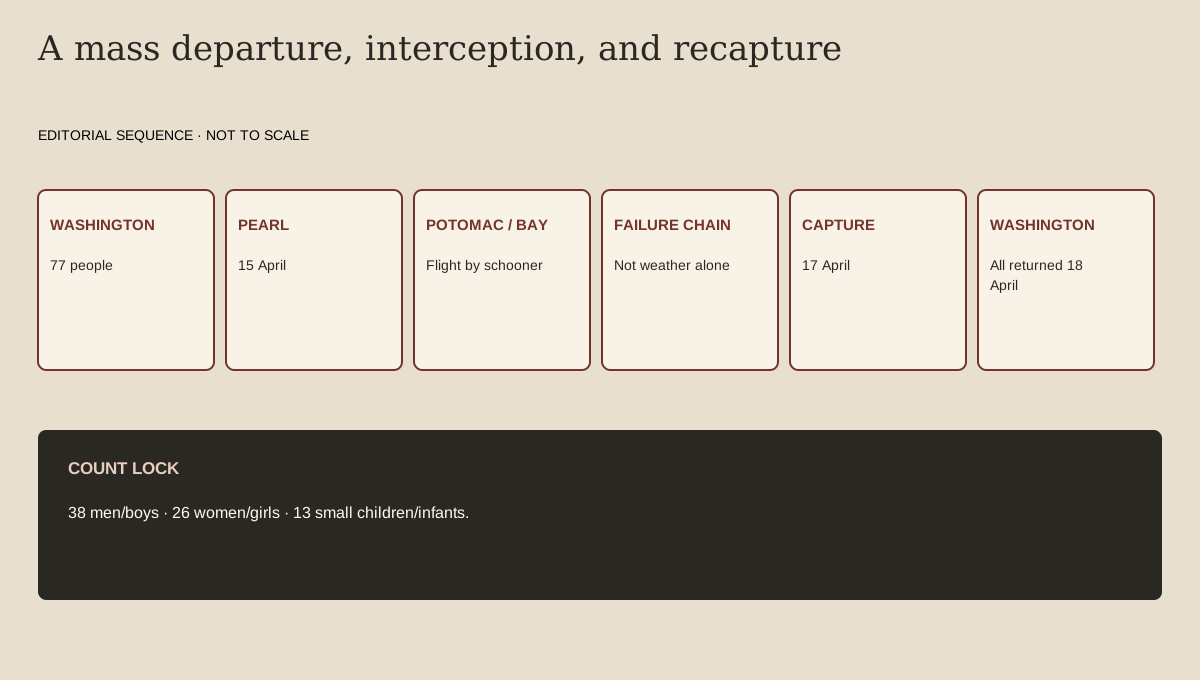
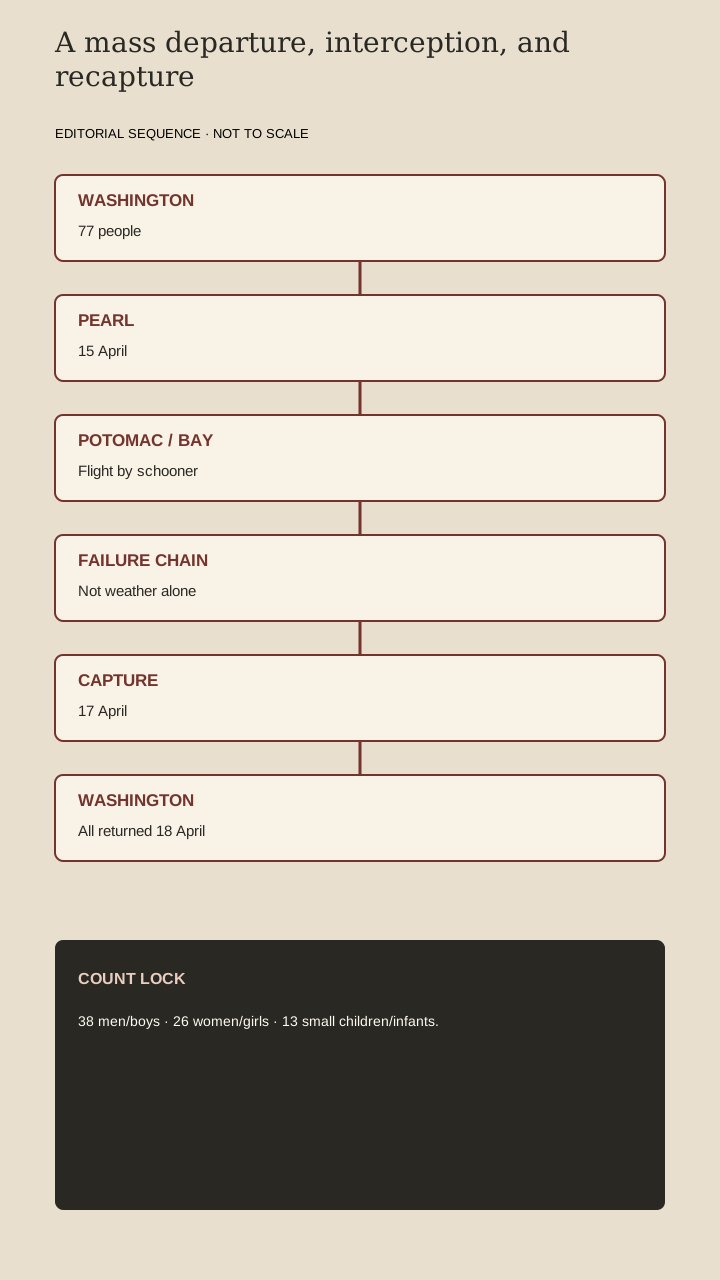
Simplified editorial reconstruction; not to scale. See adjacent text for evidence qualifications and unresolved details.
Material evidence
Tools of Escape
The objects used in an escape reveal how a plan worked under constraint.
- 01A vessel could move a very large group farther and faster than an overland escape, but a sailing vessel was completely dependent on wind.
The schooner Pearl
A shallow-draft Chesapeake bay-craft schooner chartered from Edward Sayres for the run between Washington and Frenchtown.
- 02The cover gave the Pearl an ordinary reason to enter the slaveholding capital before the passengers boarded.
Cover cargo of wood
Drayton purchased approximately twenty cords of wood on the way up the Potomac and carried it into Washington as a plausible commercial cargo.
- 03The high riverbank, open fields, limited nearby buildings, and darkness reduced immediate observation while dozens of people arrived.
Secluded waterfront boarding point
The Pearl moved to a relatively isolated southwest wharf before the Saturday-night boarding.
- 04Limiting knowledge reduced the number of people who could expose the plan before departure.
Compartmentalized information
The full passenger list and organizing network were not disclosed to every white crew member or maritime participant.
- 05The route avoided a roughly hundred-mile overland escape through slaveholding territory, but it placed the operation at the mercy of tide and wind.
Chesapeake water route
The plan used the Potomac and Chesapeake system to reach Frenchtown near the head of the bay, where friends would carry the freedom seekers onward toward Philadelphia.
Problem → response
Escape was a sequence of problems
Each response solved a practical obstacle while often creating the next one.
- 01→
Obstacle
Seventy-seven people had to board one vessel secretly
The scale made the operation historically exceptional but also increased the number of families, routes, absences, and possible observers involved.
Response
Organizers used a secluded wharf, night movement, Black community communication networks, and compartmentalized knowledge.
- 02→
Obstacle
Dead calm and opposing tide at departure
The schooner could not simply motor away; shortly after casting off, it lost the wind and faced an incoming tide.
Response
The crew used the small boat to turn the vessel and anchored until daylight brought enough wind to continue.
- 03→
Obstacle
The escape became known in Washington
Enslavers discovered the mass absence and obtained enough information to send an armed steamer down the Potomac.
Response
The Pearl kept moving, but its slow sailing progress meant it could not establish enough distance before pursuit organized.
- 04→
Obstacle
Strong north wind at the Chesapeake
The same wind direction needed for a fast escape from Washington became a barrier when the schooner needed to turn north up Chesapeake Bay.
Response
Drayton proposed an offshore route to the Delaware, but Sayres judged the bay-craft unfit for sea and held to the Frenchtown plan.
- 05→
Obstacle
Need for shelter near Point Lookout
The contrary wind made forward progress impossible and forced the schooner to stop.
Response
The Pearl anchored in Cornfield Harbor, a normal bay-craft refuge that also gave the pursuing Salem time to locate it.
- 06→
Obstacle
Heavily armed pursuit
Roughly thirty to thirty-five pursuers arrived with firearms while the Pearl passengers had no realistic means of defeating them.
Response
Drayton rejected armed resistance when passengers asked whether they should fight, avoiding a likely deadly confrontation but ending the escape attempt.
The final accounting
Outcome
Freedom seekers recaptured
The entire mass escape was stopped before reaching the free-state network planned beyond Frenchtown.
Participants sold south
Most of the recaptured freedom seekers were sold or transferred into the interstate slave trade, with many sent toward New Orleans and the Deep South.
Participants later freed or kept from permanent sale
A smaller group, including Mary and Emily Edmonson, Ellen Stewart, Alfred Pope, and some Bell family members, later reached freedom through purchase, manumission, or subsequent events.
White crew imprisoned long-term
Daniel Drayton and Edward Sayres remained jailed for more than four years until their 1852 pardon; Chester English was released earlier.
Successful collective flight to the planned northern network
The Pearl never reached Frenchtown, and the seventy-seven did not complete the planned group transfer to Philadelphia.
Evidence discipline
What the record supports
Status labels distinguish secure conclusions from uncertainty and rejected claims. Color is never the only signal.
MYTH
The Pearl escape was planned and initiated only by white abolitionists.
Free Black Washingtonians were central. Daniel Bell and Samuel Edmonson are credited as organizers, and Paul Jennings is strongly associated with spreading or supporting the plan. White abolitionists and mariners supplied important connections and transport, but the operation grew from Black family and community efforts.
Sources: SRC-003, SRC-006, SRC-008, SRC-018MYTH
Daniel Drayton owned the Pearl.
Drayton chartered the vessel from Edward Sayres for $100. Sayres retained control of navigation while Drayton controlled the passenger operation as supercargo.
Sources: SRC-004MYTH
The Pearl left Washington and sailed directly north toward Philadelphia.
Washington lies on the Potomac upstream from Chesapeake Bay. The schooner first had to sail south down the Potomac, then turn north through Chesapeake Bay toward Frenchtown before the planned overland transfer to Philadelphia.
Sources: SRC-001, SRC-002, SRC-004MYTH
Bad weather alone caused the failure.
Wind was decisive but not sufficient by itself. The attempt also suffered from early calm and tide, disclosure of the escape in Washington, an organized armed pursuit, and the Pearl's inability to take the outside ocean route safely.
Sources: SRC-002, SRC-003, SRC-004DISPUTED
The identity of the person who exposed the escape plan is settled.
Drayton described an unnamed Black hackman; other traditions name Anthony Blow or Judson Diggs, with different motives attributed to Diggs. The safe conclusion is that Washington enslavers learned enough to organize pursuit, but the identity and motive of a single betrayer are unresolved.
Sources: SRC-003, SRC-010MYTH
The Salem captured the Pearl on April 18.
Drayton's chronology and the Dickinson reconstruction place the capture at about 2 a.m. on Monday, April 17. April 18 is the date the captives were brought back into Washington.
Sources: SRC-004, SRC-010MYTH
The seventy-seven were all adult men.
National Archives research gives a breakdown of 38 men and boys, 26 women and girls, and 13 small children or infants. The presence of entire families was fundamental to the operation.
Sources: SRC-005MYTH
The passengers were passive cargo carried away by Drayton.
The freedom seekers left homes and workplaces, reached the wharf, boarded voluntarily, and participated in a plan transmitted through Washington's Black community. Even Drayton's own legal defense emphasized that they sought their own freedom rather than being taken as property for his gain.
Sources: SRC-003, SRC-004, SRC-008MYTH
Every person captured on the Pearl was immediately sold to New Orleans.
Many were sold into the Deep South, but individual outcomes varied. Some enslavers retained or reclaimed people, abolitionists and relatives purchased some, and several participants later obtained freedom by other paths.
Sources: SRC-003, SRC-005, SRC-006, SRC-009MYTH
The Pearl incident directly caused Congress to abolish slavery in Washington in 1850.
The affair became a major antislavery flashpoint and contributed to debate over slavery and the slave trade in the capital. The Compromise of 1850 prohibited the slave trade in the District, not slavery itself; slavery in D.C. ended in 1862.
Sources: SRC-012, SRC-013Selected chronology
Selected chronology
The Bell-centered plan expands
Daniel Bell's effort to protect his wife and family from sale grows into a wider Washington escape project through free Black and antislavery networks.
Pearl reaches Washington
Drayton, Sayres, and Chester English arrive with a cover cargo of wood after entering the Potomac from Chesapeake Bay.
Seventy-seven board
Men, women, and children arrive quietly at the secluded southwest waterfront and enter the Pearl.
Departure stalls immediately
A dead calm and opposing tide force the schooner to anchor shortly after getting away from the wharf.
Salem pursuit begins
Washington enslavers organize an armed expedition aboard the steamer Salem after learning of the mass escape.
Cornfield Harbor
A stiff north wind blocks the planned route up Chesapeake Bay and the Pearl anchors near Point Lookout.
Capture
The Salem finds the schooner in Cornfield Harbor and the armed posse takes control without a successful resistance.
Tow upriver
After stopping near Piney Point and Coan River, the pursuers begin towing the Pearl toward Washington.
Returned to Washington
The captured crew and freedom seekers are brought into Washington, bound and marched toward confinement amid a hostile crowd.
Mob violence and forced-sale aftermath
Public fury focuses on antislavery figures and the National Era while owners and traders begin determining the fate of the recaptured freedom seekers.
Trials begin
Drayton and Sayres face criminal proceedings; initial larceny theories and later transport charges lead to fines and prolonged imprisonment.
Slave trade in the District prohibited
Congress prohibits the slave trade in Washington as part of the Compromise of 1850. The Pearl affair was one important antecedent in the national capital's antislavery debate, but it was not the sole cause.
Drayton and Sayres freed
President Millard Fillmore pardons the imprisoned mariners after more than four years of confinement.