
Late on January 27, 1856, eight members of the Garner family left slavery in northern Kentucky. Margaret Garner and her husband Robert travelled with their four children and Robert’s parents, using a horse-drawn sled to cover the winter road toward Covington. Before dawn they abandoned the sled and crossed the frozen Ohio River on foot.
The other bank was Ohio, a state where slavery was prohibited. That fact mattered, but it did not make the family safe. Federal law allowed slaveholders to pursue alleged freedom seekers into free states, and Cincinnati stood only a river away from the people claiming ownership of the Garners.
By the morning of January 28, the family had reached a free Black household connected to their kinship network and was trying to arrange the next movement north. Within hours, slaveholders and federal officers had found them.
At a Glance
- Escape began: late January 27, 1856
- Crossing: frozen Ohio River, on foot
- From: Boone County and Covington, Kentucky
- To: Cincinnati area, Ohio
- Core family group: 8 people
- Family members: Margaret and Robert Garner, four children, Robert’s parents
- Children: Thomas, Samuel, Mary and infant Cilla
- Intended onward direction: farther north through antislavery networks, ultimately toward Canada
- Recaptured: January 28, within hours of reaching the Cincinnati area
- Federal law: Fugitive Slave Act of 1850
- Federal hearing officer: U.S. Commissioner John L. Pendery
- Defense attorney: John Jolliffe
- Ohio governor: Salmon P. Chase
- State legal strategy: murder prosecution and competing custody process
- Federal custody ruling: U.S. District Judge Humphrey H. Leavitt required the federal process to be completed first
- Outcome: forced return to slavery
- Margaret’s death: 1858, still enslaved, according to Robert Garner’s later account
A family escape was harder than a solo flight
Many successful escapes from slavery were made by young adults travelling alone or in very small groups. The Garners chose a more difficult course. Margaret and Robert intended to preserve a family that included four small children and Robert’s parents.
Historian Nikki M. Taylor reconstructs the central group as eight people. Other regional accounts describe a wider movement of roughly seventeen freedom seekers that night, with groups dividing after reaching Ohio. Those figures do not have to be treated as contradictory. The eight-person Garner family is the securely documented unit at the center of the case; other people appear to have taken advantage of the same frozen-river opportunity.
The decision to travel together changed every part of the escape. Children slowed movement and required shelter. Older adults reduced the possibility of a long flight on foot. The family needed a vehicle for the rural portion, a safe route across the river and a trusted destination immediately after reaching Ohio.
The river froze at the moment they needed it
The winter of 1855–56 was exceptionally severe in the Ohio Valley. The Ohio River froze hard enough to create a temporary foot crossing between Kentucky and Cincinnati.
For enslaved people in northern Kentucky, the river had always represented both possibility and danger. Ohio prohibited slavery, and Cincinnati contained free Black communities and antislavery organizers. Yet the river was broad, heavily travelled and normally difficult to cross secretly.
Ice changed the physical equation. The Garners could reach the opposite bank without a boatman, ferry record or vessel that might be watched. Their route therefore used winter conditions to turn the border itself into an escape mechanism.
The family left after dark
Taylor’s reconstruction places the departure at about 10 p.m. on January 27. Robert had access to horses and a sled, which allowed the family to make the roughly sixteen-mile journey from rural Boone County toward the river much faster than they could have managed on foot.
Near Covington they left the horses and sled behind. Taking the vehicle across the river would have made the fugitives easier to identify and would have preserved a direct trail from the slaveholding property they had left.
The family continued on foot over the ice. By around eight in the morning on January 28, they had reached the Cincinnati side.
For the first time, all eight stood in a state where Ohio law itself did not recognize slavery.
Free soil was not the same thing as secure freedom
The distinction between those two ideas explains the entire case.
The Fugitive Slave Act of 1850 had strengthened federal mechanisms for recovering people claimed as fugitives from slavery. It placed enforcement responsibilities on federal officers and made resistance or assistance legally dangerous. Alleged fugitives did not receive the ordinary jury process that a criminal defendant would expect, and the law heavily favored claimants seeking certificates of removal.
The National Park Service has used the Garner case as a particularly stark example of how the law operated inside a free state. Federal officers and slave catchers could enter Ohio and invoke federal authority to seize people whom Kentucky slaveholders claimed as property.
Crossing the river had defeated Kentucky’s immediate physical control. It had not defeated federal law.
The family went to people they knew
The Garners did not simply wander into Cincinnati. They went to a free Black household connected to their Kentucky family network.
The first name of the household’s principal helper varies in later institutional accounts. Ohio Memory and several scholarly sources use Joe or Joseph Kite, while other regional histories identify Elijah Kite and describe him as a cousin or family associate. The variation should not obscure the more important fact: the Garners relied on free Black kin and former Kentucky connections after crossing the river.
Someone from the Kite household contacted Levi Coffin, one of Cincinnati’s best-known Underground Railroad organizers. Coffin later recalled that plans were being made to move the family away from the border area.
The next transfer never happened.
The pursuit crossed the river too
The Garner group’s absence was discovered quickly. Archibald K. Gaines claimed Margaret and her children; other members of the family were claimed through a separate Marshall ownership line.
The claimants used the Fugitive Slave Act to obtain federal assistance in Cincinnati. The house where the Garners were hiding was located before the family could be moved again.
Federal officers and men accompanying the slaveholders surrounded the property. Robert resisted as the party entered. He had a firearm and attempted to prevent the seizure.
Inside the house, the family understood that the escape was collapsing.
The child’s death belongs in the history, not in spectacle
During the final moments before the officers took control, Margaret caused the death of her approximately two-year-old daughter Mary and injured the other children. The group was then subdued and taken into custody.
Contemporary newspapers described the scene in graphic detail. Those descriptions made the case sensational across the United States, but repeating them does not improve an account of the escape.
The essential historical fact is already severe enough. Margaret had brought her children across the frozen river to remove them from slavery. When she believed they were about to be forcibly returned, Mary died by her mother’s hand.
The event immediately changed the legal possibilities surrounding the family.
Recapture created an extraordinary legal strategy
A fugitive-slave hearing and a murder case normally pointed in opposite directions. In the Garner case, antislavery lawyers and Ohio officials tried to make state criminal prosecution a barrier against rendition.
The reason was grim but legally rational. If Ohio could take custody of Margaret as a person accused of murder, she would enter the state criminal-justice system. A state prosecution could provide procedures unavailable under the Fugitive Slave Act and keep her physically inside a free state while lawyers pursued further relief.
John Jolliffe, the leading antislavery lawyer for the family, therefore did not simply try to make the murder issue disappear. The defense repeatedly sought ways to make Ohio’s jurisdiction matter before the federal government could send Margaret back across the river.
That produced one of the strangest features of the case: a murder charge could appear to offer more legal protection than a federal proceeding nominally deciding whether a human being could be returned to slavery.
The federal case belonged to Commissioner John L. Pendery
Archibald Gaines applied to U.S. Commissioner John L. Pendery for authority to remove Margaret and her children under the Fugitive Slave Act. Separate ownership claims affected Robert and his parents.
Pendery was not an Ohio state judge deciding whether to prosecute a homicide. He was a federal commissioner operating under the rendition law.
That distinction is frequently blurred in short retellings. Phrases such as “the judge decided Margaret was property instead of a person” capture the moral contradiction but not the legal machinery.
Two systems were competing. The federal system asked whether the slaveholder claimants had proved a right to rendition under federal law, while Ohio tried to assert criminal jurisdiction over people already held through that federal process.
The hearing became unusually long
Fugitive-slave proceedings were designed to move quickly. The Garner case did not.
The litigation stretched across much of February. Newspapers reported the hearings day after day, crowds gathered around the courthouse and the question of physical custody repeatedly threatened to become a direct confrontation between local and federal officers.
Pendery later remembered the case as lasting twenty-seven days. His memoir is useful for understanding how he viewed the jurisdictional struggle, but it was written decades later and contains demonstrable errors about the Garner family itself. His precise recollections therefore need to be checked against contemporary reporting and later legal scholarship.
The duration nonetheless remains one of the case’s defining facts. A federal process intended to make rendition efficient became a public constitutional crisis.
The defense tried to make an earlier Ohio visit matter
Jolliffe pursued another argument that went beyond the death of Mary.
Margaret had reportedly spent time in Ohio years earlier while accompanying the Gaines family. The defense argued that voluntary removal by a slaveholder into a free state could have made her free under the law applicable at the time. If Margaret had acquired free status, the status of children later born to her could become part of the same argument.
The theory was difficult to establish, but it forced the hearing to consider more than simple identity and ownership papers.
Legal scholarship on the case records another unusual feature. Although the Fugitive Slave Act generally barred an alleged fugitive from testifying on their own behalf, Pendery allowed Margaret limited testimony concerning her earlier presence in Ohio because the argument also implicated the claimed status of her children.
That did not turn the hearing into an ordinary trial. It remained a federal rendition proceeding without a jury.
Ohio moved toward a murder indictment
State officials issued criminal process against the adults. By early February, the legal contest no longer concerned only whether the slaveholders could prove their federal claims.
Ohio courts and local officials were now trying to hold people whom federal officers claimed the right to remove.
The conflict produced habeas corpus petitions and competing custody claims. At different moments the Garners were physically housed in local facilities while federal marshals asserted that legal custody remained federal.
Governor Salmon P. Chase supported enforcement of Ohio process. Chase had built a national reputation as an antislavery lawyer before becoming governor, and the Garner case confronted him with a practical version of arguments he had made for years about slavery and federal power.
Crowds understood that the case was larger than one family
The courthouse proceedings drew intense attention. Black Cincinnatians, white abolitionists, reporters and supporters of federal enforcement all followed the case.
Cincinnati History Library records note that Black residents were at times excluded from the courtroom, even as the case concerned the seizure of a Black family from a free Black household. A contemporary broadside denounced federal marshal George S. Bennett and local officers for enforcing the slave-catching system.
The public debate was not uniform. Some newspapers centered the death of Mary as evidence against Margaret. Antislavery newspapers treated the same event as evidence of what slavery could make a mother believe was preferable to re-enslavement.
The competing interpretations would follow Margaret for the rest of her historical life.
Lucy Stone entered the public argument

Antislavery and women’s-rights activist Lucy Stone visited the Garners and became part of the courthouse controversy. Her defense of Margaret was emotional and political, connecting the act at the Kite house to the vulnerability of enslaved women and children.
Stone’s intervention became important in later accounts because it framed Margaret not simply as a criminal defendant or alleged fugitive but as an enslaved mother acting inside a system of coercion.
Modern historians have taken that question further. Nikki Taylor’s work places the case within the physical, sexual and psychological violence experienced by enslaved women.
The documentary record does support evidence of abuse in Margaret’s life. It is less capable of proving every later claim about biological paternity or the precise motivations that can be inferred from the complexions of her children.
The strongest history distinguishes those levels of evidence rather than turning inference into certainty.
Pendery ruled for rendition
After weeks of proceedings, Pendery concluded that the claimants had established the federal case required to return the Garners.
That did not automatically resolve who could physically take them from the jail. Ohio’s criminal process still existed, and local officials attempted to hold the family for state purposes.
The decisive jurisdictional question went to U.S. District Judge Humphrey H. Leavitt.
Leavitt ruled that the federal custody already attached to the Garners had to be respected and completed before the later state process could intervene.
The legal result was devastatingly practical. Ohio could have a murder indictment on paper and still lose the person it intended to prosecute.
Federal priority ended the family’s brief freedom
By the end of February, federal officers had the authority to complete the rendition.
The Garners were carried back across the same legal border they had crossed on foot a month earlier.
Their experience exposed the instability of the phrase “free state.” Ohio’s own law did not authorize slavery, but federal law could reach into Ohio, seize alleged freedom seekers and compel their removal.
The family’s hours of physical freedom had been followed by weeks during which lawyers tried to make Ohio’s legal system strong enough to prevent that removal. It was not strong enough to stop the federal rendition.
Ohio continued trying to prosecute Margaret
The state murder case did not simply disappear when Margaret crossed into Kentucky.
Ohio officials pursued warrants and requisition efforts. Hamilton County prosecutor Joseph Cox corresponded with Governor Chase about the extraordinary custody problem and later attempts to secure Margaret’s return.
Those efforts repeatedly arrived too late.
Archibald Gaines moved Margaret between locations. At one point Ohio officers reached Covington only to learn that she had been removed. Later pursuit found that she had been sent farther south.
Whether every movement was deliberately designed to defeat Ohio process is difficult to prove in detail, but the practical result is clear: Ohio never recovered custody for a murder trial.
Forced transport produced another loss
Margaret, Robert and the infant Cilla were transported south by steamboat. During that forced journey, the vessel Henry Lewis was involved in a collision and Cilla drowned.
Contemporary accounts conflict over exactly how Margaret and the infant entered the water. Some versions said they were thrown overboard in the accident; others accused Margaret of acting deliberately.
The University of Detroit Mercy’s Black Abolitionist Archive preserves an 1856 Provincial Freeman item specifically noting different versions of what happened. Later reporting based on Robert Garner’s recollections also complicates the more sensational accounts.
The correct conclusion is limited: Cilla died during the collision and southward transport. The exact mechanism is not secure enough to dramatize.
The family was separated again
The surviving Garner children did not all follow the same path after the federal decision.
The Encyclopedia of Arkansas notes that Margaret, Robert and the infant were sent toward a Gaines family plantation in Arkansas, while the older children did not accompany the same journey for reasons that remain unclear in the surviving public record.
Margaret and Robert spent only a limited period in Arkansas before being moved again, including service in New Orleans. They were later sold or transferred into plantation labor in Mississippi.
The January escape had been an effort to move a family together. The legal victory of the slaveholders returned control over that family’s location and separation to other people.
Margaret died enslaved
A Cincinnati newspaper found Robert Garner in 1870 and interviewed him about the family’s later life.
Robert reported that Margaret had died of typhoid fever in Mississippi in 1858. She was still enslaved.
Her burial place is not known.
That ending matters because later cultural treatments sometimes make the January episode feel self-contained. It was not. The recapture did what Margaret had tried to prevent: it restored the power to move, separate and exploit the family.
The Fugitive Slave Act is the mechanism of the failed escape
The frozen river is the most visually memorable part of the flight, but federal law explains the outcome.
Without the Fugitive Slave Act, crossing from Kentucky into Ohio would have created a radically different enforcement problem. Kentucky slaveholders would still have claimed the Garners, but they could not have relied on the same federal machinery compelling officials in a free state to facilitate rendition.
The National Park Service uses the Garner seizure to illustrate the due-process failures built into fugitive-slave enforcement. Alleged fugitives could be taken from private spaces, denied ordinary jury protections and pushed through a legal system designed around the claimant’s asserted property interest.
The Garners crossed the geographic border.
Federal law carried slaveholding power across it after them.
The case was also about federalism
The most unusual legal feature was not simply that abolitionists challenged the Fugitive Slave Act. That happened in other celebrated cases.
Here, the death of Mary gave Ohio an independent criminal basis for demanding custody. The state was not merely asking a federal commissioner to free an alleged fugitive. It was saying that Ohio had its own serious criminal process that should take precedence over removal.
Leavitt’s decision resolved the immediate conflict by prioritizing the federal custody already underway.
That made the Garner case a stark example of how slavery transformed disputes over federalism. Ohio’s ability to prosecute a death occurring within Ohio could be postponed while federal law completed a process returning the accused person to slavery.
Pendery’s later memoir must be used carefully
Decades after the case, John Pendery wrote about it in a memoir.
His account confirms his understanding that the federal commissioner’s jurisdiction attached first and that Judge Leavitt required it to be respected. It also preserves details about the extraordinary public tension around the hearing.
But Pendery’s recollection misstates basic features of the Garner family, including the family composition, and adds the claim that antislavery friends advised Margaret to kill her child if officers came.
No strong contemporary evidence in the selected source set establishes that advice. The memoir is therefore evidence about Pendery’s memory and legal viewpoint, not a transcript of January 1856.
“Modern Medea” came later
In 1867, Thomas Satterwhite Noble painted Margaret Garner as “The Modern Medea,” using the Greek story of Medea as a frame for the American case.
The work became one of the most recognizable images associated with Garner. It is also a poor choice for documenting what happened in the Kite house.
Noble was not present, and the painting was made more than a decade later. The Library of Congress catalog record for a related engraving describes two children as dead, even though the historical record identifies Mary as the child who died during the recapture.
The artwork is valuable for understanding postwar memory, but it should not be used as visual evidence of the 1856 scene.
Beloved transformed the memory again
Toni Morrison encountered the Garner story while working with historical material and later drew on it in creating Beloved, published in 1987.
The novel made the moral and psychological questions surrounding an enslaved mother and a child's death familiar to readers around the world. Morrison later wrote the libretto for the opera Margaret Garner.
The cultural connection is legitimate and important, but it creates another source problem. Sethe is not Margaret Garner, and the fictional community, chronology and events of Beloved cannot be used to fill gaps in the 1856 record.
The history and the novel illuminate different things.
The family's successful crossing still matters
Because the recapture was so consequential, it can overshadow the fact that the family had successfully escaped Kentucky. Eight people moved together through winter roads, abandoned a traceable vehicle, crossed the frozen Ohio River and reached trusted people in a free state.
The route itself worked, but the next transfer failed because the pursuers and federal legal system reached the family before the Underground Railroad network could move them farther from the border. That distinction places the case where it belongs in escape history.
This was not an escape that failed at the river. It was an escape that reached free soil and was reversed by law and force.
Why the case still resists a simple label
Margaret Garner can be described as a freedom seeker, a fugitive under the terminology of federal law, an enslaved mother, a defendant the state of Ohio tried to prosecute, and a woman whose act during recapture became one of the most contested events in antebellum American history.
None of those labels alone is sufficient. Calling the episode only an escape misses the federal rendition battle; calling it only a murder case misses why the family was inside the house and who was forcing entry; and calling it only an Underground Railroad story misses how little time the network had to operate.
The full case is a border story.
A family crossed from slavery into a state that prohibited slavery. Federal power crossed after them. For several weeks, lawyers and officials fought over which legal system could control their bodies.
The family lost that contest and was carried back south.
That is why the frozen Ohio River is both the central image of the escape and an incomplete symbol of freedom.
Documentary reconstruction
A river crossing did not end federal recapture power
A case-local visual focused on the historical question that the surviving evidence can answer.
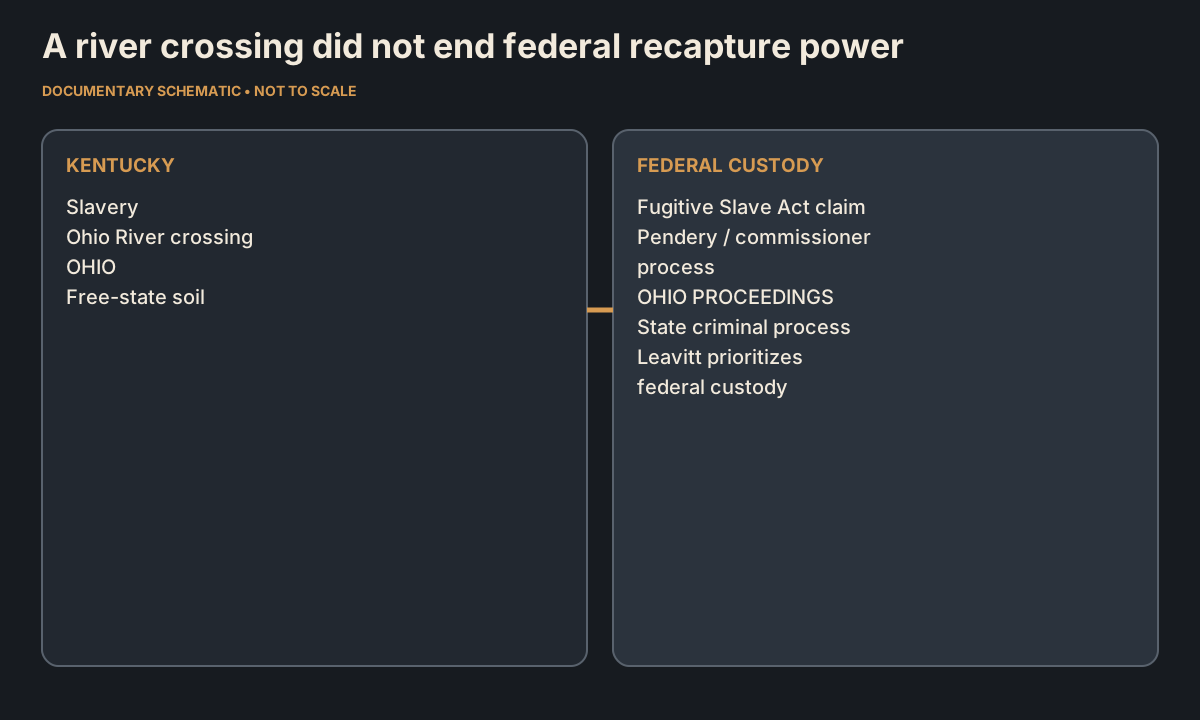
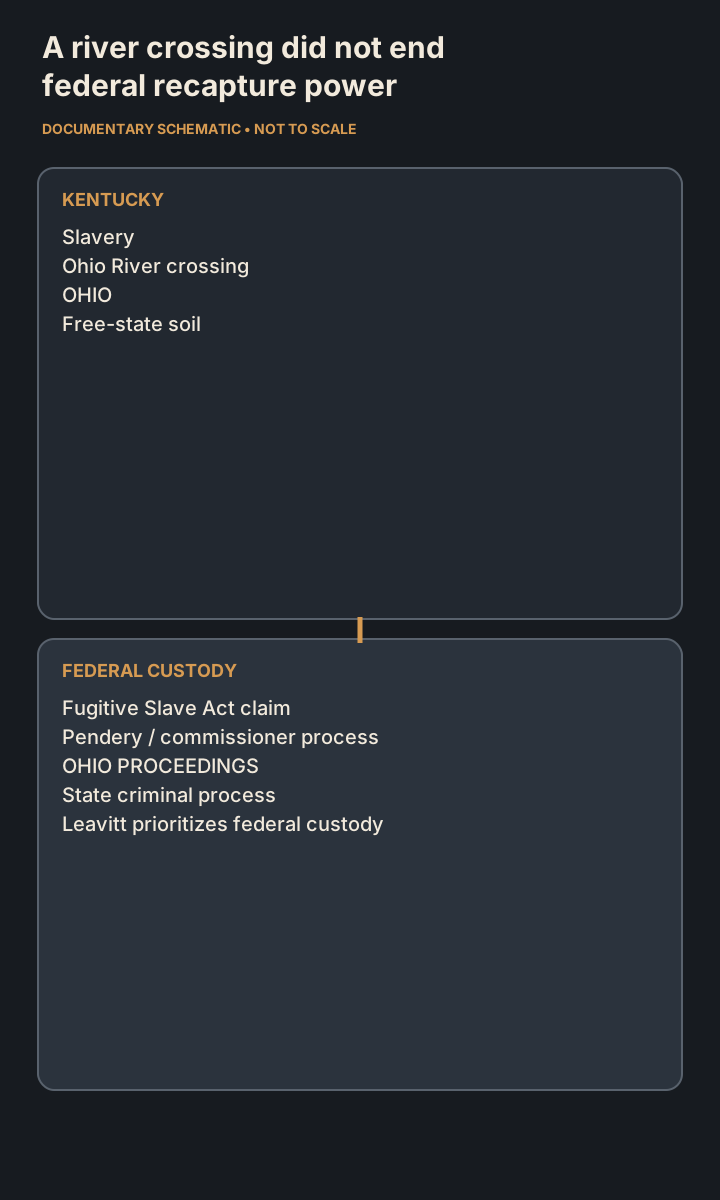
Simplified documentary reconstruction; not to scale. Evidence qualifications are written directly into the visual and explained in the adjacent text.
Evidence discipline
What the record supports
Status labels distinguish secure conclusions from uncertainty and rejected claims. Color is never the only signal.
MYTH
Crossing into Ohio made the Garner family legally secure because Ohio was a free state.
Ohio prohibited slavery, but the Fugitive Slave Act of 1850 created a federal rendition process that operated inside free states and was used against the Garners almost immediately.
Sources: SRC-001, SRC-019MYTH
The Garner case was simply a murder trial.
Ohio tried to create a murder prosecution, but the controlling proceeding that returned the family to slavery was a federal Fugitive Slave Act hearing. The conflict over which jurisdiction had custody became central to the case.
Sources: SRC-002, SRC-010, SRC-012MYTH
An Ohio court decided to treat Margaret as property instead of prosecuting her for murder.
The central rendition ruling came from U.S. Commissioner John L. Pendery, a federal officer. U.S. District Judge Humphrey H. Leavitt then held that federal custody attached first and had to be respected before Ohio's criminal process could proceed.
Sources: SRC-010, SRC-011, SRC-012MYTH
Margaret's lawyers wanted the murder charge dismissed.
Antislavery counsel and Ohio officials sought state criminal jurisdiction because it could keep Margaret in Ohio as a person accused of a crime rather than allow immediate federal rendition as an alleged fugitive from slavery.
Sources: SRC-002, SRC-010MYTH
Margaret was not allowed to say anything in the federal proceeding.
The Fugitive Slave Act generally barred an alleged fugitive from testifying on their own behalf. Historical legal scholarship indicates that Pendery nevertheless allowed Margaret limited testimony concerning an earlier stay in Ohio because the argument affected the claimed status of her children. That unusual allowance did not give her a jury trial or ordinary criminal-defense rights.
Sources: SRC-010, SRC-009LATER CLAIM
Abolitionists instructed Margaret to kill her child if recapture occurred.
Pendery asserted this decades later in his memoir, but his recollection contains factual errors about the family composition and no selected contemporaneous evidence establishes such an instruction. It should not be repeated as fact.
Sources: SRC-011DISPUTED
Margaret's enslaver was certainly the biological father of some of her children.
Modern scholars have examined the children's complexion, timing, slavery's pervasive sexual coercion, and contemporary comments. The documentary record supports serious concern about sexual exploitation but does not securely establish biological paternity for individual children.
Sources: SRC-006, SRC-008, SRC-018DISPUTED
Margaret deliberately caused her infant Cilla to enter the river during the later steamboat collision.
Contemporary abolitionist reporting recorded conflicting versions of the collision and the infant's drowning. Later accounts also differ. Robert Garner's 1870 interview reportedly denied that Margaret again tried to harm the children. The exact mechanism should remain unresolved.
Sources: SRC-004, SRC-015, SRC-018MYTH
Thomas Satterwhite Noble's 1867 'Modern Medea' is a documentary depiction of the 1856 scene.
Noble painted the work more than a decade later. The Library of Congress catalog description itself reflects later iconography and incorrectly describes two children as dead, whereas contemporary and scholarly reconstruction identifies Mary as the child who died during the recapture.
Sources: SRC-020, SRC-002, SRC-010MYTH
Toni Morrison's Beloved is a factual retelling of Margaret Garner's life.
Morrison drew inspiration from the Garner case, but Beloved is a work of fiction with different characters, chronology and artistic purposes. It should be linked as cultural legacy, not mined for historical details about 1856.
Sources: SRC-004, SRC-018, SRC-022DISPUTED
The family escaped on the night of January 28.
Modern reconstructions generally place departure late on January 27 and the river crossing/arrival in Ohio before or around dawn on January 28. Short summaries often use January 28 for the entire escape because that was the date of recapture.
Sources: SRC-007, SRC-009