
At about 4:15 on the morning of May 13, 1862, a Confederate military steamer approached Fort Sumter through the main channel of Charleston Harbor. Nothing about the vessel was supposed to look unusual.
Confederate and South Carolina flags were flying. The Planter was familiar harbor traffic. The men operating it knew the signals expected by the forts. On deck, Robert Smalls wore the coat and straw hat of Captain Charles Relyea.
Relyea was not aboard. Neither were the Planter's other white officers. The people running the vessel were Black men escaping slavery, and the women and children hidden aboard had joined them only minutes earlier. If Fort Sumter understood what it was seeing, the guns could end the escape.
The correct signal was given. The fort let the Planter pass. The freedom seekers still had one more danger ahead: the United States Navy saw an armed Confederate steamer coming toward the blockade and prepared to fire.
The Confederacy had already taught the escapees how to run the ship
The Planter was not an unfamiliar vessel suddenly seized by people who had never operated it. It was their workplace.
Built in Charleston in 1860, the 147-foot side-wheel steamer was privately owned by John Ferguson and leased for Confederate military use. It transported troops, guns, supplies and dispatches around Charleston Harbor.
White officers held formal command. Black crewmen possessed much of the practical skill.
Robert Smalls worked as a helmsman and pilot in all but the racialized title. John Small and Alfred Gourdine worked as engineers. Other enslaved men handled deck operations. Outside the normal crew were additional experienced Black sailors and workers, including harbor pilot Abram Allston.
The Confederate hierarchy assumed expertise could be safely separated from authority. The escape proved otherwise.
The white officers created the security failure
The Planter's white captain, mate and engineer developed a habit of going ashore at night. This violated standing orders. It also left the Black crew responsible for the vessel. In early May, the men began planning how to use that recurring absence.
The core idea was simple enough to state and extraordinarily dangerous to execute: take the Planter while the officers were ashore; collect the families; make the vessel look like routine Confederate traffic; pass the forts; reach the Union blockade.

The families had to be staged separately
The men were not planning to disappear alone.
Hannah Jones Smalls would go with Robert. John Small's wife Susan and their infant son Philip would go. Annie White and Lavinia Wilson would go. Children were part of the operation.
That made secrecy harder. Sixteen Black people could not gather around the Planter's Confederate berth without attracting attention. Current National Park Service research places the families around the Etiwan at the North Atlantic Wharf, where Charles Chisolm and others helped prepare the rendezvous. The Planter would first leave its berth with a smaller operating crew.
Only then would it pick up the rest.
The final accounting
Outcome
Freedom seekers reaching U.S. lines
Eight men, five women and three children.
Confederate guns captured
Two normal armament plus four transported guns.
Permanent recapture
The sixteen were not returned to Confederate enslavement.
Vessel transferred to U.S. service
Planter continued in federal service.

Sixteen people—not the larger totals sometimes repeated
The strongest contemporary count comes from Admiral Samuel Francis Du Pont. His May 13 report lists: 8 men 5 women 3 children That equals 16.
Current detailed National Park Service research reaches the same total.
The eight men were Robert Smalls, Abram Allston, John Small, Alfred Gourdine, Abraham Jackson, Gabriel Turner, Charles Chisolm and William C. Morrison.
The five women were Hannah Jones Smalls, Clara Jones, Susan Small, Annie White and Lavinia Wilson.
The three children were Elizabeth Smalls, Robert Smalls Jr. and Philip Small.
Current NPS research also corrects another common assumption: two members of the regular enslaved Planter crew, David Jones and Jack Gibs, did not join the escape.
Hannah's decision came with a cost
Successful escape stories can hide what was lost. Hannah Smalls had an older daughter, Charlotte, who had an infant of her own. Charlotte remained in Charleston. Hannah escaped with Clara, Elizabeth and Robert Jr.
That meant the plan to free part of the family also separated another part. Nothing about the successful arrival at the Union blockade makes that choice simple.
Selected chronology
Selected chronology
Secret planning
Black sailors and workers begin coordinating the escape.
White officers go ashore
The recurring security failure creates the opportunity.
Planter leaves Southern Wharf
The vessel heads toward the North Atlantic Wharf.
Families board
The group reaches sixteen.
Fort Sumter
The correct signal allows the vessel to pass.
USS Onward
White bedsheet prevents Union fire and the escape ends successfully.
Prize compensation authorized
Congress authorizes a share of Planter's appraised value for the Black captors.
May 12: the opportunity arrives carrying guns
The timing became even more significant on May 12. The Planter returned carrying extra artillery. The vessel normally had two guns. Four more were aboard for Confederate military use.
If the escape succeeded, the United States would receive not only sixteen freedom seekers and a useful ship, but six Confederate guns. That evening the white officers went ashore. The Black crew stayed behind. The operation began.
Harbor reconstruction
Sixteen freedom seekers through Charleston Harbor
The approximate route shows a collaborative operation in which maritime skill and performed Confederate authority opened a path to the Union blockade.
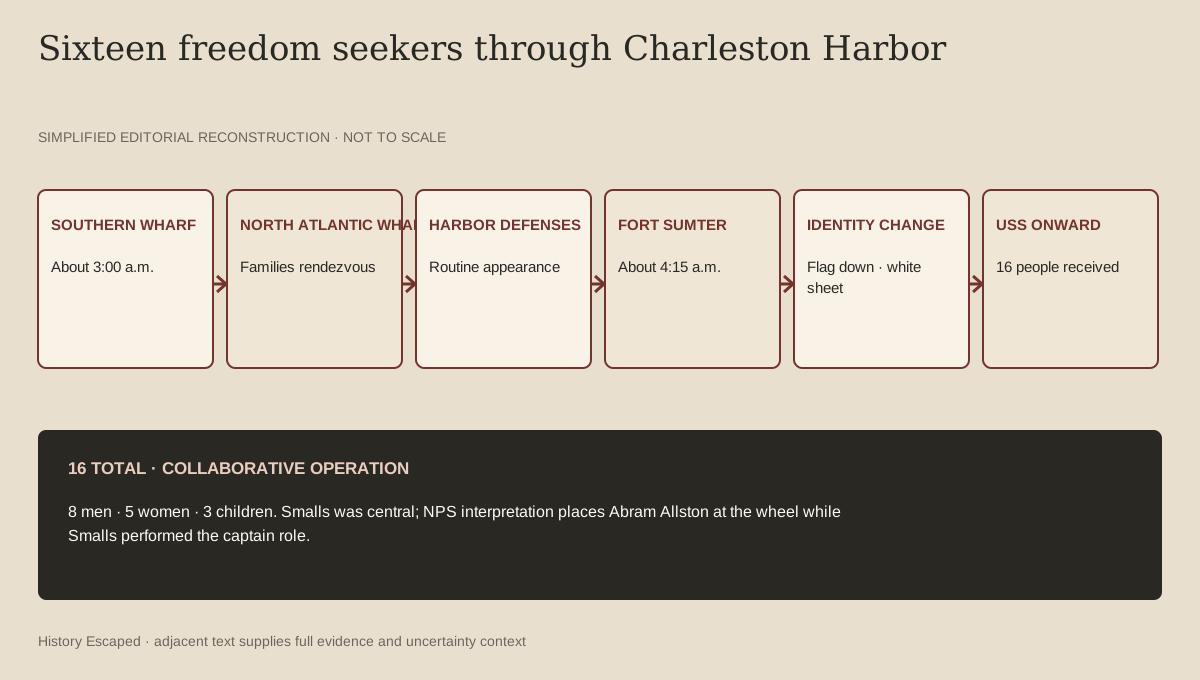
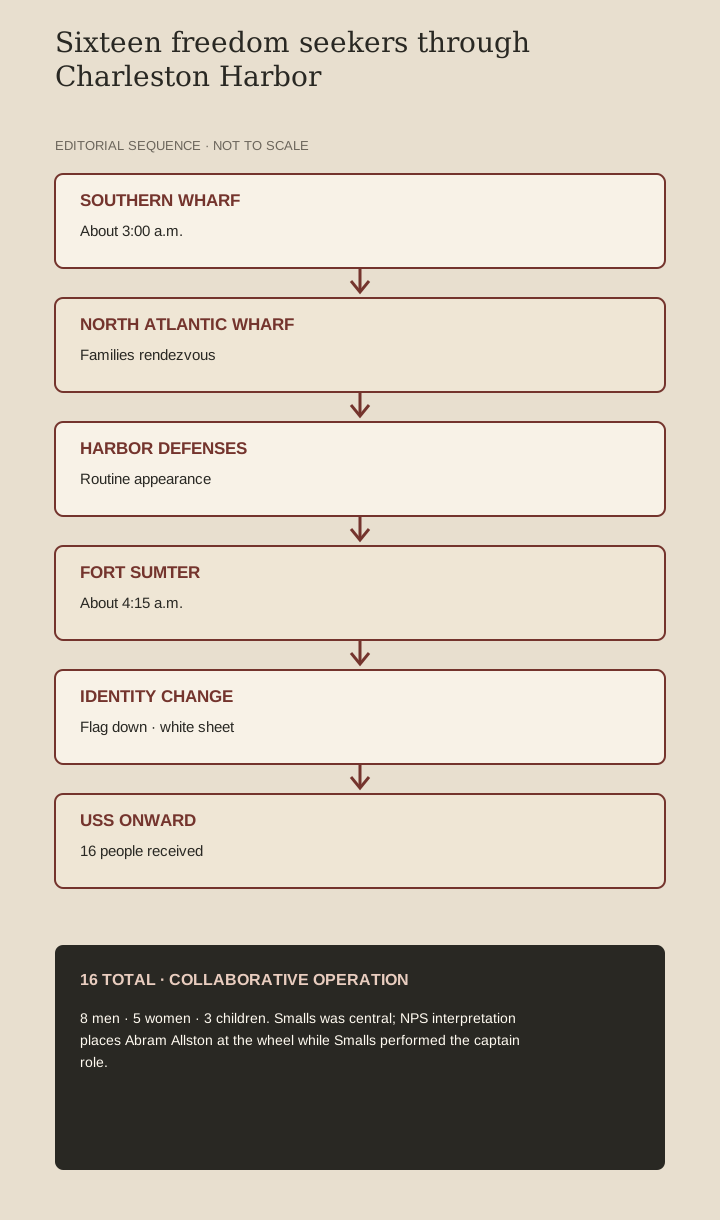
Simplified editorial reconstruction based on contemporary records and institutional interpretation; not to scale and not an exact GPS track or fort gun-arc map.
About 3:00 a.m.: the Planter leaves Southern Wharf
The boilers were made ready. At about three in the morning, the Planter moved away from Southern Wharf. It did not race for open water. Speed would look suspicious.
The vessel moved like ordinary harbor traffic. It headed up the Cooper River to North Atlantic Wharf. There, the families came aboard. Now all sixteen were committed.
Material evidence
Tools of Escape
The objects used in an escape reveal how a plan worked under constraint.
- 01Workplace, escape vehicle, disguise, and military prize in one.
Planter
147-foot side-wheel steamer used as Confederate Army transport.
- 02Supported the expected white-command silhouette.
Captain's coat and straw hat
Smalls wore Captain Relyea's clothing.
- 03Allowed the vessel to appear routine.
Whistle signals
Normal Confederate harbor signals.
- 04Preserved the vessel's expected identity.
Confederate and South Carolina flags
Kept flying inside the harbor.
- 05Prevented USS Onward from treating Planter as an attacker.
White bedsheet
Raised after clearing Confederate guns.
The captain disguise was only one part of the deception
The famous image is Robert Smalls in Captain Relyea's clothing. Current NPS research describes the captain's coat and straw hat. At distance, in the dark, that visual cue could help satisfy a sentry expecting a white officer to be visible. But the clothes could not fool Charleston Harbor by themselves.
The Planter also had to use the expected flags. It had to follow the expected route. It had to use the expected whistle signals. And it had to be operated with the confidence of people who actually knew the channel.
The disguise worked because every other part of the vessel's behavior agreed with it.
Evidence discipline
What the record supports
Status labels distinguish secure conclusions from uncertainty and rejected claims. Color is never the only signal.
DISPUTED
Robert Smalls personally steered every stage and was the uncontested sole commander.
Contemporary Union reports identify Smalls as pilot and leading figure, while current NPS research places Abram Allston at the wheel. Allston later claimed still greater credit. Smalls was central, but the operation was collaborative.
Sources: SRC-001, SRC-007, SRC-016MYTH
Smalls plus seventeen others escaped.
Du Pont's contemporary report gives 8 men, 5 women and 3 children: 16 total. Current detailed NPS research agrees.
Sources: SRC-002, SRC-007MYTH
All seven regular Black Planter crewmen escaped.
NPS says David Jones and Jack Gibs did not join. Five regular crewmen escaped with three additional men.
Sources: SRC-001MYTH
Planter was simply a commissioned Confederate Navy warship, CSS Planter.
It was privately owned and leased for Confederate military use as an armed Army transport/dispatch steamer. 'Confederate steamer Planter' is more precise.
Sources: SRC-001, SRC-005MYTH
The captain's hat alone fooled Fort Sumter.
The disguise worked with expected flags, correct whistle signals, normal route and real Black maritime expertise.
Sources: SRC-001, SRC-003MYTH
Once Fort Sumter was passed, the danger was over.
USS Onward prepared to fire until the freedom seekers raised a white bedsheet.
Sources: SRC-001, SRC-003MYTH
Prize money was divided equally among all sixteen.
The men's shares differed; most wives received no independent payment. Annie White and Lavinia Wilson received smaller individual awards.
Sources: SRC-015, SRC-017, SRC-020Who was at the wheel?
This is the most important historical complication in the famous version. Contemporary Union officers identified Smalls as the Planter's pilot and treated him as the principal figure in the escape. That recognition was immediate. But current National Park Service research reconstructs Abram Allston as the man physically at the wheel during the escape while Smalls wore the captain's clothing and managed the visible deception and signals.
Allston later argued that even this did not give him enough credit. He accused Smalls of taking command credit that should have been shared.
Smalls rejected those accusations. The evidence does not require turning Smalls into a fraud or Allston into a footnote. Smalls was central. Allston's pilot role was important.
The escape was collaborative.
Problem → response
Escape was a sequence of problems
Each response solved a practical obstacle while often creating the next one.
- 01→
Obstacle
Fortified harbor
Forts and batteries could sink the vessel.
Response
Routine flags, route and signals avoided alarm.
- 02→
Obstacle
Families had to escape too
Men risked leaving wives and children enslaved.
Response
Families were staged separately and picked up after departure.
- 03→
Obstacle
Expected white command
A Black-only military crew might attract suspicion.
Response
Smalls wore the captain's clothing.
- 04→
Obstacle
Fort Sumter
The decisive gun position controlled the main channel.
Response
Correct signal at about 4:15 a.m.
- 05→
Obstacle
Union friendly fire
Onward initially saw an enemy steamer.
Response
Confederate flags down, white bedsheet up.
The harbor was a chain of controlled spaces
Charleston's defenses made the short distance to the blockade unusually dangerous. Castle Pinckney and Fort Ripley formed part of the inner defensive environment. Fort Johnson and patrol activity created another challenge. Fort Moultrie stood across the channel from Fort Sumter.
The freedom seekers did not defeat these positions by force. They made the Planter look as though it belonged. That was the only realistic way to pass artillery capable of destroying the vessel.
Fort Sumter was the real test
The Planter approached Fort Sumter at about 4:15 a.m. The proper signal was given. The fort did not fire. A Confederate sentry report later recorded the vessel as what he believed was ordinary guard-boat traffic.
This is one of the rare moments in escape history where the deceived side's own record directly confirms the deception. The sentry saw the escape. He simply classified it incorrectly.
The vessel had to change identities immediately
Inside the Confederate harbor, Confederate flags were protection. Outside the harbor, those same flags could be fatal. USS Onward saw an armed Confederate vessel approaching. Its acting commander, John Frederick Nickels, prepared his crew to fight.
The freedom seekers had passed the Confederate guns only to face the possibility of being killed by the people they were trying to reach. The Confederate flags came down. A white bedsheet went up. The signal worked.
USS Onward receives sixteen freedom seekers and a military prize
The Planter came alongside the Onward. The escape was over. Du Pont's immediate report recorded eight Black men, five women and three children. The vessel itself was valuable.
So were its guns and cargo. And the men aboard carried intelligence about Charleston's defenses, waterways and Confederate dispositions. The Confederacy had forced Black workers to learn its military system. Those workers now turned that knowledge over to the United States.
Why “CSS Planter” is not the best label
The ship is often called CSS Planter. That shorthand can make it sound like a standard commissioned Confederate Navy warship. The more precise description is different. The Planter was privately owned.
It was leased for Confederate military service. It operated as an armed transport and dispatch vessel attached to Confederate Army operations around Charleston. The more precise labels are: Confederate steamer Planter or Confederate Army transport Planter.
Prize money exposed another hierarchy
Congress authorized financial compensation for the capture. Smalls received the largest initial share, $1,500. Other men received smaller sums. The women were treated differently.
Most wives received no separate award because officials assumed they benefited through their husbands. Annie White and Lavinia Wilson received $100 each because officials categorized them as women without male protectors in the party. The government recognized an extraordinary act of self-liberation while still applying nineteenth-century assumptions about gender and dependency.
The escape did not consist of one hero and fifteen passengers
Robert Smalls became famous almost immediately. That fame was deserved. He later served the United States, became a ship commander, entered Reconstruction politics and served in Congress. But May 13 did not happen because one man performed every job.
Engineers kept the machinery running. Pilots handled the harbor. Crewmen worked the deck. Chisolm and others helped stage the families.
Women brought children into a plan that could end in death. Every person aboard accepted the consequences if the deception failed. The correct history keeps Smalls at the center without making everyone else disappear.
What made the escape work
The operation succeeded because the freedom seekers understood the Confederate harbor system better than that system understood them. The officers believed Black crewmen could safely be left aboard. The crew knew they could operate the ship. The forts relied on flags and signals.
The freedom seekers knew the flags and signals. The harbor expected a white commander. Smalls supplied the expected silhouette. The Union blockade expected an enemy ship.
A white bedsheet changed the message at the last possible stage. The same vessel communicated two opposite things within minutes:
We belong here.
Then:
We surrender. Do not fire.
That transformation carried sixteen people out of slavery.
Why the Planter belongs at the center of escape history
The Confederacy supplied the vessel. It supplied the guns. It supplied the route. It supplied the signal system.
And through coerced labor, it supplied the knowledge needed to operate all of them. The freedom seekers turned those things against the system that held them. The best version of the story is therefore bigger than the famous image of Robert Smalls in a captain's hat. It is the story of sixteen people making a Confederate military system participate in their own escape.
Fort Sumter saw them. And let them pass.