
Ahmed Ben Bella did not leave Blida prison alone. On the night of 15–16 March 1952, he escaped with fellow Algerian nationalist Ahmed Mahsas from a colonial prison holding men tied to the Organisation Spéciale, the clandestine paramilitary structure of the PPA-MTLD.
The broad outline is secure. A window bar was filed through. Other prisoners helped conceal the work. Ben Bella and Mahsas got beyond the prison walls and disappeared into a nationalist support network. The famous details are less tidy.
At a Glance
- Date: Night of 15–16 March 1952
- Place: Civil prison, Blida, French Algeria
- Escapees: Ahmed Ben Bella and Ahmed Mahsas
- Political organization: Organisation Spéciale / PPA-MTLD
- Core method: Filed window bar, window exit and assisted wall crossing
- Outside support: Nationalist clandestine network
- Immediate outcome: Successful escape and concealment inside Algeria
- Longer route: France and Switzerland before Cairo
- Political significance: Ben Bella returned to the nationalist underground and later became part of the external leadership that helped prepare the 1954 armed uprising
- Major evidence caution: The file’s provenance and several dramatic mechanics come from later accounts
From Decorated Soldier to Anti-Colonial Militant
Ben Bella’s path to Blida prison began before the Algerian War. He had served in the French army during the Second World War and was decorated for bravery. After returning to Algeria, he entered a political world increasingly shaped by demands for independence and by anger over colonial repression.
The violence surrounding Sétif, Guelma and Kherrata in May 1945 became an important turning point for a generation of Algerian nationalists. Ben Bella joined the nationalist movement associated with the PPA and later the Mouvement pour le triomphe des libertés démocratiques, or MTLD. By the late 1940s, he had moved beyond ordinary party politics.
The Organisation Spéciale
The MTLD created the Organisation Spéciale, usually abbreviated OS, as a clandestine structure intended to prepare for armed action. Ben Bella became one of its important leaders.
The OS built underground cells, trained militants, hid weapons and sought money for future operations. In April 1949, militants seized more than three million francs from the central post office in Oran.
The operation made Ben Bella more visible to French security services. In 1950, police penetrated and dismantled much of the OS network. Ben Bella was arrested in Algiers in May.
The Blida Prisoners
The crackdown put many OS militants behind bars. Blida became one of the important sites of detention and trial.
Ben Bella received a heavy prison sentence connected to his nationalist activity. Sources disagree over the exact term: seven years appears in a 1956 Le Monde profile and in Algerian institutional accounts, while other references give eight or ten.
The disagreement matters less than the immediate reality. Ben Bella expected years in prison. So did Ahmed Mahsas.
Ahmed Mahsas
Mahsas had also been part of the OS leadership. He had organized within the nationalist movement before the police crackdown and was sentenced to prison after the organization’s dismantling.
His name varies in later sources. Some call him Ahmed Mahsas.
Others call him Ali Mahsas. Later scholarship based partly on an interview with Mahsas himself uses Ahmed, which is the clearest form for the escape story. He and Ben Bella decided not to serve out their sentences.
A Prison Break Built by a Group
Later retellings often simplify the escape into a single image: Ben Bella secretly cuts through iron bars and disappears. The better evidence points to a collective operation.
M’Hamed Yousfi, a former OS militant who later wrote a history of the organization, described prisoners coordinating the work inside Blida. The operation took advantage of evening religious and patriotic singing.
The noise helped conceal the sound of metal being filed. The prison population was not merely background. Other detainees were part of the escape.
Filing the Bar
Yousfi’s account names Arab Mohamed and Bouda Abdelkader as prisoners who took turns working on the central bar of the window. A file moved back and forth while chanting and singing continued.
The bar eventually came free. This is more convincing than the popular version in which Ben Bella alone patiently sawed his way out.
The Guardian’s later obituary likewise summarizes the escape as one made possible by sawing through cell bars. What remains disputed is how the file entered the prison.
The File in the Bread
One familiar version says the tool was hidden inside a loaf of bread. Another later account says Mohamed Boudiaf helped get it to Ben Bella.
Other traditions attribute the file to a lawyer, a prison intermediary or outside militants. These stories cannot all be treated as equally secure.
The file itself is well supported. Its exact delivery chain is not. That distinction is important because the escape has accumulated the kind of detail that often attaches itself to successful prison breaks after the fact.
Waiting for the Guard Rounds
Yousfi dates the decisive operation to the night of 15–16 March 1952. The work was timed around prison routine.
By his account, Ben Bella and Mahsas moved through the opened window at about two in the morning, between guard rounds. They had left the cell.
They were not yet outside the prison. Walls still separated them from freedom.
The First Barrier
Later narratives describe fellow prisoners helping the two men reach the first wall. Some accounts turn the sequence into a precise human pyramid.
The broad idea of prisoner assistance is credible and consistent with Yousfi’s collective description. The exact arrangement of bodies, footholds and wall measurements is not documented well enough to reproduce as architecture.
Ben Bella and Mahsas crossed the first obstacle. Outside help mattered at the next one.
The Rope
Yousfi’s narrative describes a rope being coordinated with helpers outside the inner prison area. Ben Bella used it in the final crossing.
That basic rope-and-wall sequence appears repeatedly in later Algerian accounts. Some versions add that Mahsas injured himself during the descent or wall crossing.
That detail belongs to the later narrative tradition and is not necessary to establish the escape. The secure outcome is that both men got out.
The Alarm
By daylight, French authorities had two politically important prisoners missing from Blida. The escape was embarrassing not only because Ben Bella had been under a major sentence.
He possessed experience, contacts and knowledge from the OS underground. Police pressure had dismantled much of that structure in 1950.
The prison break returned two of its experienced militants to clandestinity. The next problem was surviving the search.
Hiding in Algeria
Ben Bella did not go directly from Blida to Cairo. A 1956 Le Monde profile says that after the escape he remained concealed in Algeria for several months.
That interval is easy to lose because later biographies compress the story into “escaped from Blida and fled to Cairo.” The clandestine period mattered.
Police knew whom they were looking for. Ben Bella needed safe houses, false identities, transport and people willing to accept the risk of helping him.
The Dog-Kennel Story
One later story gives that hidden period a memorable image. The Independent’s obituary says Ben Bella and Mahsas once escaped a search by spending the night with a dog in its kennel while authorities sealed the city.
It is possible. It is also a late anecdote.
No strong contemporary record confirms that exact hiding place. The incident remains a colorful later claim, not the defining proof of how the fugitives survived.
Getting Across the Mediterranean
The larger underground network is better supported. Later testimony from nationalist organizers describes efforts to move Ben Bella and Mahsas out of Algeria by sea.
One participant recalled being summoned to arrange their evacuation to France and negotiating passage with a maritime contact. Other accounts similarly place Ben Bella arriving clandestinely in Marseille.
From there he moved into the Algerian nationalist network in metropolitan France. The two escapees did not necessarily follow identical political paths after that.
Mahsas became deeply involved with the nationalist organization in France. Ben Bella was eventually headed farther east.
Paris and Switzerland
Ben Bella spent time hidden in Paris. Later sources disagree over the exact address and duration.
Some place him in a small room near rue Rochechouart. Others give different Paris details.
Those specifics are less important than the secure route pattern. Larousse says Ben Bella eventually reached Cairo by traveling through France and Switzerland.
The movement required clandestine documents and party contacts. Blida was no longer the only barrier. He now had to cross international borders while wanted by French authorities.
Cairo
By 1953, Ben Bella had reached Cairo. There he joined Hocine Aït Ahmed and Mohamed Khider, already important figures in the nationalist movement’s external delegation.
Cairo offered something the underground inside Algeria could not. It provided access to Arab political networks, foreign governments, broadcasting, money and weapons channels.
Ben Bella increasingly concentrated on military questions and external support. His escape from Blida had moved him from a prison cell back into the strategic argument over what Algerian nationalism should do next.
The MTLD Was Coming Apart
The nationalist movement was not unified. Inside the MTLD, conflict deepened between supporters of longtime leader Messali Hadj, members of the party’s central committee and former OS militants impatient with legal political strategies.
The men who had built the OS had watched the organization collapse under police repression. Some believed the party leadership had abandoned them.
Daho Djerbal’s later scholarship, drawing in part on an interview with Ahmed Mahsas, emphasizes how prison escapes by former OS militants intensified that sense of rupture. For them, Blida was not simply a personal escape. It reinforced the belief that the armed underground had to be rebuilt outside the old party structure.
From the OS to the CRUA
In 1954, the internal MTLD crisis reached breaking point. Former OS figures including Mohamed Boudiaf, Didouche Mourad, Mostefa Ben Boulaïd, Larbi Ben M’Hidi, Rabah Bitat and others moved toward a new revolutionary organization.
The Comité révolutionnaire d’unité et d’action, or CRUA, emerged as an attempt to break through the political deadlock. Ben Bella was part of the wider group of nine historic leaders associated with the movement that became the Front de libération nationale.
The FLN did not exist when he climbed out of Blida. That matters.
The escape returned him first to the older nationalist underground. The FLN came later.
The External Front
From Cairo, Ben Bella became one of the most visible external representatives of the developing armed independence movement. He worked on foreign support and military supply.
Egypt under Gamal Abdel Nasser became increasingly important to Algerian nationalist strategy. Ben Bella’s visibility later encouraged both admirers and French authorities to portray him as the single mastermind of the revolution.
That is too simple. The uprising of 1 November 1954 was organized by a broader network of internal and external leaders.
Ben Bella’s role was important. It was not solitary.
Captured Again
The freedom gained at Blida lasted more than four years. In October 1956, Ben Bella and several other Algerian nationalist leaders boarded an aircraft traveling from Morocco toward Tunisia.
French authorities intercepted the plane and arrested them. Ben Bella returned to prison.
This second captivity would last until the end of the Algerian War. The 1956 arrest is sometimes more famous internationally than the Blida escape. The two events form a striking pair: an anti-colonial militant who escaped a prison in 1952 was seized again in midair in 1956.
Why Blida Matters
The Blida escape did not create the Algerian Revolution. It did something more specific.
It returned an experienced underground organizer to a movement that was deciding whether electoral nationalism had reached its limits. The prison break also shows the collective infrastructure behind political escape.
Ben Bella and Mahsas needed a filed bar. They needed other prisoners to conceal the noise.
They needed help crossing the walls. They needed safe houses after the alarm.
They needed a clandestine route out of Algeria. The most famous name is Ben Bella. The escape itself belonged to a network.
Evidence discipline
What the record supports
Status labels distinguish secure conclusions from uncertainty and rejected claims. Color is never the only signal.
MYTH
Ahmed Ben Bella escaped from Blida prison alone.
Ahmed Mahsas escaped with him, and the operation depended on assistance from other imprisoned and outside militants.
Sources: SRC-004, SRC-005, SRC-006DOCUMENTED
The escape date was 16 March 1952.
Multiple independent chronologies support 16 March; Yousfi places the operation during the night of 15–16 March.
Sources: SRC-001, SRC-004, SRC-005, SRC-012DISPUTED
Ben Bella simply cut through the bars with a knife hidden in bread.
The strongest detailed account describes a file used on a window bar. Later sources disagree over who smuggled in the tool and whether it was hidden in bread.
Sources: SRC-005, SRC-007, SRC-010MYTH
Ben Bella personally performed all of the filing.
Yousfi names Arab Mohamed and Bouda Abdelkader as fellow prisoners who took turns filing the bar.
Sources: SRC-005UNKNOWN
The exact wall geometry and climbing sequence are securely known.
Later narratives describe prisoner assistance, walls and rope use, but precise measurements and positions are not securely documented.
Sources: SRC-005, SRC-010LATER CLAIM
Ben Bella and Mahsas hid overnight in a dog kennel immediately after escaping.
The anecdote appears in a much later obituary and is not independently confirmed by the stronger source set.
Sources: SRC-008MYTH
Ben Bella went directly from Blida prison to Cairo.
Sources indicate months of hiding in Algeria followed by clandestine movement through France and Switzerland before Cairo.
Sources: SRC-001, SRC-002, SRC-011MYTH
Ben Bella escaped directly into the FLN in March 1952.
The FLN did not yet exist. He returned to the PPA-MTLD/OS nationalist underground and later participated in the CRUA/FLN process.
Sources: SRC-002, SRC-003, SRC-006DISPUTED
Ben Bella’s principal prison sentence is universally documented as exactly seven years.
Le Monde and Algerian institutional sources give seven years, Larousse gives eight, and some later narratives give ten; a separate later life sentence in absentia further complicates retellings.
Sources: SRC-001, SRC-002, SRC-004, SRC-011Documentary reconstruction
Documented mechanism and disputed detail
A case-local editorial visual separates the documented sequence from uncertainty without implying exact modern geography or operational detail.
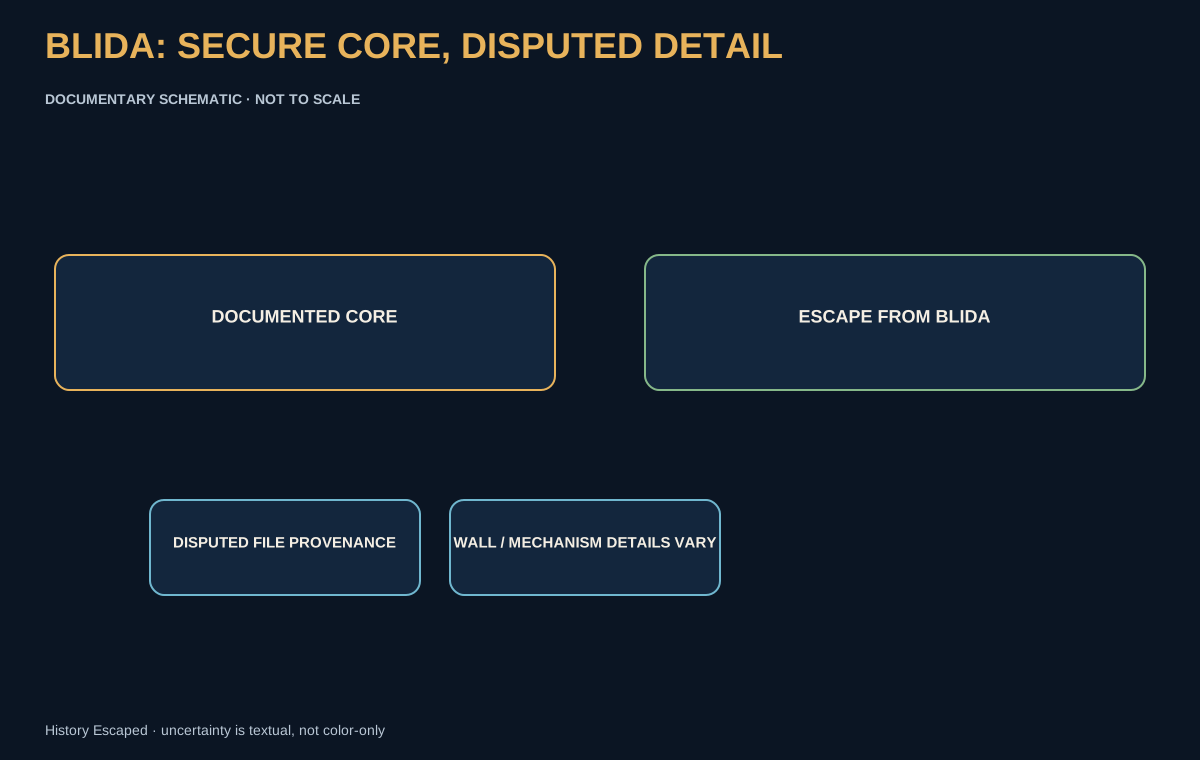
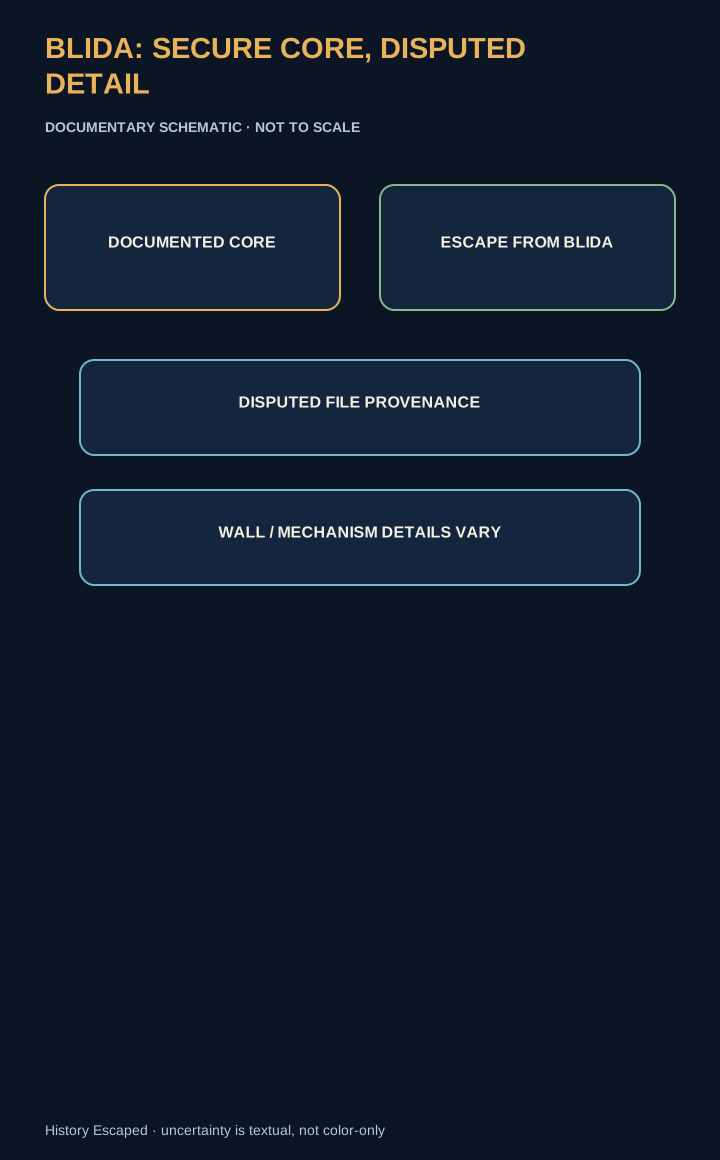
Simplified editorial reconstruction based on the cited historical record; not to scale. Uncertainty is stated directly in the visual and adjacent text.