
After more than two decades on Réunion, Abdelkrim el-Khattabi was finally leaving the island in 1947. France had not restored him to Morocco, where he had led the Rif resistance against Spanish and French power in the 1920s. Instead, French authorities authorized a transfer to southern France. Abdelkrim, his family and entourage boarded the Katoomba for a voyage that was supposed to end under a new form of French-controlled residence.
It never did. At the northern end of the Suez Canal on 31 May 1947, Abdelkrim left the ship at Port Said and did not return. Egyptian authorities allowed him through, his party’s baggage was ordered off the vessel, and he placed himself under Egyptian protection. The Katoomba continued toward Marseille without the man France expected to receive.
The episode is often compressed into a dramatic sentence: Abdelkrim “escaped at Suez.” The surviving record is more revealing when the ports, dates, and competing explanations are kept separate. The ship reached Suez on the southern end of the canal before the decisive disembarkation at Port Said. Contemporary reports also show that the question of whether Abdelkrim had planned the move in advance was disputed almost immediately.
At a Glance
Who: Mohamed ben Abd el-Krim el-Khattabi, widely known as Abdelkrim, former leader of the Rif resistance and Republic of the Rif.
Confinement: French-imposed exile on Réunion from 1926 to 1947, followed by a French-directed transfer to residence in southern France.
Escape: Abdelkrim left the Katoomba at Port Said on 31 May 1947 and refused to continue toward Marseille.
Outcome: Egyptian authorities accepted his presence and King Farouk extended protection. Abdelkrim remained in Egypt and reentered North African anticolonial politics.
Evidence issue: Contemporary reports and later recollections disagree over how far the escape was prearranged and exactly when Abdelkrim committed to it.
From the Rif to Réunion
Abdelkrim’s exile grew out of the Rif War. In northern Morocco he had led a resistance movement that fought first Spanish forces and then a combined Franco-Spanish campaign. He surrendered to the French in May 1926. Later that year he was removed from Morocco and sent with members of his family to Réunion, a French possession in the Indian Ocean.
Réunion was not a prison island in the conventional penal sense, and Abdelkrim did not spend twenty-one years behind bars. His confinement was political and geographic. French power determined where he could live and kept him far from Morocco, while his household established a life on the island. He lived first in the Saint-Denis area and later at Trois-Bassins, where the family acquired property and pursued agricultural activity.
Over the years, proposals surfaced to move him closer to Europe. Jean-Louis Miège’s scholarly biographical entry notes discussions of a transfer in 1932 and 1936, but no transfer occurred then. By 1947, age, health, family needs, and a changed postwar political environment made the question more urgent.
On 10 February 1947, according to a contemporary French account published after his escape, the governor informed Abdelkrim that he would be permitted to move to France. French officials later emphasized that he had accepted the arrangement and had made statements of loyalty. Those declarations became part of Paris’s accusation that his subsequent departure in Egypt violated commitments he had given. They are also evidence of the peculiar status of the transfer: France described it as a concession, but Abdelkrim was still not being restored to the country from which he had been removed.
The Voyage North
The travelling party boarded the Katoomba, a passenger ship carrying Abdelkrim, members of his family and entourage, and extensive baggage. Contemporary and later sources do not agree on the party’s exact size. A contemporary TIME report gave a retinue of 40, while later scholarship describes approximately 41 and notes other accounts that reach 52. “Roughly forty” is therefore more defensible than presenting one of those totals as certain.
The ship itself has also accumulated imprecise descriptions. It is sometimes called French, Australian, Greek, or Panamanian, depending on whether a writer is referring to its construction and long Australian career, its postwar ownership, its registry, or the French service for which it was then being used. What matters to the escape is simpler: the Katoomba was the vessel carrying Abdelkrim from Réunion toward Marseille under a transfer arranged by French authorities.
Later reconstructions of the voyage add an important intermediate point. A telegram preserved in the Mohamed Ali Eltaher papers reported the Katoomba leaving Aden on 23 May. By then North African and Arab activists in Cairo knew Abdelkrim was approaching Egypt and began discussing whether the canal passage could become an opportunity to remove him from French control.
How much Abdelkrim knew before reaching Egypt is less certain. The strongest contemporary account places the Katoomba at Suez on the evening of Thursday, 29 May. There Abdelkrim received Arab visitors. According to the AFP dispatch later published by Le Monde, he still spoke of his intention to live in France under the terms arranged by the French government, while adding that he would have preferred Egypt if the choice had been his.
That statement matters because it complicates later versions in which every stage of the operation had already been settled. It does not prove that Abdelkrim had no escape plan; two days later he himself reportedly said he had considered escape earlier. It does show that the surviving contemporary record did not regard the final decision as obvious while the ship was at Suez.
Suez, Port Said, and the Decision
Suez and Port Said are frequently blurred together in retellings of the escape. They are opposite ends of the canal. Suez, on the Red Sea side, was the earlier contact point. Port Said, on the Mediterranean side, was where Abdelkrim actually left the ship for good.
The contemporary AFP dispatch from Port Said is unusually specific. It reported on 31 May that Abdelkrim disembarked only minutes before the Katoomba was due to depart. Egyptian authorities had received special instructions concerning him and permitted him to pass the customs enclosure. Police then requested that baggage belonging to his party be unloaded. Abdelkrim and his companions remained in Port Said while the ship continued without them.
That sequence looks less like a physical breakout than a jurisdictional and political rupture. Abdelkrim did not force a door, overpower an escort, or secretly vanish into the city. He stepped off a ship in Egyptian territory, declined to continue the French-directed journey, and encountered authorities willing to let him remain.
The motive and planning behind that step were already contested by 3 June. One explanation reported in Paris was Abdelkrim’s own: he had contemplated escape after learning on Réunion that France intended to transfer him. The alternative was that Egyptian authorities or nationalist intermediaries presented him with an opportunity during the canal passage and that he decided to accept it only then.
The Egyptian government’s public position added another layer. Contemporary French reporting said news agencies were claiming that Egyptian officials had conveyed an explicit invitation from King Farouk. Egypt’s embassy in Paris denied that the government had formally invited him, while indicating that Egypt would not refuse him refuge if he refrained from political activity. Whatever the diplomatic wording, Egyptian arrangements for moving Abdelkrim from Port Said were already in place, and he quickly came under royal protection.
Was It a Planned Rescue?
A much more detailed version survives in the later biography and papers of Mohamed Ali Eltaher, the Palestinian journalist and anticolonial activist. In that account, Eltaher and members of the Arab Maghreb Bureau learned that the Katoomba was approaching, contacted King Farouk, divided supporters between Suez and Port Said, and coordinated with a royal emissary.
The Eltaher reconstruction says Abdelkrim received Farouk’s asylum proposal at Suez, accepted it in principle, consulted his family, and confirmed the decision at Port Said. It further describes a deliberate scenario in which Abdelkrim would appear to leave the ship as an ordinary visitor, then present the Egyptian government with a formal request for asylum. From the governor’s office he and his party were taken onward toward Cairo and royal hospitality.
This account is plausible in broad outline because it fits facts independently visible in contemporary reporting: Abdelkrim received Arab and Egyptian visitors, Egyptian authorities had special instructions, his passage through Port Said was facilitated, and transport arrangements existed after he left the ship. It is not independent proof of every conversation, private decision, or step attributed to the organizers.
The tension between the sources is therefore part of the history rather than a problem to be edited away. Contemporary reporting captured uncertainty while the diplomatic dispute was unfolding. The Eltaher material supplies the organizers’ later inside account. Together they support a planned political opportunity that Abdelkrim accepted, but they do not justify claiming that every detail of the final escape had been fixed before the Katoomba reached Egypt.
An Escape That Changed His Political Position
The immediate French reaction was angry. Paris treated Abdelkrim’s action as a breach of his commitments, and the episode became a diplomatic dispute with Egypt. Within days France’s ambassador in Cairo was called back to Paris for consultations. French politicians and newspapers argued over both Abdelkrim’s conduct and the failure of French authorities to prevent his departure.
Egyptian opinion was divided as well. Some commentators celebrated King Farouk’s protection of a famous anticolonial figure; others worried that the affair complicated Egypt’s own diplomatic interests. The disagreement itself shows why calling the event a simple rescue or a simple betrayal obscures the stakes. Abdelkrim had moved from French-controlled exile into the politics of a sovereign Arab state at a moment when North African nationalist movements were building stronger regional networks.
The change was rapid. By July 1947, United States diplomatic reporting from Cairo treated Abdelkrim as one of the leading figures influencing local North African nationalist activity. Later that year he became central to the Committee for the Liberation of the Arab Maghreb, alongside nationalist leaders from Morocco, Algeria, and Tunisia. The committee’s program sought coordinated independence across North Africa rather than a return to the limited political isolation Abdelkrim had endured on Réunion.
He never resumed the voyage to France. Nor did he return permanently to Morocco. Abdelkrim remained based in Cairo until his death in 1963, using his Egyptian exile as a platform for a much more active political role than France had permitted on Réunion.
What the Escape Actually Was
Abdelkrim’s 1947 escape belongs to the history of escape even though it lacks the physical mechanics of a prison break. The confinement was imposed through exile, surveillance, geographic removal, and control over destination. The decisive act was a refusal to remain inside that system once the ship entered a jurisdiction willing to protect him.
The best-supported chronology is narrow but clear. The Katoomba reached Suez by 29 May; Abdelkrim met visitors there and openly expressed a preference for Egypt. On 31 May, at Port Said, he left the vessel shortly before its departure, Egyptian officials facilitated his entry, and he requested or accepted protection that prevented the French transfer from continuing. Cairo, not Marseille, became the endpoint.
What remains disputed is the hidden architecture behind those public steps: when Abdelkrim finally decided to stay, how explicit Farouk’s invitation was before he disembarked, and how much of the Port Said sequence had been scripted in advance. Those uncertainties do not weaken the escape. They explain its character. Abdelkrim got free not by defeating a physical barrier, but because political opportunity, Egyptian sovereignty, and his own refusal converged at the edge of the Mediterranean.
Evidence discipline
What the record supports
Status labels distinguish secure conclusions from uncertainty and rejected claims. Color is never the only signal.
WELL-SUPPORTED
Abdelkrim’s decisive escape occurred at Port Said on 31 May 1947, not at Suez.
Contemporary AFP reporting is datelined Port Said, 31 May and distinguishes an earlier Suez stop on 29 May. The French diplomatic archive inventory and Encyclopédie berbère independently identify Port Said and 31 May.
Sources: SRC-001, SRC-004, SRC-005DISPUTED
The escape was fully planned with King Farouk before the Katoomba reached Egypt.
Later Eltaher material describes extensive advance coordination, but contemporary reporting presented both advance-planning and last-minute-decision explanations, while Egypt’s embassy denied an express royal invitation.
Sources: SRC-002, SRC-007, SRC-008DISPUTED
Abdelkrim decided only at the last minute to remain in Egypt.
The 31 May AFP report considered a late decision plausible because Abdelkrim still spoke at Suez of proceeding to France; by 3 June he was reported as saying he had contemplated escape earlier.
Sources: SRC-001, SRC-002UNKNOWN
Exactly 52 members of Abdelkrim’s entourage escaped with him.
Published counts differ. Contemporary reporting gives about 40, and later scholarship records roughly 41 while noting other sources that give 52.
Sources: SRC-008, SRC-009MYTH
The Katoomba was straightforwardly a French-owned ship.
Specialist ship history records postwar Greek ownership and Panamanian registry. French charter/operator descriptions vary, so the vessel should be identified by name and role rather than simplified nationality.
Sources: SRC-010Documentary reconstruction
Suez contact and the Port Said decision
A case-local editorial visual separates the documented sequence from uncertainty without implying exact modern geography or operational detail.
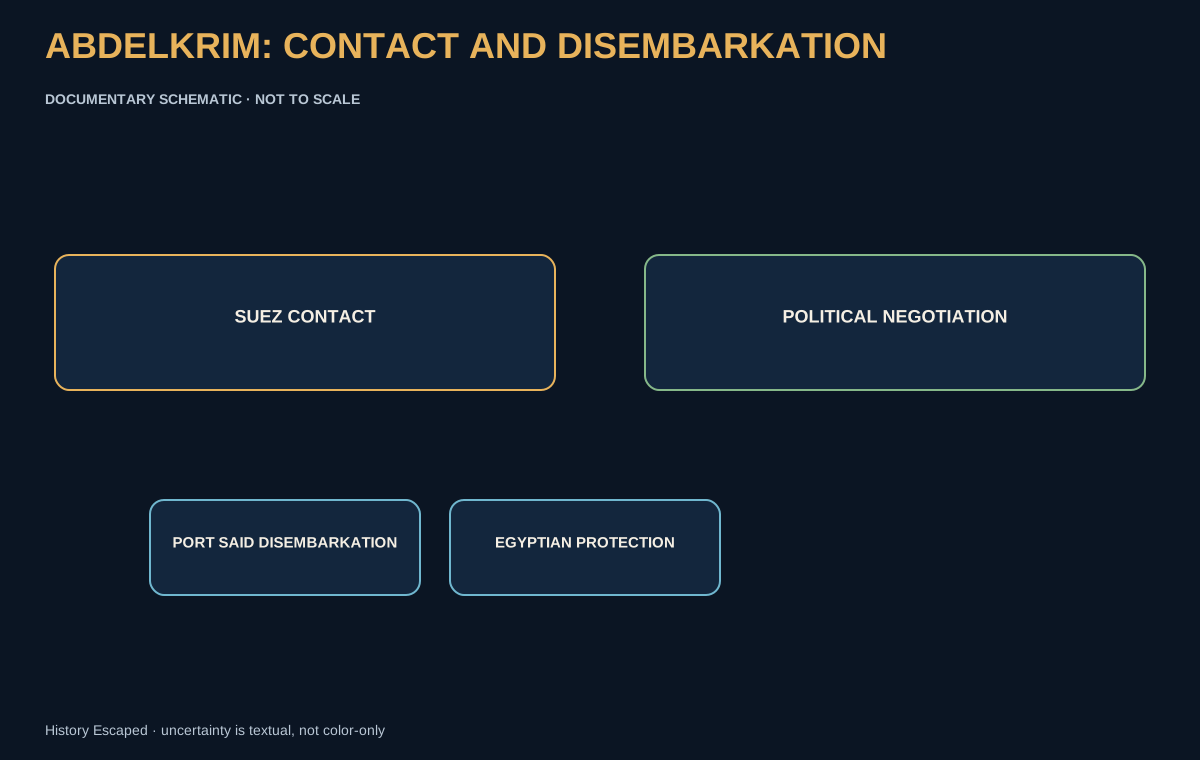
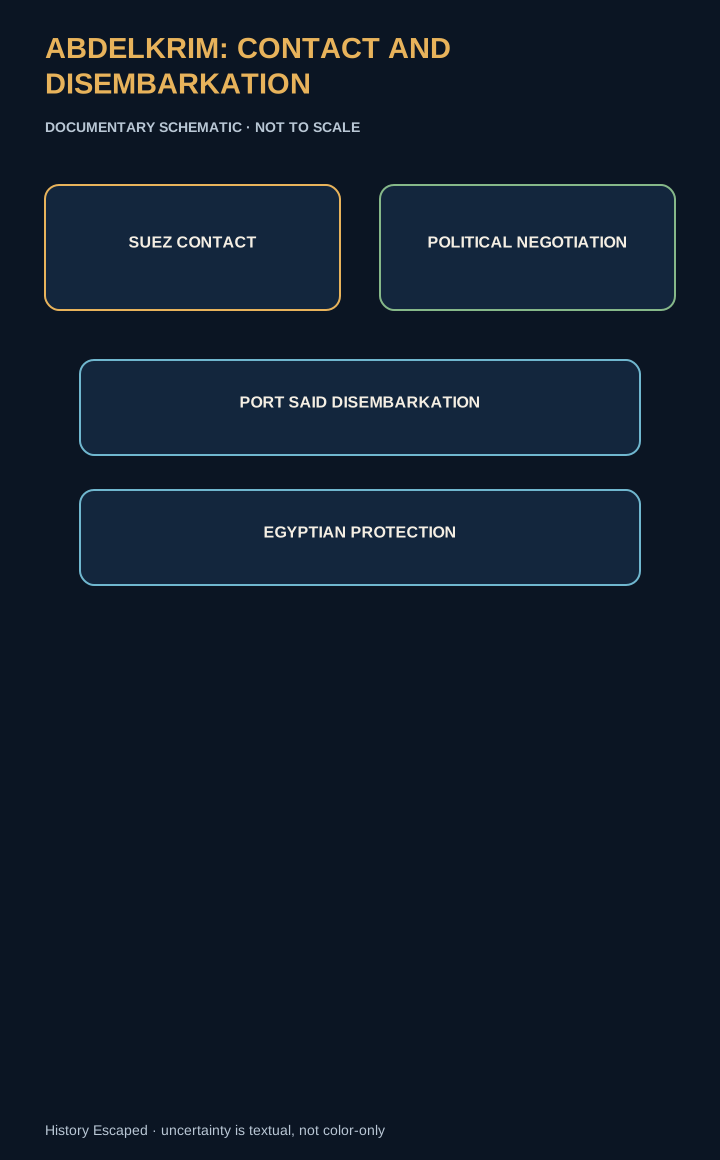
Simplified editorial reconstruction based on the cited historical record; not to scale. Uncertainty is stated directly in the visual and adjacent text.
