
On 22 January 1933, the man Hong Kong officials knew as Sung Man Cho did not climb a wall, overpower a guard or slip through a tunnel. He left British Hong Kong with help from the same colonial government that had spent more than a year trying to remove him.
His better-known identity was Nguyễn Ái Quốc, the revolutionary later known as Hồ Chí Minh.
The final maneuver was quiet and administrative. A non-government launch carried him away from the normal passenger-ship berth. Offshore, the steamer Anhui stopped and took him aboard as a late passenger. Only one police officer involved in the maneuver needed to know who he really was.
That departure was the last move in a much longer escape—one fought through habeas corpus petitions, deportation ordinances, French diplomatic pressure, secret releases, a failed journey to Singapore and an unusual settlement before the Judicial Committee of the Privy Council.
Calling it an “escape from extradition” captures the danger but not the legal complexity. Formal extradition was precisely the problem: British authorities did not have sufficient grounds to extradite Nguyễn to French Indochina. Hong Kong authorities instead tried to use deportation powers to accomplish much the same practical result. Internal British correspondence later acknowledged how uncomfortable that substitution was.
The real escape was from a legal path that could have delivered him into French colonial custody.
A Revolutionary Under Several Names
By the time British colonial police arrested him on 6 June 1931, Nguyễn Ái Quốc had already spent years moving through international anti-colonial and communist networks.
He had come to Hong Kong from Thailand in late 1929. In 1930 he played a central role in bringing Vietnamese communist groups together and in the formation of the Indochinese Communist Party. From Kowloon, he also maintained connections reaching into Malaya, Thailand, China and the wider Communist International network.
French colonial authorities regarded him as a serious political enemy. A court in Vinh had sentenced Nguyễn Ái Quốc to death in absentia in 1929. French police and diplomatic officials therefore had a powerful interest in identifying him, locating him and obtaining his return to territory under French control.
Hong Kong police arrested him at a residence in Kowloon. He denied being Nguyễn Ái Quốc and maintained that he was Sung Man Cho, a Chinese national.
The alias mattered because identity was not merely biographical. It was part of the legal problem. The French wanted a particular revolutionary returned. British authorities had to justify what they could lawfully do with the man they had in custody.
When Extradition Would Not Work
The first important correction to the familiar story is that the British could not simply process an ordinary extradition request and send Nguyễn to Indochina.
Hong Kong institutional history states that authorities considered there to be insufficient grounds for extradition. The surviving Colonial Office correspondence goes further. British officials later discussed the case in language that exposed the underlying problem: if extradition was not legally available, could deportation law be used to achieve the same end?
That question became central.
Nguyễn was placed in Victoria Gaol on 12 June 1931. By August the Hong Kong government had issued a deportation order and intended to send him to Indochina aboard a French vessel.
The distinction between extradition and deportation may sound technical, but it determined whether Nguyễn could be transferred into the control of the power that had already sentenced him in absentia.
Extradition normally requires legal grounds tied to the requested person and the offense alleged. Deportation is an exercise of immigration or colonial administrative authority: the government orders someone to leave its territory. The Hong Kong authorities’ proposed course risked making deportation function as extradition without the protections of extradition proceedings.
Internal Colonial Office memoranda show that British officials understood this. One official recorded that it was contrary to generally observed principles to use expulsion machinery as a substitute for extradition where extradition proceedings were not possible.
That vulnerability gave Nguyễn’s lawyers room to fight.

Francis Loseby and the Habeas Corpus Battle
The central local figure in the defense was Francis Henry Loseby, a Hong Kong solicitor.
Loseby and counsel challenged the legality of Nguyễn’s arrest, detention and deportation through habeas corpus proceedings. The litigation became prolonged and complicated. A first deportation order was found defective in August 1931, but the government served another. On 11 September 1931, the Hong Kong Supreme Court refused the relief Nguyễn sought against the operative arrangements.
That did not end the case. His legal team obtained leave to appeal to the Judicial Committee of the Privy Council in London, then the highest appellate body for Hong Kong.
Nguyễn remained in custody as the case moved toward London. His health deteriorated. Hong Kong institutional history records that he suffered from dysentery and tuberculosis and was transferred to the prison hospital in November 1931.
The months of detention matter because later retellings can make the eventual departure look like a sudden rescue. It was not. The escape route was created gradually as his lawyers forced British officials to defend the legal basis on which they intended to remove him.

What Stafford Cripps Actually Did
One of the most persistent errors in the story concerns Sir Stafford Cripps. He is sometimes described as the famous British lawyer who defended Hồ Chí Minh and won his freedom. That is wrong.
Dennis Duncanson’s source-critical reconstruction corrected the mistake decades ago. D. N. Pritt represented Nguyễn’s side before the Privy Council. Cripps had been retained by the London solicitors acting for the Hong Kong government.
The distinction is important because Cripps’s judgment of the government’s case helped create the settlement.
Colonial Office papers record that Cripps had serious doubts about whether he could successfully defend the Hong Kong government’s use of the provision ordering Nguyễn’s expulsion by a specific steamship bound for Saigon. He also feared that litigating that issue could place the broader deportation power at risk.
For Hong Kong, settlement offered a way to avoid an adverse appellate ruling while preserving the general deportation order. For Nguyễn, settlement offered something far more important: a barrier between deportation and French custody.
The Privy Council Did Not “Free” Him
The formal Privy Council paperwork is unusually clear.
The appeal was not decided by a sweeping judgment that reversed the Hong Kong courts. Counsel for Nguyễn asked for permission to withdraw the appeal, counsel for the respondents agreed, and the Judicial Committee recommended that the withdrawal be permitted without an order as to costs.
The reason this still represented a major practical success was the agreement reached outside the merits judgment.
Under the settlement, the Hong Kong government agreed in substance that Nguyễn would not be sent to French territory, French-controlled territory or aboard a French ship. It would use its best endeavours to help him reach a place to which he wished to go, subject to that place being willing to receive him. The government also contributed £250 toward his legal costs.
The underlying deportation order was not erased.
That point changes the entire shape of the escape. Nguyễn had won protection from the most dangerous form of removal, but he had not gained an unrestricted legal right to remain in Hong Kong. He still had to leave.
The problem became: where could he go, and how could he get there without French authorities intercepting him?
False Death and the Value of Disappearing
Secrecy was not an afterthought.
Later institutional and scholarly accounts agree that false reports of Nguyễn’s death were circulated to confuse those following his case. Hong Kong Memory states that Loseby spread a story that his client had died in prison, helping divert French attention.
The idea fit the larger challenge. A public release followed by a predictable ticketed departure could simply transfer the danger from the prison gate to a port or another colonial jurisdiction.
The safest exit required making Nguyễn difficult to follow.
The surviving official record is strongest on government arrangements, not on every cloak-and-dagger detail later attached to the story. Accounts of a false beard, Chinese dress or an elaborate merchant disguise survive mainly through later recollection and commemorative retelling. They may reflect real efforts at concealment, but they should not be presented with the same certainty as Governor Peel’s written description of the launch and ship transfer.
The documented mechanism was already unusual enough.
Released Into Hong Kong
By late 1932, the government and Nguyễn’s lawyers still had not found a simple destination.
For a time there was discussion of England. That route collapsed. According to Peel’s later report, Nguyễn then concentrated on reaching Vladivostok. He did not trust an indirect route and wanted a Soviet ship proceeding directly there, but such vessels did not call at Hong Kong.
The authorities imposed a deadline for his departure.
To give him a chance to leave secretly, they arranged for a cadet officer to collect him from the prison hospital on 28 December 1932. Instead of transferring him to another jail or escorting him openly to a ship, the officer released him into the streets.
There was to be no surveillance.
This was not a jailbreak. It was an authorized release designed to allow a deportee to disappear long enough to satisfy the settlement without exposing him to French arrest.
Nguyễn stayed covertly in Hong Kong while the next plan developed.
The Singapore Route Fails
The first attempt did not solve the problem.
Nguyễn left Hong Kong in January 1933 and tried to travel through Singapore, but the Straits Settlements would not allow the plan to proceed. He returned toward Hong Kong aboard the Ho Sang.
French intelligence had not stopped watching.
Governor Peel later reported that the French consul supplied information to police that Nguyễn had been to Singapore and was returning. When the Ho Sang reached Hong Kong on 19 January 1933, police recognized and arrested him as he was about to land.
For Loseby’s side, the arrest threatened the entire arrangement. Nguyễn’s lawyers argued that the police had breached the understanding that his movements outside the colony would not be watched and had destroyed plans intended to hide his route from French authorities.
Peel disagreed with their interpretation—but decided that keeping Nguyễn in custody would create another problem. With what he described as considerable reluctance, the governor ordered him released that same night. This second release left only a narrow window.
The Launch and the Anhui
The final maneuver came three days later.
Nguyễn’s lawyers informed the Hong Kong government that he would leave aboard the s.s. Anhui at 5 p.m. on 22 January 1933. They called on the government to honor the settlement promise to use its best endeavours to help him reach the destination he sought without exposing him to French arrest.
Peel agreed to provide direct assistance.
His dispatch describes the arrangement: a non-government launch would collect Nguyễn at an agreed time and place and carry him to a point away from the Anhui’s normal berth. The steamer would stop there and receive him as a belated passenger. The maneuver was to be handled so narrowly that only an Assistant Superintendent of Police involved in the operation needed to know the passenger’s identity.
The plan worked.
That is the most secure endpoint of the reconstruction. Nguyễn Ái Quốc left Hong Kong aboard the Anhui and escaped the immediate possibility that British deportation machinery would place him under French control.
Sources differ over how precisely to describe the vessel’s next port. Some later Hong Kong accounts say it was heading for Amoy; British correspondence and modern scholarship frame the departure as a northward movement in which Shanghai figured prominently. The distinction is not necessary to establish the success of the Hong Kong escape, so it is safer not to manufacture certainty.
Why “Escape from Extradition” Needs an Asterisk
The title survives because it communicates the stakes quickly. But the legal reality was more interesting.
French authorities wanted Nguyễn back. Formal extradition did not provide a workable route. Hong Kong authorities then tried to deport him in a manner that could put him aboard a French ship bound for French Indochina. His legal team challenged the process. British officials themselves became concerned that deportation was being used as a substitute for extradition. The Privy Council appeal ended in a negotiated settlement that separated the valid power to expel Nguyễn from the forbidden outcome of handing him to the French.
Then another problem appeared: a person can win protection from one destination and still have nowhere safe to go. Its “walls” were a web of colonial jurisdictions rather than a physical prison perimeter. The escape depended on lawyers identifying the distinction between extradition and deportation; judges forcing the administration to answer habeas corpus claims; British officials deciding that the French-directed route was legally dangerous; secrecy shielding Nguyễn’s movements; and, finally, the colonial government itself helping him board a ship outside the ordinary passenger process.
What the Famous Version Gets Wrong
Three corrections matter most.
First, Nguyễn did not escape from Victoria Gaol. His physical releases were authorized.
Second, the Privy Council did not hand down a merits judgment declaring his detention unlawful and setting him free. The appeal was withdrawn after a settlement that materially restricted how Hong Kong could deport him.
Third, Stafford Cripps did not represent Nguyễn. He advised the Hong Kong government. His doubts about defending the government’s ship-expulsion order helped make settlement attractive.
Those distinctions do not make the story less dramatic. They make it more revealing.
A French colonial government wanted a revolutionary returned. A British colonial government initially tried to oblige. A local lawyer turned administrative removal into a prolonged constitutional fight. London lawyers exposed the weakness in using deportation as surrogate extradition. The resulting settlement transformed the Hong Kong government from jailer into reluctant facilitator.
On 22 January 1933, the escape concluded not with a broken lock but with a launch pulling away from the harbor and a steamer slowing offshore to collect one late passenger. The law had become the route out.
Escape reconstruction
How the escape unfolded
An evidence-aware sequence of the principal stages.
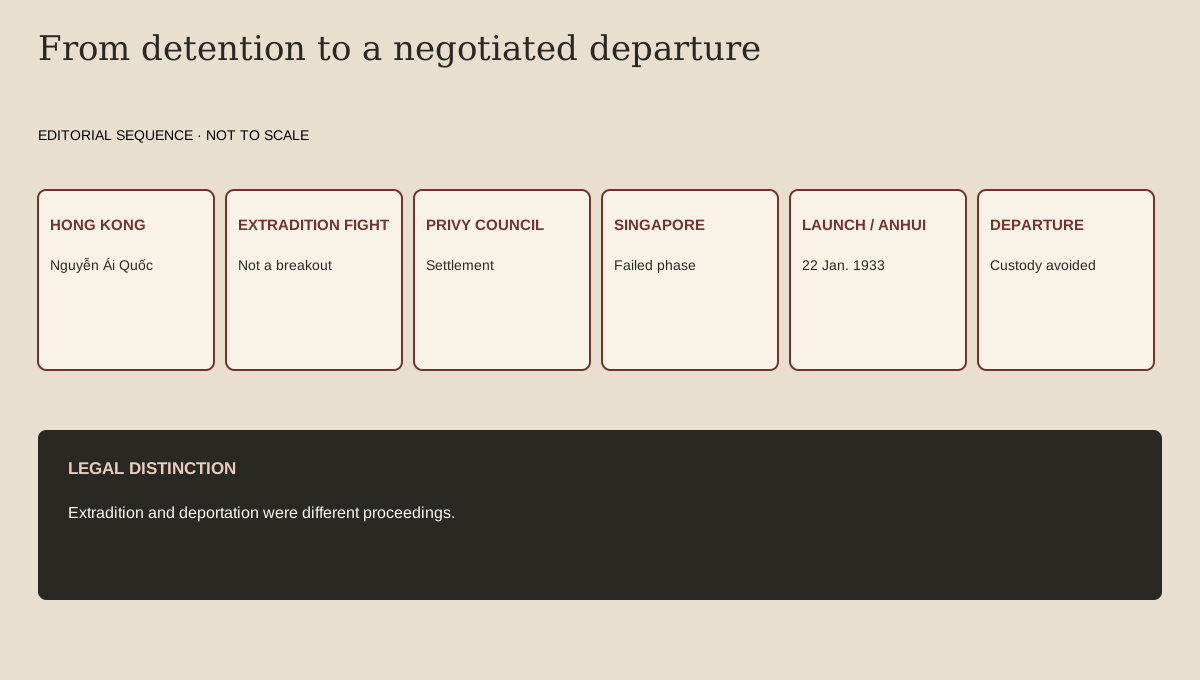
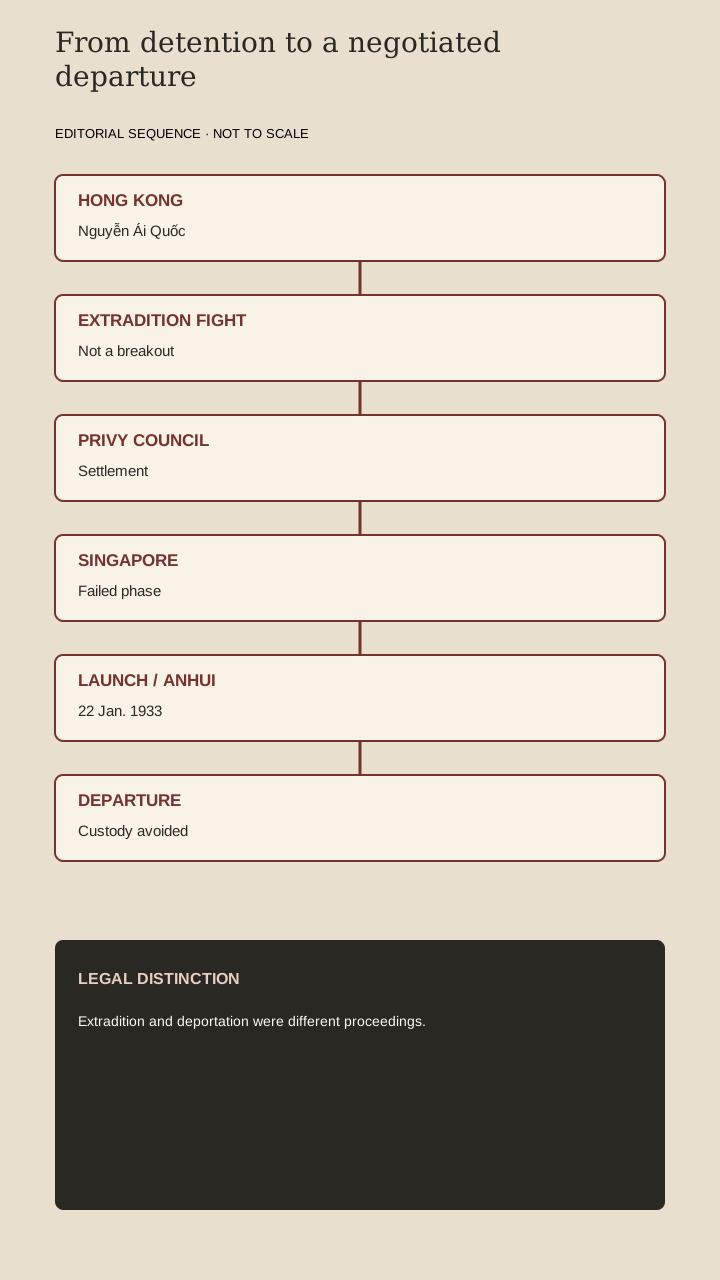
Simplified editorial reconstruction; not to scale. See adjacent text for evidence qualifications and unresolved details.
Evidence discipline
What the record supports
Status labels distinguish secure conclusions from uncertainty and rejected claims. Color is never the only signal.
MYTH
Nguyễn Ái Quốc escaped by breaking out of Victoria Gaol.
The decisive releases were authorized by the Hong Kong government. On 28 December 1932 he was collected from the prison hospital and released without surveillance; after the January rearrest Governor Peel ordered him released again.
Sources: SRC-001, SRC-006DISPUTED
The legal threat was straightforward extradition to French Indochina.
‘Escape from extradition’ is useful shorthand, but formal extradition lacked sufficient grounds. Hong Kong instead relied on deportation machinery that could have placed him aboard a French ship bound for French-controlled territory. British officials explicitly worried about deportation being used as a substitute for extradition.
Sources: SRC-001, SRC-002, SRC-006MYTH
The Privy Council issued a merits judgment overturning the Hong Kong case and freeing Nguyễn.
The formal Privy Council order records that the appellant requested leave to withdraw the appeal and the respondents agreed. The practical victory came from the negotiated settlement, not a merits ruling.
Sources: SRC-003, SRC-004MYTH
Stafford Cripps was Nguyễn’s defense lawyer.
Cripps was retained for the Hong Kong government. D. N. Pritt represented Nguyễn before the Privy Council, while Francis Loseby was his Hong Kong solicitor.
Sources: SRC-001, SRC-005WELL-SUPPORTED
False reports of Nguyễn’s death were used to misdirect French attention.
Hong Kong institutional history and modern archival scholarship both preserve the use of false death reporting as part of the effort to obscure his whereabouts, although not every detail of who initiated each report is recoverable.
Sources: SRC-004, SRC-006DOCUMENTED
Nguyễn’s final departure on 22 January 1933 used a government-arranged launch to board the Anhui away from the normal berth.
Governor William Peel described the maneuver in his 31 January 1933 dispatch, including the non-government launch, offshore rendezvous and late-passenger boarding.
Sources: SRC-001LATER CLAIM
Nguyễn escaped in a specific wealthy-Chinese-merchant disguise with a false beard.
Later recollections and commemorative accounts supply costume details, but the strongest contemporary administrative record documents the secret release and maritime transfer without establishing the exact disguise.
Sources: SRC-007, SRC-009DISPUTED
The Anhui’s first onward port after the escape can be stated with complete certainty.
Later institutional accounts describe the vessel as heading toward or via Amoy, while contemporary British correspondence and modern scholarship emphasize a northward route in which Shanghai figured prominently. The successful exit from Hong Kong does not depend on resolving this minor itinerary conflict.
Sources: SRC-001, SRC-004, SRC-006Selected chronology
Selected chronology
Nguyễn Ái Quốc is sentenced in absentia
A French colonial court at Vinh sentences Nguyễn Ái Quốc to death in absentia, increasing the stakes of any later transfer into French control.
Arrest in Kowloon
Hong Kong police arrest Nguyễn, who maintains that he is Sung Man Cho rather than Nguyễn Ái Quốc.
First deportation order is found defective
The Hong Kong Full Court determines that the first deportation order is bad, but a second order has already been served and the legal contest continues.
Hong Kong court refuses further relief
The Supreme Court refuses the habeas-related relief sought against the operative custody and deportation arrangements; leave is later obtained to appeal.
Privy Council appeal ends by settlement
Counsel agree to withdraw the appeal. The settlement preserves deportation but prevents removal to French territory, French-controlled territory or on a French ship and obliges Hong Kong to assist a safe onward destination.
Secret release from the prison hospital
A colonial officer collects Nguyễn from the prison hospital and releases him into Hong Kong without surveillance so he can attempt a discreet departure.
Rearrest after the Singapore attempt
After Singapore refuses the route, Nguyễn returns toward Hong Kong and is arrested when the Ho Sang arrives. Governor Peel orders his release later that night.
Final departure aboard the Anhui
A non-government launch carries Nguyễn away from the normal berth to meet the Anhui, which receives him as a late passenger. He leaves Hong Kong without being delivered to French authorities.