
Rash Behari Bose reached Japan in June 1915, but arrival did not make him safe. He had escaped one imperial security system only to enter a country allied to the empire hunting him.
By the end of November, British pressure had helped produce a Japanese order requiring him to leave. On 1 December, with police surveillance around him, Bose disappeared again—this time into a Japanese protection network that would keep him beyond British reach and eventually give him a permanent political base.
At a Glance
- Departure from India: 12 May 1915, best-supported
- Vessel: Sanuki Maru
- Primary cover: P. N. Tagore, presented as a relative of Rabindranath Tagore
- Voyage: Calcutta → Singapore → Hong Kong → Kobe
- Kobe arrival: 5 June 1915, according to Nakamuraya history
- Tokyo arrival: 8 June 1915
- British objective in Japan: Secure Bose's removal and return through deportation/extradition pressure
- Japanese expulsion order: 28 November 1915
- Deadline: 2 December
- Second escape: 1 December, evasion of surveillance in Tokyo
- Principal refuge: Nakamuraya, protected by Aizō and Kokkō Sōma
- Marriage to Toshiko Sōma: 1918
- Japanese citizenship: 1923
- Outcome: Successful international political flight followed by prolonged clandestine refuge and permanent establishment in Japan
The failure of the 1915 uprising
Bose had been a revolutionary long before he boarded a ship for Japan. He was implicated in the 1912 bombing attack on Viceroy Lord Hardinge in Delhi and spent the following years moving through clandestine networks opposed to British rule.
The First World War widened the possibilities imagined by those networks. With Britain engaged in a global conflict, Indian revolutionaries planned mutinies and coordinated uprisings among units of the British Indian Army. Bose became one of the central organizers of the 1915 effort.
The plan was penetrated by informants. Arrests spread, military authorities moved against suspected units, and the expected insurrection failed to materialize on the intended scale.
Joseph McQuade's modern biography describes the aftermath as the point at which Bose became the most wanted fugitive in colonial India. Remaining in the country meant trying to survive an increasingly concentrated police search while the networks around him were being broken. Bose chose another strategy: leave India and continue the struggle from abroad.
The Tagore cover
The escape depended on an identity that could plausibly travel when Bose himself could not. Rabindranath Tagore was internationally famous after receiving the Nobel Prize in Literature, and plans for a Japanese visit attracted public attention. Bose used that circumstance as cover.
McQuade's archival research identifies the assumed name as P. N. Tagore. Bose presented himself as a relative travelling ahead of the poet to make preparations.
Later sources vary over the initials and over whether the surname appears as Tagore, Thakur or another transliteration. The core device is much more secure than every spelling: Bose travelled under a Tagore-family identity rather than his own.
That distinction matters because some later retellings harden the story into a precise "forged passport" episode. The available evidence supports an assumed identity and deceptive travel cover, while the exact document mechanics remain unresolved without the original passport file.
12 May 1915
A modern scholarly history dates Bose's departure from Calcutta to 12 May 1915. The vessel was the Japanese steamer Sanuki Maru. Modern Asian Studies scholarship, drawing on Bose's collected writings, also identifies the ship in describing his fugitive passage out of Calcutta.
Once aboard, Bose still had to pass through ports controlled or monitored by governments cooperating with Britain. Singapore was particularly dangerous.
Singapore under martial law
In February 1915, Indian troops in Singapore had mutinied. By the time Bose's ship passed through, the colony was operating under heightened wartime security.
McQuade's archival research describes Bose maintaining his assumed identity there even when authorities required a fingerprint. The episode is useful precisely because it shows that boarding Sanuki Maru did not instantly end the escape. Bose had left the immediate police hunt in India, but the maritime route passed through imperial checkpoints where recognition could still have returned him to British custody.
He continued onward. The ship's broad route carried him through Hong Kong and then toward Japan.
Kobe
Nakamuraya's institutional history places Bose's arrival at Kobe on 5 June 1915. That date comes from the Japanese institution most closely connected with his later refuge rather than from a passenger manifest reproduced here, so it deserves slightly less certainty than the fact of his arrival in Japan.
The same source says Bose moved through Kyoto and reached Tokyo on 8 June. The first escape had worked.
He was outside British India. The second problem was already forming.
Japan was Britain's ally
Japan could look attractive to an Indian anti-colonial revolutionary. Japanese victory over Russia in 1905 had made the country a powerful symbol for many Asian intellectuals and activists, and Tokyo contained overlapping networks of Chinese, Indian and Japanese political exiles, nationalists and Pan-Asianists.
But Japan was not neutral in the First World War. It was bound to Britain through the Anglo-Japanese Alliance.
Bose had therefore escaped into a political environment that could shelter him socially while still exposing him diplomatically. That contradiction defined the rest of 1915.
Building a network
Bose entered circles in which anti-colonial politics intersected with Japanese Pan-Asianism and nationalism. He met Chinese revolutionary Sun Yat-sen during his first months in Japan. Japanese contacts brought him into the orbit of Tōyama Mitsuru, an influential right-wing nationalist and Pan-Asianist, as well as other figures willing to oppose British demands.
Photographs from 1915 and 1916 place Bose among these supporters. They are unusually valuable because they show that the Japanese refuge was not an abstract diplomatic condition. It depended on people with homes, organizations, money, political influence and the willingness to conceal a foreign fugitive.
Their motives were not identical. Some sympathized with Indian independence.
Some understood Bose through Pan-Asian ideas that placed Japan at the center of Asian political renewal. Some objected to the appearance that Tokyo was yielding to British pressure. Those strands overlapped without being the same thing.
Anti-colonialism and Japanese nationalism
It is tempting to turn Bose's protectors into a simple cast of rescuers. That would flatten their politics.
Tōyama Mitsuru was not merely an advocate of political asylum. He was a major figure in Japanese right-wing nationalism and Pan-Asianist politics. Other members of Bose's circle also inhabited ideological worlds that could combine opposition to Western imperialism with ambitions for Japanese leadership in Asia.
Eri Hotta's scholarship uses Bose and his Japanese supporters to examine this early transnational cooperation. Joseph McQuade later traces how Bose's own political imagination developed through life in Japan. The 1915 refuge can therefore be understood as genuine anti-British solidarity without being detached from the more complicated history of Japanese nationalism.
Britain finds him
Bose's activities in Japan did not remain hidden from British intelligence. British officials increasingly pressed the Japanese government to act against him. McQuade's 2024 study describes a sustained effort to secure Bose's deportation from Japan, while Japanese archival description records a British extradition request during 1915.
The distinction between those terms matters. "Extradition" suggests a formal legal process by which one state delivers an accused person to another.
"Deportation" or "expulsion" involves a state removing a foreign national from its own territory. British officials explored ways to get Bose out of Japan and back within British reach. The Japanese measure that eventually mattered was an expulsion order.
28 November
Nakamuraya dates that order to 28 November 1915. Bose was required to leave Japan by 2 December.
The order transformed his status again. He had spent months trying to establish a political position in Japan while avoiding British pressure. Now the Japanese state itself had created a deadline that threatened to push him back into a sphere where Britain could seize him.
Leaving Japan in compliance with the order could destroy the refuge he had spent months building. Bose's supporters decided to make him disappear.
1 December
On the evening of 1 December, Bose was at Tōyama Mitsuru's residence under police surveillance. Nakamuraya's history says he left in disguise, misled the officers watching him and escaped the tail.
The exact movements belong largely to institutional and family memory rather than a surviving police operations report. The historically secure point is broader: Bose's Japanese supporters helped him evade surveillance immediately before the expulsion deadline.
He did not report for removal. He vanished into Tokyo.
Nakamuraya
His destination was Nakamuraya. The business had been founded by Aizō Sōma and Kokkō Sōma, whose bakery and cultural salon became connected with artists, intellectuals and political figures.
The Sōmas agreed to conceal Bose. Oxford historian Joseph McQuade describes Japanese nationalists, angered by what they viewed as Japanese subservience to British interests, spiriting Bose into hiding in a popular Tokyo bakery. Nakamuraya's own history identifies that bakery as the refuge and says the founders sheltered him for approximately three and a half months.
For Bose, this was the decisive second escape of 1915. He had already escaped India. Now he had escaped a diplomatic process intended to make his Japanese refuge temporary.
A refuge inside an ordinary business
Nakamuraya's later fame can make the episode sound quaint. It was not.
Bose was a foreign revolutionary subject to an expulsion order. The people hiding him risked political and legal consequences, while British officials continued searching for a way to locate and remove him.
The bakery was useful because it belonged to a social world rather than to an obvious revolutionary headquarters. The exact rooms, entries, police positions and changing concealment arrangements are not securely reconstructed and are less important than the network itself. The Sōmas converted private space into political asylum without formal state recognition.
Beyond Nakamuraya
The bakery was not a permanent solution. Nakamuraya's history says Bose remained there for roughly three and a half months before moving through additional hiding places. The same institutional account later remembered seventeen changes of refuge during several years of clandestine life.
The exact number is difficult to verify independently. What is secure is the pattern.
Bose did not emerge from Nakamuraya into ordinary legal residence. He continued changing locations and identities while British pressure and the risk of removal persisted. The successful escape therefore had a long tail.
Toshiko Sōma
One of the people who became increasingly important to that clandestine life was Toshiko Sōma, Aizō and Kokkō's daughter. Nakamuraya's history says Toshiko acted as a liaison after Bose left the bakery, carrying communications during his period of concealment.
Bose and Toshiko married in 1918. The marriage was part of the transition from temporary refuge to a life rooted in Japan, but it did not instantly solve his legal status.
He remained a politically charged foreign revolutionary. Permanent security came more gradually.
From fugitive to resident
The end of the First World War changed the diplomatic environment in which Bose had been hunted. British pressure did not define his Japanese life forever. Over time he became more publicly established, wrote and organized from Japan, and built personal and political relationships that were much harder to reverse than his first clandestine refuge.
The decisive legal milestone came in 1923. Bose became a Japanese citizen. Eight years after leaving India under another man's name, the fugitive had acquired a recognized national status in the country where Britain had once tried to have him expelled.
What citizenship changed
Naturalization did not make Bose politically neutral. It made his base durable.
As a citizen he could operate with freedoms unavailable to a foreign fugitive threatened with removal. Japan became the center from which he continued anti-British political activity and cultivated transnational networks.
His later history would extend through the Indian Independence League and the wartime movement that produced the Indian National Army. Those developments are consequences of the successful 1915 flight. They are not the escape itself.
Bose was not a nonviolent dissident
Bose occupied a politically complex position. He was persecuted by a colonial state, but he was also an advocate and organizer of armed revolution. He had been associated with the Hardinge bombing conspiracy and with efforts to induce military mutiny against British rule.
British authorities did not pursue him merely because he wrote nationalist essays. Likewise, Japanese supporters were not protecting an apolitical refugee.
They were helping a revolutionary who intended to continue opposing the British Empire from abroad. Acknowledging that does not settle the legitimacy of British colonial rule or of Bose's methods. It clarifies what kind of escape this was.
The deportation question
Modern summaries often say that Britain demanded Bose's extradition from Japan. That is broadly understandable, but it can hide the legal complexity.
British officials sought his removal and return through diplomatic pressure and discussed deportation and extradition. The Japanese government ultimately issued an order requiring Bose to leave its territory.
Bose escaped the consequences of that order by going underground. The result was not a court ruling granting him asylum. It was de facto protection created by a network willing to conceal him until the political environment changed.
How much of the disguise story is secure?
The larger 1 December event is strong. Bose was facing removal.
He was under surveillance. Japanese supporters helped him disappear.
He reached Nakamuraya and was hidden by the Sōmas. The colorful details of exactly what he wore, who stood where, which police officer looked in which direction and the precise route from Tōyama's residence to the bakery depend more heavily on later Japanese institutional memory.
Those details do not need to carry the story. The escape is significant even when reconstructed at the level the evidence supports.
P. N. Tagore to Rash Behari Bose
The two halves of the 1915 flight were mirror images. In India, Bose survived by becoming someone else long enough to cross the imperial frontier.
In Japan, he survived by disappearing inside a network long enough to prevent the state from enforcing its expulsion order. The first method was an assumed identity.
The second was social protection. Together they transformed his life.
The photographs change the scale
The surviving visual record is unusually strong for a political flight. A 1915 photograph shows Bose in Japan with fellow Indian revolutionary Bhagwan Singh Gyanee.
Another 1915 image places him at a gathering with Tōyama Mitsuru, Tsuyoshi Inukai and Japanese associates. A 1916 group portrait records Bose among an even wider support circle.
A photograph from around 1918 shows Bose with Toshiko. These images do not prove the mechanics of individual hiding episodes. They prove something more important about the outcome: Bose did not survive in Japan as an isolated man moving endlessly between anonymous rooms. He became embedded in a visible human network.
A refuge with later complications
The political world that protected Bose in 1915 cannot be detached entirely from what followed. Japanese Pan-Asianism could present Japan as a supporter of Asian peoples resisting Western empire. It could also serve Japanese claims to political leadership and, later, imperial domination elsewhere in Asia.
Bose himself would eventually work closely with Japanese wartime structures in the struggle against Britain. That later history complicates his legacy.
It does not erase the fact that in 1915 British imperial pressure sought to remove him and Japanese individuals chose to hide him. Nor does the act of sheltering him make every supporter's larger politics benign.
Why the first escape worked
Bose's departure from India succeeded because the cover matched a believable public story. The planned travel of Rabindranath Tagore gave an otherwise suspicious Indian traveller a recognizable explanation for going to Japan.
A Japanese ship carried Bose outside India. He maintained the identity through intermediate ports.
By the time British authorities firmly located him, he was in another sovereign state. The search had become a diplomatic problem.
Why the second escape worked
In Japan, the decisive resource was not a passport. It was people.
Bose had spent months building connections before the expulsion order arrived. When the deadline threatened him, those contacts could provide political backing, private shelter and continued communication.
The Japanese government could order him to leave. It still had to find and control him to enforce the order. The support network broke that chain.
From flight to establishment
The clearest endpoint for the escape-and-establishment arc is 1923, not Bose's later Indian National Army role or his death in 1945.
By then the man who had entered Japan under an assumed Tagore identity had become a Japanese citizen. The journey from Calcutta to Kobe was a successful border escape.
The disappearance into Nakamuraya was a successful escape from forced removal. The years that followed converted temporary concealment into durable residence.
That is what distinguishes Bose's 1915 flight from an ordinary fugitive journey. He did not merely get away. He built a new political base in the country to which he escaped.
Evidence discipline
What the record supports
Status labels distinguish secure conclusions from uncertainty and rejected claims. Color is never the only signal.
WELL-SUPPORTED
Bose left Calcutta on exactly 12 May 1915.
The date appears in modern scholarly history, while the original passenger manifest has not been reproduced in the present source set.
Sources: SRC-009WELL-SUPPORTED
Bose travelled aboard the Sanuki Maru.
Modern Asian Studies scholarship identifies the vessel while discussing Bose's own account of his fugitive passage.
Sources: SRC-008WELL-SUPPORTED
The assumed identity was P. N. Tagore and represented a supposed relative travelling ahead of Rabindranath Tagore.
McQuade's archival research gives P. N. Tagore and the relative/preparatory-travel cover; later sources contain variants in initials and transliteration.
Sources: SRC-003, SRC-004UNKNOWN
Bose definitely used a forged passport fabricated from scratch.
Sources use varying language about a false identity, another person's passport, or forged documentation. The assumed identity is secure, but the exact documentary mechanism is not locked here.
Sources: SRC-003MYTH
Reaching Japan placed Bose beyond British pressure.
Japan was Britain's ally and British officials pressed Tokyo to remove Bose, eventually contributing to a Japanese expulsion order.
Sources: SRC-002, SRC-005, SRC-006MYTH
The 1915 Japanese action against Bose was a completed extradition that delivered him to British custody.
British officials pursued removal through deportation/extradition pressure, but Bose evaded the Japanese expulsion order and was never delivered to British custody.
Sources: SRC-002, SRC-003, SRC-004, SRC-005WELL-SUPPORTED
Bose disappeared from surveillance on 1 December 1915 and entered hiding at Nakamuraya.
Nakamuraya preserves the specific date and local escape tradition, while Oxford scholarship independently confirms that Japanese nationalists spirited Bose into hiding in a popular Tokyo bakery.
Sources: SRC-002, SRC-004UNKNOWN
The exact disguise and minute-by-minute path from Tōyama's residence to Nakamuraya are fully documented by a contemporary police operations file.
The detailed disguise story is preserved principally through Nakamuraya institutional memory; no contemporary police action log confirms every mechanic.
Sources: SRC-004LATER CLAIM
Bose changed hiding places exactly seventeen times.
Nakamuraya's institutional history preserves the seventeen-move figure, but it is not independently corroborated strongly enough here to become a canonical key number.
Sources: SRC-004MYTH
Bose's Japanese supporters were simply neutral liberal asylum advocates.
His support network included right-wing nationalists and Pan-Asianists. Scholarship emphasizes genuine anti-colonial cooperation while also locating it within complex Japanese nationalist politics.
Sources: SRC-006, SRC-007DOCUMENTED
Bose's 1923 Japanese citizenship marked permanent legal establishment after years of fugitive life.
Nakamuraya and modern scholarship both identify 1923 as the year of naturalization.
Sources: SRC-004, SRC-007Documentary reconstruction
Aliases, helpers and diplomatic pressure
A case-local editorial visual separates the documented sequence from uncertainty without implying exact modern geography or operational detail.
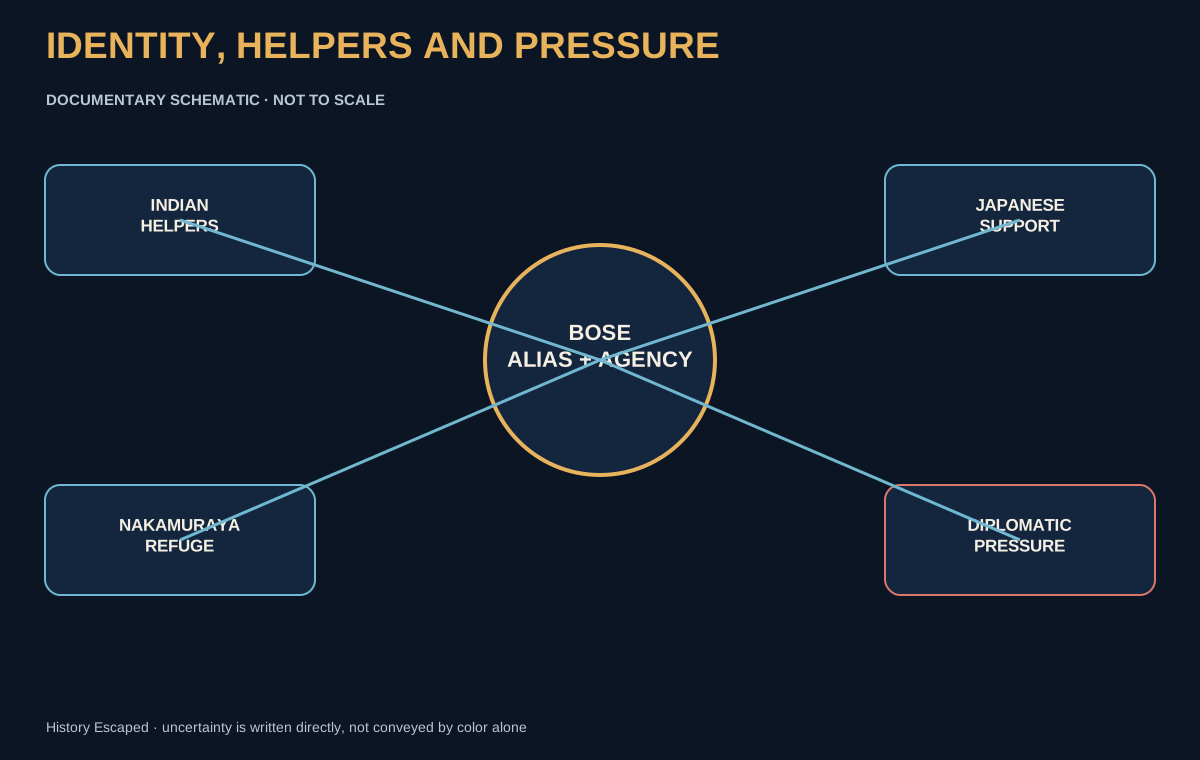
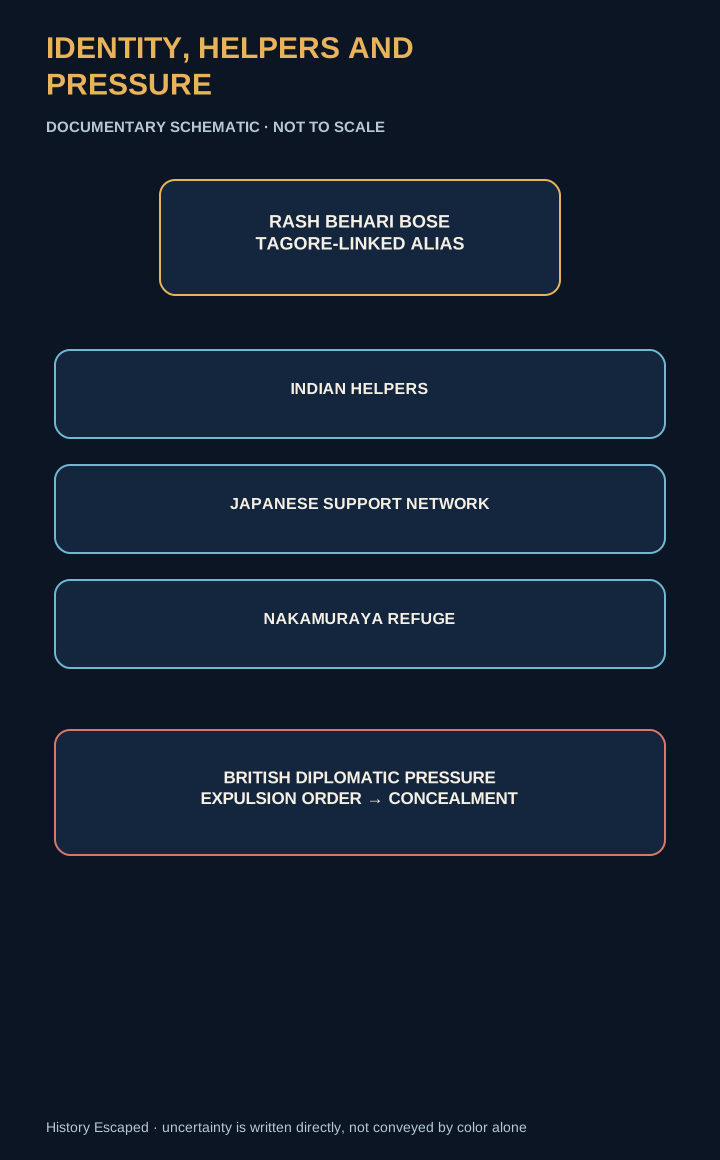
Simplified editorial reconstruction based on the cited historical record; not to scale. Uncertainty is stated directly in the visual and adjacent text.
