
In early 1910, Aurobindo Ghose was one of the most closely watched nationalist figures in British India. He had been acquitted in the Alipore Bomb Case the previous year, but police continued to record his speeches, writings, and movements while looking for another basis on which to prosecute him. When warning reached the office of his newspaper, Karmayogin, that the premises would be searched and that he was expected to be arrested, he left Calcutta almost immediately.
His first refuge was not Pondicherry but Chandernagore, a French possession upriver from Calcutta. Several weeks later he moved again, secretly returning toward Calcutta and boarding the French steamer Dupleix under an assumed name. On 4 April 1910 he reached Pondicherry, another French possession and the place where he would spend the rest of his life.
From acquittal to renewed surveillance
Aurobindo’s departure makes sense only against the political pressure that followed his acquittal in May 1909. The Alipore prosecution had tried to connect him to a revolutionary conspiracy, but the court found the evidence insufficient. Once free, he resumed public writing and nationalist activity, including work on Karmayogin.
British officials did not regard the acquittal as the end of the matter. Institutional histories based on the surviving record describe police scrutiny of his speeches and publications, while later government files show how closely intelligence officers tried to reconstruct his movements after he disappeared.
Aurobindo’s own later account says that while he was at the Karmayogin office, information arrived from a highly placed police source that the office would be searched the following day and that he would be arrested. He recalled making the decision to leave within minutes. Ramchandra Majumdar guided him to a river ghat, where Aurobindo boarded a boat with his relative Biren Ghose and the young associate Suresh Chandra Chakrabarti.
They reached Chandernagore before dawn. Biren and Suresh returned to Calcutta, while Aurobindo remained in secret.
A refuge inside French India
Chandernagore mattered because it was not under the ordinary administration of British India. Like Pondicherry, it was one of the French establishments in India. British official papers themselves recognized that the special legal position of French possessions could make them useful refuges for political activists whom British authorities wanted to arrest or monitor.
Aurobindo later described the move in a different register as well. He said that after hearing the warning in the Karmayogin office, he received an inner command to go to Chandernagore and obeyed it immediately. During the secret stay there, he wrote, he withdrew from active newspaper work and concentrated on spiritual practice.
Those two levels of explanation do not need to be forced into a single motive. The external circumstances are clear: he faced intensive surveillance and an expected police action, and Chandernagore offered a jurisdictional refuge. His claim that inner spiritual guidance determined his movements belongs to his own testimony about why he chose to act when and as he did.
The exact date on which he left Calcutta for Chandernagore is less secure than the broad sequence. His later autobiographical account does not give a day, and modern chronologies generally place the departure in mid-February 1910. The final movement to Pondicherry is documented much more precisely.
Back toward Calcutta under secrecy
By the end of March, Aurobindo had decided to leave Chandernagore for Pondicherry. That required a counterintuitive move: he had to approach Calcutta again in order to board the coastal passenger steamer that could carry him south.
The British police investigation after his disappearance preserves some of the clearest evidence for how the sea passage was concealed. A report from the Inspector-General of Police in Bengal said two Bengali passengers had reserved berths on the French S.S. Dupleix for Pondicherry under the names J. N. Mitter and Bankim Chandra Bhowmik. Neither appeared at the regular health inspection.
At about 9:30 on the night of 31 March, however, two men using those names went to the health officer’s private residence and obtained the certificates needed to sail. The shipping company later informed police that they had boarded at the last moment. When shown Aurobindo’s photograph, the health officer said that the man calling himself J. N. Mitter was probably Aurobindo. Police checks found that the real J. N. Mitter named in the booking was still at home and had not travelled by sea.
The Dupleix sailed on 1 April. British intelligence had missed the departure.
Pondicherry before the warrant
Aurobindo reached Pondicherry on 4 April 1910. The timing exposes a frequent simplification in retellings of his flight: he was not escaping an already-issued Karmayogin sedition warrant when he first left Calcutta.
In his own later recollection, the initial warning concerned an expected search and arrest. He added that the office was indeed searched, but no warrant against him was produced at that time. The formal sedition case connected with his signed article “To My Countrymen” developed after he was already in hiding, and the warrant was issued on 4 April—the same day he reached Pondicherry.
Aurobindo made the chronology explicit in a statement sent from Pondicherry to The Hindu in November 1910. He wrote that he had left British India more than a month before proceedings were taken against him. By then he also declared that he had withdrawn from active politics and was remaining in Pondicherry for spiritual practice.
French territory did not make him invisible or completely safe from British pressure. Government records show continuing surveillance in Pondicherry and British discussion of whether he could be arrested if he travelled through a place where British authority could operate. Intelligence officers reconstructed the Dupleix voyage, tracked his presence in Pondicherry, and continued watching his contacts.
What the move accomplished was narrower but decisive. By moving first into French Chandernagore and then to French Pondicherry, Aurobindo removed himself from the ordinary reach of British Indian police at the moment when officials were again trying to build a case against him.
Flight and withdrawal
The political consequences of the escape were unusual because Aurobindo did not use Pondicherry simply as a temporary base from which to resume the same public campaign. He remained there permanently and moved increasingly away from active nationalist politics toward the spiritual and philosophical work for which he later became internationally known.
That later transformation can make the 1910 movement look inevitable in retrospect. It was not. When he left the Karmayogin office, the immediate problem was an expected police action. Chandernagore provided secrecy and a different colonial jurisdiction; the assumed-name passage on the Dupleix carried him farther from British-controlled Bengal; Pondicherry gave him a durable refuge.
The result was a successful political flight built less on a spectacular physical barrier than on colonial geography, secrecy, and timing. Its most important correction is equally simple: the decisive movement out of British India came before the formal sedition warrant, not after it.
Evidence discipline
What the record supports
Status labels distinguish secure conclusions from uncertainty and rejected claims. Color is never the only signal.
MYTH
Sri Aurobindo fled Calcutta because a sedition warrant had already been issued for his arrest.
Aurobindo said he left after receiving advance warning of an expected search and arrest, but no warrant was produced in the search he later described. The formal Karmayogin sedition warrant was issued on 4 April 1910, after he had left Chandernagore and on the day he arrived in Pondicherry.
Sources: SRC-001, SRC-002, SRC-005MYTH
The British authorities lost track of Aurobindo completely after he reached Pondicherry.
British intelligence reports reconstructed his Dupleix passage, placed him in Pondicherry, continued surveillance, and discussed legal opportunities for arrest if he travelled through British-controlled territory.
Sources: SRC-003DISPUTED
Aurobindo’s decision to go first to Chandernagore and later to Pondicherry was motivated only by fear of arrest.
The political danger is documented, but Aurobindo’s own retrospective account says he acted on spiritual inner guidance and used the withdrawal for intensive spiritual practice. Historians can establish the surveillance and jurisdictional context; his spiritual explanation remains first-person testimony about motive.
Sources: SRC-001, SRC-002Documentary reconstruction
From British Calcutta to French India
A case-local editorial visual separates the documented sequence from uncertainty without implying exact modern geography or operational detail.
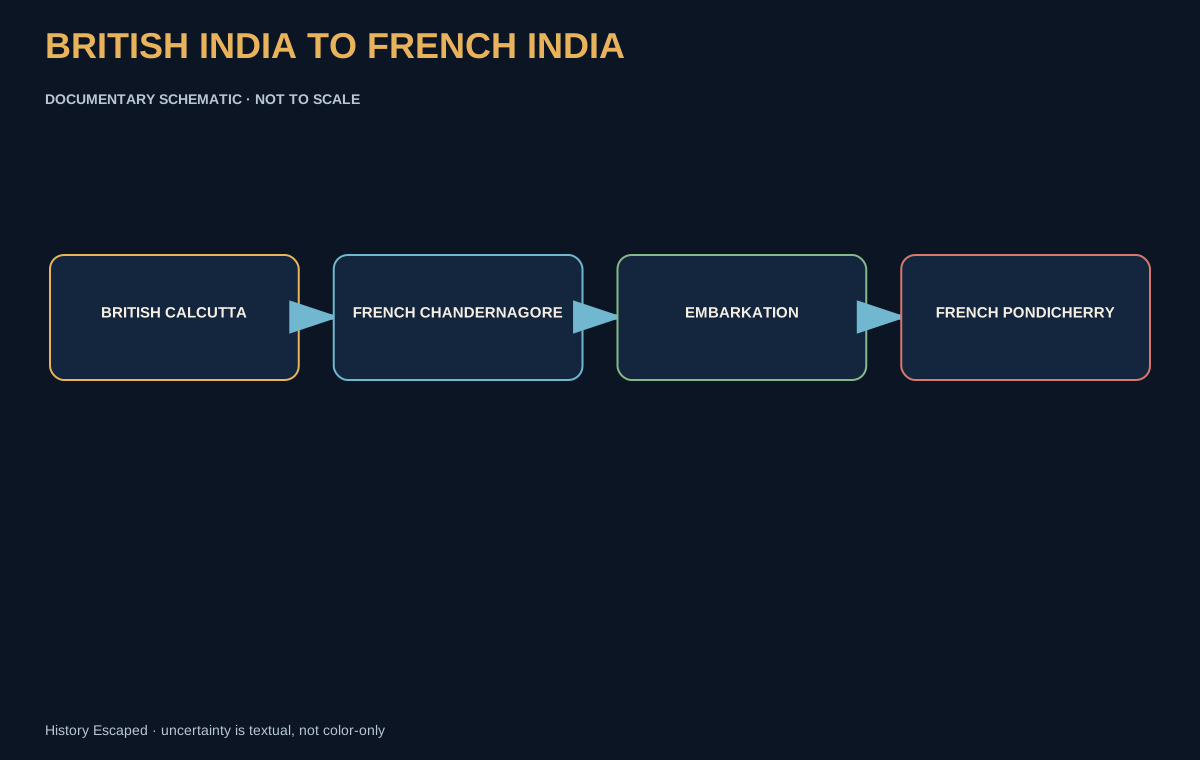
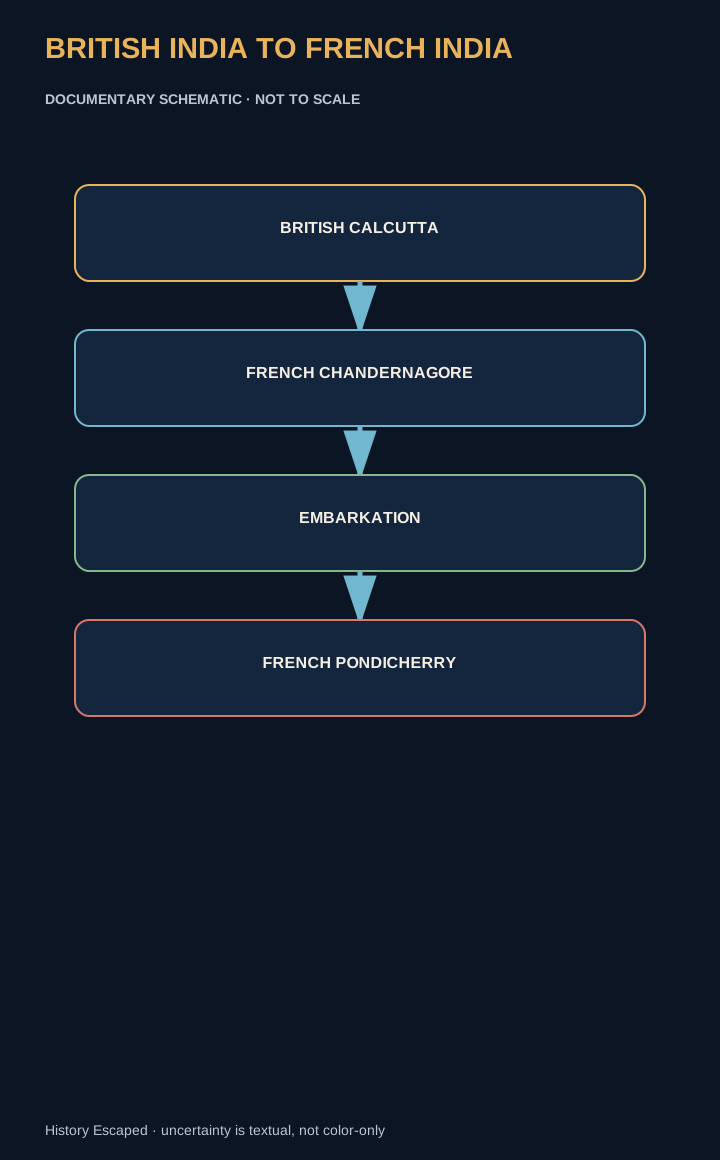
Simplified editorial reconstruction based on the cited historical record; not to scale. Uncertainty is stated directly in the visual and adjacent text.