
Yitzhak Shamir escaped British detention twice before the establishment of Israel. The first escape, from the Mizra detention camp in Mandatory Palestine in 1942, returned him to an underground movement that had been badly damaged by arrests and the killing of its founder, Avraham Stern. The second, from Sembel Camp in Eritrea on 14 January 1947, removed him from a British exile system designed to keep Irgun and Lehi detainees far from Palestine.
The two events are often compressed into a single biography line: arrested twice, escaped twice. Their evidence is not equally precise.
The 1947 escape has a securely documented date, a known five-man group, and a tunnel already associated with earlier mass escapes from Sembel. The 1942 escape is also secure, but later Lehi commemorative sources disagree over whether the final night fell in mid-August, at the end of August, or on 1 September. The Knesset’s official biography simply says August 1942, which is the strongest public date to preserve.
Both escapes also require political context. Shamir was not a nonpolitical civilian detainee. He was a member—and later a leader—of Lehi, an underground organization that used revolutionary violence and political assassination in its campaign against British rule. Modern scholarship commonly treats Lehi as a terrorist organization or terrorist underground. That history should neither erase the coercive nature of British administrative detention and overseas exile nor turn the escapes into celebratory adventure stories.
At a Glance
- Escapee: Yitzhak Shamir, born Yitzhak Yezernitsky
- Organization: Lehi, also known to the British as the Stern Group or Stern Gang
- First arrest: December 1941
- First escape: Mizra detention camp, August 1942; exact night disputed
- 1942 companion: Eliyahu Giladi
- Second arrest: 1946
- Exile: British detention in Eritrea
- Second escape: Sembel Camp, 14 January 1947
- 1947 escape group: five men total
- Broad 1947 route: Sembel → Asmara → Ethiopia → French Somaliland/Djibouti
- After Djibouti: French authorities detained Shamir and Aryeh Ben-Eliezer; Britain sought their return, but France ultimately allowed them onward to France
- Return: Shamir reached the newly established State of Israel in May 1948
Detention after Lehi’s collapse
Shamir joined the Irgun in the late 1930s and followed Avraham Stern into the breakaway organization that became Lehi in 1940. Lehi’s position during the Second World War isolated it from much of the organized Jewish community in Palestine. Stern’s faction continued to regard Britain as the principal imperial enemy even while Britain was fighting Nazi Germany. Joseph Heller’s scholarship describes the Stern movement as an avant-garde underground committed to revolutionary violence as a means of expelling the British.
British authorities arrested Shamir on 2 December 1941. A Lehi heritage biography says he was first sent through Jaffa and Acre before being placed in administrative detention at Mizra, north of Acre. Administrative detention mattered because it allowed the Mandatory authorities to hold underground suspects without relying entirely on ordinary criminal conviction and release dates.
Then, on 12 February 1942, British CID officers killed Avraham Stern in Tel Aviv. Lehi nearly disintegrated. Many of its members were dead, imprisoned or underground, and its command structure was broken. Shamir later emerged as one of the people who rebuilt the organization.
First he had to get out of Mizra.
The 1942 escape
The physical outline comes mainly from later Lehi accounts. Shamir and Eliyahu Giladi had reportedly made earlier attempts before settling on a plan that exploited movement between the camp’s inner and outer areas.
They accustomed guards to seeing them make routine trips connected with purchases for detainees.
On the escape day, the two moved into a storehouse in the outer camp and hid beneath stored mattresses or bedding until night. Later Lehi narratives add that other detainees used loud singing as a signal or distraction once the escapees were ready to move. Shamir and Giladi then passed beyond the outer wire and headed toward Haifa.
That mechanism is plausible and consistent across several versions of the story. The calendar is less stable.
The Knesset’s official biography dates the escape to August 1942. One Lehi museum account specifies the night of 15–16 August. A Lehi timeline places the event on 31 August, while the organization’s English Shamir biography gives 1 September.
Those dates cannot all be correct. Because the detailed sources come from the same broad commemorative tradition and conflict with one another, no exact night should be selected merely because it sounds precise. August 1942 is the safest date.
From the camp to the underground
The immediate post-escape movement is better remembered than documented. Later accounts say Shamir and Giladi made contact around Haifa, obtained new clothing and moved south. Giladi was reportedly dressed as a Jewish auxiliary policeman, while Shamir used the appearance of a Polish officer at a time when Polish forces were present in the region.
Avishai Margalit’s critical biographical essay preserves an anecdote in which a former Mizra guard recognized Shamir on the Haifa–Tel Aviv road despite the Polish uniform. Shamir escaped the encounter rather than being rearrested.
The importance of the 1942 escape was political, not merely personal. Outside detention, Shamir participated in rebuilding Lehi. He eventually joined a leadership structure with Nathan Yellin-Mor and Israel Eldad and took responsibility for operations.
Lehi’s campaign included assassinations and attempted assassinations of British officials. Shamir later acknowledged his role in planning the 1944 assassination of Lord Moyne, Britain’s Minister of State in the Middle East. The escape from Mizra therefore returned an underground commander to an organization that would carry out lethal political violence.
That consequence belongs in the history of the escape even though the page does not need to become a catalogue of Lehi attacks.
Arrested again in 1946
By 1946, British security pressure on Jewish underground organizations had intensified. Shamir was arrested again during the large British security operations in Tel Aviv that summer. Accounts of the arrest say he was using a rabbinical disguise but was recognized by a British police sergeant despite it.
The British did not keep him in Palestine. He was deported with underground detainees to Eritrea, part of a broader British policy of holding Irgun and Lehi members in detention camps in East Africa. The distance itself was a security measure: even if a detainee got outside a camp fence, returning to Palestine required crossing international borders and colonial jurisdictions.
The Sembel camp near Asmara already had a history of escape attempts by the time Shamir arrived. Detainees had dug tunnels, hidden in the city, tried overland routes, and used outside contacts. Some were recaptured quickly; others remained at large for months.
This accumulated escape infrastructure would matter in January 1947.
Sembel, 14 January 1947
The second escape is much better dated. A Lehi heritage account, drawing on a detention diary written by the African exiles themselves, places the breakout on 14 January 1947.
The evening roll call revealed that five men were missing: Yitzhak Shamir, Aryeh Ben-Eliezer, Yaakov Meridor, Reuven Franco and Rahamim Mizrahi. Shamir was the only Lehi member in that five-man group; the other four were associated with Irgun.
They used a tunnel at Sembel that had been dug before Shamir’s arrival and had already been connected to an earlier mass breakout. Later heritage accounts describe it as running beneath the camp’s sports ground and perimeter.
The key historical point is not the exact engineering. It is that Shamir’s 1947 escape depended on an existing collective escape system built by detainees who had spent years experimenting with ways out of British exile camps.
Once outside, the five could not simply disappear into Palestine. They first had to survive beyond the camp and find a route through East Africa.
Escaping the camp was only the first border
The men reached Asmara and entered a network of hiding places and helpers.
Accounts of the African exile system show why the post-tunnel stage was often harder than leaving the camp itself. British influence extended across much of the surrounding region, transport was limited, and local authorities could arrest men whose papers or explanations failed scrutiny.
The five did not remain together all the way to safety.
Aryeh Ben-Eliezer helped organize accommodation and supplies. Shamir and Ben-Eliezer eventually continued toward French Somaliland, whose port capital was Djibouti.
Sources differ in the exact logistical details of the journey through Ethiopia. Popular biographies sometimes reduce it to an oil truck or tanker trip. Other accounts describe a more extended period of hiding and movement through Addis Ababa before the two men reached Djibouti.
The broad route is more reliable than a single vehicle story: Eritrea → Ethiopia → French Somaliland.
Djibouti was not immediate freedom
Reaching French territory did not end the case. Shamir and Ben-Eliezer were detained by French authorities in Djibouti. British officials sought their extradition or return.
The archival trail confirms that this became a diplomatic issue. The Jabotinsky Institute catalogues British Foreign Office correspondence from 1947 concerning Shamir and Ben-Eliezer after their escape from Eritrea and the British attempt to secure custody.
The French did not simply hand them back.
Shamir remained outside British detention, and French authorities ultimately allowed him to proceed to France. The Knesset biography describes him as receiving political asylum there.
He could not yet return safely to British-controlled Palestine. He remained abroad until after the Mandate ended and Israel declared independence.
Shamir returned in May 1948.
The extra “1946 escape” problem
One Lehi biographical page creates a significant chronological conflict by saying Shamir escaped in Africa on both 23 August 1946 and 14 January 1947. That should not be accepted at face value.
The same Lehi institution’s detailed Sembel history identifies the January 1947 tunnel escape as Shamir’s escape from the camp. The Knesset biography says he was arrested in 1946, exiled to Eritrea, and then fled roughly three months later. Contemporary reporting from August 1946 also places the deportation of suspected underground members to Eritrea in that period.
The 23 August entry therefore appears to conflate Shamir’s deportation/arrival chronology with an escape, or to preserve an editorial error.
This case treats the two successful British-detention escapes as Mizra in 1942 and Sembel in 1947.
Two escapes, two different problems
The first escape was locally simple but politically consequential. Mizra was in Mandatory Palestine. Once Shamir and Giladi cleared the camp and re-entered the underground support network, they were back in the same political territory where Lehi operated.
The second escape was structurally different. Sembel was overseas. Passing through the tunnel only converted imprisonment into fugitive status in East Africa. Shamir still needed hiding places, transport, border crossings, assistance in Ethiopia, and a foreign jurisdiction unwilling to return him immediately to British custody.
The 1947 event was therefore both a camp escape and an international extraction problem.
That distinction makes the two episodes worth treating together. They show the British detention system adapting to repeated underground escapes by moving detainees farther away—and detainees responding by extending escape networks across borders.
What the evidence supports
Shamir was arrested by the British in December 1941 and held at Mizra. He and Eliyahu Giladi escaped in August 1942.
Later Lehi accounts consistently describe a storehouse and mattresses as part of the breakout, followed by movement beyond the camp at night. They do not agree on the exact date, so no day should be treated as certain.
The escape allowed Shamir to return to Lehi and participate in rebuilding its leadership and operations. Lehi subsequently conducted a campaign of revolutionary violence that included political assassinations.
Shamir was arrested again in 1946 and deported to British detention in Eritrea.
On 14 January 1947, he escaped Sembel with Aryeh Ben-Eliezer, Yaakov Meridor, Reuven Franco and Rahamim Mizrahi through an existing tunnel. After hiding and travelling through East Africa, Shamir and Ben-Eliezer reached French Somaliland, where French authorities detained them but did not return them to British custody.
Shamir later went to France and returned to Israel in May 1948.
Those are the secure elements. Exact 1942 night, exact 1947 vehicle sequence, tunnel measurements, hiding-house locations and border choreography should remain secondary details rather than the backbone of the reconstruction.
Evidence discipline
What the record supports
Status labels distinguish secure conclusions from uncertainty and rejected claims. Color is never the only signal.
DISPUTED
Shamir’s 1942 escape has one securely documented exact date.
The Knesset gives August 1942; Lehi commemorative sources variously use the night of 15–16 August, 31 August and 1 September.
Sources: SRC-001, SRC-002, SRC-009LATER CLAIM
The mattress-storehouse mechanism for the 1942 escape is contemporary official evidence.
The mechanism is preserved primarily in later Lehi institutional memory. Independent sources confirm the escape but do not document every physical step.
Sources: SRC-002, SRC-003, SRC-009MYTH
Shamir escaped alone from Mizra in 1942.
The sources consistently identify Eliyahu Giladi as his escape companion.
Sources: SRC-002, SRC-003WELL-SUPPORTED
Shamir’s 1947 Sembel escape occurred on 14 January 1947 with four other detainees.
The date and five-man group are preserved in the camp-memory source and repeated in multiple institutional histories.
Sources: SRC-004, SRC-005MYTH
All five 1947 escapees traveled together all the way to France.
The group dispersed after leaving Sembel. Shamir and Ben-Eliezer eventually continued to Djibouti; the other men followed different paths and outcomes.
Sources: SRC-004, SRC-007MYTH
Reaching Djibouti meant Shamir was immediately free.
French authorities detained Shamir and Ben-Eliezer while Britain sought their return. Their status became an international diplomatic matter.
Sources: SRC-006, SRC-011DISPUTED
Shamir made a separate successful African escape on 23 August 1946.
One Lehi biographical page says so, but its own detailed Sembel history, the Knesset biography and the broader African detention chronology instead support the January 1947 escape as Shamir’s successful escape from Eritrean detention. The 23 August entry likely conflates deportation chronology or contains an editorial error.
Sources: SRC-001, SRC-004, SRC-012Evidence diagram
Mizra in 1942 and Sembel in 1947
The two detention escapes had different settings and outcomes, and the evidence does not support merging their physical mechanisms.
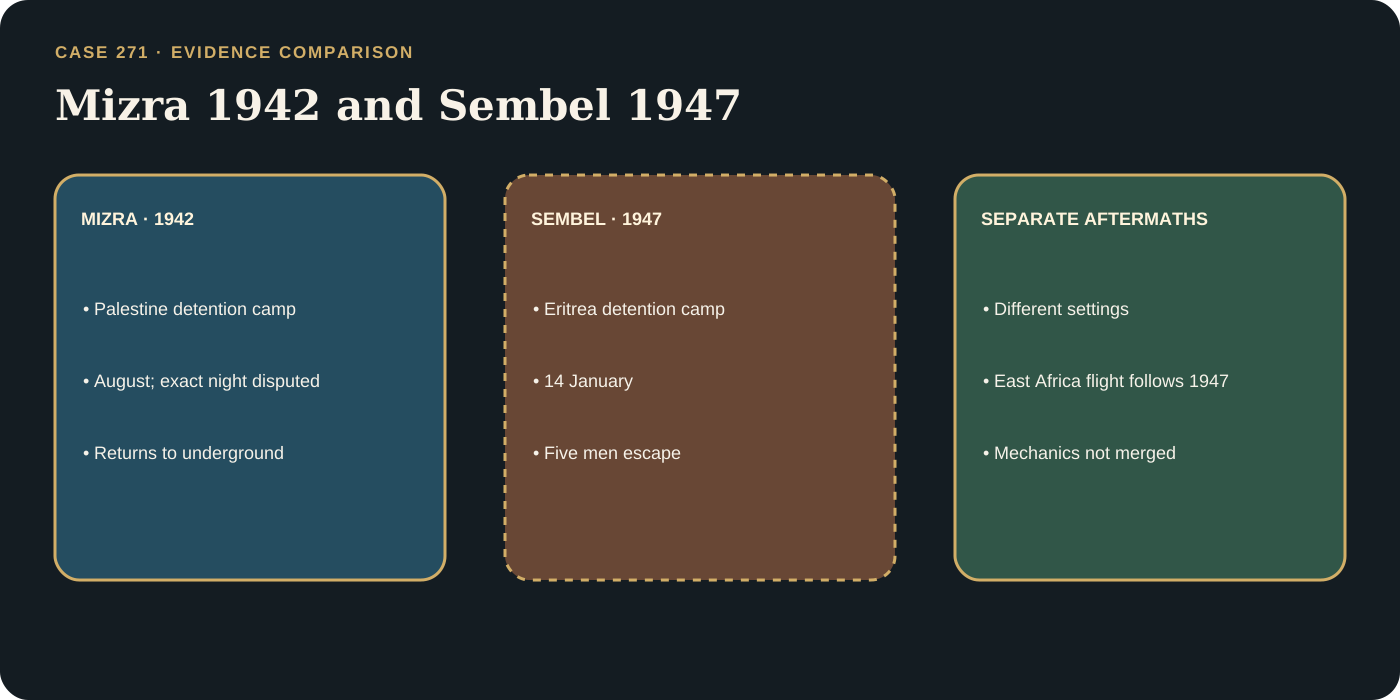
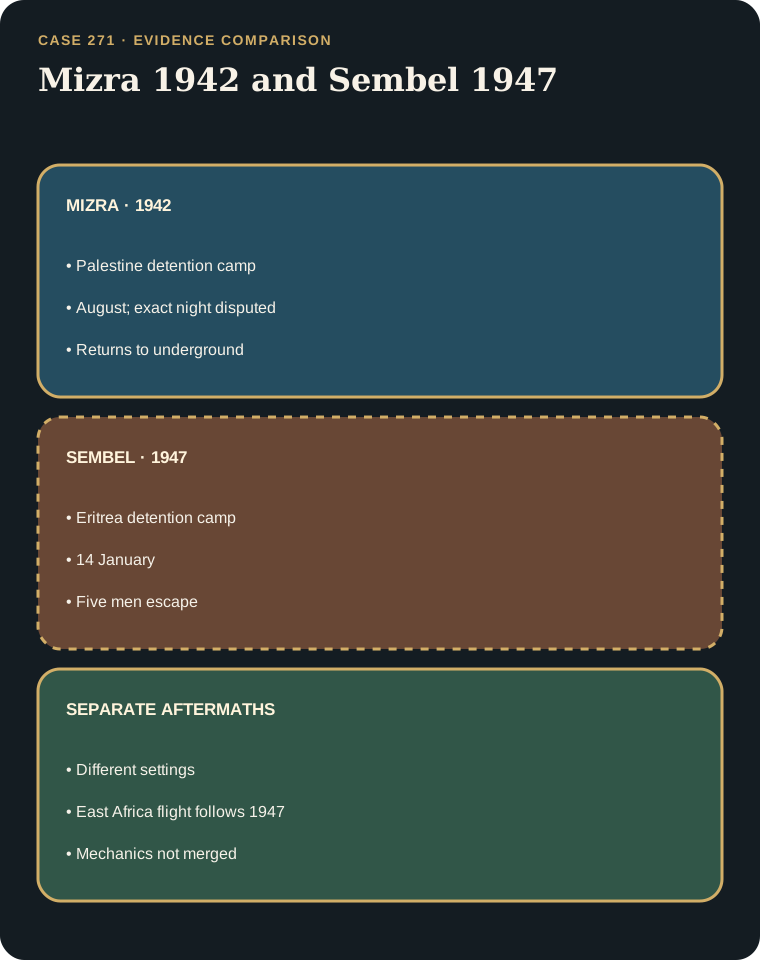
The two detention escapes had different settings and outcomes, and the evidence does not support merging their physical mechanisms.