
Harriet Jacobs's Escape from Slavery: Seven Years Hidden, Then North by Sea
In June 1842, Harriet Jacobs walked out of a hiding place in Edenton, North Carolina, that had concealed her for almost seven years. She did not emerge into freedom. She emerged into the most dangerous part of the escape. Jacobs still had to cross town without being recognized, reach the waterfront, trust a captain willing to carry a freedom seeker, survive the voyage north, land in Philadelphia, and continue to New York.
Her body had been weakened by years in a space too low for her to stand upright. Her son remained in North Carolina. Her daughter was already in the North. And under American law, the people claiming ownership over Jacobs could still pursue her even if she reached a free state.
The journey that finally carried her away from North Carolina lasted days. The escape that made that journey possible had taken six years and eleven months.
The Escape Began in 1835
Harriet Jacobs was born into slavery in Edenton in 1813. As a child, she lived for several years in circumstances that partially shielded her from the full violence of the system that legally defined her as property. That protection did not last. When her mistress Margaret Horniblow died in 1825, Jacobs was left by will to Horniblow's three-year-old niece, Mary Matilda Norcom.
Mary's father, physician Dr. James Norcom, exercised practical control over Jacobs.
In the autobiography Jacobs later published under the name Linda Brent, Norcom appears as Dr. Flint.
Jacobs describes him subjecting her to years of unwanted sexual advances, threats, and coercion. The gendered nature of that violence is central to her story. Incidents in the Life of a Slave Girl was written in part to force northern readers—especially women—to confront forms of abuse that many antislavery publications treated only indirectly.
Jacobs resisted Norcom's attempts to control her.
She later entered a relationship with white lawyer Samuel Tredwell Sawyer, represented as Mr. Sands in the narrative.
They had two children: Joseph, born around 1829, and Louisa Matilda, born in 1833. Jacobs's choices occurred inside a system that denied her legal control over her own body and her children's futures. She hoped Sawyer might eventually secure freedom for the children.
Norcom still controlled her movements. Then he sent Jacobs to work at a plantation outside Edenton. When she learned that her children could soon be sent there too, she chose flight.
Run Away—but Stay Close
Jacobs fled in June 1835. The obvious expectation was that a freedom seeker would try to travel north as quickly as possible. Jacobs exploited that expectation. She remained close to Edenton.
The strategy served more than one purpose. It separated her physically from Norcom. It kept her near her children. And it encouraged Norcom to believe that she might already be heading toward—or living in—the northern states.
That deception became one of the defining features of the next seven years.

Search the Roads. Search the Ships.
Jacobs's narrative describes an immediate search. Northbound vessels were examined. The town was watched. A reward notice was circulated.
Her relatives came under pressure. Norcom had Jacobs's children and brother confined in jail for a time, hoping the measure would help force her to reveal herself. The people searching for Jacobs assumed distance was the problem. It was not.
She was still nearby.
Peter
One of Jacobs's most important helpers appears in her memoir under the name Peter. Jacobs described him as a young Black man she had known for years and someone connected to her father's working life. Peter helped her move through the dangerous first phase after she left the plantation. The exact archival identity behind every pseudonym in Incidents is not equally certain.
Peter remains the name used in Jacobs's own account; the accessible evidence does not establish a fuller identity. What the narrative makes clear is his role. He took significant personal risks to hide and move Jacobs.
The Swamp
Before Jacobs entered the famous garret, she moved through temporary hiding places. One of them was Snaky Swamp, west of Edenton Bay. Jacobs remembered being taken there by boat while a safer hiding place was being prepared. She spent part of two days in the swamp.
Her account describes:
- dense vegetation;
- mosquitoes;
- illness;
- snakes;
- and the fear that patrols might discover her.
The swamp episode matters because it corrects another simplified version of the story. Jacobs did not flee the plantation and immediately climb into her grandmother's attic. The first days were improvised. The garret became the long-term solution only after her support network created it.
Back Into Edenton
Jacobs returned toward town disguised in sailor's clothing. She described blackening her face with charcoal. The disguise allowed her to move through familiar streets where recognition could mean capture. At one point, according to her memoir, she passed close to Samuel Sawyer, the father of her children, without being recognized.
The route ended at the home of her free grandmother, Molly Horniblow. There, above a storeroom attached to the house, a space had been prepared. Jacobs entered it. The temporary escape became nearly seven years of concealment.
The Loophole of Retreat
Jacobs called the space her "loophole of retreat." Her measurements are among the most memorable physical facts in the narrative:
- approximately nine feet long;
- seven feet wide;
- three feet high at the highest point;
- then sloping sharply lower beneath the roof.
It was not a room in the ordinary sense. Jacobs could not stand. Movement was severely restricted. Light and air were limited.
Heat accumulated beneath the roof. Cold entered in winter. Rodents and insects were part of the environment. Historic Edenton interpretation describes Jacobs as remaining there for six years and eleven months.
A modern viewer may be tempted to see the garret as an ingenious secret compartment. That misses the history. Jacobs had escaped direct physical control by creating another form of confinement for herself. The difference was that this confinement was chosen as a means of resisting slavery.
Close Enough to Hear the Search
The most extraordinary feature of Jacobs's hiding place was not simply its size. It was its location. Norcom searched outside Edenton. He travelled north looking for her.
Jacobs remained near his home. She could sometimes hear what people said about the search. Through a small opening she had created in the structure, she could look outside. She watched her children.
She watched people pass. And while Norcom imagined her hundreds of miles away, Jacobs remained within the same town.
Seven Years Near Her Children
Jacobs had not stayed in Edenton because she lacked the desire for freedom. She stayed because slavery had made freedom and family compete against each other. Her children remained in the South. Their father, Samuel Sawyer, eventually arranged to purchase Joseph, Louisa Matilda, and Jacobs's brother through another buyer.
Jacobs hoped this would lead to emancipation. It did not happen as cleanly as she expected. The children continued to occupy an insecure legal position. Louisa Matilda was eventually taken north and lived in Brooklyn.
Joseph remained in North Carolina longer. From the garret, Jacobs continued to calculate when leaving would help her children and when it might make their situation worse.
Sending Norcom in the Wrong Direction
Concealment was only half the plan. Jacobs also manipulated the search. She arranged for letters to be carried north and mailed back to Edenton so that Norcom would believe she was already living in a free state. Her memoir describes using a northern newspaper to learn enough street information to make the deception believable.
The letters worked. Norcom pursued leads outside North Carolina. Jacobs remained in the garret. The method is historically fascinating.
It should not be romanticized as a clever prank. If the deception failed, Jacobs and the people helping her risked severe consequences.
The Cost to Her Body
Nearly seven years in the garret left physical damage. Jacobs later wrote that her body continued to suffer from the effects of the confinement. When she finally travelled north in 1842, she was not an athlete emerging from a hidden training ground. Her limbs had been weakened by years of restricted movement.
During the voyage, she tried to recover strength through movement and salt-water rubbing. That detail matters because the 1842 maritime escape is often compressed into:
she boarded a ship and sailed north.
Her body carried the previous seven years with her.
The First 1842 Plan
By 1842, Jacobs finally had a possible maritime route. A vessel could carry her north. The opportunity was dangerous and expensive. Then news reached Edenton of the brutal killing of another freedom seeker.
Jacobs's grandmother became terrified that the same fate could await Harriet. Jacobs herself lost confidence in the plan. She agreed not to go. Peter was frustrated.
The opportunity could easily disappear. Instead of wasting it, Jacobs helped transfer the place to another woman seeking freedom. In her narrative that woman is called Fanny. Fanny boarded the vessel.
Jacobs stayed in the garret. For the moment.
Then the Ship Did Not Leave
Weather and wind delayed the vessel. Fanny remained hidden aboard. At the same time, the security of Jacobs's hiding place appeared to weaken. A household visitor entered an area near Jacobs unexpectedly.
Her grandmother feared the woman had noticed something and might report it. Whether the visitor actually saw Jacobs is uncertain. Jacobs later concluded that she probably had not. At the time, nobody could know.
The danger changed the decision. The route Jacobs had abandoned suddenly became the route she needed immediately.
Peter Chases the Vessel
Peter learned that the ship had begun moving down the waterway. He hired boatmen to catch it. Jacobs's narrative says he paid them and pursued the vessel. The captain initially feared that the approaching boat might be carrying officers searching for the hidden freedom seeker already aboard.
Peter reached the ship and explained that another woman needed passage. The captain agreed to wait. That decision reopened the escape. This was not the original plan proceeding smoothly.
It was a plan that had been abandoned, handed to someone else, delayed by weather, and then reclaimed under pressure.
One Last Meeting With Her Son
Before leaving, Jacobs met Joseph, her son. For years she had watched him from hiding. Now she could speak with him directly. Her daughter Louisa Matilda was already in the North.
Joseph would remain behind. Jacobs's departure therefore contained no simple family reunion at the start. She was leaving one child in order to move toward another. That is a more accurate emotional structure than a generic "journey to freedom."
Toward the Wharf
When the time came, Peter waited outside. Jacobs left her grandmother's home. Her uncle, called Phillip in the narrative, had gone toward the wharf by another route to watch for danger. A rowboat was ready.
Joseph briefly appeared near the departure point in Jacobs's account. Then Jacobs parted from:
- her son;
- her grandmother;
- her uncle;
- Peter;
- and the town in which she had spent her life.
The escape entered its maritime phase.
Fanny Was Already Aboard
The captain brought Jacobs into a small cabin. Fanny was there. Jacobs had originally given Fanny the opportunity to leave. Now both women would travel together.
Their experiences were not identical. Jacobs hoped to reunite with children in the North. Fanny, according to the narrative, had experienced the sale and separation of her children with little hope of seeing them again. The shared vessel therefore carried two freedom seekers whose family histories showed different consequences of the same institution.
The Captain
Jacobs does not give the captain's name in Incidents. He knew he was taking a serious risk. He instructed the women to stay below when another sail was visible and allowed them on deck when he considered it safer. The ship's crew represented the women under a cover story rather than openly declaring them freedom seekers.
Jacobs did not immediately trust the captain. That distrust was rational. Once aboard, she and Fanny were physically dependent on people who could have betrayed them for money. The captain did not.
He carried them north.
Chesapeake Bay
Jacobs remembered the moment the vessel was safely moving on Chesapeake Bay. For years she had lived beneath a roof with little air and sunlight. Now she was on open water. That contrast is powerful because Jacobs herself made it powerful.
Jacobs did not record enough weather, wave, or scenic detail to reconstruct those conditions responsibly. The documentary fact is enough: the woman who had spent almost seven years unable to stand upright was now moving north on a vessel through Chesapeake waters.
The Ship Did Not Go Straight to New York
Popular summaries often state that Jacobs escaped to New York. That is true as the final 1842 destination. It skips Philadelphia. Jacobs and Fanny were put into a rowboat near the end of the voyage and landed at a wood wharf in Philadelphia.
The captain helped them make first contact.
There Jacobs met Rev. Jeremiah Durham, a Black minister associated with Bethel Church.
Durham and his household assisted the women. The antislavery community also offered help. Jacobs stayed in Philadelphia for approximately five days. Only then did she continue toward New York.
Philadelphia to New York
Jacobs had feared rail travel. After several days, a companion was found for the trip. She and Fanny travelled north. When they reached New York, their paths separated.
Fanny received assistance through antislavery networks. Jacobs pursued the reason she had wanted to reach New York so urgently. Her daughter was there.
Mother and Daughter
Louisa Matilda had been sent north before Harriet escaped. In the memoir, Jacobs calls her Ellen. Their reunion was not the end of family insecurity. Jacobs worried about Louisa's legal and household situation.
Joseph still remained in the South. Her brother John was also navigating freedom and work in the North. The 1842 escape gave Jacobs room to act. It did not instantly reunite or legally secure the entire family.
A Free State Was Not the Same as Legal Freedom
Jacobs had escaped North Carolina. She had not escaped federal fugitive-slave law. The people claiming ownership over her could still attempt to seize her. Norcom and later members of the family continued looking for her.
Jacobs moved between New York and Boston when she believed capture threatened. When Congress enacted the stronger Fugitive Slave Act of 1850, the danger increased further. Northern geography alone could not guarantee safety.
1852: "Free at Last"
Jacobs's legal status changed ten years after the maritime escape.
By then Dr. James Norcom had died.
People inheriting the claim over Jacobs continued to treat her as property. Her employer Cornelia Grinnell Willis quietly arranged to buy the legal claim to Jacobs for $300 and then free her. Jacobs's reaction was complicated. She was deeply grateful to Willis.
She was also offended by the idea that human freedom had required a bill of sale. That contradiction appears clearly in her narrative. The purchase ended the legal claim. It did not make the purchase morally legitimate.
Why 1842 Still Counts as the Escape
If Jacobs was not legally free until 1852, why call 1842 her escape from slavery? Because self-emancipation and legal manumission were not the same process. In 1842:
- she left the physical reach of the North Carolina enslaving household;
- she reached northern communities;
- she chose her employment and movements with vastly greater autonomy;
- she reunited with family;
- she entered antislavery networks;
- and she refused voluntary return.
The law still threatened to re-enslave her. But Jacobs had taken freedom before the legal system recognized it.
The Book That Preserved the Escape
Jacobs began writing her life story in the 1850s. She published Incidents in the Life of a Slave Girl, Written by Herself in 1861 under the name Linda Brent. Abolitionist writer Lydia Maria Child served as editor. Jacobs changed names.
She shaped the narrative for publication. She wrote years after the events. For decades, some scholars treated the work as unreliable fiction or suspected Child had written it. Historian Jean Fagan Yellin transformed the modern understanding of the book.
By matching correspondence, wills, local records, family papers, and named events, Yellin identified the real people behind the narrative and demonstrated Jacobs's authorship. Incidents can therefore be used for what it is: an authenticated autobiographical primary source.
It should still distinguish Jacobs's retrospective memory from independently dated archival evidence.
What Happened to the Garret?
The original Horniblow house no longer survives at the Edenton site. Historic Edenton interprets the former location. Modern heritage work has created or proposed reproductions to help visitors understand the scale of the hiding space. A reproduction is not the original structure.
This distinction should be visible in image captions and interactives. The strongest custom visual is therefore not a fake architectural cutaway of the house. It is a dimension diagram showing the 9-by-7-foot footprint and 3-foot maximum height described by Jacobs, paired with the larger two-stage escape route.
Evidence, Myth and What the Sources Support
Did Harriet Jacobs escape from North Carolina in 1835?
MYTH
She fled Norcom's control in 1835 but remained hidden in and around Edenton. Her successful northbound departure occurred in 1842.
Did she hide for seven years?
WELL-SUPPORTED
Historic Edenton gives the duration as six years and eleven months. Jacobs herself wrote that she remained in the garret for nearly seven years.
Was the garret a normal attic room?
MYTH
No. Jacobs described a tiny roof space approximately nine feet long, seven feet wide, and three feet high at its highest point.
Can the exact lost garret be reconstructed today?
UNKNOWN
The narrative supplies dimensions, and Historic Edenton identifies the former site of Molly Horniblow's home, but the original structure does not survive in place. Modern reproductions should be labeled as reproductions.
Did Norcom search the North while Jacobs was still in Edenton?
WELL-SUPPORTED
Jacobs describes Norcom making trips north in search of her while she remained hidden nearby, and later archival scholarship has confirmed the people and basic setting behind the pseudonymous narrative.
Did Jacobs use deceptive letters to make Norcom think she was already in the North?
DOCUMENTED
Jacobs describes arranging for letters to be mailed from northern cities and sent back to Edenton as part of the deception.
Did Jacobs travel north alone in 1842?
MYTH
No. The woman called Fanny in her narrative travelled aboard the same vessel. A local network including Peter and Jacobs's family helped arrange the departure, and an unnamed captain carried the two women north.
Do historians know the ship's name?
UNKNOWN
The controlling sources used here do not securely identify a vessel name. Do not invent one.
Did the ship carry Jacobs directly to New York?
MYTH
No. Jacobs first landed in Philadelphia, stayed for several days, and then continued by rail toward New York.
Was Jacobs legally secure once she reached New York?
MYTH
No. She remained subject to attempted capture under fugitive-slave law and continued to fear re-enslavement.
Was Jacobs legally freed in 1842?
MYTH
Her physical self-emancipation succeeded in 1842. The legal claim of ownership was not extinguished until Cornelia Grinnell Willis purchased and freed her in 1852.
Is Incidents in the Life of a Slave Girl a fictional novel written by Lydia Maria Child?
MYTH
Modern archival scholarship established Harriet Jacobs as the author of the autobiographical narrative. Child edited the work. Jacobs used pseudonyms and wrote retrospectively, so individual details still require normal source criticism.
Why the Escape Worked
Norcom expected Jacobs to leave the region. She remained nearby. Searchers looked outward. Her family hid her inward.
A temporary hiding network was vulnerable. The garret made concealment durable. Years of hiding created physical suffering. Deceptive letters helped sustain the false geography of the search.
Jacobs wanted to remain near her children. She waited. A maritime opportunity finally appeared. Fear caused her to abandon it.
The vessel's delay kept the opportunity alive. A new security scare made leaving urgent. Peter reached the captain. The captain waited.
Jacobs reached the wharf. The vessel carried her north. Philadelphia provided another support network. Rail carried her to New York.
The escape succeeded not because one hiding place or one ship solved slavery. It succeeded because Jacobs and the people around her repeatedly adapted to a system designed to deny her control over her body, family, movement, and future.
Escape reconstruction
How the escape unfolded
An evidence-aware sequence of the principal stages.
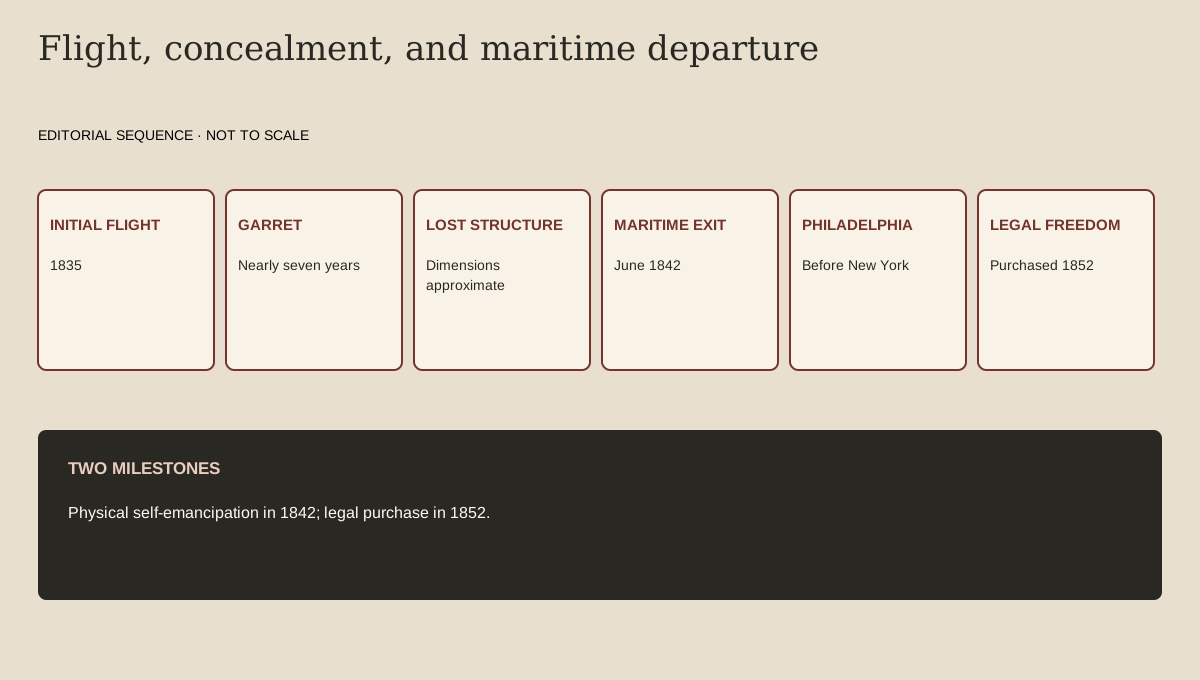
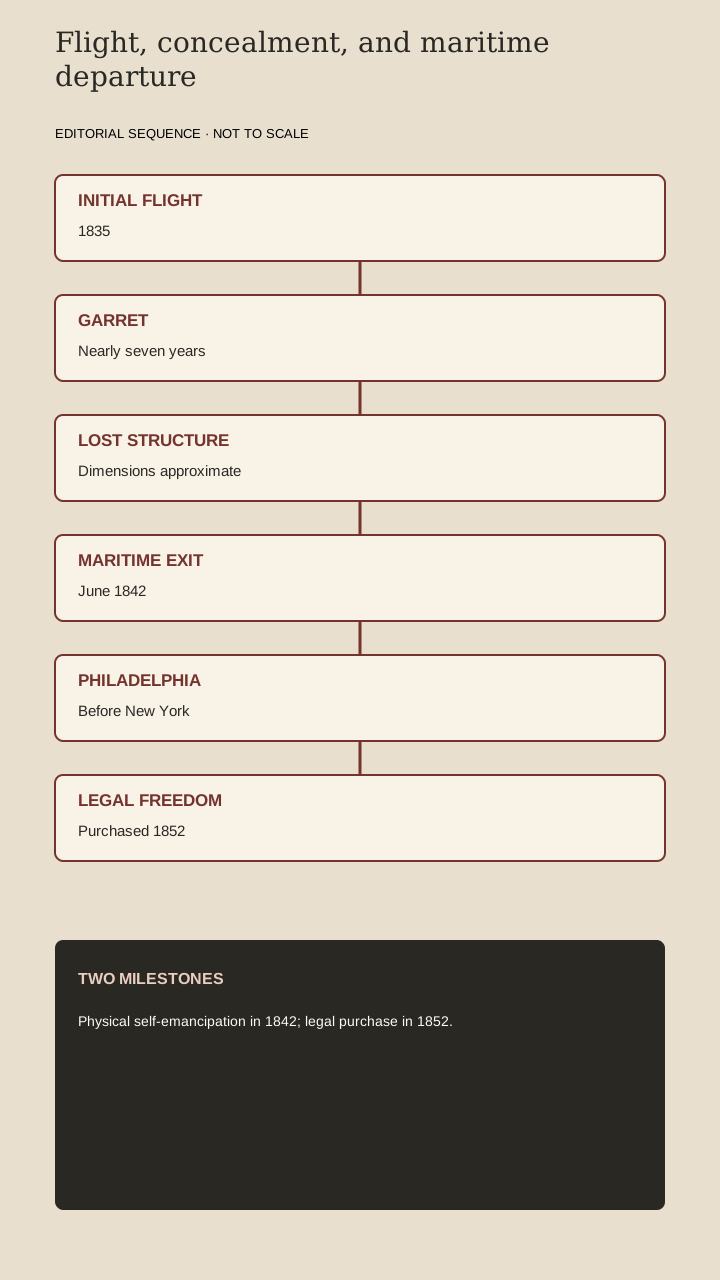
Simplified editorial reconstruction; not to scale. See adjacent text for evidence qualifications and unresolved details.
Material evidence
Tools of Escape
The objects used in an escape reveal how a plan worked under constraint.
- 01Essential
Family protection network
Molly Horniblow and other relatives provided food, communication, secrecy, and physical shelter during Jacobs's years in Edenton.
- 02Essential
Garret concealment
The tiny hidden roof space allowed Jacobs to remain physically outside Norcom's direct control while staying near her children.
- 03High
Deceptive letters
Letters mailed from northern cities helped convince Norcom that Jacobs had already left North Carolina.
- 04Essential
Maritime helper network
Peter coordinated with the captain and helped turn Edenton's waterfront into a viable escape route.
- 05Essential
Northbound vessel
An unnamed captain carried Jacobs and Fanny from Edenton toward Philadelphia through the maritime networks of the Atlantic coast and Chesapeake region.
- 06High
Philadelphia Black assistance
Rev. Jeremiah Durham and other antislavery contacts provided immediate help after landing and enabled safer onward movement.
Problem → response
Escape was a sequence of problems
Each response solved a practical obstacle while often creating the next one.
- 01→
Obstacle
Norcom's control and sexual coercion
Jacobs faced sustained coercion, threats, and legal power wielded through slavery.
Response
She resisted Norcom, eventually fled his plantation, and used clandestine self-emancipation rather than submit to continued direct control.
- 02→
Obstacle
Children left within the slave system
Immediate flight north could separate Jacobs from Joseph and Louisa without securing their futures.
Response
She remained near Edenton for years while monitoring their situation and attempting to influence the conditions under which they were held.
- 03→
Obstacle
Searches and surveillance
Norcom searched locally and travelled north looking for Jacobs while pressuring her family.
Response
Jacobs stayed hidden close to Edenton and reinforced the false belief that she had already gone north.
- 04→
Obstacle
Extremely restrictive hiding space
The garret was too low to stand in and caused long-term physical suffering.
Response
Jacobs endured the confinement because it kept her concealed until a maritime opportunity aligned with her family circumstances.
- 05→
Obstacle
Unreliable timing of maritime departure
Wind, vessel schedules, search risk, and human fear could destroy the departure plan.
Response
After initially abandoning the 1842 opportunity, Jacobs's network took advantage of the vessel's delay and Peter renegotiated with the captain.
- 06→
Obstacle
Risk of betrayal aboard ship
Jacobs and Fanny depended on a captain and crew who could have turned them over for money or legal favor.
Response
The captain maintained the cover arrangement and carried them north.
- 07→
Obstacle
Continuing fugitive status in free states
Reaching Philadelphia and New York did not extinguish the ownership claim under federal fugitive-slave law.
Response
Jacobs relied on northern support networks, moved when capture threatened, and eventually had the legal claim over her purchased and relinquished in 1852.
The final accounting
Outcome
Harriet Jacobs
Successfully self-emancipated from North Carolina in 1842 and reached New York.
Fanny
The second woman aboard the vessel also reached the North and later received antislavery assistance.
Evidence discipline
What the record supports
Status labels distinguish secure conclusions from uncertainty and rejected claims. Color is never the only signal.
DOCUMENTED
Jacobs's successful northbound escape occurred in 1842.
Her autobiography, Historic Edenton interpretation, North Carolina state history sources, and later scholarship agree that she left Edenton by water in 1842.
Sources: SRC-001, SRC-002, SRC-004, SRC-005MYTH
Jacobs left North Carolina immediately after fleeing in 1835.
Her 1835 flight began local concealment. She remained in and around Edenton for nearly seven years before leaving by sea in 1842.
Sources: SRC-001, SRC-003, SRC-004WELL-SUPPORTED
Jacobs hid in the garret for six years and eleven months.
Historic Edenton gives the duration as six years and eleven months; Jacobs herself described the period as nearly seven years.
Sources: SRC-001, SRC-003DOCUMENTED
The garret measured roughly nine feet by seven feet and no more than three feet high at its highest point.
These dimensions come directly from Jacobs's autobiographical description and are repeated by the Harriet Jacobs historical interpretation project.
Sources: SRC-001, SRC-002UNKNOWN
The surviving evidence permits an exact architectural reconstruction of Molly Horniblow's lost house and garret.
Jacobs supplied garret dimensions and the former site is identified, but the original house no longer survives in place and the available evidence does not establish a complete measured architectural record.
Sources: SRC-003, SRC-014WELL-SUPPORTED
Norcom searched in the North while Jacobs remained hidden in Edenton.
Jacobs describes Norcom travelling north in search of her while she remained nearby; archival scholarship has authenticated the people and setting behind the pseudonymous narrative.
Sources: SRC-001, SRC-008, SRC-009DOCUMENTED
Jacobs used letters mailed from northern cities to mislead Norcom about her location.
Jacobs gives a detailed first-person account of arranging northern postmarks to reinforce the belief that she had already escaped north.
Sources: SRC-001MYTH
Jacobs travelled to the North alone in 1842.
The woman called Fanny was aboard the same vessel, and Jacobs depended on a larger local and northern support network.
Sources: SRC-001UNKNOWN
The name of Jacobs's 1842 escape vessel is securely known.
The primary narrative and institutional sources used here do not provide a securely verified vessel name.
Sources: SRC-001, SRC-003MYTH
Jacobs sailed directly from Edenton to New York.
She first reached Philadelphia, stayed there for several days with assistance, and then travelled by rail toward New York.
Sources: SRC-001MYTH
Jacobs became legally secure from re-enslavement as soon as she reached New York in 1842.
She continued to live under fugitive-slave law and the threat of capture until the legal claim over her was purchased and relinquished in 1852.
Sources: SRC-001, SRC-002, SRC-007MYTH
Incidents in the Life of a Slave Girl is a fictional novel written by Lydia Maria Child.
Jean Fagan Yellin's archival research established Harriet Jacobs as the author and reconstructed the historical identities behind the pseudonyms. Child served as editor.
Sources: SRC-005, SRC-008, SRC-009Selected chronology
Selected chronology
Harriet Jacobs is born enslaved in Edenton
Jacobs is born to Elijah and Delilah Jacobs in Edenton, North Carolina.
Jacobs enters the Norcom household
After Margaret Horniblow's death, Jacobs is bequeathed to young Mary Matilda Norcom and lives under the practical control of Dr. James Norcom.
Joseph is born
Jacobs's son Joseph is born; Samuel Tredwell Sawyer is his father.
Louisa Matilda is born
Jacobs's daughter Louisa Matilda is born.
Jacobs flees
Jacobs leaves the Norcom plantation and enters a local concealment network rather than travelling immediately north.
Temporary hiding and Snaky Swamp
Peter and other helpers conceal Jacobs locally while the garret at her grandmother's home is prepared.
Six years and eleven months in the garret
Jacobs remains hidden above the storeroom at Molly Horniblow's home while maintaining the deception that she may already be in the North.
Louisa Matilda goes North
Jacobs's daughter is taken north and eventually lives in Brooklyn, increasing Jacobs's desire to leave Edenton when a safe route becomes possible.
Jacobs leaves Edenton by water
After a failed first departure plan is revived, Jacobs boards a northbound vessel from Edenton with the woman called Fanny.
Philadelphia
Jacobs and Fanny land near Philadelphia and receive assistance from Rev. Jeremiah Durham and other antislavery contacts.
New York
Jacobs continues by rail to New York and reunites with Louisa Matilda.
Legal freedom purchased
Cornelia Grinnell Willis purchases and relinquishes the legal claim over Jacobs, ending the continuing threat of re-enslavement through ownership law.
Incidents in the Life of a Slave Girl is published
Jacobs publishes her autobiographical narrative under the pseudonym Linda Brent, with Lydia Maria Child as editor.