
Henry “Box” Brown: The 1849 Escape from Slavery in a Shipping Crate
In August 1848, Henry Brown left his wife and children at their Richmond home and went to work. Before long, he learned that they had been taken to jail.
Nancy, his wife, had been sold. So had their three children. She was pregnant with a fourth.
Brown tried to prevent the separation. He appealed to the man who controlled him and sought help from others. None of it changed the legal reality that slavery imposed: Brown could earn money, rent a home and build a family, yet neither his marriage nor his parenthood protected the people he loved from sale.
He later described watching Nancy and the children being taken away toward North Carolina. Months afterward, he began planning to leave Virginia.
The method he eventually chose has made his name famous. Brown would place himself inside a wooden shipping crate and have that crate transported from Richmond to Philadelphia as commercial freight.
The plan was extraordinary. Its purpose was not. Henry Brown was attempting to take possession of a freedom that slavery denied him.
A Family Slavery Could Destroy
Brown had been born enslaved in Louisa County, Virginia, in 1815 or 1816.
As a child he lived with his parents and siblings on property associated with John Barret. After Barret died in 1830, Brown was separated from much of his birth family and sent to Richmond, where he became the property of Barret’s son William and worked in a tobacco factory.
In Richmond, Brown developed skills valuable enough that he could earn money through work beyond the labor demanded of him. None of that made him legally free.
Brown married Nancy around 1836. She was enslaved by someone else.
That fact placed the family in permanent danger.
The couple could marry, have children and live together, but they did so under separate ownership. Decisions made by either enslaver could separate them.
Brown worked additional hours and was able to rent a house for Nancy and their children. He also paid substantial sums connected with maintaining that family arrangement.
For a time, it appeared to provide stability. Then Nancy and the children were sold.
Brown’s 1849 narrative devotes far more emotional and political attention to that loss than many modern summaries do. He wanted readers to understand that the sale was not an accidental cruelty outside slavery.
It was slavery functioning as law allowed it to function. After the family was taken away, Brown no longer saw continued submission in Richmond as tolerable. The problem was how to leave.

Finding a Route Where None Was Safe
Ordinary travel offered Brown no ordinary protection. He could not buy a railroad ticket and expect to travel north as a free passenger.
He was legally treated as property. Capture could mean punishment, sale and tighter confinement.
Brown turned to people he trusted.
James Caesar Anthony Smith, a free Black man associated with Brown’s church community, became one of the people involved in developing the escape. Through Smith, Brown connected with Samuel Alexander Smith, a white Richmond shoemaker.
Samuel Smith agreed to assist for money.
His role illustrates the moral complexity of Underground Railroad history. He helped Brown escape and later suffered imprisonment after another attempted shipment of enslaved people was discovered. Yet modern Virginia scholarship also identifies him as an enslaver himself.
The three men considered methods of escape. Brown rejected the alternatives. Then he settled on a different idea. Instead of trying to pass through the transportation system as a passenger, he would enter it as freight.
The Box
Brown arranged for a carpenter to make a wooden shipping crate.
Its exact measurements vary slightly among the surviving accounts. The best period representations describe a container roughly three feet long, two feet wide and about two and a half feet high.
That was not enough room for Brown to sit normally or stretch out. The container was designed to look like cargo. Air was a separate problem.
Brown’s narratives describe small holes bored near his face and a gimlet carried inside so that additional holes could be made if necessary. He also carried water.
The lid would then be nailed down. The box bore handling instructions intended to keep it upright. Those instructions mattered because Brown had almost no control over what happened once the package entered the freight system. That was the central weakness in the plan.
Concealment could get him past inspection. Concealment also meant surrendering control of his own body to freight handlers who believed the crate contained ordinary goods.
March 1849
Modern archival work by Virginia historians places the beginning of the journey on March 23, 1849, with arrival in Philadelphia the following morning. Brown’s later 1851 narrative gives March 29 instead. The disagreement does not alter the escape itself, but it shows that the surviving sources are not perfectly synchronized. The most strongly reconstructed sequence begins in Richmond.
Brown entered the crate. His collaborators secured the lid. The box was transferred into the commercial express system and carried toward the railroad. The package was marked for careful upright handling.
Almost immediately, the instruction failed.
The First Transfer
Brown later wrote that the box was placed with his head downward before or during its early movement through Richmond. At a railroad transfer he was shifted again. Then came the steamboat portion of the route. The transportation system that made the escape possible now became its greatest danger.
Freight handlers had no reason to understand that the crate contained a person. They moved it as freight. Brown could not safely protest. If he made himself known, the escape ended.
If he remained silent, every impact and every change of orientation had to be endured inside the confined space.
Head Down
The most dangerous part of Brown’s own account came when the crate was left standing in a position that forced his head below the rest of his body. Brown described intense pressure, swelling around his head and eyes, weakness and a fear that he might die. The exact duration varies in retellings. The essential event does not.
The handling instruction had failed, and Brown was trapped in an orientation his body could not safely sustain. He could not correct it himself. Then the problem changed by accident. Brown wrote that men looking for somewhere to sit turned the box onto another side and sat on it.
They had no idea that moving the crate had relieved the person hidden inside. The same anonymity that put Brown in danger had, for the moment, saved the plan.
Washington: Another Transfer
The crate continued toward Washington.
Brown’s 1851 narrative gives a more detailed account of this stage than the 1849 version. He recalled the box being handled roughly during unloading and said that one impact left him temporarily unconscious.
The later account should not be treated as a freight company log, but its larger point is consistent with every version of the escape. Brown’s survival depended on a shipping chain in which packages were repeatedly lifted, dropped, transferred and repositioned. He had designed a box that could pass as cargo. He could not design how every worker would handle it.
At one point he heard that the package might be left behind for a later train. That posed a different danger.
The journey had been coordinated so that antislavery contacts in Philadelphia would be ready to receive him. A long delay could leave Brown sealed inside without a safe way to reveal himself.
The crate continued.
Transport sequence
From Richmond freight to Philadelphia freedom
The route treated Brown as commercial freight. Each transfer increased the risk of delay, inspection or inversion while moving the crate toward an abolitionist receiving network.
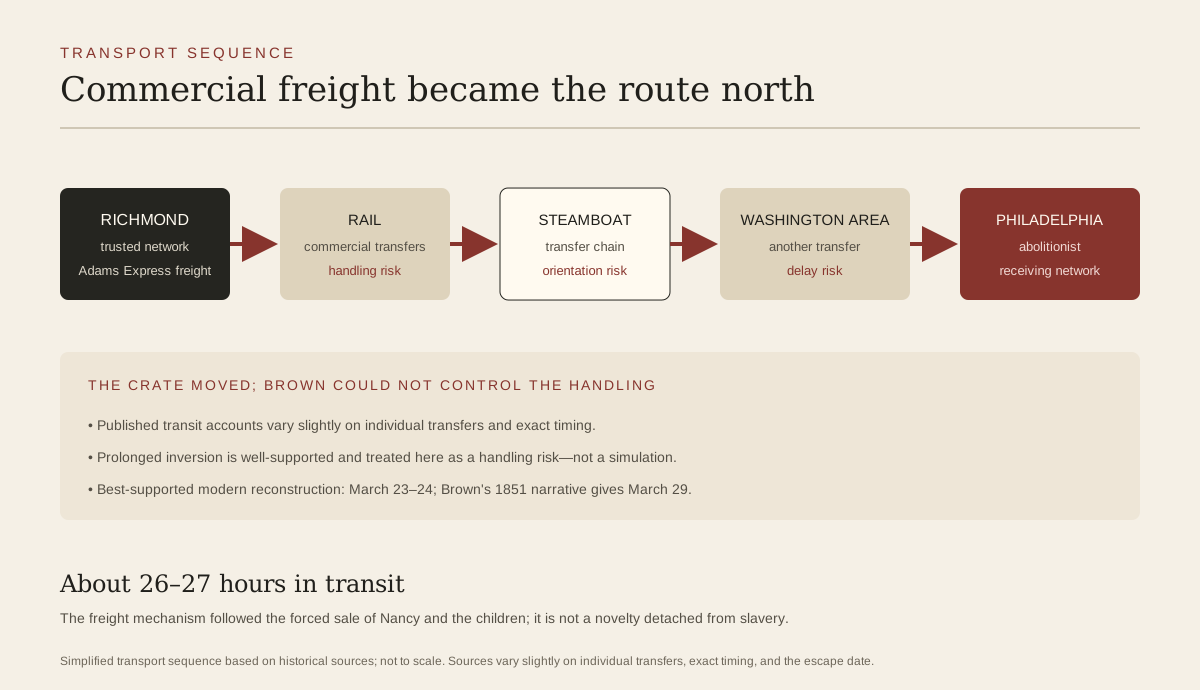
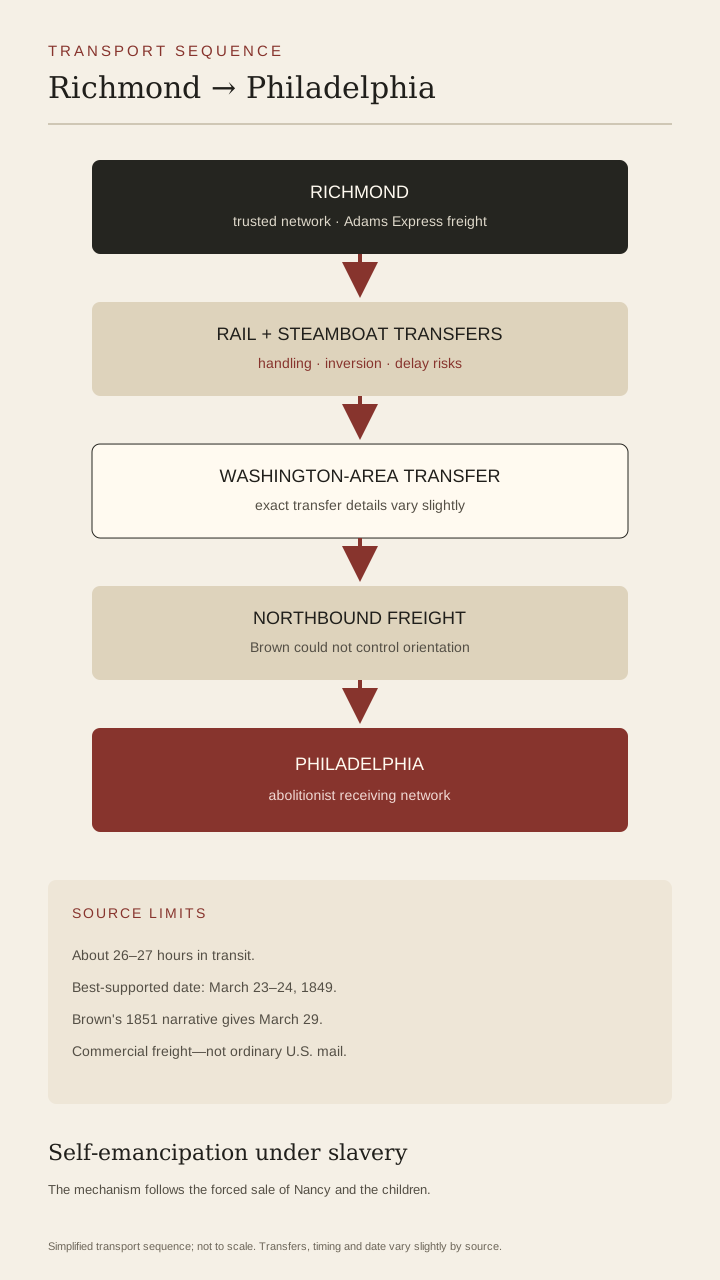
- 01
Richmond
Trusted helpers placed Brown inside a shipping crate carried as commercial freight—not ordinary U.S. mail.
- 02
Transfer chain
Express, rail and steamboat connections moved the crate north while Brown had no control over handling or orientation.
- 03
Washington area
Another transfer kept the crate within the commercial freight system.
- 04
Philadelphia
Abolitionists received and opened the crate after about 26–27 hours.
Simplified transport sequence based on historical sources; not to scale. Sources vary slightly on individual transfers, exact timing, and the escape date.
North Toward Philadelphia
From Washington, the package moved farther north by rail and related connections. Brown’s position inside improved at points and worsened at others. The sources differ slightly over the exact chain of wagons, railroads, steamboat and ferry transfers, but they agree on the larger fact: Brown passed through an ordinary nineteenth-century freight network while hidden inside the box.
Nothing about the transportation system had been designed for him. That was why the disguise worked. A crate could move through places where an enslaved Black man attempting to flee openly could not. The strategy converted Brown, in the eyes of the transportation system, from a person whom slave law claimed as property into a piece of property that the freight system was paid to move.
That inversion carried him north.
Philadelphia
The package reached Philadelphia. Abolitionists associated with the Pennsylvania Anti-Slavery Society had been alerted that a suspiciously ordinary shipment was coming from Richmond.
Modern scholarship identifies James Miller McKim as the principal Philadelphia organizer connected to the delivery. William Still later recorded the story in The Underground Rail Road.
The box was collected and taken to a secure place. The people waiting there still faced a final uncertainty. Brown had spent more than a day sealed inside a container that had repeatedly been mishandled. They did not know in what condition they would find him.
The crate was opened. Henry Brown was alive. He had reached a state where slavery was illegal under state law, although federal fugitive-slave law meant that legal danger did not simply disappear.
Brown’s 1849 narrative framed the moment in explicitly religious terms. He sang a hymn of thanksgiving after emerging.
The escape quickly became known as a kind of “resurrection.” That metaphor soon appeared in abolitionist speeches, songs and prints.
What the Famous Picture Shows—and What It Does Not
One of the best-known images of the escape is the lithograph The Resurrection of Henry Box Brown at Philadelphia, published around 1850. It should not be treated as a photograph of the unboxing. The Library of Congress describes the scene as a sympathetic but partly comic representation of Brown emerging while antislavery figures surround him.
The Virginia Museum of History & Culture adds an important warning: although the lithograph includes recognizable abolitionist figures, the standing figures do not accurately reproduce everyone who was actually present. Frederick Douglass, for example, appears in a role the museum describes as standing in for William Still.
The image is historically important for another reason. Brown was connected to its production and used his own escape publicly as an antislavery argument. The print shows how quickly the wooden crate became more than an object. It became a symbol of what slavery forced a person to endure in order to claim freedom.
Key Object: The Shipping Box
Brown’s box was not a secret compartment built into a vehicle. It was the vehicle. The design had to satisfy two contradictory requirements. It needed to look normal enough to enter commercial freight.
It also needed to keep Brown alive. The surviving sources agree on the essential features:
- compact wooden construction;
- a nailed lid;
- handling instructions;
- small openings for air;
- water carried inside;
- an implement for making additional air holes.
The exact dimensions differ slightly. That difference is a reminder that even a famous object can acquire false precision through repetition. The period measurement is best treated as an approximation, not a modern engineering specification. The most useful question is not whether the box was exactly thirty or thirty-one inches in one dimension.
It is how little physical margin Brown had once the lid was closed.

Not the U.S. Mail
Brown is often described as the man who mailed himself to freedom. The phrase survives because it compresses the entire escape into a memorable image. Technically, it is misleading. Brown traveled through Adams Express, a private commercial express and freight network.
The crate moved using the same expanding combination of rail, water and wagon transportation that allowed nineteenth-century businesses to move parcels between cities. This distinction makes the escape more interesting, not less. Brown did not exploit a whimsical loophole in the postal service. He exploited the increasing speed and connectivity of commercial transportation.
A freight company carried a person out of a slave state because its workers believed they were carrying goods.
Freedom Did Not End the Danger
Brown’s arrival in Philadelphia was successful self-emancipation. It did not create secure citizenship.
Federal law already required the return of people claimed as fugitives from slavery under the 1793 Fugitive Slave Act. The political crisis intensified in 1850 when Congress passed a much stronger Fugitive Slave Act.
Brown had made himself highly visible. He lectured. He appeared at antislavery conventions. He collaborated in the publication of the 1849 Narrative of Henry Box Brown.
He turned his experience into public abolitionist testimony. In 1850 he developed Henry Box Brown’s Mirror of Slavery, a moving panorama that presented scenes connected to slavery before paying audiences. Publicity helped make Brown a powerful antislavery witness. It also made anonymity impossible.
With the new fugitive-slave law increasing the danger of capture and forced return, Brown left the United States for England in October 1850. The route out of Richmond had ended in Philadelphia. The struggle to remain free continued across the Atlantic.
The Method Could Not Simply Be Repeated
Brown’s escape is sometimes told as though the crate had revealed a perfect new route to freedom. It had not. Samuel Smith tried to help arrange another shipment of enslaved people from Richmond only weeks later. The attempt was discovered.
Smith was arrested and ultimately sentenced to years in prison. James C. A. Smith was also arrested in connection with efforts to assist further escapes, although he avoided conviction.
The lesson was not that Brown had found a safe commercial formula. It was that one carefully coordinated shipment had succeeded before authorities understood what had happened. Brown’s public fame ensured that no later crate from Richmond could be regarded quite as innocently.
The Man After the Box
Brown’s public life lasted far longer than the twenty-six or twenty-seven hours that made him famous. He spoke against slavery. He published and performed. He used panoramas, song, public storytelling, mesmerism and later stage magic.
He lived for years in Britain and eventually returned to North America.
By the 1870s he was again performing in the United States, billing himself as Professor H. Box Brown.
Later records place him in Canada. Modern scholarship has established that he died in Toronto on June 15, 1897. That larger life matters because the famous box can reduce Brown to a single act. He was not a man who existed only while hidden inside a crate.
He was a husband and father whose family slavery destroyed, a skilled worker, a self-emancipated fugitive, an abolitionist lecturer, an artist and performer, and a man who spent decades shaping how the public understood his escape. The box is the mechanism. Brown is the history.
Evidence discipline
What the record supports
Status labels distinguish secure conclusions from uncertainty and rejected claims. Color is never the only signal.
DOCUMENTED
Henry Brown escaped slavery by being shipped from Richmond to Philadelphia inside a wooden crate.
Brown’s narratives, abolitionist testimony, William Still’s account, period publications and modern archival scholarship all support the central event.
Sources: SRC-001, SRC-003, SRC-004, SRC-005DOCUMENTED
The forced sale of Nancy and the children was central to Brown’s decision to escape.
Brown’s near-contemporary narrative explicitly links the destruction of his family to his determination to free himself.
Sources: SRC-001, SRC-002, SRC-003MYTH
Brown traveled through the ordinary United States postal mail.
The crate traveled as private commercial express freight through Adams Express and connected transport services, not as ordinary U.S. postal mail.
Sources: SRC-001, SRC-002, SRC-006DISPUTED
Brown entered the box on March 23, 1849.
Modern Virginia archival scholarship uses March 23 with arrival March 24, while Brown’s 1851 narrative gives March 29 and some modern federal pages repeat that date.
Sources: SRC-001, SRC-002, SRC-004, SRC-006, SRC-007DISPUTED
Brown spent exactly twenty-seven hours inside the box.
The 1849 narrative and several later sources use twenty-seven hours; modern Virginia scholarship often gives twenty-six. The responsible summary is approximately twenty-six to twenty-seven hours.
Sources: SRC-001, SRC-003, SRC-004, SRC-005, SRC-006DISPUTED
The exact dimensions of the original escape box are undisputed.
Period sources give slightly different measurements. The 1849 narrative representation gives 3 feet 1 inch by 2 feet by 2 feet 6 inches, while other accounts vary by several inches.
Sources: SRC-003, SRC-005, SRC-007, SRC-010WELL-SUPPORTED
Brown was repeatedly placed head-down during the journey.
Brown describes the experience in both narrative traditions, and modern institutional histories preserve the same core event.
Sources: SRC-001, SRC-003, SRC-004, SRC-006MYTH
Frederick Douglass was necessarily present when Brown’s box was opened because he appears in the famous lithograph.
The commemorative image is not a documentary record of the room. VMHC states that its standing figures do not accurately represent all actual participants and that Douglass functions as a stand-in for William Still.
Sources: SRC-007, SRC-009Evidence, Myth and Source Differences
Did Henry Brown really escape slavery inside a shipping box?
DOCUMENTED
Yes. Brown’s near-contemporary 1849 narrative, his 1851 narrative, abolitionist testimony, William Still’s later account, period images and modern archival scholarship all establish the escape.
Did he literally mail himself through the United States Postal Service?
MYTH / MISLEADING
No. Brown was shipped as commercial freight through Adams Express and a chain of nineteenth-century transportation services. “Mailing himself” is a popular shorthand, not a precise description of the logistics.
Was the escape caused by the sale of Brown’s wife and children?
DOCUMENTED
The forced sale of Nancy and their children in 1848 is central to Brown’s own explanation of why he determined to escape. The shipping method only makes sense within this context.
Did Brown leave Richmond on March 23, 1849?
DISPUTED, WITH MARCH 23 BEST SUPPORTED BY MODERN VIRGINIA SCHOLARSHIP
Encyclopedia Virginia and the Library of Virginia place the departure on March 23 and arrival on March 24. Brown’s 1851 narrative instead states that he entered the box on March 29. Some modern federal pages follow the March 29 date. Use March 23–24 for the main chronology while disclosing the discrepancy.
Was Brown in the box exactly twenty-seven hours?
DISPUTED / SOURCE-VARIANT
The 1849 narrative and several later accounts state twenty-seven hours. Modern Virginia scholarship often gives twenty-six. Use about 26–27 hours.
Was the box exactly three feet one inch by two feet by two feet six inches?
DISPUTED / SOURCE-VARIANT
That measurement appears in the 1849 narrative’s representation and related testimony. Other period and later sources give slightly different dimensions, including three feet by two feet by two and one-half feet and William Still’s later two-foot-eight-inch depth. Use approximate measurements unless discussing a specific source.
Was Brown upside down for part of the trip?
DOCUMENTED IN BROWN’S OWN ACCOUNTS AND CONSISTENTLY REPEATED
Yes. Brown described being placed head-down during freight handling and experiencing severe physical distress. The precise duration should not be overstated.
Did passengers unknowingly save Brown by turning the box over and sitting on it?
WELL-SUPPORTED PARTICIPANT ACCOUNT
Brown describes the episode in his narratives. It cannot be independently reconstructed minute by minute, but it appears consistently in the escape tradition and explains the end of one prolonged inversion.
Was Frederick Douglass one of the men who opened the box in Philadelphia?
MYTH / MISLEADING IF INFERRED FROM THE FAMOUS LITHOGRAPH
Frederick Douglass appears in the commemorative lithograph. The Virginia Museum of History & Culture states that the standing figures do not accurately represent all the people actually present and identifies Douglass as a stand-in for William Still in that artistic composition. The print is not documentary photography.
Why the Escape Worked
Brown’s plan succeeded because each part solved a different barrier created by slavery. He could not travel north openly. He became freight. Freight might be inspected.
The crate looked ordinary. A sealed crate required air. Small holes and a tool offered a limited supply. Brown needed the shipment to arrive at people who understood what it contained.
His collaborators established contact with abolitionists in Philadelphia. The box needed careful handling. It was marked accordingly. That safeguard failed.
Brown could not correct the freight workers without revealing himself. He endured until the crate was moved again. At another transfer, the package risked being delayed. The express system sent it onward.
Philadelphia ended the transport problem. It did not end the legal one. Brown responded by turning private escape into public antislavery testimony—and when federal law threatened to reach him again, he left the country. The box was not a trick that made slavery disappear.
It was one dangerous solution to one impossible situation.
Selected chronology
Family separation, self-emancipation and aftermath
Brown is separated from his birth family
After John Barret’s death, Brown is sent to Richmond to work in a tobacco factory.
Henry and Nancy marry
Brown marries Nancy, an enslaved woman controlled by a different enslaver; they later have three children together.
Nancy and the children are sold away
Nancy and the couple’s three children are sold and taken toward North Carolina. Nancy is pregnant with a fourth child.
Best-supported departure from Richmond
Modern Virginia archival scholarship dates Brown’s entry into the freight system to March 23; Brown’s 1851 narrative instead gives March 29.
Brown reaches Philadelphia
The crate is received by abolitionist contacts and Brown emerges alive after approximately twenty-six to twenty-seven hours.
Brown enters public abolitionist work
Brown appears at the New England Anti-Slavery Convention and becomes publicly known as Henry “Box” Brown.
The first Narrative is published
Narrative of Henry Box Brown, based on Brown’s statement of facts and compiled with Charles Stearns, appears in Boston.
Mirror of Slavery opens
Brown’s moving panorama becomes part of his antislavery public work.
Brown leaves for England
With the Fugitive Slave Act increasing the danger of seizure and re-enslavement, Brown leaves the United States.
Brown dies in Toronto
Modern scholarship places Brown’s death in Toronto, Ontario.