
William Okeley’s escape from Algiers began long before five men pushed a homemade canvas boat into the Mediterranean on 30 June 1644. It began with a failed Atlantic voyage in 1639, followed by capture at sea, sale in Algiers, years of enslavement, and a problem that Okeley and several companions could not solve by simply walking away. The sea surrounding North Africa offered a possible route to Christian-controlled territory, but it also created a barrier that could be as effective as a wall.
Okeley eventually chose an extraordinary answer: build a small boat secretly, move it out of Algiers in pieces, assemble it near the coast, and try to reach Mallorca. Seven men participated in the escape project. Only five could safely leave in the boat. Six days later, according to Okeley’s account, all five reached Mallorca.
The broad story is historically strong. The difficulty lies in the source. Okeley’s surviving book appeared more than thirty years after the escape and framed the entire experience as evidence of divine providence. Modern scholarship has confirmed enough people and context around the narrative to reject the idea that it is simply fiction, but its most vivid scenes still need to be read as retrospective testimony rather than a contemporary log.
At a Glance
Who: William Okeley and four other Englishmen who ultimately escaped with him: John Anthony, William Adams, John Jephs, and an otherwise unnamed John whose occupation was carpenter.
Confinement: Enslavement in Algiers after capture by North African corsairs.
Captured: 11 August 1639, according to Okeley’s later account.
Escape: Departed Algiers on 30 June 1644 in a small boat built secretly from a sectional frame and canvas.
Landing: Mallorca, 6 July 1644.
Count: Seven men were active in the escape project; two remained behind before launch; five made the crossing.
Evidence issue: Most details of the plan and voyage come from Okeley’s own retrospective narrative, published decades later and shaped by a strong providential purpose.
Captured on the Way to Providence Island
In June 1639 Okeley boarded the Mary of London at Gravesend. The ship was bound for Providence Island, an English Puritan colony in the western Caribbean. Okeley remembered the Mary as carrying a mixed company of sailors and passengers along with a commercial cargo.
The voyage never reached the Atlantic destination. After delays in English waters, the Mary sailed from the Isle of Wight and encountered three corsair vessels. Okeley dated the capture to 11 August 1639. He described a pursuit and fight before the English ship was taken, after which the captives spent several more weeks aboard their captors’ vessels before arriving in Algiers.
There they entered a system in which European captives could be sold, put to work, ransomed, exchanged, or transferred among owners. Modern historians often study these accounts under the broad category of “Barbary captivity,” but in Okeley’s case the word captivity does not fully describe the status he claimed for himself. He repeatedly called it slavery.
That distinction matters. Okeley described being subject to sale and ownership, and he worried that even tolerable conditions under one owner could disappear if he were transferred to another. Bernard Capp’s modern study of the narrative argues that historians should take that self-description seriously rather than retroactively soften it.
Life in Algiers and the Problem of Escape
Okeley’s account does not portray every owner or every part of Algiers through one simple stereotype. His last owner, in particular, treated him comparatively kindly and allowed him opportunities to work. That relative freedom created both an opportunity and a moral problem.
An enslaved person could have a less brutal owner and still remain unfree. Okeley understood that the arrangement depended on someone else’s claimed right to possess and transfer him. When he began considering escape, he wrestled with whether leaving a man who had treated him well amounted to a betrayal. He ultimately decided that the ownership itself gave the master no legitimate claim over his liberty.
The risk was not theoretical. Okeley recalled that he had previously been suspected of escape activity and detained. His narrative also makes clear that unauthorized flight could bring severe punishment and could create problems for English merchants and diplomats who depended on negotiated relationships with Algiers.
Bernard Capp’s broader study of British enslavement in North Africa confirms the larger problem. Escape from Algiers by land offered little realistic access to safety. Some captives tried to hide on visiting ships, swim to vessels offshore, seize ships, or make improvised craft. Many plans failed before launch.
Choosing the Group
Okeley did not begin by gathering everyone he knew who wanted freedom. He first sought advice.
He named three men whom he consulted but who did not join the operational escape: the minister Devereux Spratt, Robert Lake, and John Randal. Their reasons differed. Some had realistic prospects of ransom or release; others had family obligations or health problems. Their presence in the narrative can create confusion because they were part of the deliberations without being part of the seven-man escape team.
Okeley then formed a working group of seven. Alongside him were John Anthony, a carpenter; William Adams, who had learned bricklaying while enslaved; John Jephs, a seaman; another man printed only as “John —,” whose occupation was carpenter; and two unnamed men who worked near the shore washing small clothes.
The unnamed carpenter requires particular care. Later summaries can turn the typography into a surname and call him “John Carpenter.” Okeley’s title page and narrative do not provide that surname. They identify an unnamed John and then give his trade.
The group’s composition reflected practical needs. They required people who could make parts, move materials, understand the sea, and work without attracting attention. They also needed a design that could be created inside Algiers without having a recognizable boat sitting in plain view.
A Boat Built in Pieces
Their answer was a small sectional craft covered with canvas. Okeley described preparing parts in a cellar, taking the structure apart, moving components out separately, and concealing materials until they could be brought together beyond the city.
He devoted considerable space to the construction. The historical significance is less in the exact dimensions or recipes than in the principle: the boat had to exist in two states. Inside Algiers it had to look like scattered materials that could be moved without revealing the plan. Near the water it had to become a vessel capable of carrying several men across open sea.
Okeley says the group acquired canvas and waterproofing materials and fashioned a frame that could be disassembled. Components left the city at different times and were hidden until the night chosen for departure. His narrative presents the entire process as a chain of narrow escapes from discovery, but those moment-by-moment episodes remain his later recollection.
The destination was Mallorca. It offered a reachable Christian-controlled shore across the western Mediterranean, though the group had no ordinary seaworthy vessel with which to cross the distance.
Seven at the Water, Five in the Boat
On the night of 30 June 1644 the seven active participants brought the components together and assembled the craft outside Algiers. Okeley’s account records uncertainty even over where to complete the work. Eventually they finished the boat and carried it toward the sea.
Then the plan changed.
All seven climbed in, and the boat sat dangerously low. One man chose to remain ashore. The remaining six tried again, but the vessel was still too heavily loaded. A second man left.
That reduced the escape party to five: John Anthony, William Adams, John Jephs, John — the carpenter, and William Okeley. Okeley explicitly listed those five after recording their farewell to the two companions who remained behind.
This count is one of the most important pieces of evidence to preserve because different parts of the narrative involve different groups. Three advisers had been consulted. Seven men carried out the operational project. Five actually left Algiers.
The five launched on 30 June 1644.
Six Days in the Mediterranean
Okeley’s section describing the crossing is the most dramatic part of Eben-ezer. He portrayed a craft that leaked, four men rowing while a fifth repeatedly removed water, limited provisions, punishing heat, adverse wind, exhaustion, and uncertain navigation. He also described extreme measures taken when supplies deteriorated.
Those details gave the book much of its later appeal, but they should be read in context. Okeley was writing retrospectively, and the published work was constructed as a religious testimony. Hardship was not merely reported; it was interpreted as part of a providential trial in which survival demonstrated divine mercy.
The basic crossing is nevertheless well supported by the structure of his narrative and by modern scholarship that treats the escape as historical. The men traveled for six days and nights in an improvised canvas-covered boat. Their progress depended on rowing, continual attention to leakage, and enough navigation to keep moving toward the northern side of the western Mediterranean.
Okeley said that they lacked the normal equipment of a proper seagoing vessel and relied on rudimentary directional aids and observation of the sky. The exact course they followed cannot be reconstructed with confidence from his prose, and no precise route line should be treated as measured history.
On the sixth day they reached land.
Mallorca, 6 July 1644
Okeley dated the landing to 6 July 1644. Mallorca was under Spanish rule, and reaching it changed the men’s status decisively. They were no longer within the jurisdiction of Algiers or exposed to immediate recapture by their former owners.
His account then shifts from escape to recovery and return. The men received assistance on Mallorca and later moved through Spanish territory while trying to find a route back to England. That journey could still be difficult: being free did not mean being well funded, and Okeley complained that some English merchants showed little sympathy for men who had escaped rather than been formally ransomed.
Eventually Okeley returned to England. He did not publish the familiar surviving version of his story immediately. The best-known 1675 edition appeared more than three decades after the events, and Capp’s research indicates that earlier editions or forms of the story had already circulated.
The long delay matters because it separates the event from the text through which the event is known. The Okeley who wrote for readers after the Restoration was remembering the experiences of a younger man during the turmoil of the 1630s and 1640s. His narrative was also shaped by religious argument, publishing history, and the expectations of the captivity genre.
What Okeley’s Narrative Can Prove
Okeley is indispensable to this case. Without his account, the construction, participant list, moral debate, launch problem, and six-day crossing would be far less visible. Modern research has also strengthened confidence in the work by identifying several named people from Okeley’s Algiers circle in independent records.
That does not make every line independent evidence. A memoir can establish what its author later remembered or wanted readers to understand without proving every spoken exchange, danger, providential interpretation, or precise survival episode exactly as printed.
The strongest reconstruction therefore stays close to the points that recur consistently and fit the verified context. Okeley was captured in 1639 and enslaved in Algiers. He spent years there. He and six other men worked on a secret escape involving a boat built in sections. Two remained behind when the craft proved unable to carry seven safely. Five launched on 30 June 1644. Okeley says they reached Mallorca on 6 July, and modern scholarship accepts the escape as a historical event.
The story does not need its most sensational details to remain extraordinary. Five enslaved men used skills acquired before and during captivity, a concealed construction project, collective planning, and a small improvised vessel to cross from Algiers to Mallorca. Their escape was not a miracle in the evidentiary sense. It was an event Okeley understood as miraculous—and one whose historical core survives even after that belief is separated from what the sources can independently establish.
Evidence discipline
What the record supports
Status labels distinguish secure conclusions from uncertainty and rejected claims. Color is never the only signal.
WELL-SUPPORTED
Okeley’s condition in Algiers is accurately described as enslavement rather than merely detention.
Okeley repeatedly described himself as a slave and discussed sale, ownership, and possible resale. Bernard Capp’s modern reassessment explicitly supports taking that terminology seriously.
Sources: SRC-001, SRC-002, SRC-003, SRC-004MYTH
Seven men escaped from Algiers in the canvas boat.
Seven men formed the active project group and all seven initially entered the boat, but two remained ashore after overload tests. Okeley explicitly lists five departing men.
Sources: SRC-001MYTH
The fifth escapee was a man whose surname was Carpenter.
The 1675 title and narrative print him as John followed by a dash and then identify his occupation as carpenter. His surname is not supplied.
Sources: SRC-001, SRC-005LATER CLAIM
The exact detailed construction process of the escape boat is independently documented.
The construction description comes from Okeley’s retrospective narrative. Modern scholarship accepts the improvised canvas-boat escape as historical but does not independently verify every fabrication detail.
Sources: SRC-001, SRC-002, SRC-003WELL-SUPPORTED
The five departed on 30 June and reached Mallorca on 6 July 1644.
Okeley gives both dates explicitly, and modern scholarship accepts the six-day escape crossing in outline. No independent day-by-day 1644 voyage log was located.
Sources: SRC-001, SRC-002, SRC-003LATER CLAIM
All vivid survival episodes in Eben-ezer can be treated as independently verified facts.
The sea-crossing details are Okeley’s own later recollections embedded in a consciously providential narrative published decades after the event.
Sources: SRC-001, SRC-002Documentary reconstruction
Seven participants, five places in the boat
A case-local editorial visual separates the secure historical sequence from uncertainty without exposing reusable modern operational detail.
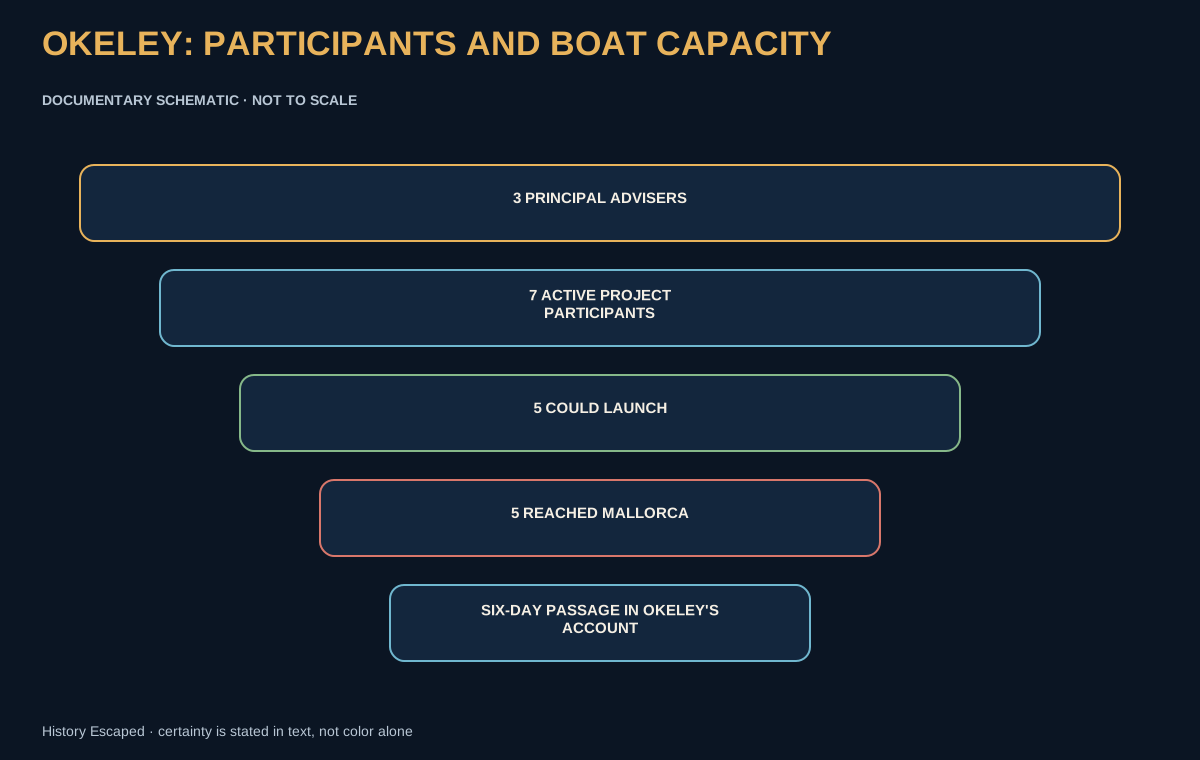
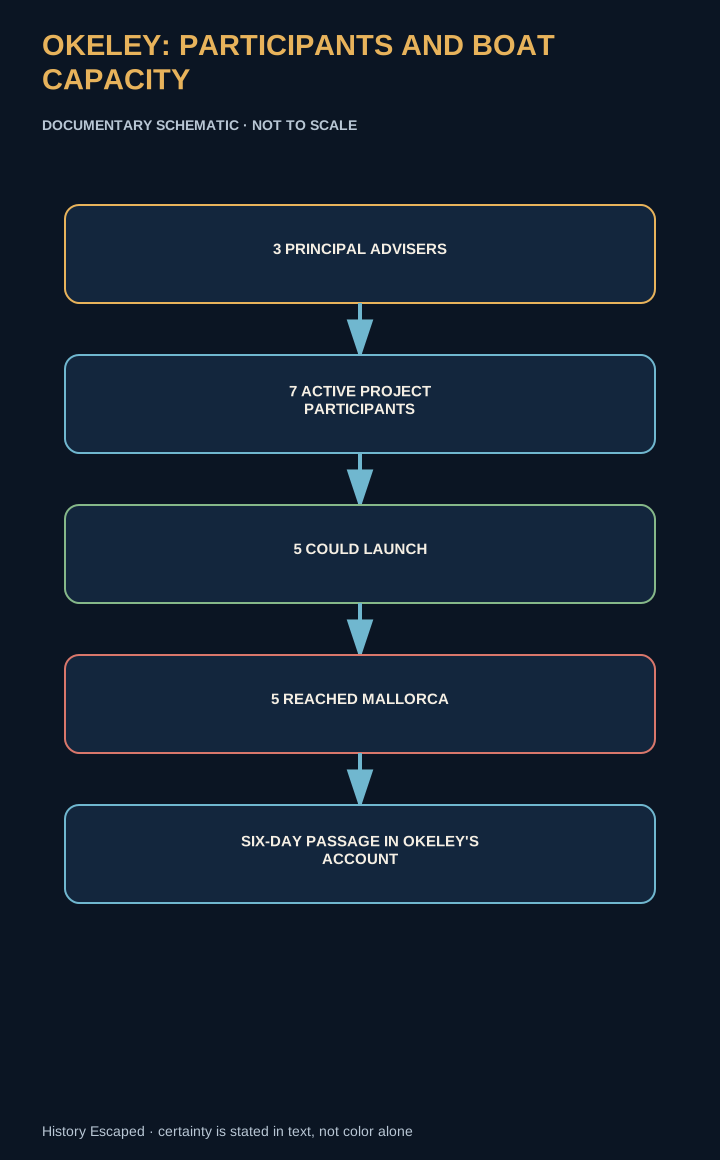
Simplified evidence-led editorial reconstruction based on the cited record; not to scale. Uncertainty is stated directly in the visual and adjacent text.
