
Caravaggio reached Malta already living under the consequences of violence. In 1606, after Ranuccio Tomassoni died in a fight in Rome, Michelangelo Merisi da Caravaggio fled papal territory and built a new career through powerful patrons in Naples. Malta offered more than another refuge: the Order of St John could give him status, protection and, potentially, leverage in the effort to obtain a papal pardon.
For a time, the plan worked. Caravaggio entered the Order, painted for its leaders, and in July 1608 became a knight. Less than two months later he was in Fort St Angelo, detained after a violent brawl involving several members of the Order. By early October he was gone from the fortress and from Malta.
The escape is famous because the prison was formidable and the fugitive was already one of Europe’s most celebrated painters. It is also a case in which later biography has often supplied a cleaner story than the surviving record allows. The documents establish detention, escape, the use of ropes, a failed effort to recover him, and his flight to Sicily. They do not securely identify the people who helped him, the precise route through the fort, or the exact moment at which he slipped away.
At a Glance
- Who escaped: Michelangelo Merisi da Caravaggio, painter and newly admitted Knight of the Order of St John
- Place: Fort St Angelo, Birgu, Malta
- When: Early October 1608; the escape had been formally reported by 6 October
- Why he was confined: His documented involvement in an August brawl in Valletta in which a senior knight was seriously wounded
- What is secure about the method: An Order report later stated that he escaped from the fortress using ropes
- What remains uncertain: The precise route, the identities of any helpers, the vessel or departure point, and whether senior officials knowingly facilitated the escape
- Immediate destination: Sicily, with Syracuse the first securely associated city after Malta
- Result: Caravaggio remained at large and was expelled from the Order in absentia on 1 December 1608
A fugitive looking for protection
Caravaggio arrived in Malta in mid-1607 after passing through Naples. His position was unusual. He was not an obscure runaway seeking anonymity but an artist with elite patrons, a major reputation, and an unresolved criminal sentence in Rome.
The Order of St John was a sovereign religious-military institution centered on Malta. Admission offered Caravaggio a way to remake his public standing, but his Roman past posed an obvious obstacle. The Order’s rules did not normally accommodate a man with a killing behind him, and Grand Master Alof de Wignacourt obtained papal permission before Caravaggio’s reception.
On 14 July 1608 Caravaggio was invested as a knight of magistral obedience. His Maltese works included the enormous Beheading of St John the Baptist for the Order’s oratory in Valletta, as well as portraits and other commissions connected to senior members. His new status therefore rested on more than artistic celebrity: he had been formally absorbed into the institutional world whose patronage he had sought.
That success lasted only weeks.
The brawl that ended the Maltese experiment
Older biographies knew that Caravaggio quarreled with a knight in Malta, but archival research has recovered a more specific event. On the night of 18 August 1608, a violent disturbance broke out at the Valletta house of Fra Prospero Coppini, an organist connected with the conventual church of St John. Seven Italian knights were involved, an illegal pistol was fired, a door was broken, and Fra Giovanni Rodomonte Roero, Count della Vezza di Asti, was seriously wounded.
The surviving evidence places Caravaggio in the brawl, but it does not justify turning every injury into his personal act. Modern retellings sometimes collapse collective violence into a one-on-one duel in which Caravaggio simply attacked Roero. The archival reconstruction is more cautious: Caravaggio participated in the disorder, Roero was badly hurt, and responsibility within the melee is not completely individualized by the surviving evidence.
An investigation followed. By 27 August Caravaggio and Fra Giovanni Pietro de Ponte had been identified and detained in Fort St Angelo. The painter who had been raised to knighthood in July was now a prisoner of the same Order.
Fort St Angelo
Fort St Angelo occupied the tip of Birgu inside Malta’s Grand Harbour. It was not merely a picturesque castle but one of the Order’s principal fortified positions, and it also served as a place of confinement for troublesome or accused members. For Caravaggio, imprisonment there sharply reversed the security and prestige he had spent the previous year building.
A popular version of the story puts him in a particular subterranean chamber, often described as an oubliette or a bell-shaped “birdcage,” and then reconstructs his emergence from it step by step. Fort St Angelo does contain spaces associated with imprisonment, and modern interpretation at the site discusses Caravaggio’s detention. Yet the surviving evidence does not securely prove that one specific surviving chamber was his cell.
The difference matters because the escape mechanism is often narrated with architectural certainty that the documents do not support. The record can take the story further than “he somehow escaped,” but not all the way to a measured route through the fortress.
What the record actually says about the escape
On 6 October 1608, Fra Hieronymus Varays, procurator for the Order’s Treasury, informed the governing council that Caravaggio had escaped from detention in Fort St Angelo and secretly fled Malta. That date is the strongest chronological anchor. Some modern accounts simply call 6 October the date of escape, while the underlying notice proves at minimum that the escape had occurred by then.
The Order opened an inquiry and sought to recover him. Later proceedings referred to a report stating that Caravaggio had escaped from Fort St Angelo “by means of ropes.” Keith Sciberras, whose archival work transformed understanding of the Maltese episode, likewise treats rope use as the one concrete mechanical detail to emerge from the investigation.
Ropes do not tell us the full route. They do not establish which wall or opening he used, how he crossed guarded areas, where he reached the water or land outside the fort, or who supplied transportation away from Malta. Those gaps have encouraged increasingly elaborate reconstructions.
Early biographers add some details, but they were writing years later. Giovanni Baglione, whose life of Caravaggio appeared in 1642, says that the painter escaped at night, scaled the prison, and reached Sicily. Giovanni Pietro Bellori, writing in 1672, likewise describes a dangerous nighttime escape followed by rapid flight to Sicily. These accounts are important evidence for the early tradition, but neither is a contemporary prison log or eyewitness report.
Was he helped?
An assisted escape is highly plausible. A prisoner leaving a major fortified complex and then getting off an island required opportunities that are difficult to explain as a purely solitary improvisation. Sciberras argues that there was an “arrangement” to help Caravaggio, while also emphasizing that the identities of the helpers cannot be established.
That distinction is essential. Historians and biographers have proposed patrons, members of the Colonna network, sympathetic knights, prison officials, and even Grand Master Wignacourt himself. None of those possibilities should be converted into a named accomplice without stronger evidence.
The failed investigation is suggestive rather than dispositive. Malta was a small political world in which helping a fugitive knight could expose an accomplice to serious punishment, yet the inquiry did not produce a secure public identification of those responsible for enabling the escape. The absence of a named helper can support suspicion of protection, but it cannot tell us whose protection it was.
Sicily instead of recapture
Caravaggio reached Sicily and was soon associated with Syracuse. His movements after Malta were conspicuous rather than deeply underground. In Syracuse he obtained the commission for the Burial of Saint Lucy, and he later worked in Messina and Palermo.
That public activity complicates the image of a fugitive permanently hiding from sight. The Order had reason to want him back, but local patrons in Sicily had reason to value his presence. Sciberras notes the political awkwardness this created: securing the services of an internationally famous painter could compete with the expectation that authorities would assist in returning an escaped knight.
The Maltese escape therefore succeeded in its immediate purpose. Caravaggio was not recaptured and returned to Fort St Angelo. It did not, however, make him a free man in every legal or political sense. The Roman case that had driven him south in the first place still shaped his movements, and his remaining years were spent trying to restore the protection needed for a return.
Expelled in absentia
Leaving Malta without permission placed Caravaggio in direct breach of the Order’s discipline. The institution summoned him to answer for his conduct, but he did not return. On 1 December 1608, an assembly in the Oratory of St John in Valletta formally expelled him from the Order in absentia.
The ceremony has acquired a fittingly dramatic place in Caravaggio biography because it took place beneath or near the artistic world he had helped create for the knights. The Order used a formula translated as casting him out like a “rotten and fetid limb.” The phrase was institutional language of expulsion, not a unique psychological verdict invented for the painter.
His expulsion is also a useful reminder that the case against him after the escape was not simply a delayed verdict on the August brawl. His unauthorized flight and failure to submit to the Order’s authority became offenses in their own right.
What can be reconstructed—and what cannot
The broad sequence is unusually strong. Caravaggio entered the Order in July 1608, took part in the August disturbance, was detained at Fort St Angelo, escaped by early October, left Malta, reached Sicily, and was expelled in December. The record also gives one physical clue: ropes were used.
The uncertainty begins when that clue is expanded into a complete action scene. It is not securely known which cell he occupied, where the rope was fixed, whether he climbed upward or descended a wall at each stage, how many people assisted him, whether guards were bribed or instructed to look away, where a boat waited, or who paid for the passage. Even the common statement that he escaped specifically on the night of 6 October treats the date of the official report as more exact than the archival wording necessarily permits.
The best reconstruction is therefore partly negative. Caravaggio did not simply vanish through an unexplained miracle, because the Order’s own later record preserves the use of ropes. But neither the surviving documents nor the earliest biographies justify a precise fortress diagram with named accomplices and a timed route.
After the escape
Caravaggio’s Sicilian period lasted into 1609, after which he returned to Naples. There he continued to seek the political support necessary for a papal pardon and a return to Rome. He never made that return; he died in 1610 while traveling north.
The Fort St Angelo escape nevertheless changed the last phase of his career. It turned a painter who had entered Malta hoping to rebuild status into a fugitive from two different systems of authority. At the same time, his movement through Sicily helped spread his artistic influence across the central Mediterranean.
The most striking part of the episode is not that every legendary detail can be verified. It is that the documentary core is dramatic enough without embellishment: within twelve weeks of becoming a Knight of St John, Caravaggio was involved in a major brawl, imprisoned in one of Malta’s most important fortresses, out of the fort with the aid of ropes, off the island, and beyond the Order’s reach.
Evidence discipline
What the record supports
Status labels distinguish secure conclusions from uncertainty and rejected claims. Color is never the only signal.
UNKNOWN
Caravaggio’s escape can be dated exactly to 6 October 1608.
The documentary anchor is a 6 October report that he had escaped and fled Malta. Some specialist summaries use 6 October as the escape date, but the notice itself proves at minimum that the escape occurred by then.
Sources: SRC-001, SRC-002WELL-SUPPORTED
Caravaggio used ropes to escape Fort St Angelo.
A report later read in the Order’s proceedings stated that he had escaped from the fortress by means of ropes; modern archival scholarship treats this as the clearest mechanical detail.
Sources: SRC-002UNKNOWN
Grand Master Alof de Wignacourt secretly arranged Caravaggio’s escape.
Assistance is highly plausible, but the surviving evidence does not securely identify the helpers or establish an order from the Grand Master.
Sources: SRC-002UNKNOWN
Caravaggio personally inflicted Fra Giovanni Rodomonte Roero’s serious wounds.
The archival reconstruction places Caravaggio in the multi-person brawl and records Roero’s injuries, but the sources used here do not securely individualize the wounding act.
Sources: SRC-001, SRC-002UNKNOWN
A specific surviving oubliette at Fort St Angelo can be identified as Caravaggio’s exact cell.
Fort interpretation preserves the imprisonment association, but the sources used here do not provide enough evidence to identify one surviving chamber as his exact cell with certainty.
Sources: SRC-004LATER CLAIM
The later biographies preserve every detail of the escape accurately.
Baglione and Bellori describe a nighttime escape and rapid flight to Sicily, but they were writing decades after the event and should not override the narrower contemporary institutional record.
Sources: SRC-005, SRC-006Documentary reconstruction
What the Order’s record establishes
A case-local editorial visual separates the secure historical sequence from uncertainty without exposing reusable modern operational detail.
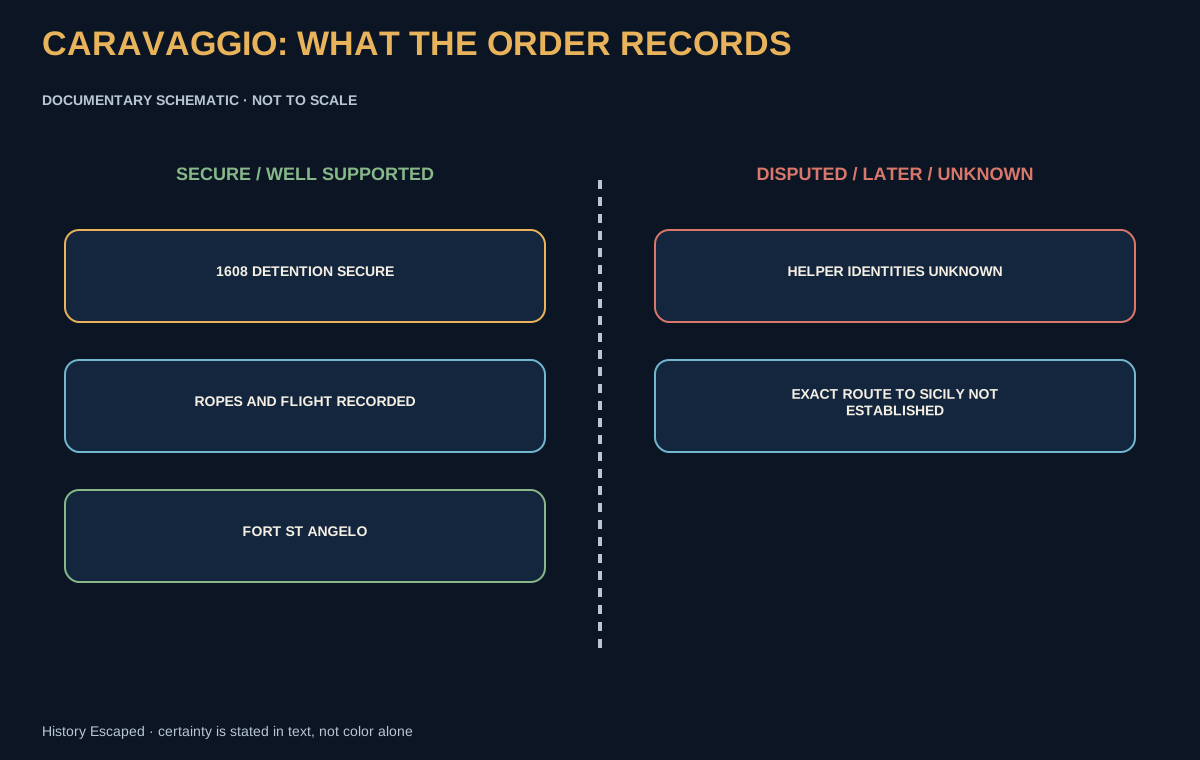
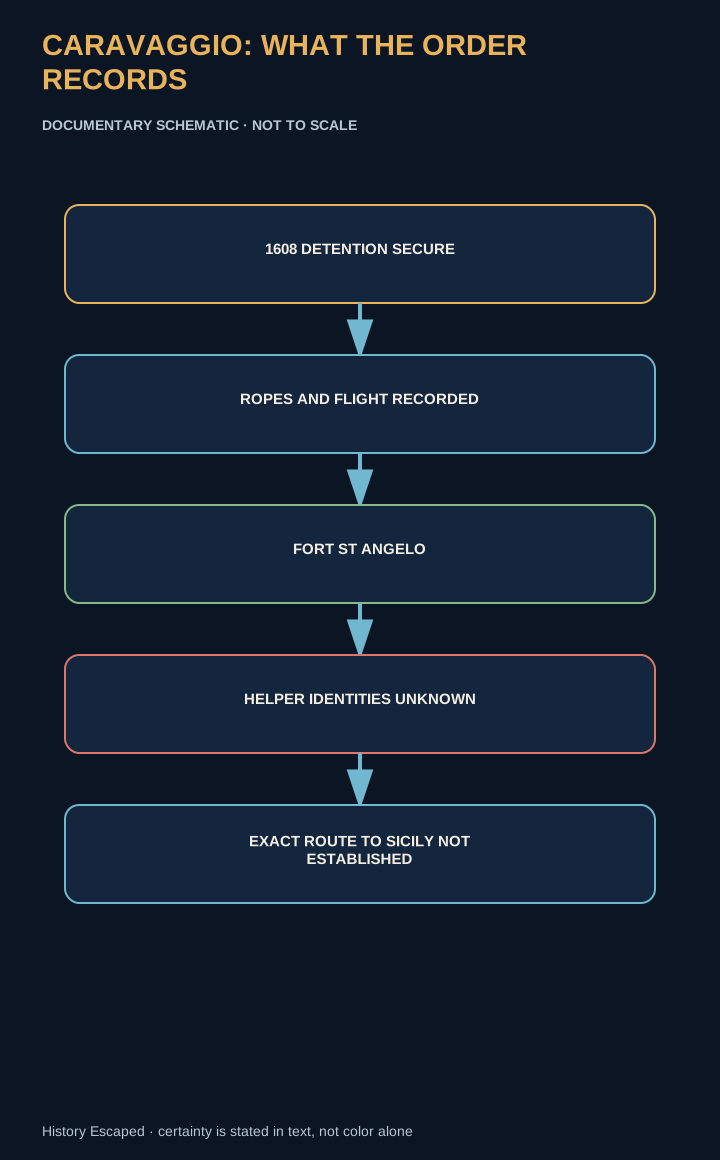
Simplified evidence-led editorial reconstruction based on the cited record; not to scale. Uncertainty is stated directly in the visual and adjacent text.
