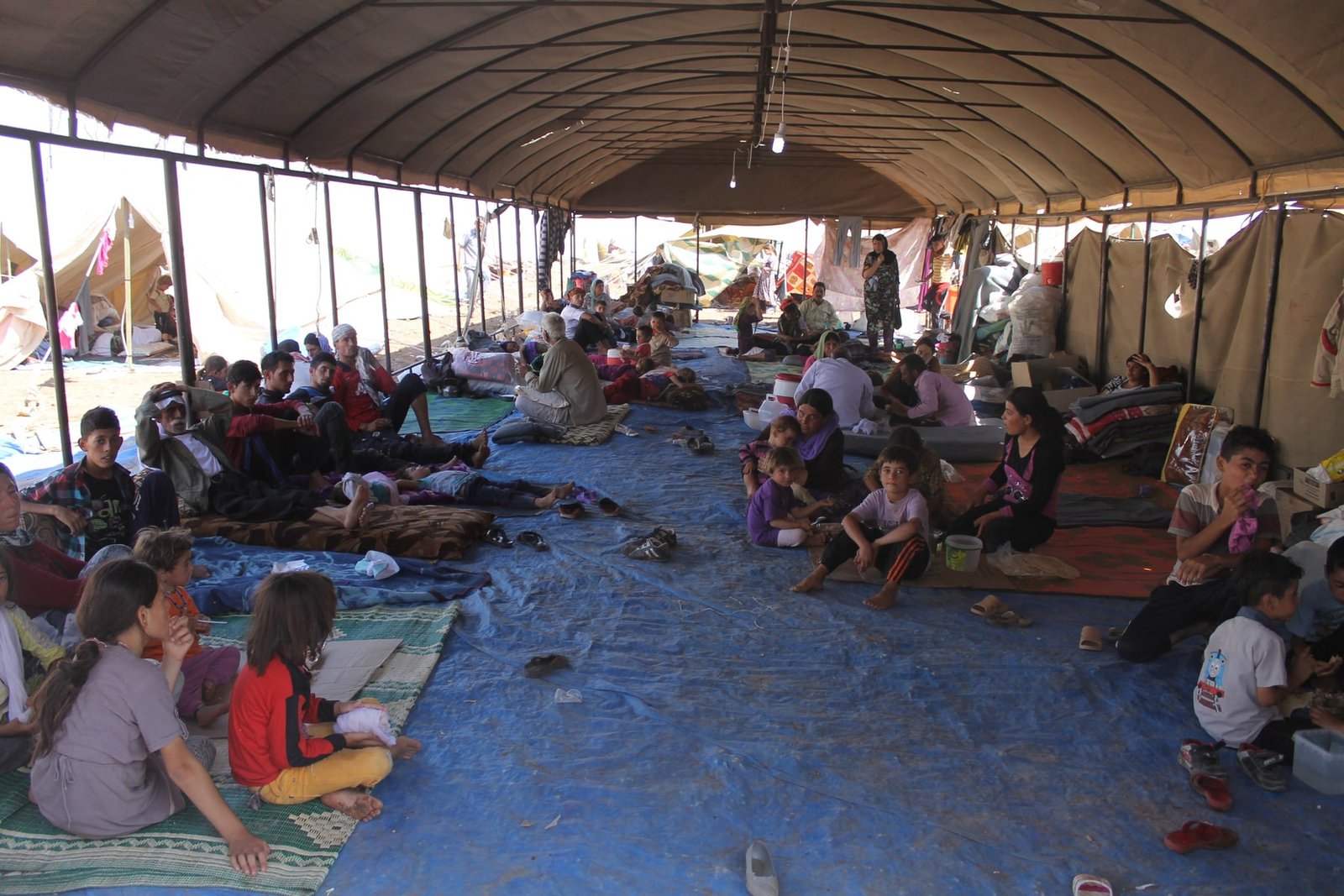
Nadia Murad’s escape from Islamic State captivity in 2014 began with an opportunity that could easily have led to another recapture. After months of enslavement in and around Mosul, one of her captors left her alone in a house and the way out was unsecured. Murad left, crossed into the surrounding streets, and eventually chose a household at which to ask for help. The people who opened the door could have returned her to the organization that was holding Yazidi women and girls as property. Instead, they hid her and helped her leave Islamic State-controlled territory.
That sequence is now well known because Murad later described it in her memoir and in interviews, and because one of the men who helped her, Omar Abdel Jabar, eventually spoke publicly. The earliest public record is less detailed. When Murad addressed the United Nations Security Council in December 2015, she testified to her capture, sexual enslavement, a failed attempt to escape and her eventual freedom after about three months, but she did not give the later step-by-step account of the unlocked door and the family that sheltered her.
The difference matters. Murad’s escape is unusually well documented for an individual flight from Islamic State captivity, but the detail accumulated over time. The secure historical core should be distinguished from later recollection, especially because her story sits inside a much larger genocide in which thousands of Yazidis were killed, abducted, enslaved or remained missing.
At a Glance
- Captured: Kocho, Sinjar district, Iraq, 15 August 2014
- Age: 21
- Captivity: about three months
- Primary area of captivity: Mosul and other Islamic State-controlled locations in northern Iraq
- Earlier escape attempt: failed; Murad testified that she was violently punished after recapture
- Successful escape: November 2014; exact day not securely established
- Immediate mechanism: an unsecured door created an opportunity to leave a captor’s house
- Critical helpers: a Sunni Muslim family in Mosul, later publicly identified through the family of Omar Abdel Jabar
- Exit from Islamic State territory: with a concealed identity and an escort posing as a family relationship
- Outcome: reached Kurdish-controlled territory and later a displaced-persons/refugee setting; resettled in Germany in 2015
Kocho Did Not Fall on 3 August
The date most closely associated with the Yazidi genocide is 3 August 2014, when Islamic State forces attacked the Sinjar region. Murad’s own capture came later. Kocho, her village south of Mount Sinjar, remained encircled after the initial offensive rather than being emptied that first day.
Murad’s December 2015 testimony placed the decisive events in Kocho on 15 August. The United Nations later described the village as having endured about twelve days of siege before Islamic State fighters gathered its residents, separated men and boys from women and children, and carried out mass killings and abductions. Murad testified that six of her brothers and stepbrothers were killed, while three escaped the massacre.
The women and children were taken away. Murad, then 21, was among the younger women transferred into a system of sexual slavery that Islamic State had imposed on captured Yazidis. The United Nations Commission of Inquiry later concluded that the organization’s campaign against Yazidis constituted genocide and that enslavement, sexual violence, forced conversion, killings and forcible transfer formed part of the systematic attack.
For Murad’s story, that broader context is essential because captivity was not an accidental consequence of battle. The organization had created rules and markets for treating Yazidi women and girls as property. Her escape therefore meant getting out of both an individual captor’s control and a wider administrative system designed to keep people enslaved.
Captivity and the First Failed Escape
Murad was taken with other Yazidi women and girls to Mosul. In her first major international testimony, she described being held with many other captives and being assigned to an Islamic State fighter. She was pressured to convert and was repeatedly subjected to sexual violence and other abuse.
At some point during this captivity, Murad tried to escape and was caught. Her 2015 Security Council statement is the strongest early source for that attempt. She testified that the punishment included severe physical and sexual violence.
The failed attempt is important to understanding the successful one. It established that capture after flight could bring further violence, and Murad already knew the consequences personally. Later accounts also make clear that other escaped Yazidi women had sometimes been returned by people they approached for help.
Murad remained captive under different circumstances and with different men. Later retellings sometimes turn that period into a precise sequence of sales and transfers, but the numbers and exact chronology vary depending on the account. The central fact is more secure: she was held for roughly three months within an organized system of enslavement and was moved among captors before the opportunity for a second escape appeared.
An Unlocked Door
Murad’s December 2015 Security Council testimony said simply that after three months of abduction she was finally able to escape. Her later memoir, The Last Girl, supplied the physical turning point. A captor left the house while Murad was alone, and the exit had not been secured.
Murad later remembered the unlocked door and the quiet yard as the beginning of her freedom. She left the property and moved through Mosul while trying not to draw attention. The exact streets and route are not necessary to establish what happened, and the surviving public accounts do not justify a precise map of her movement through the city.
Freedom at that stage was extremely fragile. Mosul remained under Islamic State control. Murad did not have an ordinary identity or travel situation that would allow her simply to leave the city, and approaching the wrong household could have resulted in her being returned to her captors.
She eventually knocked at the gate of a family home. That choice became the second decisive event of the escape.
The Family That Opened the Door
Murad’s memoir initially protected the identity of the family that helped her. One of the men was called “Nasser” in the book. By 2018, after Mosul had been retaken from Islamic State, TIME publicly identified him as Omar Abdel Jabar and interviewed him and members of his family.
Jabar described opening the gate with his father and finding Murad outside. The family brought her in, heard what had happened to her and decided not to turn her over. Their decision carried serious risk because Islamic State sought escaped Yazidi captives and punished people who helped them.
The family kept Murad inside while working out how to move her beyond Islamic State-controlled territory. They also contacted surviving members of her family in the Kurdish region. A relative of the Jabars prepared identification that gave Murad a Sunni Arab identity, and the plan presented her as the wife of a male family member traveling with her.
The essential point is not the disguise itself but the transfer of risk. Murad had escaped the house in which she was held, but she had not yet escaped the territory in which her enslavement was enforced. Jabar and his family chose to make that second escape possible and exposed themselves to retaliation in doing so.
Leaving Islamic State-Controlled Mosul
Murad and Jabar traveled out of Mosul under the false family identity. Later accounts describe questioning at Islamic State checkpoints and Murad seeing evidence that escaped Yazidi women were being actively sought. The pair continued until they reached the boundary between Islamic State-controlled territory and Kurdish-held areas.
The public evidence supports that broad route without requiring a tactical reconstruction of checkpoint locations or road geometry. Once beyond Islamic State control, Murad could begin reconnecting with surviving relatives and the displaced Yazidi community.
Jabar returned toward Mosul after helping her reach safety. According to his later account, Islamic State soon learned enough about his role that he had to flee. His family was questioned, and he eventually sought refuge in Europe. Murad’s escape therefore had consequences for the people who assisted her long after she had crossed into safety.
This part of the story also corrects a common simplification. Murad seized the first opportunity herself, but she did not make the entire journey to safety alone. Her survival depended on a chain of choices: leaving the unlocked house, risking an appeal to strangers, and then accepting the help of a Muslim family willing to protect and accompany a Yazidi woman whom Islamic State claimed as property.
What the Sources Actually Establish
Murad’s own testimony is the foundation of the case, but it survives in different layers. The December 2015 Security Council statement was close in time to the events and was given publicly under her own name. It establishes the Kocho massacre, her enslavement, the failed escape attempt, severe punishment and the fact that she escaped after about three months.
The detailed mechanics came later. Her 2017 memoir described the unlocked door, her movement through Mosul, the household that sheltered her and the use of a false identity. The book is primary evidence for Murad’s recollection, but it was written several years after the event with journalist Jenna Krajeski and should not automatically be treated as independent corroboration of every small detail.
TIME’s 2018 reporting added a genuinely separate source tradition for the rescue phase by interviewing Omar Abdel Jabar and his family. Their account broadly matches Murad’s description of shelter, false identification, an escort out of the city and the danger to the family afterward. The article also reported that Jabar’s father retained a Kurdish official document confirming Jabar’s role in helping Murad.
There are limitations even in that strong corroboration. TIME mistakenly described Murad as 19 during the 2014 events, while her documented birth date of 10 March 1993 makes her 21. The age error does not undermine the reported interviews about Jabar’s role, but it is a reminder that later journalism must be checked claim by claim rather than accepted wholesale.
The exact day of Murad’s successful escape remains uncertain in the public record used here. Official and institutional accounts consistently place it in November 2014 after roughly three months of captivity. A precise date would create a false certainty, so November is the correct chronological level.
From Survivor to Witness
Reaching safety did not end Murad’s connection to the captives left behind. She spent time among displaced Yazidis in northern Iraq and was later selected for a humanitarian resettlement program in Germany. By December 2015 she had chosen to describe what happened publicly before the United Nations Security Council.
Her testimony was part of the Council’s first meeting devoted specifically to human trafficking in conflict. Murad asked governments to recognize Islamic State’s campaign against the Yazidis as genocide, free those still captive and create a path to accountability.
The legal and investigative record developed significantly after that appearance. In June 2016, the UN-mandated Independent International Commission of Inquiry on Syria concluded that Islamic State had committed genocide against the Yazidis. In 2024, UNITAD, the United Nations investigative team for crimes committed by Islamic State in Iraq, published detailed findings concluding that there were reasonable grounds to believe that war crimes, crimes against humanity and genocide had been committed against the Yazidi community.
Murad herself became the United Nations Office on Drugs and Crime’s first Goodwill Ambassador for the Dignity of Survivors of Human Trafficking in September 2016. She and fellow Yazidi survivor Lamiya Aji Bashar received the European Parliament’s Sakharov Prize that year. In 2018, Murad shared the Nobel Peace Prize with physician Denis Mukwege for their efforts to end the use of sexual violence as a weapon of war and armed conflict.
Why the Escape Matters
Murad’s later prominence can distort the scale of the event around her. Her escape did not mark the liberation of the Yazidi captives, and it did not end Islamic State’s system of enslavement. Thousands of Yazidis had been abducted, and many remained captive or missing long after Murad reached safety.
Its historical importance lies partly in the survival of a witness who could describe a system that Islamic State had attempted to normalize and justify. Murad’s testimony connected the destruction of Kocho, the separation and killing of family members, the trafficking of women and girls, forced conversion and sexual slavery as parts of the same campaign rather than isolated crimes.
The escape also depended on people whose choices complicate any account that divides communities into simple categories of perpetrators and victims. Islamic State recruited and governed among predominantly Muslim populations, yet the family that sheltered Murad was Muslim and risked its own safety to get her out. Murad later emphasized that fact rather than hiding it.
The unlocked door was the opening, not the whole escape. Murad had to leave a guarded system, find someone willing to believe and protect her, cross territory controlled by the organization that claimed ownership of her, and reach a place where that claim could no longer be enforced. The strongest evidence supports that sequence while leaving some smaller details—especially the exact date and minute-by-minute route—where they belong: unknown.
Evidence discipline
What the record supports
Status labels distinguish secure conclusions from uncertainty and rejected claims. Color is never the only signal.
MYTH
Nadia Murad was captured on 3 August 2014.
3 August was the start of the wider Islamic State attack on Sinjar. Murad's Kocho community was surrounded afterward, and her own testimony and later UN accounts place the Kocho massacre and her capture on 15 August.
Sources: SRC-001, SRC-006WELL-SUPPORTED
Murad was held for about three months before escaping in November 2014.
Murad's 2015 testimony states that she escaped after three months of abduction, and multiple institutional accounts place her successful escape in November.
Sources: SRC-001, SRC-008, SRC-010UNKNOWN
The exact calendar day of Murad's successful escape is known.
The strongest surviving evidence consistently identifies November 2014 but does not establish a single exact day with sufficient authority.
Sources: SRC-008, SRC-010WELL-SUPPORTED
An unlocked or unsecured door created the immediate opportunity for the successful escape.
This detail appears in Murad's later first-person accounts and is consistent with the published memoir account. It is later recollection rather than a detail contained in her shorter 2015 Security Council statement.
Sources: SRC-003, SRC-004MYTH
Murad escaped Islamic State territory entirely without help.
Murad left the captor's house herself, but a Sunni Muslim family sheltered her, prepared a cover identity and helped her reach territory outside Islamic State control.
Sources: SRC-004, SRC-005WELL-SUPPORTED
Omar Abdel Jabar was the helper called ‘Nasser’ in Murad's memoir.
TIME identified Jabar after Mosul's liberation, interviewed him and his family, and reported that Murad had used a pseudonym in the memoir to protect him while Islamic State still posed a direct threat.
Sources: SRC-005DOCUMENTED
Islamic State's campaign against the Yazidis constituted genocide.
A UN-mandated Commission of Inquiry concluded in 2016 that Islamic State committed genocide against the Yazidis; UNITAD's 2024 findings likewise found reasonable grounds to believe genocide, war crimes and crimes against humanity were committed.
Sources: SRC-007, SRC-011Evidence diagram
Three evidence layers for Nadia Murad’s escape
Testimony, memoir, and helper interviews establish different parts of the escape and assistance sequence.
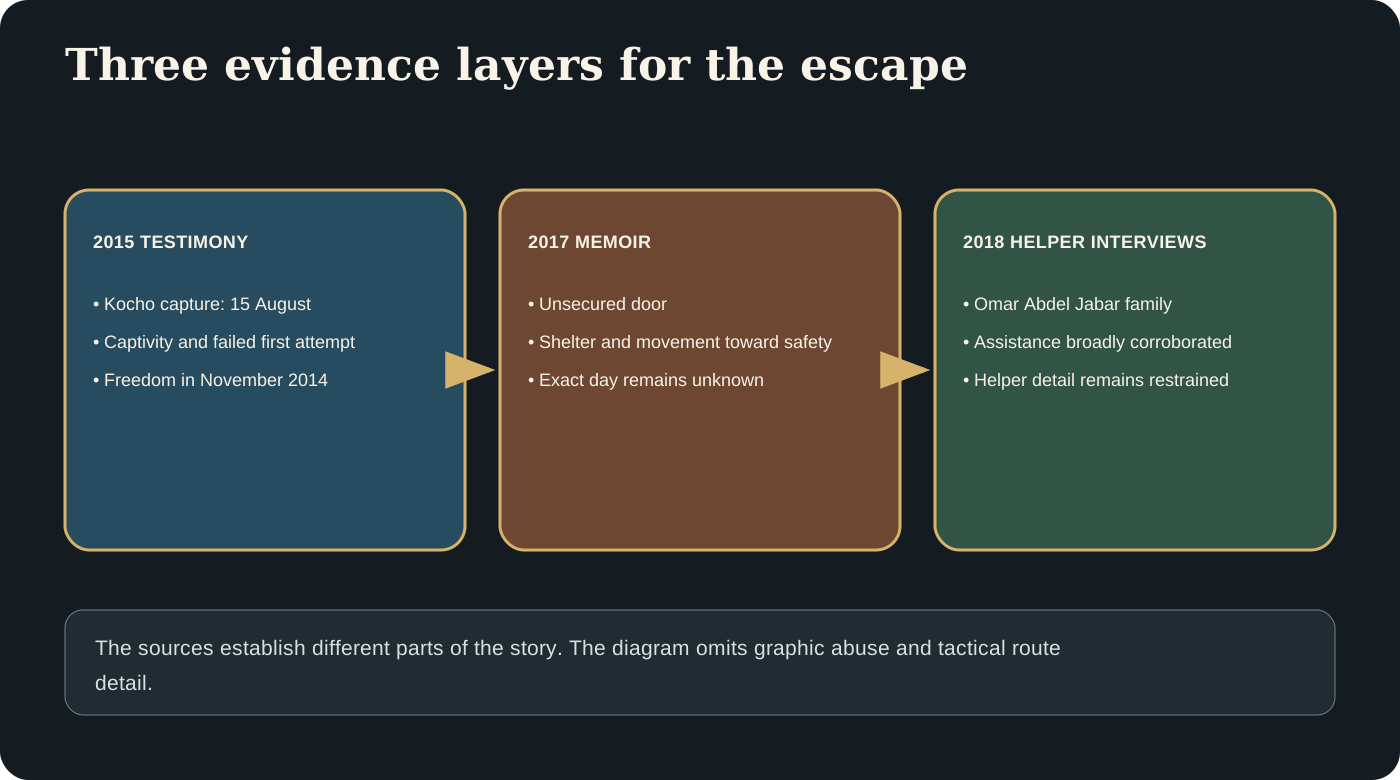
Testimony, memoir, and helper interviews establish different parts of the escape and assistance sequence.