
Thomas Pellow was eleven when a voyage from Cornwall ended in capture off the Iberian coast and forced removal to Morocco. By the time he returned to Britain in 1738, he had spent roughly twenty-three years in a society he had entered as an enslaved child but in which his position had changed repeatedly: he learned Arabic, converted to Islam under circumstances he later described as coercive, served in royal and military roles, married, and moved through parts of Morocco with far more freedom than the word “prisoner” alone suggests.
His eventual escape was therefore not a simple breakout from a cell. It was a withdrawal from a life formed under coercion, followed by a long fugitive journey through a politically unstable country, a search for a sea captain willing to risk carrying him away, and finally a passage from Salé to British-held Gibraltar. Much of the detail comes from Pellow’s own captivity narrative, published soon after his return. That makes the book indispensable—and also requires caution.
At a Glance
- Captured: 1715, aged eleven, after the merchant ship Francis was taken by Salé corsairs on its return voyage from the Mediterranean.
- Primary place of captivity: Morocco, including long periods connected with Meknes and the royal court.
- Length of captivity: about twenty-three years, from 1715 to 1738.
- Final flight: began before the documented sea departure and lasted for months; the exact starting date is uncertain.
- Departure from Morocco: 10 July 1738, according to Pellow’s narrative.
- Reached Gibraltar: 21 July 1738.
- Returned to Penryn, Cornwall: 15 October 1738, the date Pellow gave for his homecoming.
- Evidence caution: the broad captivity and return are well supported; many of the final journey’s dramatic episodes survive chiefly in Pellow’s retrospective account.
From an eleven-year-old captive to a Moroccan insider
Pellow left Penryn in 1715 aboard the Francis, commanded by his uncle John Pellow. His own narrative places the voyage in the second year of George I’s reign and says he was eleven. On the homeward leg, the ship was taken by corsairs associated with Salé. Pellow and other captives were brought into Morocco and sent inland toward Meknes, the imperial center of Sultan Moulay Ismail.
Pellow later described severe violence intended to force him to convert to Islam. His account says that he eventually submitted, was circumcised, adopted local dress, and learned Arabic. Those claims belong to a captivity narrative written for an eighteenth-century British readership in which coerced conversion carried enormous religious and social weight. The broad fact of his conversion and subsequent life as a Muslim in Morocco is accepted by modern scholars, but his insistence that his inner Christian identity never changed cannot be independently proved.
His social position also shifted. Pellow described work in and around the royal household, military service, marriage, travel, and responsibility over other men. Later scholarship has emphasized how deeply he adapted to Moroccan language and custom even while his published story repeatedly asserted English and Christian superiority. That tension matters. Calling him simply “a slave for twenty-three years” captures the coercive origin of his situation but can obscure the changing authority, mobility, and family ties he acquired inside Morocco.
None of those changes meant that he could simply choose to return to Britain. Pellow’s narrative repeatedly treats unauthorized departure as dangerous and describes earlier efforts to escape that failed. By the 1730s, after Moulay Ismail’s death and amid continuing dynastic instability, Pellow believed the disorder gave him another opportunity.
A flight without a clean starting date
Pellow’s own account says that after returning to Meknes from military service he left alone around midnight and headed first toward Salé. He could not find a ship there that suited his purpose, so he moved southward. The journey that follows is the most vivid part of the narrative: he says he concealed his identity, sometimes passed as a blind man, traveled with itinerant performers, practiced improvised medicine, endured robberies, and repeatedly searched for a vessel whose captain would take him away.
Those episodes should not all be treated as independently documented facts. They come principally from Pellow’s book, written after his return and shaped by the conventions of captivity and adventure literature. A nineteenth-century biographical assessment nevertheless judged the flight section to be among the most credible portions of the book, even while warning that other parts of the volume incorporated material from earlier published works on Morocco.
The route can be reconstructed only in broad strokes. Pellow describes moving from the Meknes–Salé region toward Santa Cruz, the port now known as Agadir, and says he remained in and around that area for three or four months while trying to find passage. He later moved northward again through coastal settlements, including Oualidia. Exact day-by-day geography would imply a precision the source does not provide.
Captain Toobin and a chance to leave
At Oualidia, Pellow encountered Captain Toobin, an Irish master from Dublin. In Pellow’s telling, Toobin was engaged in coastal trade and needed an Arabic-speaking interpreter. After hearing Pellow’s history, he promised to help him escape and allowed him to remain with the vessel while it continued trading along the Moroccan coast.
This was not an immediate dash for Gibraltar. Pellow accompanied the vessel through further commercial stops, sometimes staying out of sight when he feared recognition. The ship eventually reached Salé. There, according to the narrative, disputes over freight and payments convinced Toobin that remaining in port had become dangerous. He decided to sail without waiting for the situation to be resolved.
Pellow’s role in that departure complicates any simple rescue story. His account says that several passengers aboard the vessel did not want to leave Morocco and that he helped prevent them from interfering while the crew got under way. The people carried off included Moroccan and Jewish passengers. The episode is reported by Pellow himself and lacks independent corroboration, but it belongs in the history because it shows that one man’s escape could coincide with the loss of choice for others.
Pellow dated the ship’s departure to a little after ten at night on 10 July 1738. Soon afterward it had to anchor off Mamora before favorable wind allowed it to continue north and then east through the Strait of Gibraltar. He dated the arrival in Gibraltar Bay to the morning of 21 July.
Gibraltar did not immediately erase the ambiguity
British-held Gibraltar represented safety, but Pellow’s arrival also exposed how much his identity had changed. He wrote that sentries initially refused to let him land because his clothing made them take him for a Moor. He protested that he was English and Christian, and after authorization was obtained he was permitted ashore.
Pellow also claimed that an interpreter acting for the pasha of Tangier demanded him as a Moroccan subject. In his version, Governor Richard Sabine rejected the claim and treated Pellow as a subject of the British crown. The incident is plausible in the context of Pellow’s long residence, conversion, dress, and service in Morocco, but the surviving account used here is Pellow’s own. It should be read as evidence of what he said happened, not as a complete diplomatic record.
Gibraltar’s British community raised money for him and helped arrange onward passage. Pellow eventually boarded the Euphrates, commanded by Captain Peacock, bound for London. He described a thirty-one-day voyage from Gibraltar to the Thames and a short stay in London before continuing west.
What the captivity narrative can prove
Pellow’s book appeared around 1739–1740, although the exact dating of early editions is complicated. It is unusually valuable because it gives a long, first-person account of life inside eighteenth-century Morocco from someone who had entered as an English captive, acquired Arabic, converted, served Moroccan rulers, and eventually returned to Britain.
It is not a stenographic record. The book was shaped for publication, and later scholarship has shown that parts of it draw on or reproduce material from other works about Morocco. Captivity narratives also had recognizable literary and religious conventions: providential deliverance, condemnation of captivity, hostility toward Islam, and the restoration of Christian identity all had strong appeal to British readers.
The final flight is still historically important. Its broad sequence fits what is otherwise known of Pellow’s return: a long period of captivity ending in 1738, passage from Morocco to Gibraltar, onward travel to Britain, and eventual arrival in Penryn. But the more picturesque the episode—the disguises, dreams, robberies, medical performances, private conversations, and exact motives of strangers—the more carefully it should be attributed to Pellow rather than narrated as independently witnessed fact.
That source problem is especially important because Pellow had become culturally entangled with Morocco. Scholars have pointed out that some scenes he framed as evidence of distance from Moroccan society actually reveal how much local knowledge he had absorbed. His narrative simultaneously insists on an enduring English Christian self and demonstrates a man transformed by more than two decades abroad.
Home after twenty-three years
Pellow eventually sailed back toward Cornwall and reached Falmouth before traveling the short distance to Penryn. He dated his arrival home to 15 October 1738. In one of the narrative’s most memorable claims, he wrote that after so many years he did not recognize his parents and they did not immediately recognize him.
That reunion is difficult to verify independently in its intimate detail. What is secure is the larger outcome: Pellow returned to Britain after more than two decades in Morocco and soon became known through the account published under his name. The escape succeeded not because he crossed one wall or defeated one guard, but because he endured a prolonged period of concealment and movement, found a captain willing to carry him, and finally reached a jurisdiction that accepted his claim to British identity.
His story is strongest when read with both halves visible at once: the coercion that began with an eleven-year-old’s capture, and the complicated life that followed. The final escape ended his forced attachment to Morocco, but it did not make the preceding twenty-three years simple, nor does Pellow’s vivid memoir allow every detail to be treated as certain.
Evidence discipline
What the record supports
Status labels distinguish secure conclusions from uncertainty and rejected claims. Color is never the only signal.
WELL-SUPPORTED
Pellow was captured as an eleven-year-old in 1715 and returned from Morocco in 1738 after roughly twenty-three years.
The date range is stated by the narrative and adopted by modern scholarly editions and later biographical treatments, despite occasional secondary sources giving 1716.
Sources: SRC-001, SRC-003, SRC-004, SRC-007MYTH
Pellow's position in Morocco remained a single, unchanged form of slavery for the entire twenty-three years.
His captivity began in enslavement, but the sources describe later conversion, royal service, military authority, marriage, travel, and substantial mobility. These changes complicate status without erasing the coercive origin or restrictions on departure.
Sources: SRC-001, SRC-004, SRC-005, SRC-006LATER CLAIM
Pellow remained inwardly Christian throughout his conversion and Muslim life in Morocco.
Pellow framed his conversion as coerced and emphasized Christian loyalty after returning to Britain. Modern scholars note that his language, behavior, and local knowledge also demonstrate significant assimilation; his private belief cannot be independently recovered.
Sources: SRC-001, SRC-005, SRC-006MYTH
Every dramatic detail of Pellow's final flight can be treated as independently verified eyewitness history.
The escape section is considered relatively credible by later biographical criticism, but most of its detailed encounters, disguises, robberies, dreams, and conversations survive through Pellow's shaped retrospective narrative rather than independent records.
Sources: SRC-001, SRC-003, SRC-007MYTH
The published narrative is an entirely unmediated transcript of Pellow's personal recollections.
Later textual criticism identified editorial shaping and borrowing from earlier published descriptions of Morocco. The book remains crucial testimony but is also a literary and publishing artifact.
Sources: SRC-003, SRC-004, SRC-007WELL-SUPPORTED
Pellow departed Morocco on 10 July 1738 and reached Gibraltar on 21 July.
These dates are explicitly supplied in Pellow's narrative and have been consistently repeated in later treatments. They remain dependent on his account for their exactness.
Sources: SRC-001, SRC-002, SRC-005Documentary reconstruction
Changing status and the documented sea passage
A case-local editorial visual separates the documented sequence from uncertainty without implying exact modern geography or operational detail.
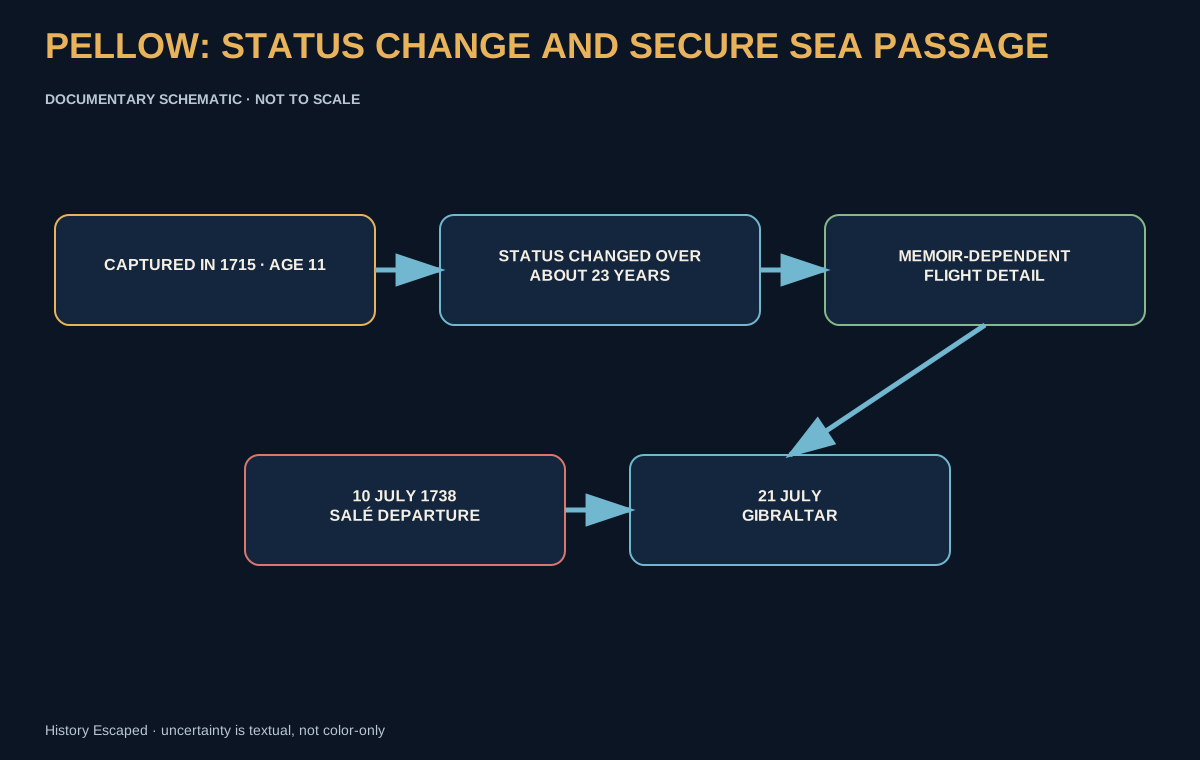
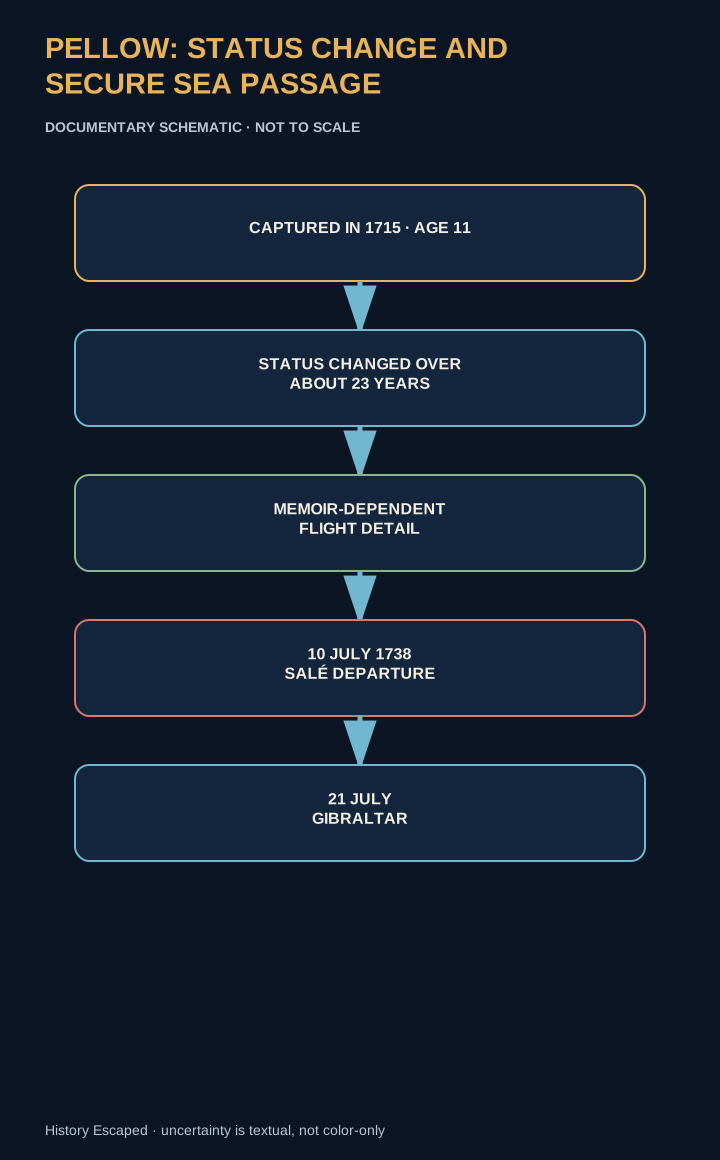
Simplified editorial reconstruction based on the cited historical record; not to scale. Uncertainty is stated directly in the visual and adjacent text.