
Thomas Muir's celebrated escape from "Botany Bay" did not begin at Botany Bay. In February 1796 he slipped away from the British penal colony at Sydney Cove, rowed out through Port Jackson, and was picked up offshore by an American fur-trading vessel. "Botany Bay" was already a convenient shorthand for transportation to New South Wales, and it remained attached to Muir's story long after the geography became blurred.
The escape was the turning point in a much larger political exile. Muir had been sentenced in Scotland to fourteen years' transportation for sedition, arrived at Sydney in 1794, and lived under an unusual regime that gave him more personal freedom than an ordinary convict while still forbidding him to leave the colony. His departure on the Otter succeeded, but his hoped-for destination—the United States—never did. Instead he crossed the Pacific, passed into Spanish custody, was imprisoned in Havana, badly wounded near Cádiz, and finally reached France.
At a Glance
- Escape: Night of 17 February 1796
- Departure point: Sydney Cove and Port Jackson, New South Wales
- Common historical shorthand: "Botany Bay"
- Sentence: Fourteen years' transportation for sedition
- Escape vessel: American fur trader Otter, commanded by Ebenezer Dorr
- Immediate method: Small boat through Sydney Heads, followed by offshore pickup
- Companions in the small boat: Two assigned convict servants, not securely named in the principal sources
- Intended destination: United States
- Actual post-escape path: Nootka Sound → Spanish California → Mexico → Havana → Spain → France
- Major myth: No reliable evidence shows that George Washington arranged or dispatched the Otter to rescue Muir
From reform campaigner to transported prisoner
Muir was a Scottish advocate and one of the leading figures in the movement for parliamentary reform during the political crisis created by the French Revolution. He supported broader representation, circulated reform literature, and read an address from the United Irishmen. In August 1793 the High Court of Justiciary convicted him of sedition and sentenced him to fourteen years' transportation.
The sentence was extraordinary enough to become a political event in its own right. National Records of Scotland preserves the High Court papers for Muir's 1793 case, while contemporary printed trial accounts spread far beyond Scotland. His supporters denounced the proceedings as political persecution; the government treated his activities as dangerous sedition during a period of war and revolutionary anxiety.
Muir sailed for New South Wales aboard the Surprize with Thomas Fyshe Palmer, William Skirving, and Maurice Margarot. They reached Sydney on 25 October 1794. Joseph Gerrald, later counted with them among the five "Scottish Martyrs," followed on another ship.
Transportation did not mean that Muir lived behind prison walls in Sydney. Governor Francis Grose had instructions not to compel the political prisoners to labor, and Muir had money of his own. He was given a brick hut near Sydney Cove, had two convict servants assigned to him, and acquired a small piece of land somewhere across the harbour. The exact location of that property is unknown despite later claims linking it to modern Hunters Hill.
This relative freedom can obscure the essential fact of his status. Muir could live privately, trade, read, write, and move around the local settlement, but his fourteen-year sentence had not expired. The issue was whether transportation legally required him to remain in New South Wales or merely prevented him from returning to Britain.
Muir tests the limits of his sentence
Before escaping, Muir tried to resolve that question by argument. In October 1795 he and fellow political prisoners submitted a petition to the new governor, John Hunter. Muir argued that their punishment amounted to banishment from Britain rather than compulsory residence in New South Wales and that they should therefore be free to go elsewhere.
Hunter took the argument seriously. In a dispatch to the Duke of Portland, he acknowledged difficulty in justifying the forcible detention of the men if they wished to leave for somewhere outside Great Britain. That uncertainty is important: Muir did not simply imagine that the law allowed his departure. The colonial governor himself believed the wording of the sentences created a genuine problem.
London ultimately rejected that interpretation. The Duke of Portland's answer, sent in August 1796, stated that the transported reformers were not permitted to leave New South Wales before completing their terms. The reply arrived long after Muir had escaped.
The legal dispute therefore had an unusual timing. Muir left while Hunter's question remained unanswered locally, but the home government later declared that he had no right to do so. His departure can accurately be described as an escape from transportation without pretending that the legal meaning of transportation had seemed equally clear to everyone in Sydney beforehand.
The Otter appears in Sydney
The opportunity came with an American trading vessel. The Otter, commanded by Ebenezer Dorr, arrived at Port Jackson in late January 1796 while bound toward the northwest coast of North America for the maritime fur trade.
The strongest accounts agree that Dorr was willing to carry Muir away if Muir could reach the vessel without making the captain openly responsible for breaking him out of the colony. Muir had a practical advantage: the land he occupied across the harbour gave him reason to possess and use a small boat.
Later biographies transformed the Otter into a rescue ship specially fitted out in America for Muir. Peter Mackenzie's nineteenth-century biography even gave its captain the wrong surname and helped popularize the claim that American admirers—or George Washington himself—had organized the mission. The Australian Dictionary of Biography and the Dictionary of Sydney both reject that story for lack of evidence.
Muir did write to Washington after crossing the Pacific. That later appeal may have helped the rescue legend grow, but asking Washington for assistance from Spanish California is not evidence that the president had secretly dispatched the ship months earlier.
Out through Sydney Heads
On the night of 17 February, Muir left in a small boat with his two convict servants. The Dictionary of Sydney, drawing on David Collins's contemporary colonial account, shipping records, and Muir's own later letter from Monterey, places the party rowing out through Sydney Heads and being picked up by the Otter the following day at a considerable distance from land.
The distinction between February 17 and February 18 explains some date variation in older accounts. The flight by boat began on the night of the 17th; the Otter carried Muir away from the colony on the 18th. Some later biographies gave February 11, but the better-supported contemporary reconstruction favors the 17–18 February sequence.
Muir left a letter for Governor Hunter explaining his position and his intention to practice law in America rather than return illegally to Britain. Hunter reported the departure to London without the language of a dramatic manhunt. Collins later recorded that Muir had gone in the Otter along with other convicts whose transportation terms had not expired.
The two servants are a limit in the surviving evidence. They were clearly part of the small-boat phase in the principal modern reconstructions, but the surviving sources do not securely identify them by name or establish their later outcomes. They should not be turned into named accomplices by inference.
Across the Pacific
Leaving New South Wales was only the first stage. The Otter crossed the Pacific toward the northwest coast of North America and reached Nootka Sound on Vancouver Island in June 1796.
There Muir encountered a new risk. HMS Providence, a British naval vessel whose presence made recognition and recapture plausible, was operating in the region. Muir transferred from the American trader to the Spanish vessel Sutil under the pilot José Tovar and traveled south to Monterey in Spanish California.
This part of the journey is unusually well anchored by Spanish archival material. Muir's presence generated correspondence among Spanish officials, and letters he wrote from Monterey—including appeals to political contacts and to Washington—were intercepted and preserved in Spanish archives. Later scholarship has used these records to reconstruct his movements far more securely than the romantic biographies that followed.
The Spanish authorities treated him cautiously. He wanted to reach the United States, but they did not simply release him to travel there. He was moved by sea to San Blas and then across Mexico toward Veracruz. By November he had reached Havana, where the changing international situation made his position worse: Britain and Spain were now at war, and Muir was confined there for several months.
The journey that replaced America
In March 1797 Spanish authorities placed Muir aboard a vessel bound for Spain. Near Cádiz the ship became involved in combat with British warships. Muir was severely wounded in the face and lost his left eye.
Older biographies turned this episode into another sequence of extraordinary escapes, complete with mistaken death, miraculous recognition, and dramatic rescue. The broad facts of the naval action, Muir's wounds, and his survival are well supported; some of the more theatrical details come from much later accounts and should not be treated as equivalent to contemporary naval and diplomatic records.
After hospitalization and prolonged diplomatic negotiation, Muir was finally permitted to leave Spain for France late in 1797. He received a public welcome in Bordeaux and later went to Paris, where revolutionary France presented him as a victim of British political repression.
He never reached the United States, never resumed a legal career there, and never returned to Scotland. Weakened by his wounds and years of displacement, he died at Chantilly near Paris on 26 January 1799, aged thirty-three.
How the escape became a legend
Muir's escape accumulated mythology almost immediately because it fit several political narratives at once. To admirers he was a martyr to reform who had broken free from an unjust sentence. To British conservatives he remained a dangerous radical. In Australia he became one of the earliest famous political prisoners associated with transportation.
The documentary problem is that later retellings repeatedly improved the adventure. A French account published in 1798 claimed to preserve Muir's own recollections, yet modern analysis has shown that parts of its description of New South Wales were borrowed from Watkin Tench's earlier writing. Mackenzie's 1831 biography then supplied further errors and embellishments.
Two of the most persistent claims do not survive comparison with stronger sources. The first is that Washington arranged Muir's rescue. The second is that the Otter was wrecked after reaching North America, leaving Muir among only a handful of survivors who then undertook an epic journey overland. More secure maritime and Spanish records instead place Muir transferring from the still-operating Otter to the Sutil at Nootka and continuing south under Spanish control.
Even the familiar phrase "escape from Botany Bay" requires correction. Muir had been transported to the colony popularly called Botany Bay, but the settlement was at Sydney Cove on Port Jackson, and his physical escape route ran out through Sydney Harbour.
The result is a case in which the real history is more useful than the legend. Muir did not need a presidential rescue ship, a shipwreck, or a miraculous transcontinental trek to make his escape significant. He exploited an unresolved legal argument, a rare shipping opportunity, and the mobility available to him within an unusual form of political transportation. On 17–18 February 1796 he successfully got beyond the colony that Britain had ordered him to remain in. What followed turned that local escape into an international odyssey.
Evidence discipline
What the record supports
Status labels distinguish secure conclusions from uncertainty and rejected claims. Color is never the only signal.
MYTH
Muir's famous 'Botany Bay' escape physically began at Botany Bay.
Botany Bay was common shorthand for transportation to New South Wales, but Muir lived at Sydney Cove and escaped by rowing out through Port Jackson and Sydney Heads.
Sources: SRC-002, SRC-003WELL-SUPPORTED
Muir began his escape on the night of 17 February 1796 and was carried away on the Otter on 18 February.
Modern reconstructions using Collins, shipping records, and Muir's own later correspondence support the 17–18 February sequence. Older sources sometimes give 11 February.
Sources: SRC-002, SRC-003, SRC-004, SRC-005MYTH
George Washington arranged or dispatched the Otter specifically to rescue Muir.
The claim appears in later celebratory biography, but the Australian Dictionary of Biography and Dictionary of Sydney find no evidence for it. Muir wrote to Washington only after reaching Monterey.
Sources: SRC-002, SRC-003, SRC-007DISPUTED
Muir was clearly legally entitled to leave New South Wales whenever he wished.
Muir advanced this legal interpretation and Governor Hunter found it persuasive enough to seek guidance. The British government later ruled that transported prisoners were required to remain in New South Wales until their sentences expired.
Sources: SRC-002, SRC-005MYTH
The Otter was wrecked near North America, leaving Muir among only a few survivors who then crossed the continent.
This appears in later biographies. Stronger maritime and Spanish archival reconstructions instead place Muir transferring from the operating Otter to the Spanish Sutil at Nootka Sound.
Sources: SRC-003, SRC-005, SRC-006, SRC-007MYTH
Every dramatic detail of Muir's later journey survives in contemporary documentation.
The broad route and major events are well supported, but later biographies added shipwreck, miraculous-survival, and recognition stories that do not carry the same evidentiary weight as contemporary colonial, Spanish, and naval records.
Sources: SRC-002, SRC-005, SRC-007Documentary reconstruction
Intended destination and documented onward route
A case-local editorial visual separates the secure historical sequence from uncertainty without exposing reusable modern operational detail.
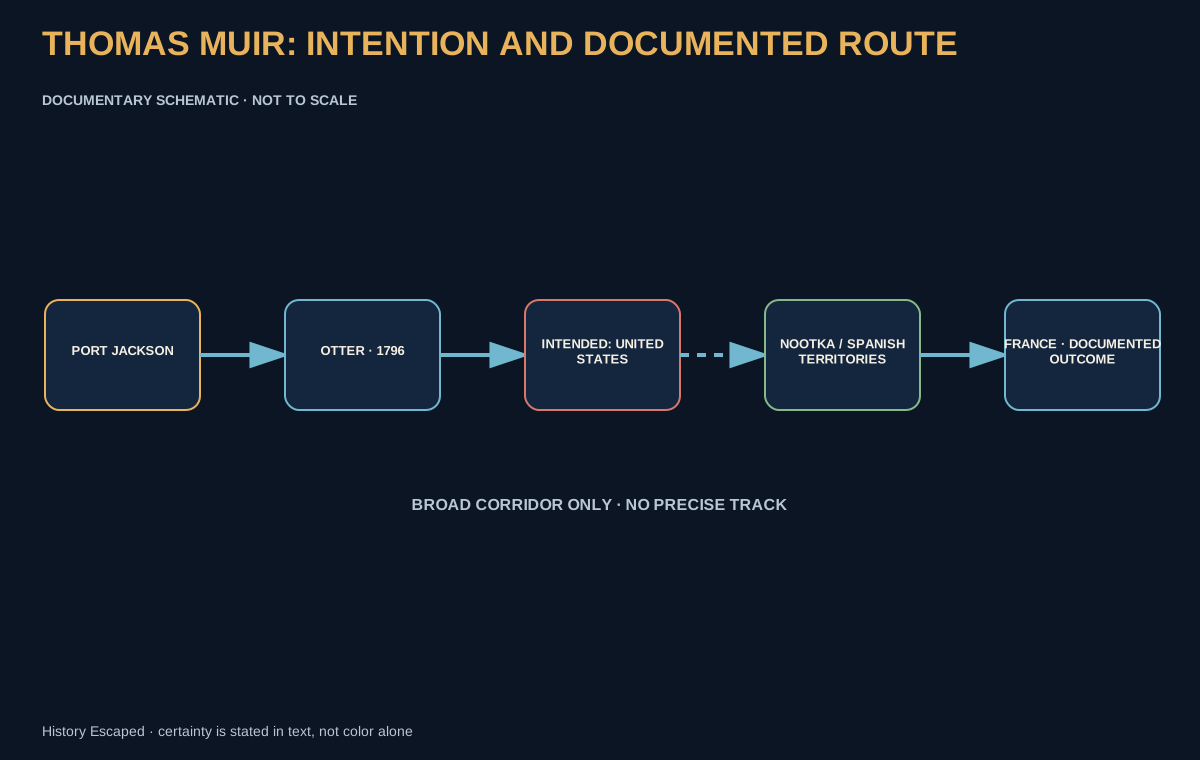
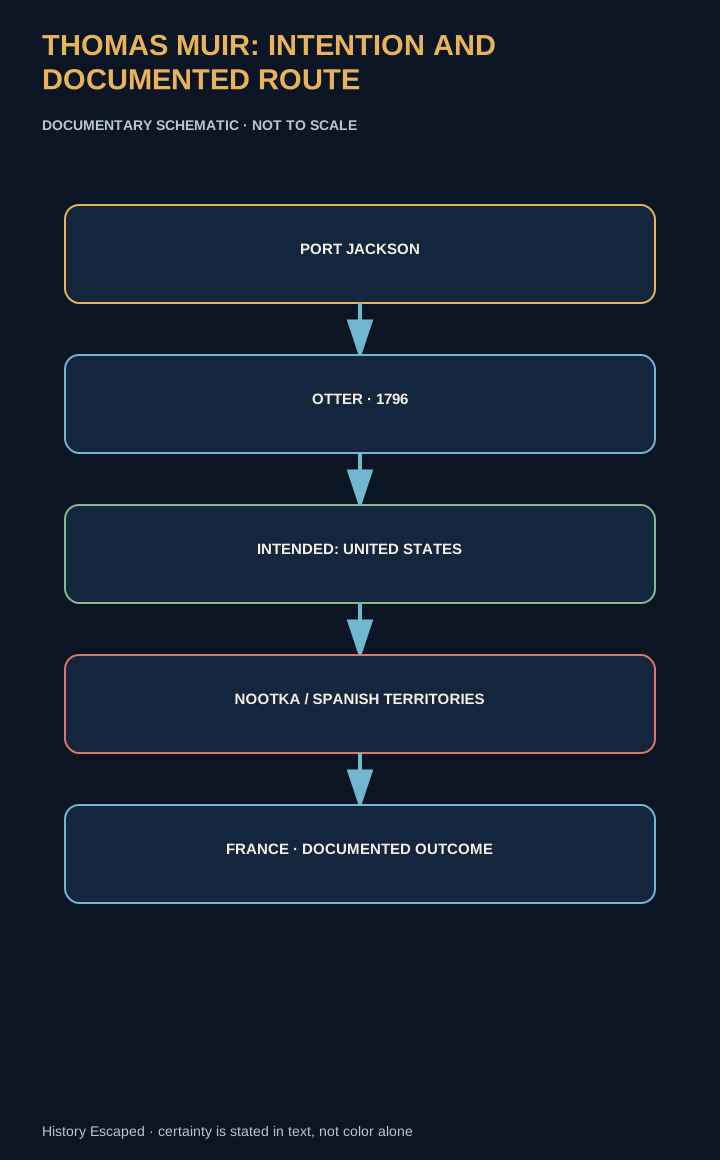
Simplified evidence-led editorial reconstruction based on the cited record; not to scale. Uncertainty is stated directly in the visual and adjacent text.