
At a Glance
- Escape: 27 December 1803
- Place: Sullivan Bay, Port Phillip, on Bunurong Country
- Escape attempt: Six convicts in the contemporary Knopwood journal
- Escapee: William Buckley
- Immediate aim: Later accounts say the fugitives hoped to reach Sydney
- Long-term outcome: Buckley remained outside British custody for more than three decades
- Indigenous community: Wadawurrung people
- Return to a European camp: 6 July 1835 at Indented Head
- Source warning: Most details of Buckley’s decades on Country were written down years later by non-Indigenous intermediaries
William Buckley’s escape from Sullivan Bay lasted only minutes. The story built around it lasted more than half a century before its most famous version reached print.
At nine o’clock on 27 December 1803, Reverend Robert Knopwood recorded that six convicts attempted to flee the struggling British settlement at Port Phillip. A sentry shot Charles Shaw, and another man appears to have been captured. Others got away. Buckley was among them.
What happened after he disappeared from the settlement is harder to reconstruct with the same precision. Buckley eventually lived for more than three decades with Wadawurrung people on and around the Bellarine and Barwon region. He learned their language and became socially embedded in their community. Yet the surviving written descriptions of those years came mainly through Buckley himself, dictated to Europeans in 1837 and 1852. That makes the case both an extraordinary escape and a warning about who gets to record colonial history.
Sullivan Bay
Buckley arrived at Port Phillip aboard the Calcutta in 1803 as a transported convict. The Australian Dictionary of Biography records that he had been convicted at the Sussex Assizes on 2 August 1802 of receiving a roll of cloth knowing it to have been stolen and sentenced to transportation for life. Buckley later insisted that he had unknowingly carried stolen cloth and had been unjustly convicted. That is his retrospective account, not something the surviving record can independently prove.
Lieutenant-Governor David Collins’s expedition was attempting to create a new British settlement near present-day Sorrento. The landing was itself an act of colonization on Bunurong Country, even though the settlement proved short-lived.
Conditions were poor. Fresh water was difficult to obtain, the site disappointed colonial planners, and Collins soon sought permission to move the establishment elsewhere. Many convicts understood that the country beyond the camp created both an apparent opening and a severe danger: Sydney was hundreds of miles away, and British authorities knew little about the lands and peoples between. Buckley decided to run.
The contemporary record says six
The best evidence for the actual breakout does not come from Buckley’s famous memoir.
Knopwood, chaplain to the expedition, kept a journal at the time. His entry for 27 December 1803 records that at 9 p.m. six convicts endeavoured to make their escape. Charles Shaw was shot and badly wounded. Morgan’s later publication of the journal adds that another man was taken besides Shaw.
The remaining fugitives disappeared into the country around Port Phillip. Knopwood noted distant fires and search efforts in the days that followed. On 16 January 1804, Daniel M’Allender surrendered and returned a gun that had been taken from the settlement.
Those entries matter because Buckley’s later story remembers the episode differently. In John Morgan’s 1852 narrative, Buckley says four men had arranged to leave, one was shot, and three continued. George Langhorne’s 1837 record likewise compresses the flight into Buckley and two companions. The contemporary journal is closer to the event and therefore controls the count: six attempted the breakout, while a smaller group continued after the shooting and capture. The exact membership of every later stage cannot be reconstructed with the same confidence.
An impossible plan for Sydney
Buckley’s later narrative says the fugitives intended to reach Sydney. That plan demonstrates how little they knew about the scale of the country around them. Morgan’s book describes movement around Port Phillip Bay, dwindling provisions, shellfish gathered along the shore, crossings of waterways, and the gradual abandonment of the attempt by Buckley’s companions.
These scenes are plausible, and some broad geography can be reconciled with later place names. They are not equivalent to Knopwood’s dated journal.
Morgan met Buckley in 1852, nearly half a century after the escape. Buckley could not write his own account, and Morgan openly acknowledged constructing the published story from notes and conversation. Buckley himself told Morgan that the passage of so many years had damaged his memory and that events might no longer be in their proper order.
The route should therefore be understood as a remembered sequence rather than a track that can be plotted precisely. Eventually Buckley was alone.
From escape to Wadawurrung Country
The familiar story says that after a period of severe isolation, Buckley came into contact with Aboriginal people on the western side of Port Phillip.
The modern name used here is Wadawurrung, following the Wadawurrung Traditional Owners Aboriginal Corporation. Historical documents spell the name in several ways, including Wathaurong, Wathaurung and Watourong.
State Library Victoria’s 1837 manuscript, recorded by missionary George Langhorne, is the closest substantial dictated account of Buckley’s years among the Wadawurrung. Even that source was written more than three decades after the initial escape and through a European recorder.
Later institutional summaries preserve a well-known tradition: Buckley had found a spear associated with a burial place, and Wadawurrung people who encountered him associated him with the return of a deceased kinsman, often named Murrangurk in the literature.
That tradition should not be mistaken for an independently preserved nineteenth-century Wadawurrung oral account. What the written sources can show securely is that Wadawurrung people accepted Buckley into their social world rather than leaving him outside it.
He did not survive alone
Older versions of the Buckley story often make his achievement sound like solitary wilderness survival. That framing places the wrong person at the center of the explanation.
Buckley’s long freedom from British custody became possible because Wadawurrung people fed him, sheltered him, taught him, and incorporated him into community. His own 1837 recollection says he learned to fish and hunt within that life and eventually became fluent enough in the local language that he felt his English weakening.
After about six months with one group, according to the Langhorne manuscript, Buckley said he had decided to continue with the Watourong and lived mainly around the Barwon River. Whatever uncertainties surround the precise chronology, the central dependency is unmistakable.
He did not spend thirty years outside society. He spent them inside a society that British colonial sources frequently failed to describe on its own terms.
The Murrangurk tradition
The story that Buckley was regarded as a returned kinsman has become one of the most repeated parts of his biography.
State Library Victoria summarizes the tradition by saying that Wadawurrung people believed he was the spirit of the deceased Murrangurk, whose spear he was carrying when women found him. Morgan later gave an elaborate version of the same general recognition story.
There are reasons to preserve it. The tradition helps explain how an unknown European man could be placed within a network of relationships rather than treated permanently as an outsider.
There are also reasons to qualify it. Almost everything surviving in writing was mediated through Buckley and European recorders. Indigenous knowledge was collected under colonial conditions, and the State Library itself acknowledges that such collections contain traditional cultural knowledge belonging to Indigenous communities.
The responsible conclusion is therefore limited: an early Buckley-derived tradition says Wadawurrung people associated him with a deceased kinsman named Murrangurk. The exact cultural meaning should not be enlarged beyond what the available Indigenous-authorized sources support.
More than three decades
Buckley remained on Wadawurrung Country until 1835.
The conventional phrase is that he spent 32 years with Aboriginal people. From his escape on 27 December 1803 to his documented appearance at Indented Head on 6 July 1835 is closer to thirty-one and a half years, so “about 32 years” is best understood as historical shorthand.
The written record during most of that interval is thin. That absence is itself significant. British authorities had abandoned the Sullivan Bay experiment and did not maintain a settlement around the bay. Buckley’s life was being lived largely outside the documentary systems that later colonial historians relied upon.
His two main dictated narratives were produced only after Europeans had returned in force.
That gap explains why apparently precise episodes from the middle years deserve caution. Morgan’s 1852 book contains detailed fights, journeys, relationships, deaths and ceremonies. Some may preserve genuine memory. The book cannot transform them into independently documented events merely through narrative detail.
Colonization returns to Port Phillip
By 1835, the political world around Buckley was changing rapidly.
People from Van Diemen’s Land were moving toward Port Phillip in search of land. John Batman and the Port Phillip Association sought enormous areas around the bay through documents later known as Batman’s “treaties.” Aboriginal-community historical resources emphasize that these agreements did not amount to a valid sale of Kulin Country and that the colonization that followed brought dispossession and violence.
For Wadawurrung people, the arrival of large numbers of Europeans did not represent the beginning of human history or the discovery of empty land. It was the expansion of a colonial system into Country on which people already held law, relationships and obligations.
This is the setting in which Buckley’s long absence from British society ended.
6 July 1835
William Todd’s journal records Buckley appearing at the Port Phillip Association camp at Indented Head on 6 July 1835.
Later retellings often give the encounter a dramatic moral purpose: Buckley supposedly came forward because he had learned of an Aboriginal plan to attack or kill the newcomers and wanted to warn them.
State Library Victoria’s comparison of the sources does not support treating that as the only established motive.
The 1837 Langhorne account records something almost opposite in emotional tone. Buckley said that even after hearing Europeans had arrived, he had difficulty deciding to leave the people to whom he had become attached and doubted that he would again be comfortable among his own countrymen.
That testimony does not prove that he had no concern for the settlers. It does establish that his reappearance cannot be reduced to a simple rescue-of-Europeans narrative.
He was leaving one social world for another after more than three decades.
What Tommy McRae saw in the story
A later Aboriginal artist provides a useful way to rethink where the climax belongs.
Tommy McRae, a Kwat Kwat/Koorie artist born around the time Buckley re-entered colonial society, repeatedly drew Buckley’s story in the nineteenth century. The National Museum of Australia later acquired one of those drawings, Buckley’s Escape.
When announcing the acquisition, the museum drew attention to a striking difference. European artists tended to make Buckley’s eventual return to colonial society the dramatic endpoint. McRae instead centered the moment when Buckley entered the Aboriginal world.
That difference matters.
If the story is told only from British records, the thirty-one years between escape and reappearance can look like a blank interval in which an escaped convict somehow survived. From an Indigenous-centered perspective, those decades are not empty at all. They are the period in which Buckley lived within Aboriginal Country and community.
The Koorie Heritage Trust holds related McRae drawings today. Their digital reuse requires cultural approval, so they should not be treated as decorative public-domain illustrations merely because the original artist lived in the nineteenth century.
Interpreter in an expanding colony
After re-entering European society, Buckley became useful to the newcomers because he could speak with Aboriginal people.
He worked as an interpreter and intermediary during the early colonial occupation of the Port Phillip district. That role should not be romanticized as uncomplicated reconciliation. The settlers with whom he worked were expanding onto Indigenous land, and Buckley was positioned between communities whose interests were increasingly in conflict.
State Library Victoria notes that he came to feel mistrusted by both Aboriginal people and Europeans. His knowledge could make him valuable while also making both sides uncertain about where his loyalties lay.
Pardon paperwork followed his return. The State Library preserves a fourteen-page group of records from 1835–36 relating to his free pardon, including his petition and a memorandum dated 1 September 1836.
By the end of 1837 he left Port Phillip for Van Diemen’s Land.
Which Buckley should be believed?
There is no version of Buckley’s thirty-two-year story that comes directly and unfiltered from Buckley, still less one that provides a full Wadawurrung account of him.
The 1803 escape is strongest when Knopwood’s contemporary journal controls the date and number of attempted escapees. The 1835 reappearance can be checked against Todd’s contemporary journal and the early Port Phillip papers.
The years between depend heavily on Buckley’s memory. Langhorne recorded him in 1837, relatively soon after he left Wadawurrung life. Morgan wrote the famous book in 1852, when Buckley was elderly and the events were much further away.
Morgan’s narrative remains indispensable. It is also the source most likely to produce false certainty when quoted without criticism.
The result is not that nothing can be known. It is that different parts of the story deserve different levels of confidence.
What the escape actually changed
Buckley escaped a penal settlement that was itself about to fail and relocate. Had he remained, he almost certainly would have been transported with the establishment to Van Diemen’s Land.
Instead, his flight placed him outside British custody—and eventually inside a Wadawurrung community—for more than thirty years.
That outcome makes the Sullivan Bay escape unusual in the history of transported convicts. Yet the remarkable duration of Buckley’s freedom cannot be credited to escape technique alone. The decisive event after the sentry line was his incorporation into Indigenous society.
By 1835 the colonial frontier had caught up with him. The world he re-entered was not simply the one he had left in 1803. European occupation was beginning to transform Wadawurrung and neighboring Kulin Country through land seizure, disease and violence.
Buckley’s escape gave him decades beyond the reach of the penal system. Wadawurrung people made those decades livable. Any history that remembers the first fact and treats the second as scenery has only reconstructed half the escape.
Evidence discipline
What the record supports
Status labels distinguish secure conclusions from uncertainty and rejected claims. Color is never the only signal.
DISPUTED
Only four men attempted the Sullivan Bay escape with Buckley.
Buckley’s later Morgan narrative remembers four, but Knopwood’s contemporary journal records six convicts attempting the escape on 27 December 1803. The contemporary count controls.
Sources: SRC-001, SRC-003MYTH
The escape occurred on Christmas Eve or 30 December 1803.
Knopwood’s contemporary journal gives 27 December 1803 at about 9 p.m.; later educational and narrative sources contain conflicting dates.
Sources: SRC-001DISPUTED
Buckley was sentenced to fourteen years’ transportation.
That figure appears in some later retellings, while the Australian Dictionary of Biography’s convict record gives transportation for life after the 1802 conviction.
Sources: SRC-005MYTH
Buckley independently survived in an empty wilderness for 32 years.
The surviving accounts describe Buckley being taken in by Wadawurrung people, learning language and living within community. The land was Indigenous Country, not empty wilderness.
Sources: SRC-002, SRC-006, SRC-007, SRC-008UNKNOWN
The Murrangurk recognition story is independently documented from a surviving nineteenth-century Wadawurrung oral source.
The tradition is well established in Buckley-derived and later institutional accounts, but the reviewed record does not provide an independent Wadawurrung-authored nineteenth-century account with which to verify its precise cultural meaning.
Sources: SRC-002, SRC-006DISPUTED
Buckley returned to Europeans in 1835 solely to warn them of a planned Aboriginal massacre.
Several explanations circulated. Buckley’s 1837 reminiscence emphasizes his reluctance to leave the people to whom he had become attached, making a single heroic-warning motive unsafe.
Sources: SRC-002, SRC-010MYTH
Morgan’s 1852 book is a verbatim memoir written by Buckley.
Buckley was illiterate. Morgan constructed the book from notes and fragments of conversation and shaped it into a lengthy first-person narrative decades after many of the events.
Sources: SRC-003, SRC-004Documentary reconstruction
Contemporary anchors and later recollection
A case-local editorial visual separates the documented sequence from uncertainty without implying exact modern geography or operational detail.
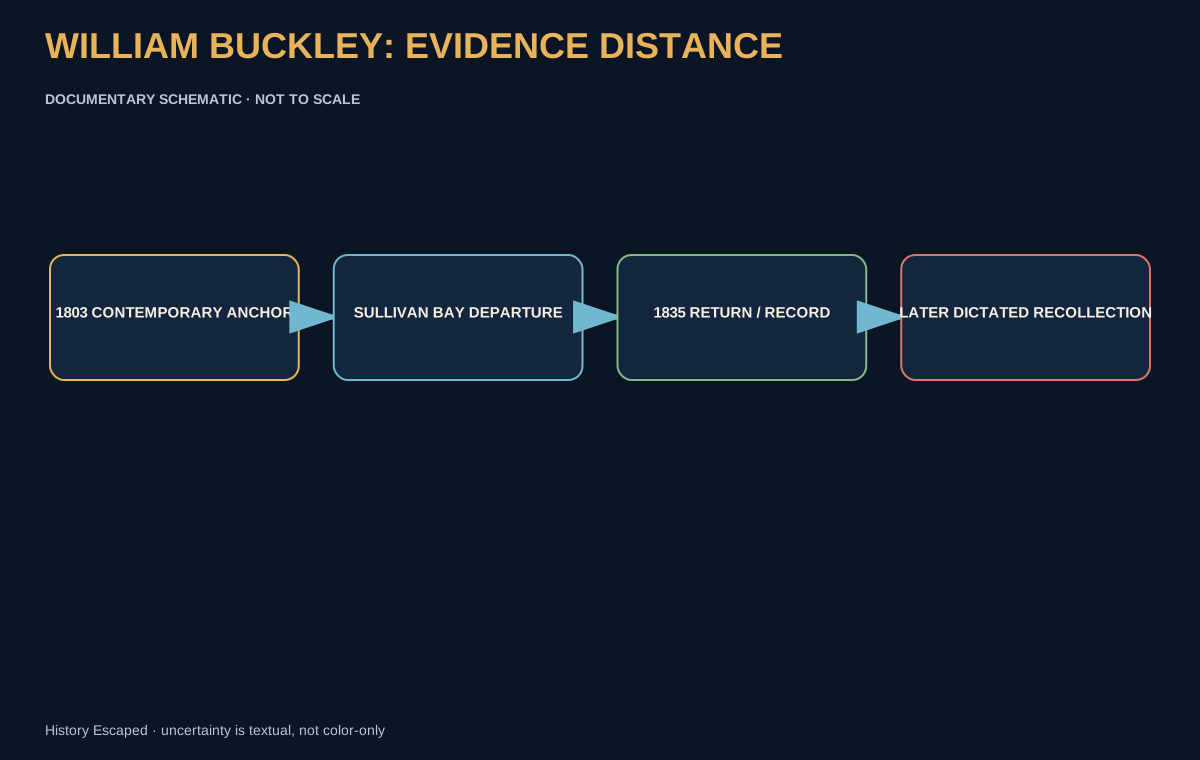
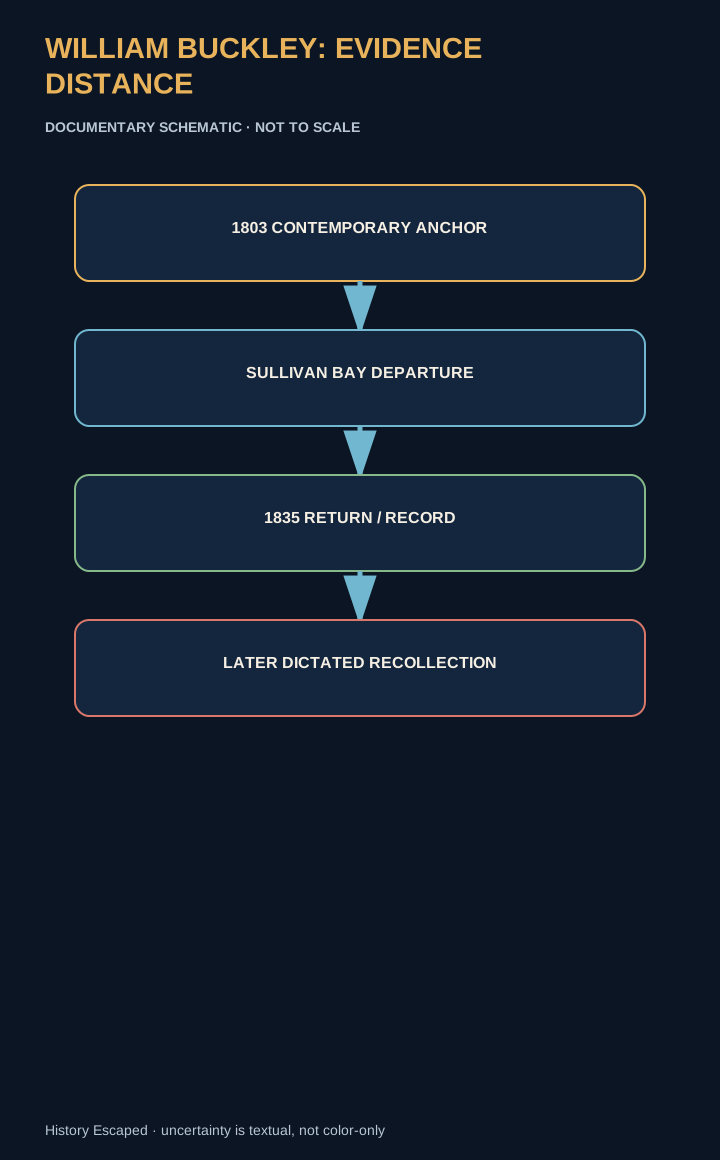
Simplified editorial reconstruction based on the cited historical record; not to scale. Uncertainty is stated directly in the visual and adjacent text.