
John Mitchel’s escape from Van Diemen’s Land did not happen in one night. It began publicly at a police office in Bothwell on 9 June 1853, continued for more than five weeks as colonial authorities searched for him, and did not carry him physically off the island until he boarded the Emma below Hobart on the night of 18 July.
Even then he was not yet safely beyond British jurisdiction. Sydney, Tahiti, San Francisco, Central America, Cuba, and finally New York still lay ahead. By the time Mitchel reached New York on 29 November, an argument over a ticket-of-leave in a Tasmanian police office had become an international nationalist spectacle.
At a Glance
- Political prisoner: John Mitchel
- Movement: Young Ireland
- Sentence: fourteen years’ transportation
- Van Diemen’s Land arrival: April 1850
- Status: ticket-of-leave on parole
- Parole revocation letter: 8 June 1853
- Flight from Bothwell: 9 June 1853
- Physical departure from Van Diemen’s Land: 18 July 1853, best-supported
- Escape ship: Emma
- First external stop: Sydney
- Pacific route: Sydney → Tahiti → San Francisco
- American route: Nicaragua/Greytown → Cuba → New York
- New York arrival: 29 November 1853
- Principal organizer: Patrick James “P. J.” Smyth
- Outcome: successful political escape and international flight
A political conviction
Mitchel was transported because of politics expressed in language the British state had made criminal. During the upheavals of 1848, he had become one of the most radical voices in the Young Ireland movement. His newspaper, the United Irishman, urged active resistance to British rule at a moment when Ireland was still living through the Great Famine. The government prosecuted him under treason-felony legislation. The official certificate later laid before Parliament recorded a conviction in Dublin in May 1848 and a sentence of fourteen years’ transportation.
That sentence did not send him directly to Tasmania. Mitchel spent time in the British prison system and in Bermuda before being placed aboard the Neptune for transportation toward the Cape of Good Hope. Anti-convict resistance there prevented the intended landing, and the ship eventually continued to Van Diemen’s Land. He arrived at Hobart in April 1850.
A ticket-of-leave
Mitchel did not spend the next three years behind the walls of a conventional prison. Lieutenant-Governor William Denison gave him a ticket-of-leave because of concerns about his health. The concession allowed Mitchel to live within a police district and gave him extensive day-to-day freedom. It came with a precise condition.
Denison told London that Mitchel had accepted the ticket on the condition that he would not use the opportunity it gave him to escape from the colony. That condition sits at the center of everything that happened in June 1853.
Bothwell
Mitchel was placed in the Bothwell district in the Tasmanian interior. He lived for a time with fellow Young Irelander John Martin, and later his wife Jane and their children joined him. The family eventually occupied Nant Cottage, a rural property whose surviving heritage record remains closely associated with Mitchel and Martin. The setting could look surprisingly unlike a prison. Mitchel had a home, livestock, family life, visitors, and substantial local mobility.
But the legal boundary remained. He could not simply leave Van Diemen’s Land.
Other Young Irelanders escape
Mitchel was not the first of the transported Irish nationalists to contemplate getting away. The exiles maintained contact despite restrictions on their districts, and several escape efforts preceded his. Thomas Francis Meagher, for example, reached the United States in 1852. These successes changed what exile looked like from Bothwell.
The United States was no longer an abstract refuge. Friends and political allies were already there. By 1853, Irish-American supporters were prepared to send help back across the Pacific.
Patrick James Smyth
That help arrived in the form of Patrick James Smyth, often called “Nicaragua.” Smyth came from New York and worked within the Irish-American nationalist network. The Australian Dictionary of Biography identifies him as a New York Tribune correspondent who had come for the purpose of helping Mitchel escape. The two men spent months considering possibilities.
Mitchel’s journal records ships, rendezvous plans, reconnaissance, and changing routes. Some collapsed before they could be attempted. Others became unsafe after authorities learned enough to make them dangerous. The important fact is not the exact number of discarded schemes. It is that the final escape had been prepared long before Mitchel walked into the Bothwell Police Office.
The problem of honour
Mitchel believed the ticket-of-leave created a moral problem. He had given his word not to escape while enjoying its privileges. If he simply disappeared, critics could say he had broken that word. His solution was to revoke the parole first.
On 8 June 1853, he wrote to Lieutenant-Governor Denison. The letter resigned what Mitchel called the “comparative liberty” of the ticket-of-leave and revoked his parole of honour. He said he would appear before the police magistrate at Bothwell, show the letter, and offer himself to be taken into custody. The letter survives in the official colonial papers later reproduced by the British Parliament. What happened next is just as well documented.
9 June
At about one o’clock on 9 June, Mitchel entered the Bothwell Police Office. Assistant Police Magistrate G. A. Davis later reported that Mitchel placed the letter in his hands and immediately left before Davis could read it. Outside, a horse was waiting.
Smyth was with him. The two men mounted and rode away. Davis’s report says the chief district constable was in pursuit within minutes. The government sent descriptions and warrants outward and dispatched police toward likely routes. Mitchel was officially an absconder.
Did he really surrender?
This question became part of Mitchel’s legend almost immediately. His letter said he would “offer” himself for custody. The magistrate rejected that description. Davis emphasized that Mitchel left before the note could be read and before an arrest could take place.
Both facts can be true at once. Mitchel formally announced the end of his parole. He did not restore himself to actual confinement and then escape from it. Whether that performance satisfied the demands of personal honour is not a fact that a modern historian can certify. It was Mitchel’s argument about his own conduct.
Colonial officials thought the argument was hollow.
An official absconder
The colonial government’s view was unambiguous. The Hobart Town Gazette listed Mitchel as an absconder and published a physical description. A reward was offered for his apprehension. Governor Denison later reported to Britain that the police pursuit had failed.
The official record is useful because it prevents the scene from becoming only a nationalist adventure told by its protagonist. From the government’s perspective, Mitchel had used the liberty of a conditional release to prepare an escape, revoked the condition at the last possible moment, and ridden away before authorities could act.
The first chase
Mitchel’s own account turns the hours after Bothwell into a winter pursuit through the Tasmanian interior. He describes hard riding, changing horses, guides, isolated houses, and efforts to stay ahead of police information. The general danger is independently supported by the official pursuit orders. The detailed trail is not equally secure.
No evidence base used here permits a GPS-style reconstruction of every road, cottage, and police movement. The safe historical conclusion is broader: Mitchel was openly hunted after 9 June and survived by moving through a network of supporters while trying to reach a viable ship.
A plan for the sea fails
The first weeks did not carry Mitchel directly to Hobart. His journal records plans for extraction from other parts of the island, including a hoped-for ship rendezvous that failed. Winter conditions and police attention complicated movement. At one stage he moved toward the north and the Launceston region.
At another, maritime arrangements broke down. Each failure increased the danger because the authorities now knew he had absconded. The escape was becoming less a single dash and more a prolonged contest over information.
Disguise
Mitchel eventually relied on disguise to move through places where an openly travelling political fugitive risked recognition. The most famous disguise was clerical. Institutional reconstructions describe him dressed as a Catholic priest during the later movement toward Hobart and his final embarkation. This was more than theatrical flourish. Mitchel was a nationally known political prisoner whose appearance had been circulated through official descriptions.
An assumed social identity allowed him to pass through a landscape in which simply being recognized could end the escape.
Back toward Hobart
After the northern plans failed, the route turned south. Mitchel’s journal describes travel under disguise and a return toward the Hobart area. He ultimately reached sympathetic contacts there and was hidden near Sandy Bay. This stage is supported by something stronger than a later memoir.
The State Library of New South Wales preserves a letter Mitchel wrote in July 1853 while still hiding. He told G. Baker that he was safe and concealed in a house two miles down the Sandy Bay road and could see the brig Emma that was supposed to carry him away. The escape had acquired a ship.
The family would travel openly
Mitchel’s July letter also reveals the final plan’s most unusual feature. His wife and children would board the Emma as ordinary passengers. Mitchel would not. They could move through the port openly. He remained a wanted absconder.
The intention was to get him aboard only after the vessel had moved down the Derwent, preserving his disguise even in front of other passengers. That division between an open family journey and a concealed fugitive embarkation is one of the most securely documented mechanics in the case.
16 or 18 July?
Even strong institutional sources disagree over the exact night. The State Library catalog description of Mitchel’s G. Baker letter says his escape from Hobart occurred on 16 July 1853. The Library’s separate exhibition material says 18 July.
The University of Tasmania also says 18 July. Mitchel’s journal contains the clearest internal clock. His entry dated 19 July says he was already at sea and had been put aboard “yesterday evening.” That makes 18 July the stronger date for the physical departure from Van Diemen’s Land. The disagreement should still be visible rather than erased.
The Emma
The Emma was not a pirate ship or a secret nationalist vessel. It was a regular passenger brig sailing between Hobart and Sydney. That normality was part of the plan. Mitchel’s supporters could place his family aboard through ordinary procedures while arranging to pick him up below Hobart after the ship had left the principal wharf area.
The University of Tasmania describes Mitchel approaching in Catholic clerical dress and boarding under moonlight. On the ship, he became “Mr Wright.” His wife and children knew who he was. Other passengers were not supposed to.
19 July: at sea
Mitchel’s journal entry for 19 July places the Emma sailing north with the coast of Van Diemen’s Land still visible. That scene marks the first indisputable physical crossing of the colonial boundary that had confined him since 1850. It is tempting to call this the end of the escape. It was only the end of the Tasmanian phase.
Sydney was another British colony. Recognition there could still bring arrest.
Sydney
The Emma reached Sydney with Mitchel still under an assumed identity. He remained concealed while supporters worked on an outward passage. This second waiting period matters because the political geography had changed less than the map suggests. Mitchel had left Van Diemen’s Land but had not yet reached a jurisdiction where the British colonial authorities could simply be ignored.
He therefore continued using disguise and aliases. A new ship would carry him into the Pacific.
The Orkney Lass
On 2 August 1853, Mitchel sailed from Sydney aboard the Orkney Lass. The vessel’s intended route was toward the Sandwich Islands, but Mitchel’s journey brought him to Tahiti. His journal continued recording the voyage. For a fugitive who had spent weeks measuring movement against police districts and colonial ports, Tahiti represented a major change in the geography of risk. Still, the United States was not yet reached.
Tahiti
Mitchel remained at Tahiti while the Orkney Lass handled cargo and prepared to continue. On 13 September, he saw an American barque offshore. It was the Julia Ann. Smyth and members of Mitchel’s family were aboard.
Mitchel transferred to the American ship and treated the moment as a symbolic break in the journal. He was now travelling under the American flag. The change did not magically settle every legal question, but politically and psychologically it mattered enormously to him.
A route often misreported
Some later biographical summaries give Mitchel’s route from Sydney through Batavia. That is difficult to reconcile with his own 1854 journal. The original edition identifies the later route through Sydney, Tahiti, San Francisco, Greytown, and New York, and contemporary American reporting also describes the Tahiti connection with the Julia Ann. The stronger reconstruction therefore excludes Batavia from the core route. This is a useful reminder that even respected biographical summaries can compress a complicated escape incorrectly.
San Francisco
The Julia Ann carried Mitchel to California. He arrived in early October 1853 and no longer needed to behave as an unknown passenger. Irish-American supporters greeted him publicly. The fugitive had become a celebrity.
That transformation altered the remaining journey. Police concealment had dominated Tasmania; political reception now dominated California. Mitchel spent several weeks there before beginning the final movement to the Atlantic coast.
Across Central America
In 1853, there was no completed transcontinental railroad across the United States. Mitchel used the interoceanic travel system through Central America. His journal places him on the Nicaragua route, through the San Juan River and Greytown on the Caribbean side. He then travelled north by sea, passing through the Caribbean and stopping at Cuba. These stages belong to the international flight because New York—not merely California—was the political destination around which his supporters had organized.
Why New York mattered
New York was home to a large Irish immigrant population and to the political network that had helped organize Mitchel’s rescue. Smyth had come from that world. Other Young Ireland exiles were already in the United States. Mitchel was not simply seeking a country where British colonial police could not easily recapture him.
He was entering a ready-made political audience. That is why the final arrival became a public event rather than a quiet resettlement.
29 November 1853
Mitchel reached New York on 29 November 1853. Contemporary American newspapers had reported Irish organizations preparing to meet his expected ship from California. Later chronological sources give the 29th as the arrival date. He received the sort of welcome that transformed an escape into political theater.
Bands, delegations, dinners, speeches, and Irish-American organizations celebrated a man whose departure from Bothwell had begun with a two-pound colonial reward for his arrest. The scale of that reception made it harder for later memory to separate the historical fugitive from the nationalist symbol built around him.
What Mitchel’s journal gives us
Mitchel’s Jail Journal is indispensable. It was published in 1854, close to the events, and contains dated entries, route information, names, ship movements, disguises, and the author’s explanation of his parole decision. Its original title traces the extraordinary geography of his confinement and escape from Ireland through Bermuda and Van Diemen’s Land to Sydney, Tahiti, San Francisco, Greytown, and New York. No modern reconstruction can responsibly ignore it. Neither should it be treated as a police log.
A political narrator
Mitchel wrote to persuade. He wanted readers to see British rule as illegitimate and his resistance as honourable. Officials are frequently objects of ridicule, nationalist solidarity receives heroic emphasis, and events are shaped into confrontations between authority and personal defiance. The parole scene is the clearest example.
Mitchel presents his written revocation as morally decisive. The magistrate’s official report presents the same encounter as an absconder handing over a note and fleeing before its contents could even be acted upon. The strongest history needs both documents.
What can be independently anchored
The escape becomes surprisingly firm when the sources are layered. The colonial record establishes the original parole condition. The same record establishes the 8 June revocation letter, the 9 June departure, immediate pursuit, and official absconder status. A contemporary Hobart newspaper confirms the public version of the Bothwell flight within a day.
Mitchel’s pre-departure July letter establishes his concealment near Sandy Bay and the planned Emma embarkation. The University of Tasmania and State Library material establish the ship and broad 18 July sequence. Mitchel’s journal and contemporary American reporting anchor the Pacific route. American press and later chronological sources anchor New York in late November. The case is therefore not dependent on believing every dramatic sentence Mitchel wrote.
What remains mostly Mitchel’s story
The exact conversations in safe houses. The precise emotional reactions of magistrates and constables. Every firearm supposedly carried by supporters. Every hidden road and river crossing.
Every moment at which a disguise nearly failed, exact police positions, and the internal thoughts of fellow passengers aboard the Emma survive mainly as attributed memoir texture; they do not support the same level of certainty as the independently anchored chronology.
Was it a parole break?
The answer depends on which question is being asked. Legally, colonial officials considered Mitchel an absconder and sought his arrest. Factually, he had prepared the escape while benefiting from the ticket-of-leave. Factually, he also wrote a revocation before the public flight and presented it at the police office.
Morally, Mitchel believed that act released him from his promise. Later critics disagreed. The surviving evidence does not settle which nineteenth-century code of honour was persuasive; it does show why the argument existed.
From a district boundary to an ocean
The structure of Mitchel’s escape becomes clearer if it is divided into three thresholds. The first threshold was Bothwell. On 9 June he ended obedience to the parole restrictions and became a hunted absconder. The second was the Derwent. On 18 July he boarded the Emma and physically left Van Diemen’s Land.
The third was international. Through Sydney, Tahiti, California, Nicaragua, and the Caribbean, he moved from a fugitive inside British colonial space into the political refuge of the United States. Each threshold changed the kind of danger he faced.
The political afterlife
Mitchel quickly returned to journalism in New York. His earlier opposition to British rule remained central to his public identity, but his American politics developed in directions that make his modern legacy deeply contested. He became an outspoken defender of slavery in the United States and later supported the Confederacy during the Civil War. Those views cannot be treated as an irrelevant footnote to a man celebrated solely as a freedom fighter.
They also do not alter the documentary facts of his transportation and escape. The historical Mitchel contained both.
An escape that became a symbol
The nationalist reception of 1853 simplified the story. A political prisoner had defied British authority, crossed oceans, and appeared in New York. The parole dispute became a proof of honour in sympathetic accounts. The failed plans became adventure.
The weeks of dependence on guides, priests, merchants, sailors, family members, and Irish-American organizers became part of the background. The actual escape was more collective and more ambiguous than the legend. That makes it more interesting.
What the Evidence Supports
Mitchel received a ticket-of-leave in Van Diemen’s Land on the condition that he not escape. With outside help from P. J. Smyth and local supporters, he spent months preparing a way out.
On 8 June 1853 he wrote a formal revocation of his parole. On 9 June he delivered it at Bothwell and rode away before he could be taken into custody. Police pursued him. Several maritime plans failed.
He moved through the island under disguise and eventually reached concealment near Hobart. On the night of 18 July he was put aboard the Emma below the city. He reached Sydney, sailed on the Orkney Lass, transferred at Tahiti to the American Julia Ann, reached San Francisco, crossed through Nicaragua, travelled by the Caribbean, and arrived in New York on 29 November. The entire journey took almost six months from Bothwell to New York.
Freedom in stages
Mitchel’s case asks a question that a simple “prison break” cannot answer. When did he become free? Was it the moment he revoked the parole? The moment the police failed to catch him?
The night Tasmania disappeared behind the Emma? The moment he stepped onto an American ship? Or the day Irish New York welcomed him publicly? The sources suggest a better answer. Freedom arrived in stages.
Evidence discipline
What the record supports
Status labels distinguish secure conclusions from uncertainty and rejected claims. Color is never the only signal.
DOCUMENTED
Mitchel's ticket-of-leave was granted on condition that he not attempt to escape from Van Diemen’s Land.
Governor Denison's 2 May 1850 dispatch states the condition explicitly.
Sources: SRC-001DOCUMENTED
Mitchel formally revoked his ticket-of-leave and parole before fleeing.
The 8 June letter is reproduced in the colonial papers later laid before Parliament.
Sources: SRC-001MYTH
Mitchel fully surrendered into police custody before escaping.
The magistrate reported that Mitchel handed over the note and left before it could be read or custody effected.
Sources: SRC-001DISPUTED
Because he revoked parole first, Mitchel unquestionably kept his parole of honour.
Mitchel framed the revocation as preserving his honour, while colonial officials and later critics argued that he had planned the escape under the freedom of the ticket and left before actual surrender.
Sources: SRC-001, SRC-012DOCUMENTED
The escape itself began on 9 June 1853.
Official police correspondence and contemporary newspapers record the Bothwell flight on 9 June.
Sources: SRC-001, SRC-009WELL-SUPPORTED
Mitchel physically left Van Diemen’s Land on 18 July 1853.
University of Tasmania and State Library exhibition material give 18 July, and Mitchel's journal entry dated 19 July says he boarded the previous evening. A State Library catalog note instead gives 16 July.
Sources: SRC-002, SRC-004, SRC-005, SRC-007DISPUTED
Mitchel physically left Van Diemen’s Land on 16 July 1853.
The State Library of New South Wales catalog description for the G. Baker letter uses 16 July, but its separate exhibition material and other detailed sources support 18 July.
Sources: SRC-007, SRC-004DOCUMENTED
The July departure plan involved Mitchel hiding near Sandy Bay while his wife and children travelled openly aboard the Emma.
Mitchel's pre-departure letter to G. Baker describes the concealment, the Emma and the family travel plan before the voyage occurred.
Sources: SRC-007WELL-SUPPORTED
Mitchel boarded the Emma in clerical disguise under an assumed identity.
Mitchel's near-contemporary journal and University of Tasmania reconstruction agree on disguise and the assumed identity during embarkation.
Sources: SRC-002, SRC-005DISPUTED
Mitchel travelled from Sydney to Batavia before San Francisco.
The Australian Dictionary of Biography gives Batavia in a compressed route summary, but Mitchel's 1854 journal and contemporary American reporting identify Tahiti and the Julia Ann. Production follows the better-supported Tahiti route.
Sources: SRC-003, SRC-005, SRC-006, SRC-010DOCUMENTED
Mitchel transferred to the Julia Ann at Tahiti on 13 September 1853.
His dated near-contemporary journal records the Julia Ann's appearance and his transfer that day.
Sources: SRC-006WELL-SUPPORTED
Mitchel reached New York on 29 November 1853.
Contemporary U.S. reporting and later chronological sources agree on the late-November arrival, with 29 November the strongest specific date.
Sources: SRC-010, SRC-011MYTH
Mitchel can be presented as an uncomplicated modern freedom icon because he opposed British colonial rule.
His later U.S. journalism included explicit defense of slavery and support for the Southern slaveholding political order; that legacy should be acknowledged separately from the facts of his 1853 escape.
Sources: SRC-003, SRC-015Documentary reconstruction
Three thresholds of escape
A case-local editorial visual separates the documented sequence from uncertainty without implying exact modern geography or operational detail.
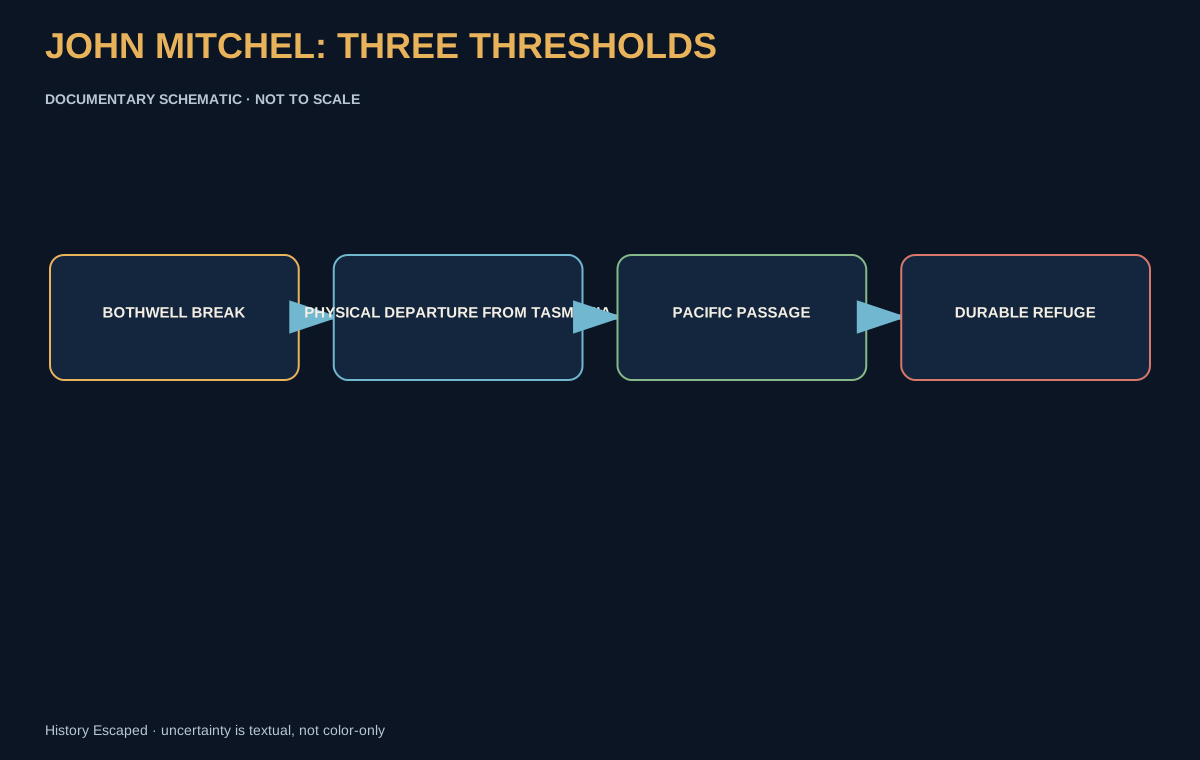
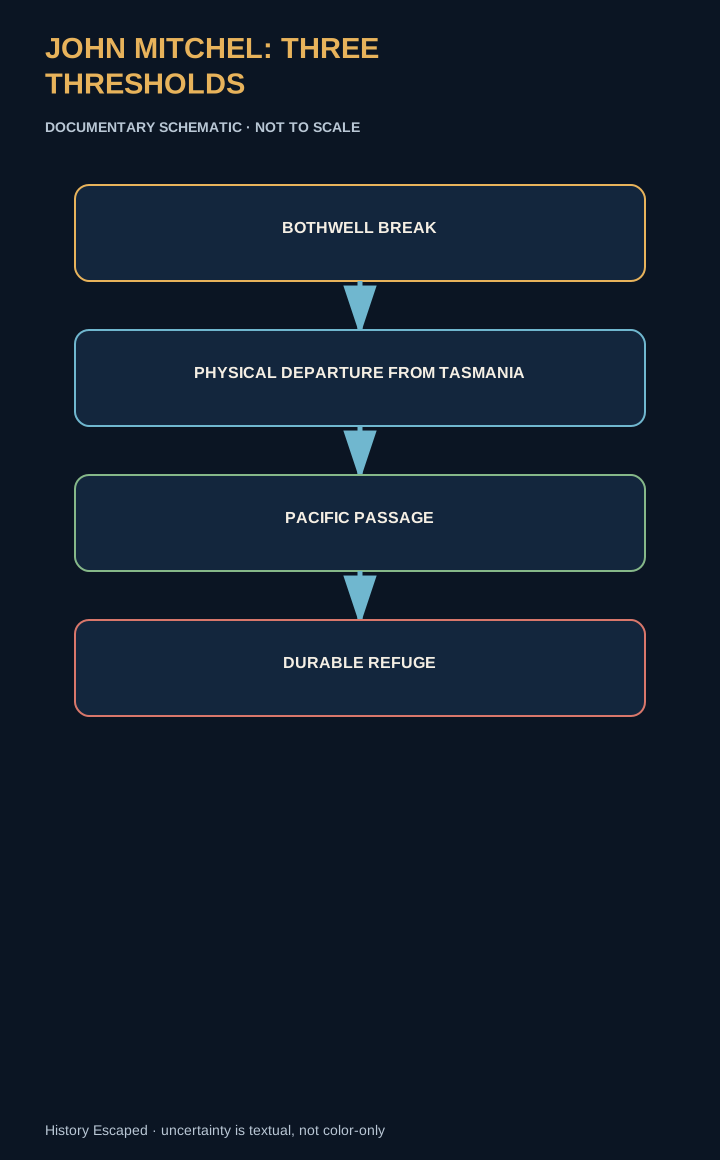
Simplified editorial reconstruction based on the cited historical record; not to scale. Uncertainty is stated directly in the visual and adjacent text.