
At a Glance
- First escape: December 1809
- Second escape: 9 August 1820
- Place: Robben Island, Cape Colony
- Escapee: David Stuurman, Khoikhoi/Khoe leader
- Captivity type: Colonial political imprisonment and banishment
- First outcome: Returned to the Eastern Cape and remained free for about a decade
- Second outcome: Escaped the island but was recaptured after reaching the mainland
- Later fate: Sentenced to transportation for life and taken to New South Wales in 1823
David Stuurman escaped Robben Island twice, but the two events were not repetitions of the same story. His first escape, in December 1809, restored him to freedom for nearly a decade. He returned to the Eastern Cape and re-entered a frontier struggle in which Khoi and Xhosa communities were resisting colonial expansion, labour coercion and dispossession.
His second escape, on 9 August 1820, belonged to a different situation. Stuurman was again a prisoner on Robben Island, this time after his recapture in 1819. He escaped during a large uprising in which prisoners overpowered guards, seized weapons and took whaling boats toward the mainland. He survived the wreck of one of those boats but was recaptured. The colonial government then removed the possibility of another long return to the frontier by sentencing him to transportation for life in New South Wales.
Taken together, the escapes show why Stuurman’s history cannot be separated from colonial imprisonment itself. Robben Island was not merely a place from which he wanted to get away. It was one instrument in a larger effort to remove an Indigenous political leader from land, community and resistance.
Before Robben Island
Stuurman was born around 1773, probably near the Gamtoos River in what is now the Eastern Cape. He emerged from a frontier society in which Khoi communities had already experienced generations of land loss, settler expansion and pressure to work on colonial farms.
South African History Online describes Stuurman as having worked for the farmer Johannes Vermaak and records missionary accounts of severe physical abuse. By the end of the eighteenth century, hundreds of Khoi people in the eastern districts were leaving farms and joining or cooperating with Xhosa communities rather than returning to colonial service.
Stuurman’s brother Klaas became a prominent Khoi leader during the upheavals around the Third Frontier War. After Klaas’s death, David assumed a greater leadership role. His community became a source of repeated complaints from colonial farmers and officials because it offered space to people whom settlers wanted returned to service, including deserters and fugitives.
This conflict was about more than individual lawbreaking. The colonial government sought labour, military manpower and control of frontier land. Stuurman’s group sought room to live outside the authority of settler employers and magistrates. By 1808–09, disputes over recruitment, fugitives and political authority had hardened into direct confrontation.
Colonial officials moved against Stuurman’s settlement in 1809. Land and livestock were confiscated, people were bound into service, and Stuurman and several others were arrested. Julia Wells’s research describes Landdrost Jacob Cuyler as having entrapped Stuurman, sent him to Robben Island and retained four of his children as servants.
That context matters when Stuurman is described as a political prisoner. His imprisonment followed a colonial campaign against a leader whose authority, landholding and refusal to surrender people challenged the labour and territorial order of the Cape frontier.
First imprisonment
The surviving summaries do not give a perfectly consistent date for Stuurman’s first arrival on Robben Island. Later accounts often place his formal commitment in September 1809, while Robben Island Museum says that he escaped only a few months after being imprisoned. The important chronology is secure at a broader scale: he was removed from the eastern frontier during 1809 and was on Robben Island by the time of his escape that December.
South African History Online states that he was sent to the island without the benefit of a trial. Colonial records attached descriptions such as “suspicious conduct” and disobedience to his case, language that reflected administrative treatment of a person considered politically dangerous rather than a conventional prosecution for a single ordinary crime.
Robben Island’s geography provided the main barrier. The prison of the early nineteenth century should not be imagined as the later apartheid-era maximum-security complex, but the surrounding sea still made unauthorized departure difficult.
Stuurman did not remain there long.
Selected chronology
Selected chronology
Stuurman is born near the Gamtoos River
Later historical reconstruction places his birth in the eastern Cape frontier region.
Colonial suppression and first imprisonment
Stuurman’s community was broken up, land and livestock were confiscated, and he was sent to Robben Island.
First escape from Robben Island
Stuurman escaped with others, probably by whaling boat, and ultimately returned to the Eastern Cape.
Stuurman remains active in frontier resistance
Colonial military correspondence continued to identify the escaped leader among forces resisting British campaigns in the Zuurberg and surrounding frontier.
Recapture and return to Robben Island
After roughly a decade at large, Stuurman was captured and again imprisoned on Robben Island.
Second Robben Island escape
A large prisoner uprising seized weapons and whaling boats; Stuurman escaped in one of the boats but was recaptured after reaching the mainland.
Trial after recapture
Museums of History NSW places Stuurman’s trial on this date; he received transportation for life to New South Wales.
Departure from the Cape aboard Brampton
The convict ship Brampton sailed from the Cape carrying Stuurman and other transported prisoners toward New South Wales.
Death in Sydney
Stuurman died in the General Hospital in Sydney while still living within the colonial convict system.
Escape One: December 1809
In December 1809, Stuurman and a group of other prisoners escaped from Robben Island.
The strongest institutional account is cautious about the mechanics. South African History Online says they probably used whaling boats to reach the mainland. That supports a maritime escape but not a precise reconstruction of the launch point, passenger list, landing beach or route afterward.
Most of the escapees were caught again. Stuurman was not.
Later heritage accounts identify his brother Bootsman among the group and describe Bootsman’s recapture after reaching the mainland. Such details fit the larger story but are less securely documented than David’s own outcome. What can be said confidently is that Stuurman made his way east and returned to the frontier region from which the colonial government had removed him.
The first escape was therefore successful in the long-term sense. He did not merely reach shore. He regained sustained freedom.
Ten years outside colonial custody
Robben Island Museum summarizes the interval simply: Stuurman was not recaptured for roughly ten years.
His freedom was politically consequential. During the frontier conflict of 1811–12, colonial military correspondence continued to identify him as an active opponent. Julia Wells places the recently escaped Stuurman among Khoe fighters resisting British operations in the Zuurberg and notes that colonial forces had difficulty capturing him.
This was also a period of aggressive colonial clearance. British troops sought to remove African communities from contested territory, destroyed houses and crops, and imposed stronger military control of crossing points. Stuurman’s presence among resistance networks meant that his 1809 escape had undone the immediate purpose of his banishment: he was again part of the frontier politics from which officials had tried to remove him.
His years at large should not be turned into a simple fugitive adventure. They overlapped with war, violent raids, colonial counterinsurgency, family separation and continued dispossession. Stuurman was both an escaped prisoner and a political-military figure within a much larger conflict.
Recaptured in 1819
Stuurman’s first period of freedom ended in 1819. He was captured during the aftermath of the fifth frontier war and returned to Robben Island, where South African History Online says he was put to hard labour.
This second imprisonment began under different circumstances from the first. He had already demonstrated that the sea around Robben Island was not an absolute barrier. He had also spent about a decade beyond colonial custody and remained associated with resistance.
Less than a year later, another escape opportunity emerged.
Escape Two: 9 August 1820
The second escape is much more clearly documented.
On the morning of 9 August 1820, a large group of Robben Island prisoners rose against their guards. Julia Wells, using Cape archival records from subsequent legal proceedings, describes prisoners overpowering sleeping guards, seizing weapons and fighting their way out of confinement.
This was not Stuurman acting alone or leading a small clandestine departure. The uprising included prisoners connected to the recent eastern frontier wars as well as other convicts. Hans Trompetter played a major role in freeing additional prisoners, including the Xhosa religious and political leader Makhanda, also known as Makana or Nxele.
The escapees seized three whaling boats and set out for the mainland. South African History Online describes the group as about thirty prisoners.
Stuurman was in one of the boats carrying men associated with the eastern frontier resistance. Wells places Makhanda in the same boat. As it approached the shore near Blaauwberg or Bloubergstrand, the boat wrecked in the surf.
The crossing became a disaster.
Documentary reconstruction
Two escapes, eleven years apart
A case-local editorial visual separates the documented sequence from uncertainty without implying exact modern geography or operational detail.
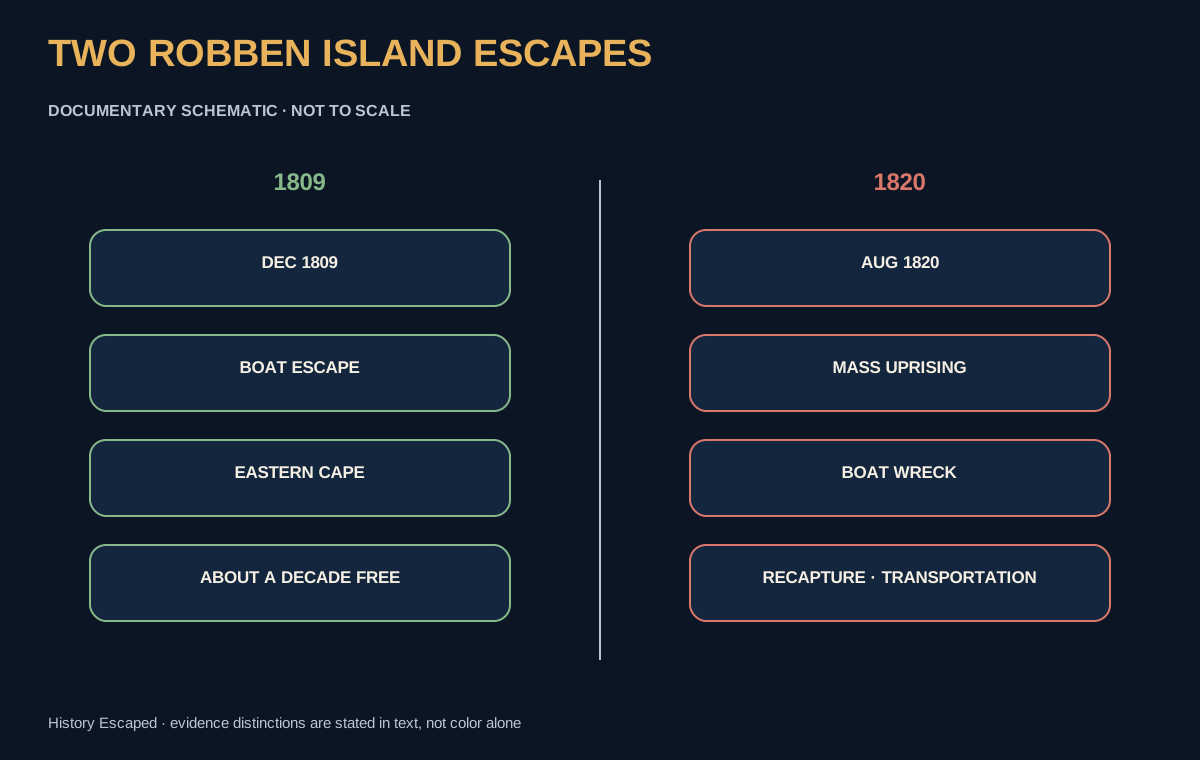
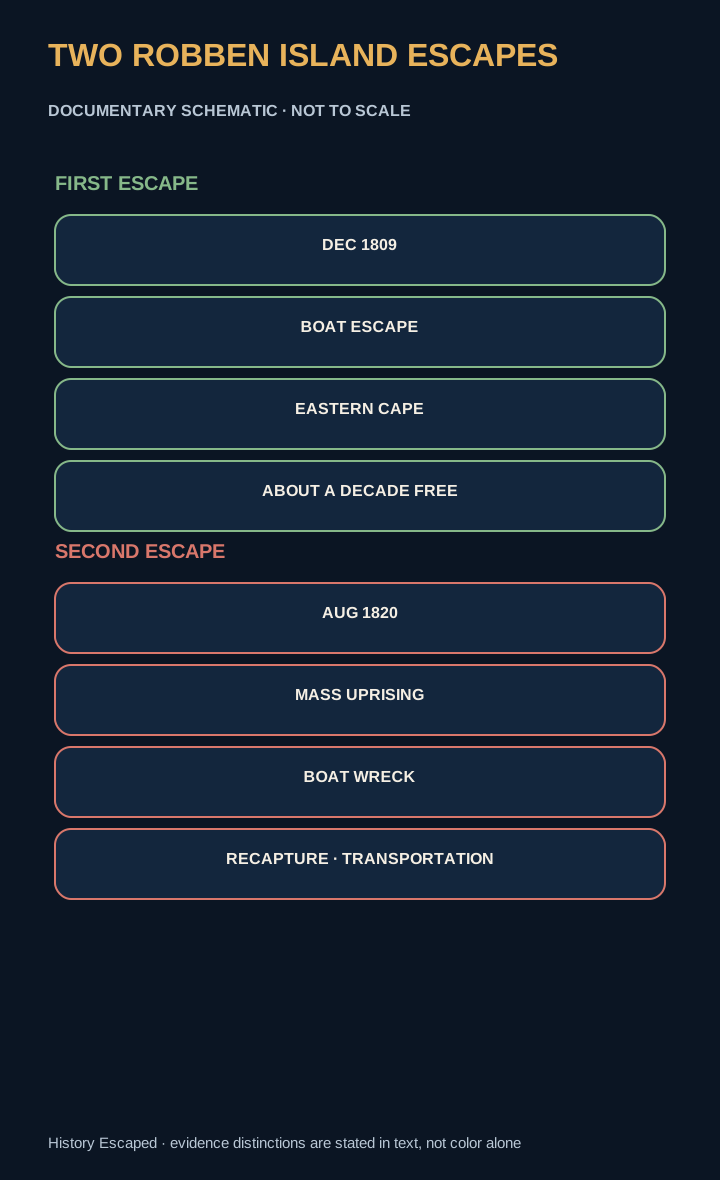
Simplified editorial reconstruction based on the cited historical record; not to scale. Uncertainty is stated directly in the visual and adjacent text.
Survival was not freedom
Makhanda drowned. So did many of the other prisoners.
Wells’s archival reconstruction says roughly half the people in Stuurman’s boat drowned while the rest reached shore. South African History Online gives a broader accounting: 14 drowned, 12 were recaptured, two were killed by commandos and three ultimately escaped. Because the same source describes the party as “about 30,” those figures are better treated as an approximate outcome reconstruction than as a perfectly reconciled total.
Stuurman survived the wreck.
For a second time, he had physically escaped Robben Island and reached the mainland. Unlike 1809, however, he did not recover durable freedom. Colonial forces recaptured him.
That distinction is central to classifying the two events. The 1809 escape was successful both immediately and in the long term. The 1820 escape succeeded at breaching confinement and crossing the water but failed as a permanent escape.
Trial after the second escape
The colonial response was severe.
Museums of History NSW places Stuurman’s trial on 2 September 1820. The uprising had included armed resistance, injury to soldiers and a death, and some of its leaders faced execution. South African History Online states that Johan Smit and Hans Trompetter were condemned to hang.
Stuurman was not executed. SAHO records that the overseer John Bryant credited Stuurman with having previously saved his life, and that this was raised after the recapture. Whatever the precise effect of that intervention, Stuurman ultimately received a sentence of transportation for life to New South Wales.
The colonial state had now faced the same prisoner escaping Robben Island twice. Transportation across the Indian Ocean offered a much more distant form of removal.
Yet Stuurman did not leave immediately.
The final accounting
Outcome
1809 escape — long-term success
Stuurman reached the mainland, returned to the Eastern Cape and remained free until 1819.
1820 escape — breakout succeeded, freedom did not
Stuurman left Robben Island and survived the wreck near the mainland but was recaptured.
Transportation to New South Wales
After the second escape, Stuurman was sentenced to transportation for life and removed from southern Africa in 1823.
A third period on Robben Island
After the 1820 trial, Stuurman was returned to Robben Island while colonial authorities waited for transportation to Australia. This was his third period of confinement on the island, but there was no third escape.
He remained at the Cape for more than two years. The delay shows how transportation functioned: a sentence to New South Wales depended on a vessel able to carry colonial prisoners into the British penal system in Australia.
In 1823 the Brampton provided that passage. The ship had sailed from Britain and Ireland with convicts and called at Table Bay. Stuurman was among the Cape prisoners taken aboard.
A Sydney shipping report later noted that the Brampton left the Cape on 20 February 1823 carrying eleven convicts from there. The ship reached Sydney in April.
Stuurman never again saw southern Africa.
Evidence discipline
What the record supports
Status labels distinguish secure conclusions from uncertainty and rejected claims. Color is never the only signal.
MYTH
Stuurman’s two Robben Island escapes were essentially the same type of event.
The 1809 escape was a smaller maritime flight followed by about a decade of freedom. The 1820 escape was a large armed prison uprising followed by a boat wreck and Stuurman’s recapture.
Sources: SRC-001, SRC-002, SRC-003MYTH
The exact mechanics of Stuurman’s 1809 escape are fully documented.
Institutional sources agree that he escaped in December 1809 and probably used a whaling boat, but the exact departure, passenger list, landing point and route east are not securely documented.
Sources: SRC-001, SRC-002MYTH
The 1820 escape ended with Stuurman drowning alongside Makhanda.
Makhanda drowned when their boat wrecked near the mainland. Stuurman survived the wreck and reached shore but was later recaptured.
Sources: SRC-001, SRC-003MYTH
Stuurman escaped Robben Island twice and remained free after both escapes.
Only the first escape produced long-term freedom. The second successfully breached Robben Island but ended in recapture and transportation.
Sources: SRC-001, SRC-002, SRC-004MYTH
Stuurman was imprisoned only for ordinary criminal conduct unrelated to colonial politics.
His imprisonment followed conflicts over land, labour, fugitives, military recruitment and Khoi political autonomy. Institutional histories place him among early political prisoners and anti-colonial resisters.
Sources: SRC-001, SRC-002, SRC-003DISPUTED
Exactly thirty prisoners took part in the 1820 escape.
SAHO describes about thirty prisoners and separately gives outcome figures of 14 drowned, 12 recaptured, two killed and three escaping. The totals do not reconcile perfectly, so the overall number should remain approximate.
Sources: SRC-001Transportation as colonial removal
Stuurman’s transportation should not be treated merely as an epilogue to two dramatic escapes. It completed the colonial effort to separate him from the region in which he had exercised political leadership.
Robben Island had placed sea between Stuurman and the frontier. New South Wales placed an ocean and another continent between them.
In Sydney he entered compulsory government service. Later records show that he obtained a ticket of leave, giving him limited ability to work for wages while remaining within the convict system. South African History Online gives his death as 22 February 1830 in Sydney.
His burial place later became difficult to identify after redevelopment of the cemetery area. Modern South African attempts to recover or symbolically repatriate him have therefore dealt as much with historical memory as with physical remains.
Two escapes, two outcomes
The temptation is to describe Stuurman simply as “the man who escaped Robben Island twice.” That is true, but incomplete.
The 1809 escape was a smaller maritime break whose details are poorly preserved. Its outcome was enormous: Stuurman made his way back to the Eastern Cape and remained outside colonial custody for about a decade.
The 1820 escape is much more visible in the records because it was a large, violent prisoner uprising. Guards were overpowered, weapons were seized, three boats left the island, and one wrecked with heavy loss of life. Stuurman again survived the crossing, but this time he was recaptured.
The two events belong on the same case page because they illuminate each other. They should never be merged into one escape sequence.
Why Stuurman matters
Stuurman’s story belongs to Robben Island history long before the prison became internationally associated with twentieth-century apartheid.
Robben Island Museum places early escapes within a tradition of resistance to imprisonment and banishment. Stuurman’s two escapes show that the island was already being used by colonial authorities to isolate political and military opponents from their communities.
His case also shows why “prisoner” cannot be the only frame. Stuurman had been a Khoi leader before his first imprisonment and returned to resistance afterward. Colonial officials confiscated land, compelled labour, separated families and used banishment to remove people who challenged the emerging frontier order.
The escapes were acts of personal liberation, but they were also episodes within that larger confrontation.
In 1809, Stuurman escaped the island and returned to the struggle from which he had been removed. In 1820, he escaped the island again but could not escape the expanding reach of colonial punishment. The final response was to send him far beyond Robben Island—to another British penal colony on the other side of the world.