
At a Glance
- Escape began: 3 January 1852
- Starting point: Lake Sorell, Van Diemen’s Land
- Escapee: Thomas Francis Meagher
- Captivity type: Transportation for life with ticket-of-leave restrictions
- Main method: Withdrawal of parole, overland evasion, clandestine maritime departure
- Route: Lake Sorell → northeast coast / Waterhouse Island → Pernambuco → New York
- Outcome: Reached New York in May 1852 and remained beyond British custody
Thomas Francis Meagher did not escape from behind prison walls. By January 1852, the Young Ireland revolutionary was living in a cottage beside Lake Sorell, married, able to receive friends, and enjoying considerably more freedom than an inmate at Port Arthur. Yet he was not legally free. His death sentence for the failed Irish rising of 1848 had been commuted to transportation for life, and his relative liberty in Van Diemen’s Land depended on a ticket-of-leave and his word that he would obey its restrictions.
His escape turned that unusual form of custody into the central problem. Before leaving, Meagher wrote to the local magistrate declaring that he was surrendering his ticket-of-leave and withdrawing his parole. He tried to present the coming flight as an open renunciation rather than a secret betrayal of his word. The government did not recognize that declaration as a release from his sentence, and even some of his fellow Irish exiles questioned whether he had handled the matter honourably.
What followed was less a prison break than a long-distance evasion: out of the interior, to an offshore island, aboard a merchant ship bound across the oceans, then through Brazil and finally to New York.
From death sentence to conditional liberty
Meagher had become one of the most prominent voices of the Young Ireland movement during the political crisis of the late 1840s. After the attempted rising of 1848 collapsed, he was tried and sentenced to death. The sentence was later commuted to transportation for life.
He reached Hobart Town in October 1849 aboard the Swift with William Smith O’Brien, Terence Bellew MacManus, and Patrick O’Donoghue. The transported Young Irelanders did not all experience the same conditions. O’Brien initially refused to promise that he would not escape and consequently endured confinement on Maria Island. Meagher accepted a ticket-of-leave and was allowed to live under restrictions in the Campbell Town district.
The ticket-of-leave system gave him a degree of everyday autonomy that can make the word “escape” misleading if the conditions are not explained. Meagher was not locked in a cell each night. He could live in a private dwelling and move within an assigned area, but the sentence of transportation still governed his status. His liberty was conditional, geographically limited, and backed by the threat of arrest and harsher punishment if he breached the rules.
At Ross he met Catherine Bennett. They married on 22 February 1851 and later lived at Lake Sorell, where Meagher had a cottage and a small farming operation. The setting was remote but not a penal station. That was precisely why his eventual flight depended less on defeating physical security than on deciding when his promise to the authorities no longer bound him.
The letter of 3 January
On Saturday, 3 January 1852, Meagher sent a letter to Thomas Mason, the police magistrate at Campbell Town. The text was reproduced in the colonial press and is the strongest surviving evidence for how Meagher wanted the escape to be understood.
He said that urgent private circumstances had led him to “resign” his ticket-of-leave and withdraw his parole. He then set his own deadline: after noon on the following day, he wrote, he would no longer regard himself as constrained by the obligation. If the authorities chose to arrest him before then, he added, he would consider himself absolved from the restraint of his word.
The distinction was meaningful to Meagher’s sense of honour, but it had no power to erase a sentence of transportation for life. A transported prisoner could not make himself legally free simply by returning a ticket-of-leave. From the government’s perspective, Meagher remained liable to custody whether or not he declared his parole ended.
This gap between honour and law explains much of the later controversy. Meagher could argue that he had announced his intention rather than fleeing secretly. Critics could answer that his promise existed precisely to prevent escape and that he had no authority to dictate when officials must arrest him.
Police arrive before his deadline
The contemporary newspaper account says Meagher remained at his cottage for much of 3 January. Later that day, while he was outside with friends, word reached him that the chief district constable and another constable had arrived.
What happened next became part of the legend. The published account has Meagher riding toward the cottage, identifying himself to the constable and issuing a challenge to catch him before riding away. Because the report was printed weeks later in a politically charged press environment, its exact dialogue should not be mistaken for a verbatim police transcript.
The essential sequence is nevertheless clear. Officers came for Meagher before the deadline he had written into his letter. He did not submit to arrest. He left the Lake Sorell district and became a fugitive from the colonial authorities.
That timing was the source of an uncomfortable question among the Young Ireland exiles. If Meagher’s promise required notice before escape, had he genuinely given the authorities a chance to act? John Mitchel later treated the issue seriously because the ticket-of-leave system rested partly on the exiles’ personal assurances. A perceived breach by one man could be used against the others.
There is no need to decide the nineteenth-century honour dispute for them. Meagher plainly attempted to distinguish his conduct from a secret violation of parole, while the authorities plainly did not accept his declaration as a lawful end to custody. In penal terms, he escaped. In his own political and personal code, he claimed to have withdrawn his word first.
From the interior to Waterhouse Island
The next part of the journey is less precisely documented. Meagher had to move from the central interior of Van Diemen’s Land toward the northeast coast without being retaken. Later biographies identify sympathizers and hiding places, but the surviving evidence is not strong enough to plot an exact road.
The secure destination is Waterhouse Island, a small island off the northeast coast. University of Tasmania research places Meagher there while he waited for the merchant vessel Elizabeth Thompson. The ship had already become associated with another Young Ireland escape: Terence Bellew MacManus had used it to leave the colony.
Waterhouse Island solved one problem and created another. Once offshore, Meagher was separated from the ordinary police routes of the interior, but he still depended on the rendezvous occurring. Later narratives describe a difficult wait for the ship. The duration and fine details vary enough that they are better left out of a definitive reconstruction unless supported by additional primary evidence.
Eventually the Elizabeth Thompson appeared and took him aboard. At that moment the escape changed scale. The problem was no longer how to get beyond a district constable; it was how to remain beyond British custody across an international sea route.
The long way to America
The Elizabeth Thompson did not carry Meagher directly to New York. The University of Tasmania reconstruction and later biographical sources agree that he traveled first to Pernambuco, now Recife, on the northeastern coast of Brazil.
There he transferred to the American brig Acorn. Contemporary American newspaper reporting later described his arrival aboard the Acorn from Pernambuco, independently supporting the final maritime leg.
This route matters because simplified biographies often compress the escape into a single line: Meagher fled Tasmania and went to America. In reality, the successful departure required several distinct transitions—interior exile to coast, coast to offshore rendezvous, Waterhouse Island to an ocean-going merchant vessel, Brazil to an American ship, and finally New York.
The sources do not justify drawing every ocean track with navigational precision. They do establish the principal nodes strongly enough for a schematic route: Lake Sorell → Waterhouse Island → Pernambuco → New York.
New York, May 1852
Michael Cavanagh’s 1892 biography gives 26 May 1852 as the date Meagher reached New York aboard the Acorn. Contemporary American newspapers soon reported his arrival and the fact that he had escaped from Van Diemen’s Land. Some later accounts use 27 May, probably reflecting the first full day of public notice or reception. The safer reconstruction retains 26 May for arrival while acknowledging that the public welcome unfolded over the following days.
Meagher entered the United States as a celebrated Irish nationalist exile. His arrival transformed the meaning of the escape. In Van Diemen’s Land he had been a transported convict living on conditional liberty. In New York he was able to turn his political reputation into a new public career as a lecturer, journalist, lawyer, and later military officer.
The British sentence itself had not been lawfully extinguished by the January letter. What changed was practical jurisdiction: Meagher had put oceans and another sovereign state between himself and the colonial authorities who could enforce it.
The argument over honour
The most distinctive feature of Meagher’s escape is not the ship rendezvous but the argument he created before he left.
Ticket-of-leave exile depended on a peculiar mixture of coercion and trust. The colonial government retained power over a transported prisoner but permitted conditional liberty. Among the Young Irelanders, that arrangement also carried a social code: a man who had explicitly promised not to escape was expected, at least in their own understanding, not to betray that promise secretly.
Meagher tried to solve the problem by renouncing the parole in advance. His letter was therefore both practical notice and a political statement. He was telling the government that he no longer accepted the moral restraint of the arrangement.
The difficulty was that he wrote the rules of the withdrawal himself. He specified when the obligation would end and what police action would absolve him. The authorities were under no duty to accept those terms. When constables appeared on 3 January, he fled instead of surrendering.
For History Escaped, the most accurate classification is therefore neither “honourable legal departure” nor “traditional prison break.” It was a successful escape from penal exile through violation of conditional liberty, preceded by a documented attempt to withdraw the personal parole on which that liberty partly rested.
Why it worked
Meagher’s ticket-of-leave status gave him opportunities that a prisoner inside a secure penal station would not have possessed. He had a private residence, social contacts, horses and local mobility, and enough freedom to communicate with sympathizers. The system controlled him administratively rather than through continuous physical confinement.
His supporters then extended that mobility toward the coast. An offshore rendezvous reduced the chance that ordinary colonial police could simply intercept him at a public harbor. The Elizabeth Thompson provided the decisive international departure, while the transfer at Pernambuco placed him aboard an American vessel bound for the country where he intended to build a new life.
The escape therefore depended on a chain rather than a single trick: conditional liberty, advance planning, sympathetic assistance, coastal movement, maritime rendezvous, and international shipping.
What the escape was—and was not
Meagher did not tunnel out of a prison, scale a wall, overpower a guard, or walk out of Port Arthur. By 1852 he was living under a ticket-of-leave system that allowed substantial but revocable freedom.
Nor did surrendering his ticket-of-leave make the remainder of his transportation sentence disappear. His letter is historically important because it shows how he understood his word of honour, not because it functioned as a legal discharge.
The escape is best understood as a flight from penal transportation and supervised exile. Its decisive breach occurred when Meagher refused renewed custody and left the district; its success was completed only when he left Van Diemen’s Land and eventually reached the United States.
That distinction makes the case more interesting, not less. The security barrier Meagher defeated was not made primarily of stone. It was a system of legal status, geographic restriction, police supervision, personal parole, and imperial distance. His 1852 escape worked because he found a way through each layer in turn.
Documentary reconstruction
Route to New York with the ticket-of-leave dispute alongside it
A case-local visual focused on the historical question that the surviving evidence can answer.
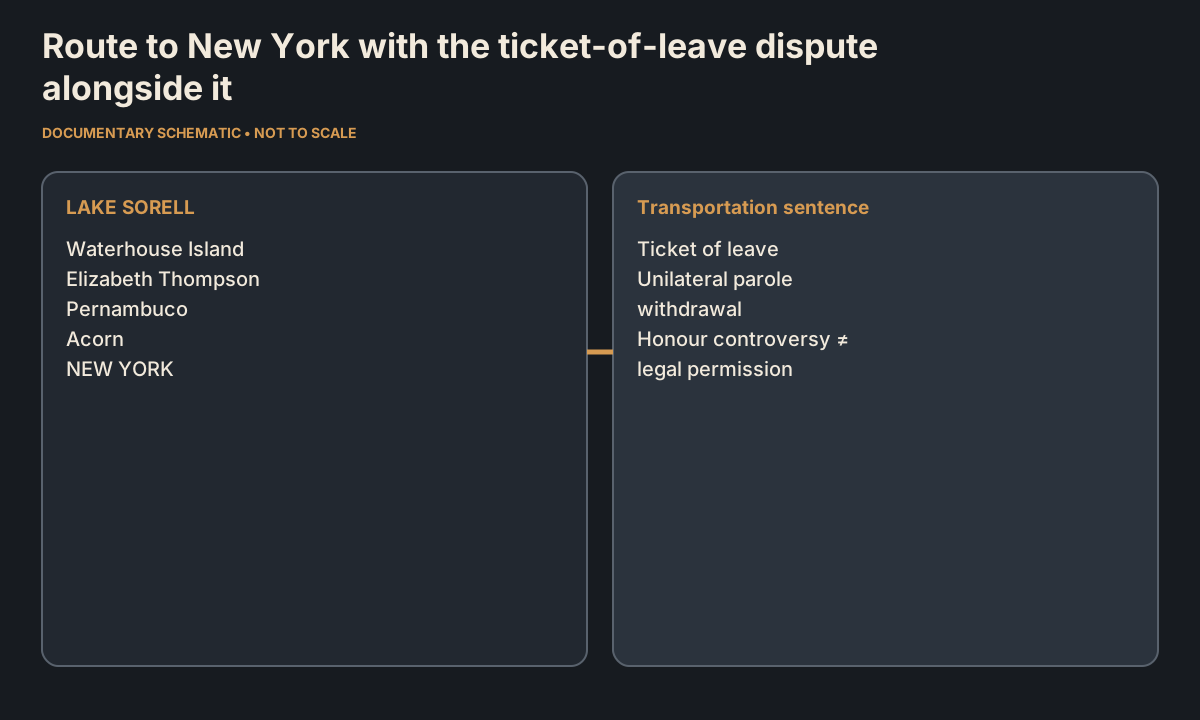
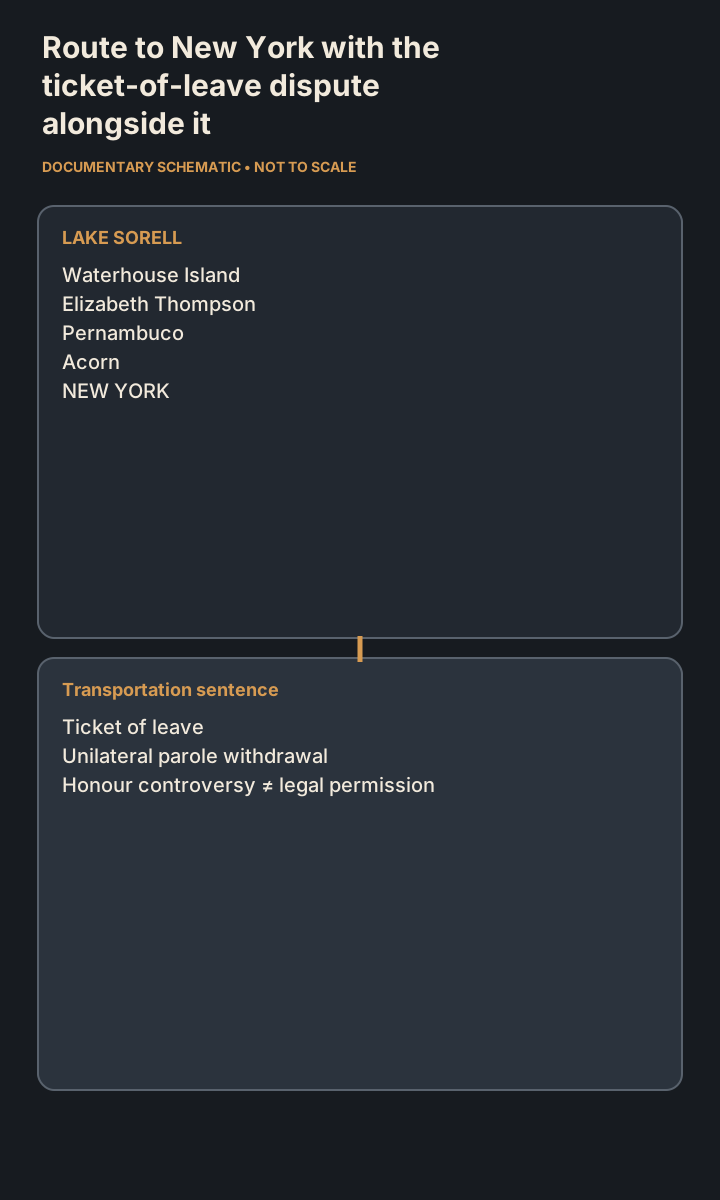
Simplified documentary reconstruction; not to scale. Evidence qualifications are written directly into the visual and explained in the adjacent text.
Evidence discipline
What the record supports
Status labels distinguish secure conclusions from uncertainty and rejected claims. Color is never the only signal.
MYTH
Meagher broke out of a prison in Van Diemen’s Land in 1852.
He was serving transportation for life but living under ticket-of-leave restrictions at Lake Sorell. The escape was from supervised penal exile, not from a closed gaol or penal station.
Sources: SRC-001, SRC-002MYTH
Surrendering his ticket-of-leave legally freed Meagher from his transportation sentence.
The 3 January letter documents Meagher’s attempt to withdraw his personal parole obligation. It did not function as a legal pardon or discharge from transportation for life.
Sources: SRC-001, SRC-003DISPUTED
Meagher gave the authorities a completely uncontested fair opportunity to arrest him before escaping.
He gave written notice and named a future deadline, but constables came before that deadline and he fled. Fellow exile John Mitchel later questioned whether his conduct had satisfied the exiles’ code of honour.
Sources: SRC-002, SRC-003MYTH
Meagher sailed directly from Tasmania to New York.
The secure broad route ran via Waterhouse Island and the Elizabeth Thompson to Pernambuco, where he transferred to the American brig Acorn for New York.
Sources: SRC-001, SRC-002, SRC-004, SRC-005UNKNOWN
The exact road taken from Lake Sorell to Waterhouse Island is known.
Later biographies add helpers and intermediate stages, but the sources used here do not support a precise road-by-road reconstruction.
Sources: SRC-002, SRC-004