Sun Bin’s extraction from Wei is one of the cleanest examples of how a short ancient source can accumulate centuries of additional story. The earliest major biography, Sima Qian’s Shiji, says that Pang Juan had Sun Bin subjected to penal mutilation in Wei, including the cutting off of both feet and facial tattooing. Sun Bin then remained a “penal prisoner.” When an envoy from Qi came to Liang, Sun Bin secretly obtained an audience with him. The envoy was impressed, concealed Sun Bin in his vehicle, and carried him back to Qi.
That is the entire escape mechanism in the Shiji. The familiar version in which Sun Bin is falsely accused of treason, spared from execution, locked away, pretends to be insane, lives in filth, fools Pang Juan and then escapes with a named rescuer belongs to much later literary tradition. Those stories became enormously influential, but they should not be folded backward into the fourth century BCE as if Sima Qian had recorded them.
At a Glance
- Escapee: Sun Bin
- Captive authority: the state of Wei
- Principal antagonist in the Shiji: Pang Juan
- Status before extraction: penal prisoner after corporal punishment
- Punishments in the Shiji: both feet cut off and face tattooed
- Exact charge: not stated in the Shiji
- Exact place of confinement: not stated
- Exact extraction date: unknown, sometime in the fourth century BCE
- Rescue contact: an unnamed envoy from Qi
- Core method: secret meeting followed by covert transport out of Wei
- Destination: Qi
- Immediate aftermath: General Tian Ji received Sun Bin as an honored guest
- Major evidence warning: the feigned-madness and pigsty story is a much later embellishment
Pang Juan and Sun Bin
The Shiji introduces Sun Bin more than a century after the time of Sun Wu, the figure traditionally associated with the earlier Art of War. Sima Qian presents Sun Bin as a descendant of Sun Wu and says that he studied military strategy together with Pang Juan.
Pang entered the service of Wei and became a general under King Hui. According to Sima Qian, Pang believed his own ability was inferior to Sun Bin’s. He therefore secretly caused Sun Bin to be summoned to Wei.
Once Sun arrived, the relationship turned openly dangerous. Sima Qian attributes Pang’s conduct to jealousy and fear that Sun Bin’s greater ability would eclipse him. Pang used the penal system against his former fellow student. The text says Sun Bin’s two feet were cut off and his face was tattooed, with the purpose of keeping him hidden and unseen.
The wording matters because later versions supply much more than the Shiji does. Sima Qian does not say that Pang fabricated a treason letter. He does not describe King Hui first sentencing Sun Bin to death. He does not say Pang intervened to commute the sentence so that he could steal a secret military book. Those details belong to later retellings.
What “penal prisoner” means here
The Chinese phrase used when the Qi envoy appears identifies Sun Bin as a xíngtú—a person subjected to penal punishment, often translated as convict or penal prisoner. That is stronger evidence for coercive custody than calling him merely a disgraced courtier. Sun Bin had undergone punishments designed to mark the body permanently and lower legal and social status. Facial tattooing, or qing, was itself a recognized ancient penal practice.
Yet the Shiji does not describe a prison building, cell, chains, guards, walls or a fixed place of confinement. For that reason, “secret extraction from Wei penal custody” is more accurate than “prison escape.” Sun Bin was plainly not free to leave openly, but the surviving source does not give enough physical detail to reconstruct the custody site. This distinction also keeps the case from inheriting architecture and security details invented in later fiction.
The punishment itself
Translations differ over how to describe the mutilation. The Shiji passage literally says that both of Sun Bin’s feet were cut off and that he was tattooed. Later Chinese tradition strongly associated his name, Bin, with the punishment known as bin, which could be understood in relation to the knee or lower limb. Modern popular accounts therefore often say his kneecaps were removed.
The most defensible historical description is to preserve Sima Qian’s wording rather than convert it into an anatomical certainty the text does not provide: both feet were cut off or disabled through severe penal mutilation, and his face was tattooed. Whatever the precise surgical act, the consequence was lasting disability. Later in the same biography, Sun Bin declines formal field command because he is a man who has suffered criminal punishment and instead advises from a vehicle.
The mutilation was therefore not only painful. It continued to shape how he could appear publicly and militarily after reaching Qi.
The unnamed Qi envoy
The escape begins with an unnamed diplomat. Sima Qian says that a Qi envoy came to Liang. In Warring States sources, Liang can refer to the Wei political center associated with Daliang. Sun Bin, still a penal prisoner, secretly arranged to meet him.
There is no explanation of how that contact was made. Sun Bin spoke with the envoy, who judged him extraordinary. The envoy then secretly carried him back to Qi.
The verb used in the Shiji has encouraged translations such as “smuggled him in his carriage” or “secretly transported him.” The essential point is concealment: Sun Bin could not simply accompany the diplomatic party in public. This is a rare ancient escape story in which diplomatic status may have created the extraction channel. The source does not say that the envoy stormed a prison or bribed guards. He seems instead to have used the mobility available to an official mission to remove a penal captive without Wei’s consent.
No named rescuer in the earliest account
Later stories often name Chunyu Kun as the man who extracted Sun Bin from Wei. That name is not in Sima Qian’s account of the escape. The Shiji simply says “the Qi envoy.”
This matters because a named rescuer changes the shape of the story. It can turn a short episode of opportunistic diplomatic extraction into a planned state operation with specific agents and detailed preparation.
The surviving early evidence does not support that level of certainty. Qi may have had prior knowledge of Sun Bin. The envoy may have acted on his own initiative after the secret meeting. Someone inside Wei may have helped create the meeting. None of those possibilities can be resolved from the text.
What happened after the extraction
Once in Qi, Sun Bin entered the household of General Tian Ji. Sima Qian says Tian Ji treated him generously as a guest. The biography then introduces the famous horse-racing episode in which Sun Bin advises Tian Ji how to rearrange three grades of horses so that he will lose one race but win two.
Whether every detail of that anecdote is historical is less important here than its narrative function. It is the Shiji’s demonstration that the mutilated penal prisoner whom Pang wanted hidden possessed strategic insight valuable enough to impress the Qi elite.
Tian Ji eventually presented him to King Wei of Qi. The king questioned Sun Bin about military affairs and employed him as a strategist. In the later campaign traditionally associated with the Battle of Guiling, Sun Bin advised Qi to strike at Wei’s vulnerable center rather than attack the Wei army directly in Zhao. The extraction had therefore transferred an important military thinker from Wei’s custody into the service of Wei’s major rival.
The revenge story grows
That outcome gave later writers a perfect structure for moral drama. Pang Juan cripples a more talented rival. Sun Bin survives humiliation. He escapes to Qi. He later defeats Pang through superior strategy.
Over the centuries, the gaps in the Shiji were filled with increasingly elaborate episodes. Leiden University scholar Wilt Idema notes that the Sun Bin–Pang Juan tale was greatly embellished in later ages. Vernacular versions circulated by the fourteenth century, and dramatic and fictional treatments made the story of betrayal, madness, humiliation and revenge far more detailed than Sima Qian’s biography.
In those later traditions, Sun Bin may discover that Pang intends to kill him after extracting his strategic knowledge. He then feigns insanity, endures degrading tests, fools Pang into relaxing surveillance and finally meets the man sent to take him back to Qi.
These are important parts of Sun Bin’s cultural afterlife. They are not evidence of how the fourth-century BCE extraction actually worked.
The feigned-madness problem
The madness story has become so widespread that modern summaries often present it without qualification. It should instead be treated as MYTH or LATER CLAIM, depending on how precisely it is phrased.
Nothing in the Shiji says Sun Bin pretended to be insane. Nothing there places him in a pigsty. Nothing there says he ate filth to convince Pang that his mind had broken.
The earliest secure core is much simpler: Sun Bin, as a penal prisoner, met a Qi envoy secretly and was covertly carried to Qi. Later literature may preserve older oral material that Sima Qian omitted. That possibility cannot be excluded. But historical method cannot promote a late story to equal evidentiary status merely because it is vivid.
The Yinqueshan discovery
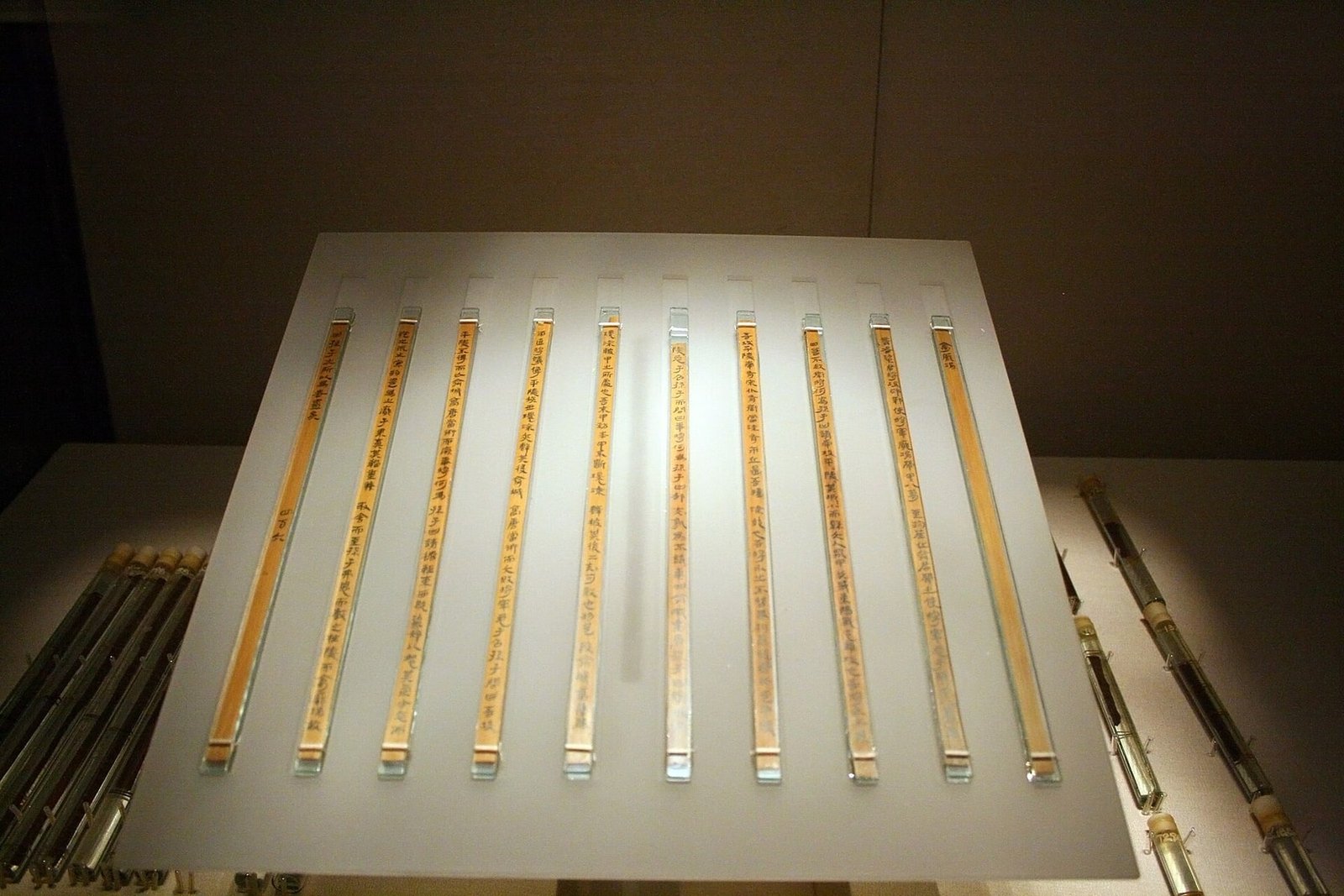
Modern archaeology adds an important piece of context, although not a new escape narrative. In 1972, excavators at Yinqueshan in Linyi, Shandong, recovered thousands of Western Han bamboo slips. Among them were texts of both the Sunzi and the long-lost Sun Bin Bingfa, or Sun Bin’s Military Methods.
The discovery was historically important because it confirmed that the tradition knew two distinct military works associated with two different “Masters Sun.” Chinese archival and museum authorities date the Yinqueshan manuscripts to the early Western Han, centuries after Sun Bin’s lifetime but far earlier than the late-imperial novels that elaborated his biography. The bamboo slips do not prove Sima Qian’s escape story.
They do, however, show that Sun Bin was not merely a character invented by Ming fiction and that a distinct military-text tradition associated with him circulated in antiquity. That distinction is useful: archaeology strengthens the historical context around Sun Bin without validating every biographical anecdote attached to him.
When did the extraction happen?
No surviving source gives a year. Sun Bin belongs to the fourth century BCE and later appears in Qi’s military history before the campaigns traditionally dated to the 350s BCE. That makes the extraction earlier than his established service under Tian Ji and King Wei.
Trying to narrow the event to a precise year would create false precision. The most defensible public date is simply 4th century BCE, with a note that the extraction necessarily preceded Sun Bin’s documented rise as a Qi strategist.
Even the sequence between punishment, secret meeting and departure lacks measured intervals. The Shiji moves directly from one to the next. There is no evidence for “one year in prison,” “months in a pigsty,” or any other fixed duration often supplied in modern retellings.
Why the extraction matters
Sun Bin’s case is unusual because the decisive act was not a physical feat by the captive. The source gives the agency to a secret conversation and to the diplomatic vehicle that carried him away.
Sun Bin’s own action was intellectual and political: he obtained access to the envoy and persuaded him that saving this mutilated convict was worth the risk of removing him from Wei. The Qi envoy then transformed that opportunity into movement across a state boundary.
It is therefore better understood as covert extraction than as a conventional prison break. That framing also explains why the episode belongs in an escape archive. A person under coercive penal control, permanently marked and disabled by punishment, secretly secured outside assistance and was transported beyond the authority holding him.
What the evidence supports
Sun Bin was a fourth-century BCE military thinker associated with Qi. Sima Qian says that Pang Juan, serving Wei, feared Sun Bin’s superior ability and had him punished under law: his feet were mutilated and his face tattooed.
The Shiji then explicitly calls Sun Bin a penal prisoner. When an unnamed envoy from Qi came to Liang, Sun Bin secretly met him. The envoy found him remarkable and covertly transported him to Qi, where Tian Ji accepted him as a guest.
That is the secure escape core.
The exact criminal charge is unknown. The exact custody site is unknown. The exact extraction date is unknown. The method used to arrange the secret meeting is unknown.
The treason frame, death sentence, secret military book, feigned madness, pigsty and named rescuer belong to later storytelling unless independently demonstrated.
Sun Bin’s extraction is therefore strongest when told with fewer details, not more. The surviving ancient biography already contains a remarkable reversal: a man whom Wei’s penal system had mutilated and tried to hide was quietly removed by a foreign envoy and went on to advise the rival state of Qi against Wei itself.
Evidence discipline
What the record supports
Status labels distinguish secure conclusions from uncertainty and rejected claims. Color is never the only signal.
MYTH
The Shiji says Sun Bin was imprisoned in a specific jail or cell.
The text calls him a penal prisoner but supplies no prison architecture, cell, chains or fixed custody site.
Sources: SRC-001, SRC-002MYTH
The Shiji says Pang Juan framed Sun Bin for treason and first obtained a death sentence.
Those details are absent from the Shiji’s Sun Bin biography. It says Pang feared and envied Sun Bin and used penal law to mutilate and tattoo him.
Sources: SRC-001MYTH
Sun Bin escaped by pretending to be insane and living in a pigsty.
The Shiji does not contain the madness or pigsty episode. Leiden scholarship notes that the Pang Juan–Sun Bin story was extensively embellished in later vernacular and dramatic traditions.
Sources: SRC-001, SRC-008MYTH
Chunyu Kun is securely named as the envoy who extracted Sun Bin.
The earliest major biography names no extractor; it says only that a Qi envoy secretly transported Sun Bin to Qi.
Sources: SRC-001, SRC-002DISPUTED
Sun Bin’s exact punishment is anatomically certain as removal of both kneecaps.
Later tradition associates his name with the bin punishment and popular accounts often say kneecaps. The Shiji wording itself says both feet were cut off and the face tattooed.
Sources: SRC-001, SRC-003MYTH
The Yinqueshan discovery independently proves the details of Sun Bin’s escape.
The Han manuscripts establish an ancient Sun Bin military-text tradition but do not narrate or corroborate the penal-custody extraction.
Sources: SRC-004, SRC-005, SRC-006LATER CLAIM
A Qi envoy secretly extracted Sun Bin from Wei after a private meeting.
This is the direct account in Sima Qian’s Shiji, written centuries after the fourth-century BCE events and therefore not contemporary testimony.
Sources: SRC-001, SRC-002Evidence diagram
The Shiji core and the later legend
The earliest major biography preserves a covert extraction; the famous madness and pigsty story belongs to much later tradition.
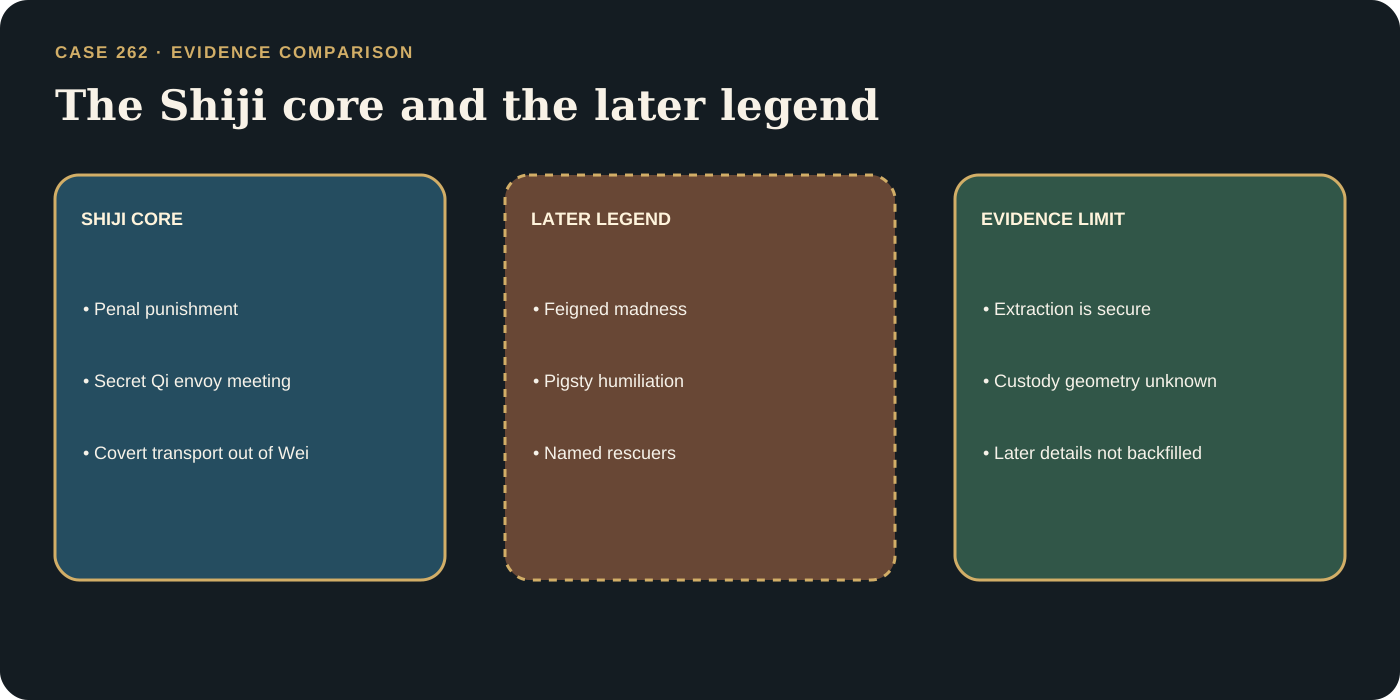
The earliest major biography preserves a covert extraction; the famous madness and pigsty story belongs to much later tradition.