
The Warburg Wire Job was a mass escape built around a different assumption from most famous prisoner-of-war breakouts. Instead of trying to disappear beneath the perimeter in a tunnel, Allied officers at Oflag VI-B planned to go over it in a sudden, coordinated rush.
On the night of 30–31 August 1942, four teams moved toward the wire carrying improvised ladder-and-bridge apparatus while the camp's perimeter lighting was disabled. One of the devices failed. Somewhere between 28 and 30 men appear to have cleared the boundary, depending on which surviving account is followed. Only three ultimately made it back to Britain.
At a Glance
- Date: Night of 30–31 August 1942
- Camp: Oflag VI-B, near Dössel and Warburg, Germany
- Other name: Operation Olympia
- Method: Four improvised ladder-and-bridge devices
- Material: Bed slats and other available camp timber
- Supporting measure: Deliberate blackout of perimeter lighting
- Gross breakout: Disputed; strong sources give 28, 29, or 30
- Home runs: 3
- Successful returnees: Albert Arkwright, Henry Coombe-Tennant, Rupert J. Fuller
Why the Date Matters
The Warburg Wire Job belongs firmly to the Second World War. Oflag VI-B opened near Dössel in 1940 as a German prisoner-of-war camp for officers. By 1941 and 1942 it held British and Commonwealth officers with a strong culture of escape planning.
The breakout took place on 30 August 1942, continuing into the early hours of the 31st. The date appears in the Second World War Experience Centre's account of Operation Olympia and in Imperial War Museums material concerning both the electrical blackout and participants in the ladder escape.
A date of 1918 cannot fit this event. That year belongs to the First World War and to other famous POW escapes, including Holzminden. The Warburg operation involved a camp that did not exist until the next war.
Oflag VI-B
The camp stood roughly a kilometre from Dössel, now part of Warburg, in Westphalia. A German military camp plan dated May 1940 survives. It provides useful evidence for the overall site, but it is not an exact engineering drawing of the perimeter as it existed more than two years later.
For prisoners planning an escape, the essential problem was straightforward. Barracks stood inside a guarded perimeter of barbed-wire obstacles watched under artificial light.
A large group trying to cut through the fence would create delay and congestion. A tunnel demanded weeks or months of hidden excavation. The Warburg planners chose a third possibility: create a temporary route across the top.
Designing a Way Over the Wire
The Second World War Experience Centre describes four approximately twelve-foot ladders with extensions that would permit men to cross the wire and descend on the outside. The word “ladder” can make the design sound simpler than it was. The apparatus had to do more than lean against an ordinary fence. It had to carry a man up to the obstacle, allow him to pass above or across the barbed-wire zone, and give him a way down without forcing everyone through a single narrow cut.
Four devices would allow several teams to move at once. The prisoners trained inside the huts, practicing how to mount, cross, and descend quickly while carrying the packs they intended to take on the run.
This was mass escape as choreography. If men hesitated at the top or if one device blocked the others, the guards would gain the time they needed.
Bed Slats, Bookshelves, and Music
Timber was limited and had to come from inside the camp. The Experience Centre account says the ladder components were constructed from bed slats. They also had to remain hidden between work sessions and the night of the escape.
The solution was to make the pieces capable of appearing useful in ordinary camp life. Components could be dismantled and arranged as objects such as bookshelves rather than left in the shape of obvious scaling equipment.
Construction created another problem: noise. Loud music practice helped conceal the sounds of fabrication.
These details are well established at a high level, but an exact modern reconstruction should stop there. The surviving public sources do not justify inventing every joint, hinge, rung spacing, or fence dimension.
The Blackout Problem
Even a well-built crossing device would be exposed under the perimeter lights. The escape committee therefore needed darkness at the moment the teams reached the wire.
Imperial War Museums catalogues a detailed technical account written by Captain K. A. Searle describing the electrical devices used in Operation Olympia. Its collection description states that the method diverted electrical current from the lights around the perimeter fence.
Another IWM oral-history record specifically identifies Major B. D. S. “Skelly” Ginn's role in the Warburg ladder escape.
Later narratives often present Ginn's electrical knowledge as one of the operation's crucial ingredients. That attribution fits the institutional record, though the escape remained a collective project rather than the invention of one man.
Four Teams
The Second World War Experience Centre describes the plan as four teams of ten assigned to four ladders. That gives a planned structure of forty men. Other later summaries use 41 participants, so the exact head count at the moment of the rush is less secure than the four-team organization itself.
When the lights went out, the signal was given. The teams ran for the perimeter. The escape did not unfold exactly as rehearsed.
One Ladder Collapses
One of the four apparatuses collapsed. That failure immediately reduced the capacity of the breakout and created the kind of delay the planners had tried to avoid. The other teams continued.
Men climbed, crossed the wire obstacle, descended outside, and ran. Then the available accounts begin to disagree about how many had actually made it.
The Australian War Memorial gives 28. The Second World War Experience Centre gives 30.
An escape-line reconstruction drawing on numbered MI9 reports describes Arkwright, Coombe-Tennant, and Fuller as three of 29 men who escaped from Warburg that night. The surviving figures do not resolve to one exact gross count. Strong institutional and archival-derived sources therefore place the breakout at roughly 28 to 30 men, while the exact total remains disputed.
Getting Over Was Only the First Escape
Clearing the perimeter did not mean freedom. The men were now fugitives inside wartime Germany, without legal travel documents and still hundreds of miles from a neutral border or Allied-controlled territory.
Australian War Memorial records illustrate the difference between the first success and the final one. Captain Rex Baxter and Lieutenant Jack Champ made it out during the Warburg Wire Job but were recaptured within minutes.
Captain Doug Crawford stayed free longer, remaining at large for several nights before he too was caught. The Second World War Experience Centre gives an even longer example: officer L. T. “Dick” Tomes remained free for ten days and eleven nights before recapture. For most of the breakout party, the Warburg Wire Job ended somewhere between the fence and the wider German search effort.
Three Men Stay Together
Three officers went farther: Albert Seymour Bertram Arkwright, Augustus Henry Serocold Coombe-Tennant, and Rupert J. Fuller.
Their identities are strongly anchored in the postwar escape-report tradition. Imperial War Museums also holds Arkwright's published account, Return Journey: Escape from Oflag VI B.
An MI9-derived reconstruction states that the three were among the first over the wire in their team. Rather than splitting up immediately, they stayed together.
Their first objective was not Spain or Britain. It was simply to get west.
Walking Toward the Netherlands
The three moved chiefly at night and hid during daylight. The MI9-derived route research places their crossing into the Netherlands near Denekamp around 14 September, roughly two weeks after the Warburg breakout.
There they encountered Dutch civilians willing to help. That changed the character of their escape. Until then, survival depended mostly on their own movement and concealment. Once helpers accepted that they were British officers, food, shelter, transport, and local knowledge became available. They were passed onward through a network that eventually carried them toward Belgium.
Into the Escape Lines
From the Netherlands, Arkwright, Coombe-Tennant, and Fuller moved into Belgium and reached Brussels. There they joined the Comète escape line, one of the civilian networks that moved Allied fugitives and evading airmen through occupied western Europe toward Spain.
The route then led southwest through France and across the Pyrenees. A modern biography of Coombe-Tennant independently confirms the broad path: Warburg to Belgium, France, and Spain, then home to England.
The detailed MI9-derived reconstruction ultimately places the three in Gibraltar and records their flight back to Bristol during the night of 6–7 November 1942. More than two months had passed since they went over the wire.
Why the Count Conflict Matters
The Warburg numbers show why escape history benefits from separating stages. A source might count a man once he cleared the perimeter. Another might use a camp escape report with a slightly different roster. Later summaries can inherit one total while memoirs or institutional histories preserve another.
That may explain the 28, 29, and 30 figures, but the surviving public evidence does not prove the reason for the discrepancy. The final home-run count is different.
On that point, the sources converge: three men reached Britain. The distinction can therefore be stated without false precision.
Approximately 28–30 men appear to have made it out of Oflag VI-B during the mass rush. Three completed the escape all the way home.
Why the Warburg Wire Job Matters
The operation deserves a place beside the better-known POW tunnel escapes because it solved the perimeter problem in a fundamentally different way. The prisoners did not spend months trying to hide a route beneath the camp. They transformed ordinary camp materials into temporary crossing equipment, rehearsed a coordinated mass movement, and paired the physical apparatus with a deliberate blackout.
The plan was also fragile. One failed ladder immediately reduced its effectiveness, and almost everyone who got outside was eventually caught.
Yet three men turned a few seconds at the wire into a journey across occupied Europe. The Warburg Wire Job was therefore both a mass breakout and a reminder that breaking the boundary of a POW camp was only the first stage of an escape.
Evidence discipline
What the record supports
Status labels distinguish secure conclusions from uncertainty and rejected claims. Color is never the only signal.
MYTH
The Warburg Wire Job took place in 1918.
Oflag VI-B was a Second World War camp opened in 1940, and institutional sources explicitly date Operation Olympia to 30 August 1942.
Sources: SRC-001, SRC-002, SRC-003, SRC-010DOCUMENTED
The escape occurred on the night of 30–31 August 1942.
The date is consistent across the Second World War Experience Centre, IWM collection records, and Australian War Memorial context.
Sources: SRC-001, SRC-002, SRC-003DISPUTED
Exactly 28 prisoners cleared the camp perimeter.
The Australian War Memorial gives 28, the Second World War Experience Centre gives 30, and an archival-derived MI9 route reconstruction gives 29. The difference likely reflects counting or classification choices, but the public sources do not settle that explanation.
Sources: SRC-001, SRC-002, SRC-006DISPUTED
Exactly 40 prisoners took part in the rush.
The Second World War Experience Centre describes four teams of ten, while other later summaries give 41 participants. Forty is well supported as the intended four-team structure, but the exact participant total is not treated as settled.
Sources: SRC-001, SRC-009MYTH
The escape was a tunnel breakout.
Operation Olympia was an over-the-wire mass escape using improvised ladders and a blackout, not a tunnel.
Sources: SRC-001, SRC-002, SRC-003WELL-SUPPORTED
The improvised ladders were built largely from bed slats.
The Second World War Experience Centre specifically describes bed-slat construction and concealment as camp furniture.
Sources: SRC-001MYTH
All men who cleared the wire successfully returned to Britain.
Most were recaptured; only Arkwright, Coombe-Tennant, and Fuller completed home runs.
Sources: SRC-001, SRC-002, SRC-005, SRC-006MYTH
Rupert Fuller's first name was Robert.
MI9-derived indexing and escape-line research identify him as Captain Rupert J. Fuller of the Royal Sussex Regiment.
Sources: SRC-005, SRC-006Documentary reconstruction
Ladders, bridge and the perimeter crossing
A case-local editorial visual separates the documented sequence from uncertainty without implying exact modern geography or operational detail.
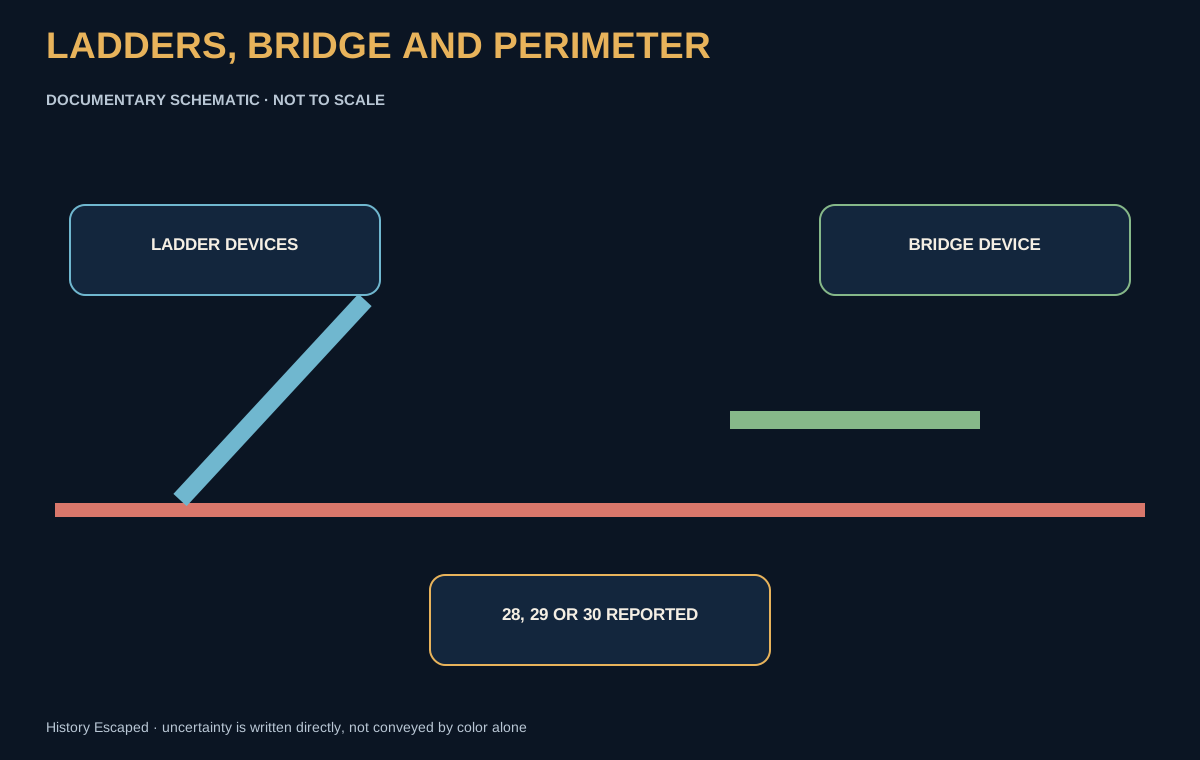
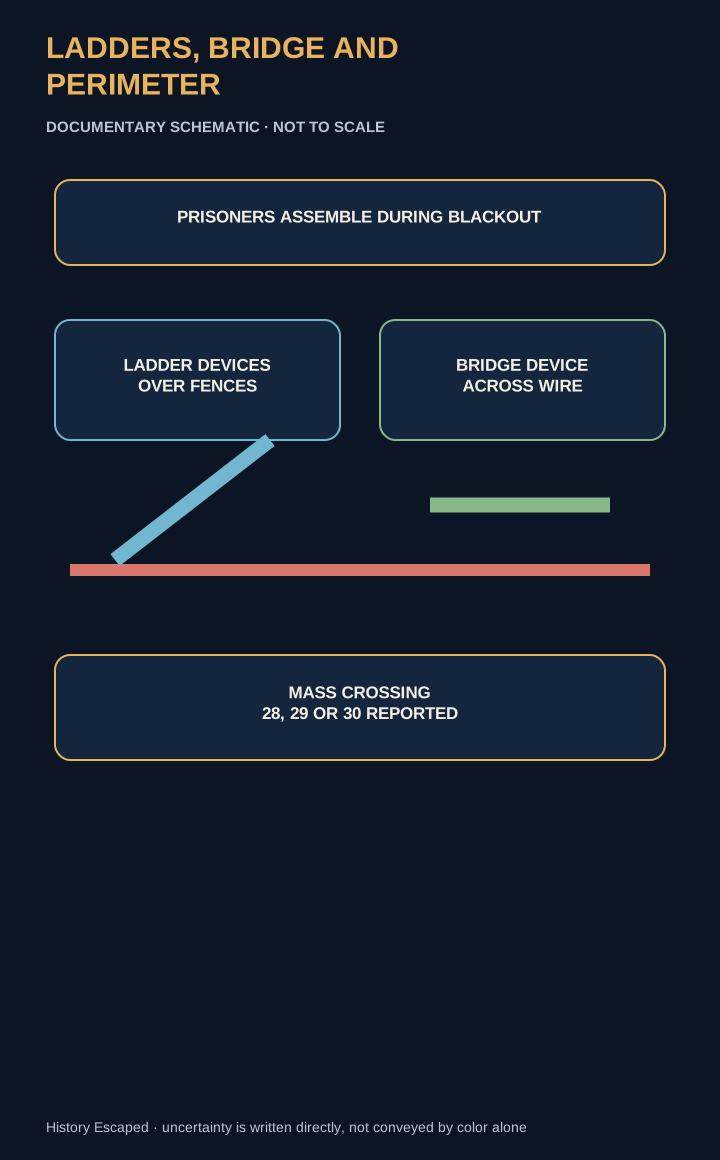
Simplified editorial reconstruction based on the cited historical record; not to scale. Uncertainty is stated directly in the visual and adjacent text.