
The coordinated flight in which Arbella slipped out of guarded custody at East Barnet while her husband escaped the Tower of London — only for the couple to miss one another and meet opposite fates.
This was not, strictly speaking, Arbella’s escape from the Tower
The most important correction comes at the beginning.
Lady Arbella Stuart did not walk out of the Tower of London in June 1611. Her husband did.
Arbella was being held under guard at East Barnet, north of London, after King James I ordered that she be removed to Durham. William Seymour was imprisoned in the Tower. Their plan required two separate escapes to succeed at almost the same time, followed by a rendezvous on the Thames and passage to the Continent.
That distinction matters because the familiar shorthand — “Arbella Stuart’s Tower escape” — collapses two different movements into one. The real operation was more difficult. The couple were separated, watched by different keepers, and dependent on servants, horses, boats, tides and timing.
On Monday, 3 June 1611, both got out. Only one remained free.
Why Arbella’s marriage frightened the king
Arbella Stuart had spent much of her life in the shadow of the English succession.
She was a great-great-granddaughter of Henry VII through Margaret Tudor and a first cousin of James VI of Scotland, who became James I of England in 1603. Her precise constitutional place in the succession was complicated by statute, dynastic argument and political preference, but contemporaries understood that her blood made her a plausible claimant around the end of Elizabeth I’s reign.
That made her marriage politically sensitive in a way an ordinary noble marriage was not.
In 1610 Arbella secretly married William Seymour. Seymour also possessed royal ancestry, descending through Lady Katherine Grey from Mary Tudor, Henry VIII’s younger sister. A marriage joining two families with claims connected to the Tudor succession could alarm a monarch whose own accession had depended on political acceptance as much as genealogical theory.
There is no good evidence that Arbella and Seymour were preparing an armed coup in 1610 or 1611. But James did not have to believe a coup was already under way to fear what their marriage might create: a rival dynastic household, and potentially children around whom opponents could rally.
The couple had already been warned not to marry without royal consent. Nevertheless, they married secretly at Greenwich in June 1610.
When the marriage was discovered, Seymour was sent to the Tower. Arbella was placed in the custody of Sir Thomas Parry at Lambeth.
Their marriage had become a state problem.

The order to send Arbella north
By early 1611 the government decided that simply keeping husband and wife in separate parts of London was not enough.
A royal warrant placed Arbella in the custody of William James, Bishop of Durham, with orders that she be taken north. Surviving British Library papers preserve copies of the warrant and the council instructions surrounding the transfer.
The dating requires one small historical caution. Some contemporary English documents call the warrant 13 March 1610 because the legal year did not begin on 1 January. In modern calendar usage, the event falls in March 1611.
Arbella did not get far.
Administrative accounts recording the cost of her custody show the party stopping first at Highgate and then Barnet. Her health was poor enough that the northward journey stalled. The surviving account states that she was later appointed to remain at East Barnet during the king’s pleasure.
That account is particularly valuable because it resolves a problem in later retellings. Some modern summaries say Arbella escaped from house arrest in Lambeth. Lambeth was indeed where she had earlier been confined. But by the time of the June escape, the government’s own financial record places her custody at East Barnet.
The escape began there.
A plan built around two clocks
The difficulty was synchronization. Arbella needed to leave her guarded house, travel south and east toward the Thames, reach Blackwall, then board a boat that would take her downriver to a ship arranged for the Channel crossing. Seymour needed to get out of the Tower independently and find the same escape network.
The couple could not simply leave together. Nor could one safely wait indefinitely for the other.
Their helpers included men identified in contemporary records and the subsequent royal proclamation, among them Markham, Crompton and Edward Rodney. British Library manuscripts preserve examinations, letters and lists of people arrested after the escape, as well as the names of watermen who assisted Arbella.
The documentary trail is unusually rich for an early seventeenth-century escape attempt because the government treated the incident as a security emergency.
Arbella changes clothes
On 3 June, Arbella adopted male dress. A nineteenth-century documentary history drawing on contemporary accounts describes French-style hose pulled over her clothing, a man’s doublet, a long-haired wig, a black hat and cloak, boots and a rapier.
The exact wardrobe is not important because it sounds dramatic. It is important because disguise changed the assumptions of everyone Arbella needed to pass.
Her physical condition almost betrayed her immediately.
The same documentary account says she walked roughly a mile and a half before reaching a small inn where horses were waiting. She became faint and looked so unwell that the ostler reportedly doubted the apparent young gentleman would make it to London.
She did.
Riding was itself part of the disguise. Arbella had to travel astride in a manner unusual for an aristocratic woman of her background.
By about six in the evening, the party reached Blackwall. Seymour was not there.
The rendezvous fails
This was the point at which a successful breakout became a dangerous waiting game.
Arbella expected Seymour to join her. He did not appear.
She waited. Every extra minute increased the chance that her absence would be discovered, messages would move through the royal administration, roads and waterways would be watched, and vessels would be sent after her. Eventually her party continued without him.
Arbella and a female attendant took one boat; other helpers and baggage followed. They moved down the Thames looking for the French vessel arranged to carry the fugitives overseas.
At first they approached the wrong ship. After asking for a French vessel nearby, they found the correct one and boarded.
They had reached the ship that could take them out of England. But Arbella still wanted to wait for Seymour.
Her attendants understood the danger. The longer the vessel remained within reach of English authority, the less likely anyone aboard was to get away.
At last the ship sailed.
Seymour gets out of the Tower
Meanwhile, Seymour’s side of the plan had worked. Accounts of his breakout differ in some costume details, but the essential mechanism is well established: disguise, assistance from people able to move through the Tower, and departure through a gate without attracting immediate suspicion.
One documentary account has him following a cart that had delivered firewood. Another later biographical tradition emphasizes assistance from his barber. The safest conclusion is that he used disguise and inside help to pass out of the Tower and reach the Thames.
Edward Rodney was waiting with a boat. Seymour and his companions rowed downriver toward the place where they expected to find Arbella’s ship. They were too late. The French vessel had gone.
Seymour then improvised. His party reached a collier whose master could be persuaded to alter course. Bad winds prevented the planned run to Calais, so Seymour eventually reached Ostend instead.
The husband who had started inside the Tower escaped England. The wife who had started outside it did not.
The government reacts
Once the escape was discovered, the response moved quickly. On 4 June, James issued a royal proclamation ordering the fugitives apprehended and forbidding anyone from receiving, sheltering or assisting them.
The proclamation is especially important for dating the escape. It states that Arbella and Seymour had broken custody and escaped on “Monday, the third of June.” A later nineteenth-century Dictionary of National Biography entry gives 4 June, but the contemporary proclamation makes 3 June the stronger date for the actual breakout.
The government did not rely on the proclamation alone.
Messages went to officials and ports. Searchers examined vessels and houses. A messenger was sent to the royal shipwright Phineas Pett at Deptford with orders to send a vessel downriver and search shipping for Arbella.
The Lord High Admiral, Charles Howard, Earl of Nottingham, coordinated the maritime pursuit. Sir William Monson became involved in the search. A vessel named the Adventure was sent toward Calais.
The escape had become a chase across the Channel.
Arbella is intercepted
Arbella’s French vessel was eventually sighted by the English pursuit.
The surviving documentary narrative describes warning shots and armed men sent toward the fugitive ship before it surrendered. Arbella then identified herself.
One detail from the account captures the central tragedy of the plan: when questioned about Seymour, she said she had not seen him and expressed hope that he had escaped. He had. Arbella was transferred to English custody and brought back. James ordered her committed to the Tower of London.
Only at that point did Arbella become the Tower prisoner with whom her name is now so strongly associated.
One escape succeeds; the other becomes permanent imprisonment
The government arrested or detained numerous people connected to the operation. British Library catalogues still list the resulting papers: letters, reports, lists of prisoners, names of watermen, petitions and Arbella’s later correspondence.
Seymour remained abroad for years before eventually returning to royal favor. Arbella never regained her freedom.
She was kept as a close prisoner in the Tower. The exact rooms in which she spent her confinement are uncertain. Historic Royal Palaces considers the royal lodgings a likely location but does not present that identification as certain.
Her health and mental condition deteriorated during the years that followed. She continued to petition for relief and challenged the basis of her detention. British Library holdings preserve a letter to the chief justices from this period, part of a documentary record showing that her imprisonment was not simply a romantic legend added later.
Arbella died in the Tower on 25 September 1615. She was buried in Westminster Abbey in the royal vault in Henry VII’s chapel. William Seymour outlived her by decades.
Was Arbella trying to seize the throne?
The available evidence does not support turning the June 1611 escape into a failed coup.
James and his councillors had real political reasons to fear the couple. Their marriage joined two dynastic lines. Flight abroad could create new uncertainties, especially if foreign courts, religious factions or English opponents decided to use them.
But political usefulness to other people is not the same as a documented plan by Arbella to overthrow James.
The royal proclamation used severe language, referring to “great and heinous offences.” That language tells us how the crown wanted the emergency understood. It does not by itself prove a treason conspiracy.
Arbella’s documented actions in other succession crises complicate the image of a determined usurper. In 1603, when conspirators attempted to use her name in a plot against James, she informed the authorities.
The strongest formulation is therefore narrower: James considered the marriage and escape politically dangerous; Arbella and Seymour deliberately fled royal custody; their intended life and political role abroad cannot be reconstructed with absolute certainty.
Why the attempt failed
Arbella’s escape did not fail because the disguise was immediately seen through. It did not fail because she could not get out of East Barnet. It did not fail because the Thames route was impossible. She reached the waiting French ship.
The decisive weakness was coordination. Two prisoners in two different locations had to get out, reach a rendezvous and board the same vessel before the state realized what was happening.
Seymour’s escape from the Tower took longer than Arbella could safely wait. Arbella then delayed again because she hoped he would arrive. Once the government understood that both had gone, royal authority could move through messengers, ports, shipyards and naval vessels much faster than a small escape party could remain invisible.
The state recovered from its initial surprise. The couple never recovered from missing one another.
Why this case belongs in the history of escape
Arbella Stuart’s attempt sits at the intersection of prison escape, house-arrest evasion, disguise, maritime flight and dynastic politics. It also demonstrates why the label “Tower escape” is both useful and misleading. William Seymour escaped the Tower. Arbella Stuart escaped East Barnet.
The plan joined those two events into one operation.
For several hours it nearly worked. Arbella passed her guards, crossed miles of country, reached Blackwall, transferred to the Thames, found the arranged ship and sailed for the Continent. Seymour got out of one of England’s most famous prisons and eventually reached safety overseas.
The operation failed as a reunion, not as a pair of breakouts. That is what makes the ending so severe. The person who escaped the Tower survived abroad. The person who never escaped the Tower was the one brought back to it.
Escape reconstruction
How the escape unfolded
An evidence-aware sequence of the principal stages.
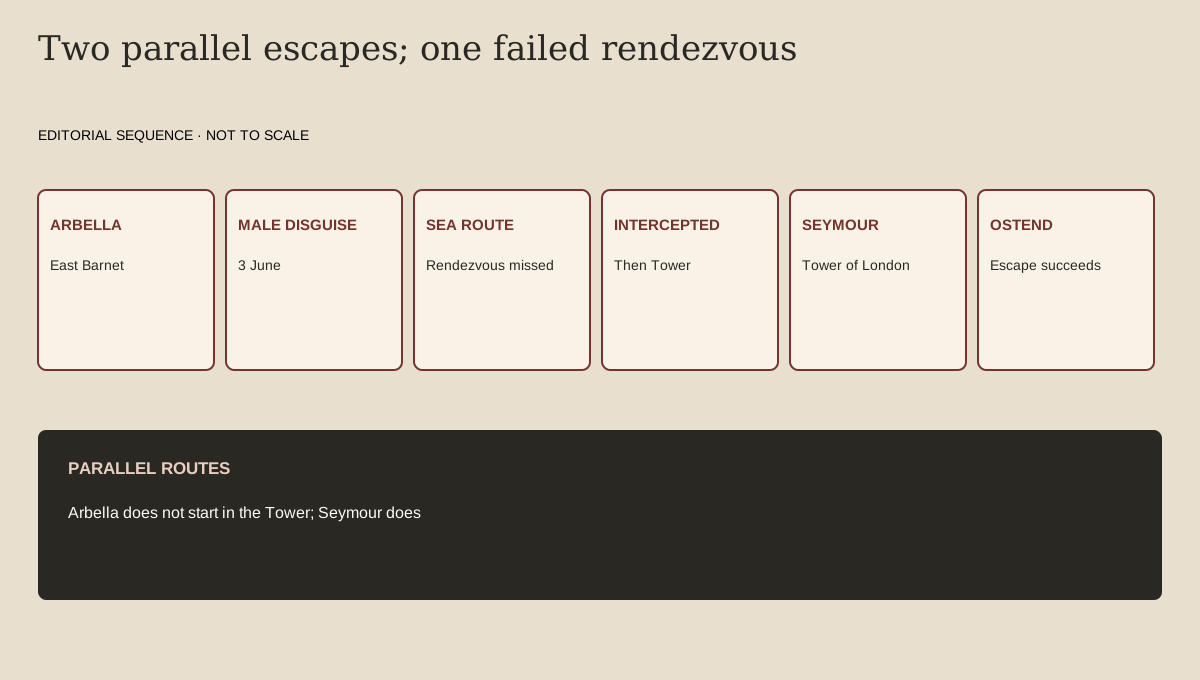

Simplified editorial reconstruction; not to scale. See adjacent text for evidence qualifications and unresolved details.
Material evidence
Tools of Escape
The objects used in an escape reveal how a plan worked under constraint.
- 01Primary disguise
Male disguise
Arbella used male clothing, a wig, hat, boots and a rapier to alter how observers read her identity while she moved from East Barnet toward London.
- 02Overland transport
Horses
Horses waiting after the initial walk allowed Arbella’s party to move more quickly toward Blackwall.
- 03Transfer transport
Thames boats
Small boats moved both escape parties down the Thames toward seagoing vessels.
- 04Planned exit from England
Prearranged French vessel
A French ship waited downriver to carry Arbella and, if the rendezvous succeeded, Seymour across the Channel.
Problem → response
Escape was a sequence of problems
Each response solved a practical obstacle while often creating the next one.
- 01→
Obstacle
Separated confinement
Arbella and Seymour were held in different places under different forms of custody.
Response
The escape plan coordinated two independent breakouts around a shared rendezvous and maritime route.
- 02→
Obstacle
Arbella’s poor health
Her health had already interrupted the forced journey north and she became faint during the escape.
Response
Her party used a short initial walk followed by horses and then river transport to continue despite her condition.
- 03→
Obstacle
Failed rendezvous
Seymour did not reach Blackwall or the waiting vessel before Arbella’s party had to depart.
Response
Arbella continued toward France without him; Seymour separately improvised passage on another vessel.
- 04→
Obstacle
Rapid state pursuit
Once the escape was discovered, the crown mobilized messengers, searchers and maritime assets.
Response
Arbella’s vessel continued toward Calais, but the pursuit caught it before she reached foreign protection.
The final accounting
Outcome
Arbella recaptured
Arbella reached the seagoing stage of the escape but was intercepted before obtaining durable freedom abroad.
Seymour escapes
William Seymour successfully left the Tower, improvised a separate maritime route and reached Ostend.
Arbella imprisoned for life
After recapture Arbella was committed to the Tower, where she remained until her death on 25 September 1615.
Evidence discipline
What the record supports
Status labels distinguish secure conclusions from uncertainty and rejected claims. Color is never the only signal.
MYTH
Arbella escaped from the Tower of London in June 1611.
Arbella escaped guarded custody at East Barnet. Her husband, William Seymour, was the person who escaped the Tower during the coordinated operation. Arbella entered the Tower as a prisoner after she was recaptured.
Sources: SRC-001, SRC-003, SRC-004DOCUMENTED
The coordinated escape began on 3 June 1611.
The royal proclamation issued on 4 June explicitly states that Arbella and Seymour escaped on Monday, 3 June. Some later biographies give 4 June, but the contemporary proclamation is stronger evidence.
Sources: SRC-004, SRC-005MYTH
Arbella was still confined at Lambeth when she escaped.
Lambeth was an earlier place of custody. A surviving administrative account states that she was later appointed to remain at East Barnet; contemporary escape narratives also place the breakout at Conyers’s house. A modern Historic Royal Palaces summary nevertheless says Lambeth, so the conflict is preserved rather than silently ignored.
Sources: SRC-002, SRC-003, SRC-004UNKNOWN
Arbella and Seymour were attempting to overthrow James I in June 1611.
Their marriage and flight had obvious dynastic implications and James treated the escape as a security threat, but the available public evidence does not establish a concrete coup plan by the couple.
Sources: SRC-002, SRC-004, SRC-005MYTH
The couple’s escape failed completely.
The reunion and joint flight failed, and Arbella was recaptured. Seymour, however, escaped the Tower and successfully reached the Continent.
Sources: SRC-004, SRC-005UNKNOWN
Arbella’s exact rooms in the Tower are known.
Historic Royal Palaces considers the royal lodgings a likely place of confinement but explicitly notes that the precise location is unclear.
Sources: SRC-002Selected chronology
Selected chronology
Arbella and Seymour marry secretly
The couple marry at Greenwich without the king’s approval, creating a dynastic and political crisis.
The couple are separated
Seymour is committed to the Tower of London while Arbella is placed in Sir Thomas Parry’s custody at Lambeth.
Royal warrant orders Arbella north
A royal warrant places Arbella in the custody of the Bishop of Durham for removal away from London.
The journey stalls
Administrative accounts record stays at Highgate and Barnet as Arbella’s poor health interrupts the planned journey to Durham.
Custody continues at East Barnet
The surviving expense account records that Arbella was appointed to remain at East Barnet during the king’s pleasure.
The coordinated escape begins
Arbella leaves East Barnet in male disguise while Seymour escapes the Tower of London. They fail to reunite before Arbella’s ship leaves.
James orders their apprehension
A royal proclamation orders all subjects not to assist the fugitives and commands their capture.
Opposite outcomes
Arbella is intercepted during the Channel flight and returned to custody; Seymour reaches the Low Countries and remains free.
Arbella dies in the Tower
After roughly four years of close imprisonment, Arbella dies in the Tower of London and is later buried at Westminster Abbey.