
Munir Redfa's defection on 16 August 1966 turned a pilot's decision to leave Iraq into one of the most valuable foreign-aircraft intelligence acquisitions of the Cold War. The flight had been prepared by Israeli intelligence, Redfa's family had been moved out of danger, and the Israeli Air Force was waiting for the MiG-21 that arrived with him.
The aircraft mattered because Israel expected to fight air forces equipped with Soviet-designed MiGs. When Redfa landed at Hatzor Air Base, Israeli pilots and engineers gained something reports and photographs could not fully provide: a flyable MiG-21 that could be tested directly.
At a Glance
- Date: 16 August 1966
- Pilot: Iraqi Air Force Captain Munir Redfa
- Aircraft: MiG-21F-13
- Operation: Diamond
- Landing: Hatzor Air Base, Israel
- Israeli escort: Two Mirage fighters
- Immediate result: Israel obtained a flyable MiG-21
- Later U.S. program: HAVE DOUGHNUT, 1968
- Classification: Military defection and intelligence acquisition
Why Israel Wanted a MiG-21
By the mid-1960s, the MiG-21 had become one of the most important Soviet fighter exports of the Cold War. Egypt, Syria, and Iraq operated the type, placing it directly inside the air-war problem that Israeli planners expected to face.
Written intelligence could describe the fighter, but it had limits. Pilots wanted to understand how the MiG accelerated, turned, lost energy, and behaved at different speeds and altitudes, while engineers wanted access to the real airframe and systems.
Israeli intelligence-history material describes acquisition of an operational MiG-21 as a major priority. The effort that eventually succeeded became known as Operation Diamond.
The Breakthrough Came Through Iraq
Earlier efforts to obtain a MiG-21 had failed. The route that eventually reached Redfa came through personal access rather than a dramatic airborne interception or battlefield capture.
Former Mossad officer Avner Avraham's account for the Israeli Intelligence Heritage Center traces the breakthrough to an Iraqi-born contact named Yosef Shemesh. Through a family connection, Shemesh could point Israeli officers toward Munir Redfa, an Iraqi Christian serving as a MiG-21 pilot.
That account matters because Operation Diamond later accumulated a much more cinematic recruitment story. Some retellings introduce a female Israeli operative who befriended or seduced Redfa, while the 1988 HBO film Steal the Sky made a romantic relationship the center of its plot.
A female intermediary may have been involved somewhere in the wider story, but the stronger Israeli institutional account centers family access, case officers, direct meetings, and negotiated preparation. It does not establish sexual seduction or blackmail as the mechanism that produced the defection.
Why Redfa Was Willing to Leave
Israeli retrospectives attribute several motives to Redfa. They describe frustration that his Christian background limited advancement inside the Iraqi Air Force and say he objected to bombing Kurdish civilians during Iraq's northern war.
Those claims come from later Israeli institutional and military accounts rather than an independently preserved Iraqi personnel file or signed statement from the moment of defection. Even so, they provide a more complex explanation than the idea that Redfa acted only for cash.
A one-million-dollar payment or offer appears frequently in later English-language histories. The figure may preserve part of the agreement, but it is not stated in the strongest Israeli intelligence-history account reviewed here and remains a later claim rather than a secure key number.
Preparing the Defection
Once Redfa had agreed in principle, the operation moved from recruitment to aviation planning. The Israeli Intelligence Heritage Center account says Redfa met Israeli personnel outside Iraq, including Ze'ev Liron from the intelligence side and Yehuda Porat, who brought Israeli Air Force expertise into the preparation.
Redfa was then brought secretly to Israel for roughly twenty-four hours. During that visit, according to the same account, he saw Hatzor from the air and coordinated the practical framework of the future flight.
Communications, codes, route, altitude, and several possible arrival dates were discussed. The visit allowed Redfa to see the airfield he would use and allowed Israeli officers to judge whether the pilot offering them a MiG-21 could plausibly deliver it intact.
His Family Had to Be Safe First
Redfa's decision involved more than his own future. If he defected without warning, relatives remaining in Iraq could face interrogation or retaliation, and the danger to them could cause the operation to collapse before the flight.
Israeli intelligence therefore arranged to move family members out before the defection. The broad fact is well supported by Israeli intelligence and military retrospectives.
The exact routes are less clear. Some accounts describe family movement through Europe, while later narratives divide relatives among European travel and an Iran or Kurdish-assisted route.
Those versions may refer to different family members, but the accessible public sources do not reconcile every person and transfer cleanly. What is secure is that Redfa's family had been removed from Iraq before he committed himself to the aircraft flight.
16 August 1966
On 16 August, Redfa took an Iraqi MiG-21F-13 west toward Israel. The date is consistent across Israeli military retrospectives and U.S. aviation histories and forms the secure center of the case.
Air & Space Forces Magazine describes the journey as roughly 560 miles and says Redfa crossed Jordanian airspace, where Jordanian Hawker Hunters attempted radio contact. That detailed episode is widely repeated, but the strongest Israeli intelligence account focuses more on the prearranged route and Israeli reception than on every airspace crossing.
The exact Iraqi takeoff base also varies in later accounts. For that reason, the flight is reconstructed only at the level that the strongest evidence consistently supports: Redfa left Iraq in the MiG-21, flew west on the prepared defection, and approached Israeli airspace.
Two Israeli Mirage fighters came to meet him.
The Risk of Being Mistaken for an Attacker
An incoming Iraqi MiG-21 was exactly the type of aircraft Israeli air defense was trained to treat as hostile. The operation therefore needed a reception plan as carefully as it needed a recruitment plan.
The Israeli Intelligence Heritage Center account describes warning and identification measures designed to prevent Redfa from being shot down by the country expecting him. Not everyone could be told the full intelligence story, but the air-defense and air-force response had to recognize that this particular MiG was different.
When Redfa appeared on Israeli radar, two Mirage fighters were sent toward him. Israeli and U.S. accounts agree that the Mirages escorted the MiG to Hatzor, where Redfa landed safely with the aircraft intact.
The personal defection had succeeded, and the intelligence exploitation could begin.
What Israel Had Acquired
The MiG-21 was valuable because it could still fly. Israeli test pilots, including Dani Shapira, evaluated the aircraft and flew it against Israeli fighters so the air force could compare real performance rather than rely entirely on estimates.
That work exposed both strengths and weaknesses. A foreign fighter that had previously existed mainly as an adversary in intelligence assessments could now be handled, measured, and flown by Israeli personnel.
The aircraft later carried the Israeli number “007,” which became closely associated with Operation Diamond. The historical point is more important than the spy-themed marking: a front-line Soviet-designed fighter had moved from an Iraqi combat unit into an Israeli test program without being damaged in combat.
From Israel to Area 51
The intelligence value did not remain solely Israeli. The National Security Archive documents that Israel loaned the MiG-21 to the United States from 23 January to 8 April 1968, after which it entered the secret test environment at Groom Lake, better known as Area 51.
The U.S. program was called HAVE DOUGHNUT. A declassified National Air and Space Intelligence Center briefing identifies the evaluation aircraft as a MiG-21F-13 and records the objectives of the program.
Air Force and Navy specialists wanted to test existing tactics against the MiG, identify its tactical capabilities and limitations, develop better ways to defeat it, and evaluate its design and performance. The aircraft acquired through Redfa's defection had become a source of measured U.S. combat intelligence.
What HAVE DOUGHNUT Added
The U.S. tests examined the fighter in detail and identified both strengths and exploitable limitations. The declassified briefing describes strong instantaneous turning ability while also documenting rapid energy loss during hard maneuvering, visibility problems, control issues under some conditions, and weapon-system limitations.
Those findings came from a formal evaluation program. Their importance is historical: American pilots could now fly against a real MiG-21 and compare it with U.S. aircraft rather than infer its behavior from photographs, intelligence summaries, or combat anecdotes.
The National Museum of the U.S. Air Force describes HAVE DOUGHNUT and related programs as providing some of the first complete technical breakdowns of MiG-17 and MiG-21 aircraft available to the United States. Redfa's 1966 defection therefore had an intelligence afterlife far beyond Hatzor.
Did Operation Diamond Win the Six-Day War?
Later accounts sometimes compress the story into a simple chain: Redfa delivered the MiG, Israel learned its secrets, and those secrets explain the air victory of June 1967. The first two points are strongly supported; the third turns one intelligence success into a single-cause explanation for an entire campaign.
Testing the MiG-21 clearly improved Israeli familiarity with an important adversary aircraft. That knowledge mattered, especially for pilots and planners who could compare the fighter directly with Israeli types.
The Six-Day War's air campaign nevertheless depended on far more than one captured aircraft. Planning, training, intelligence about enemy airfields, timing, command decisions, maintenance, basing, and many other factors shaped the result.
Operation Diamond belongs among the contributors to Israeli air knowledge, not as a complete explanation for the war's air outcome.
The Story the Film Changed
Steal the Sky, released in 1988, ensured that Operation Diamond would be remembered by many people as a romantic espionage story. Its plot centers an Israeli female agent who entices an Iraqi pilot into defecting with his fighter.
That makes a clear dramatic structure, but it is not reliable evidence for the actual recruitment. The public historical record is less tidy and more bureaucratic: a family intermediary, Mossad officers, Israeli Air Force personnel, secret meetings, a short preliminary visit to Israel, protection for Redfa's family, and a carefully prepared arrival.
Some details remain contradictory because intelligence operations are documented unevenly and because participants told their stories later. Separating the secure stages from the later spy mythology produces a more useful reconstruction than treating the movie version as documentary.
Why the Defection Matters
Redfa's flight was both an escape and an acquisition. He left a military he no longer wanted to serve, moved his family out of Iraq, and crossed into a state that had prepared to receive him.
At the same time, the aircraft he carried became an intelligence object more valuable than a conventional document cache. Israel could fly it, measure it, and test its pilots against it; the United States could later do the same under HAVE DOUGHNUT.
That dual outcome distinguishes Operation Diamond from an ordinary pilot defection. The person escaped, and the machine crossed with him, allowing one flight on 16 August 1966 to produce years of intelligence exploitation.
Evidence discipline
What the record supports
Status labels distinguish secure conclusions from uncertainty and rejected claims. Color is never the only signal.
DOCUMENTED
Redfa's MiG-21 landed in Israel on 16 August 1966.
Israeli military/intelligence retrospectives and U.S. aviation sources converge on this date.
Sources: SRC-002, SRC-003, SRC-004DOCUMENTED
The aircraft was a MiG-21F-13.
The declassified HAVE DOUGHNUT tactical briefing identifies the evaluation aircraft as a MiG-21F-13, and U.S. aviation histories connect that exploitation aircraft to Israel's 1966 acquisition.
Sources: SRC-006, SRC-007, SRC-009MYTH
Operation Diamond was primarily a romantic honey trap in which a female Mossad agent seduced Redfa into stealing the MiG.
The 1988 film Steal the Sky dramatized the story in that form. Some later intelligence narratives mention a female intermediary, but the Israeli Intelligence Heritage Center account centers an Iraqi family contact, Mossad officers, direct meetings, and negotiated preparation rather than sexual blackmail.
Sources: SRC-001, SRC-011, SRC-013LATER CLAIM
Redfa was definitely paid exactly $1 million for the MiG-21.
The one-million-dollar figure appears in later English-language histories and educational summaries, but it is not stated in the strongest Israeli intelligence-history narrative used here.
Sources: SRC-010, SRC-011, SRC-012MYTH
Redfa's motives were only financial.
Israeli institutional retrospectives attribute his decision to several factors, including blocked advancement as a Christian and objections to bombing Kurdish civilians. Payment claims exist, but the available sources do not support reducing the defection to a single financial motive.
Sources: SRC-001, SRC-003, SRC-011DISPUTED
The exact route used to move every member of Redfa's family out of Iraq is fully documented in public sources.
The family's pre-flight removal is well supported, but public accounts differ over which relatives traveled through Europe, Iran, or Kurdish-assisted routes and in what sequence.
Sources: SRC-001, SRC-010, SRC-011UNKNOWN
The exact takeoff base and every leg of Redfa's flight are securely established by the strongest public sources.
Hatzor landing, the westward flight, and Israeli escort are secure. Later aviation accounts disagree over the Iraqi base and some route details, so no exact tactical path is locked.
Sources: SRC-001, SRC-004, SRC-012MYTH
Operation Diamond by itself explains Israel's air victory in the Six-Day War.
The MiG-21 testing improved Israeli knowledge of an adversary aircraft, but the 1967 air campaign depended on many additional operational, intelligence, training, maintenance, strategic, and command factors.
Sources: SRC-002, SRC-004, SRC-006Documentary reconstruction
The intelligence-acquisition chain
A case-local editorial visual separates the documented sequence from uncertainty without implying exact modern geography or operational detail.
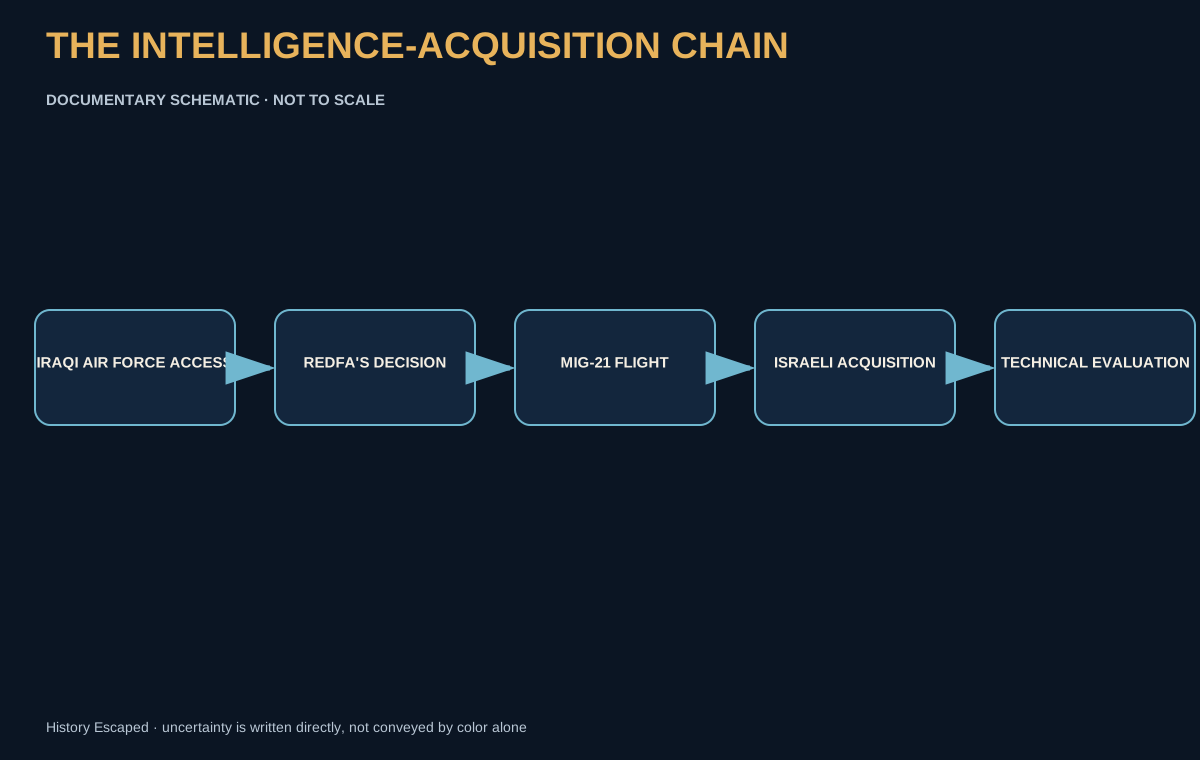
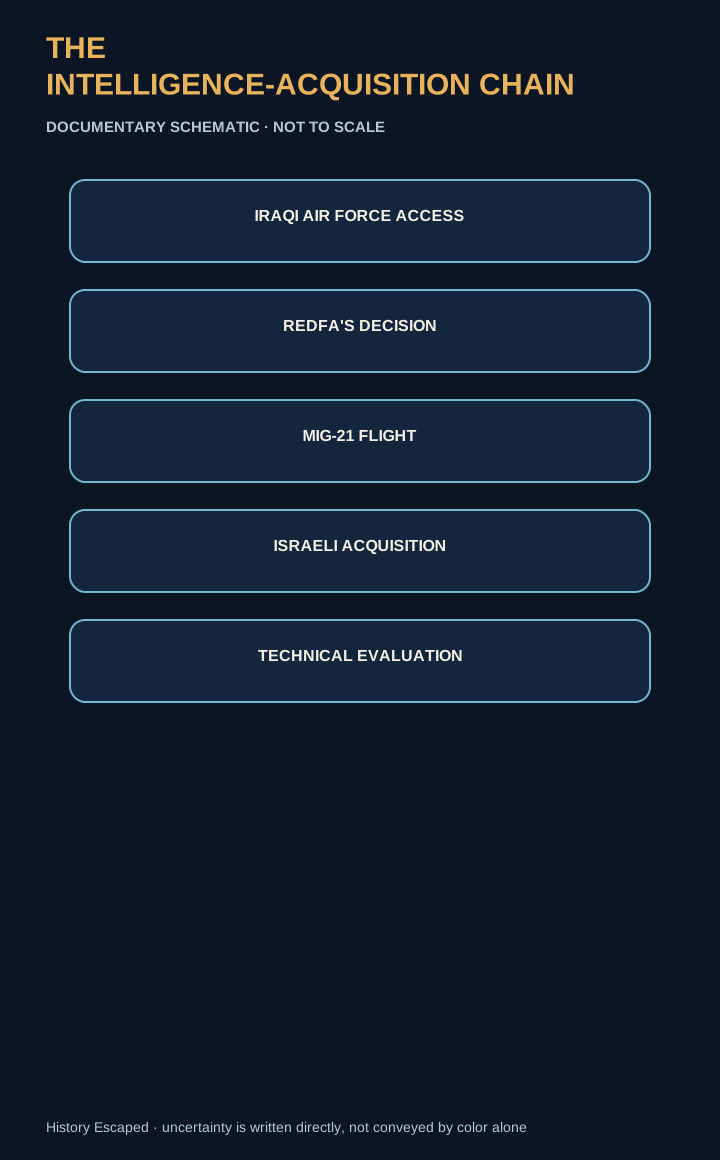
Simplified editorial reconstruction based on the cited historical record; not to scale. Uncertainty is stated directly in the visual and adjacent text.