
The most famous versions of Chamkaur end with a scene made for legend: a tiny Sikh force surrounded by an enormous army, Guru Gobind Singh's two elder sons dead in battle, five survivors ordering their own Guru to preserve himself, a look-alike left behind in the Guru's dress, and the Guru deliberately announcing his departure before vanishing through the enemy lines.
The broad event is historical. The complete dramatic sequence is not equally documented.
A near-contemporary Sikh account, Sainapati's Sri Gur Sobha, confirms the catastrophic fighting at Chamkaur and the Guru's successful escape. Guru Gobind Singh's Zafarnama, the Persian epistle addressed to Aurangzeb after the crisis, remembers a desperately unequal battle and condemns the violation of solemn assurances connected with the evacuation of Anandpur. Modern scholarship likewise accepts that Guru Gobind Singh escaped Chamkaur after the deaths of his two elder sons and continued into the Malwa region.
But the surviving evidence becomes thinner when the story reaches its most cinematic details. Who wore the Guru's clothing? Exactly how many Sikhs remained when the decision was made? Did the Guru clap and proclaim his departure? Which path did he take through the encirclement? Even the year of the battle is not uniform across serious Sikh historical sources.
That makes Chamkaur an unusually revealing escape story: the central event is secure, while the mechanism survives through overlapping layers of contemporary poetry, later Sikh historical tradition, institutional memory, and sacred commemoration.
From Anandpur to Chamkaur
Chamkaur cannot be understood as an isolated jailbreak. It was the next stage of a military and political collapse around Anandpur.
By the final siege of Anandpur, Guru Gobind Singh and the Khalsa faced hostile hill rulers reinforced by Mughal authority. J. S. Grewal's modern scholarly reconstruction emphasizes that prolonged pressure and shortages eventually produced offers of safe passage. The Guru left Anandpur only after intense pressure from those trapped inside, despite his distrust of the assurances being offered.
What followed was not an orderly evacuation. The departing Sikhs were attacked and scattered. Guru Gobind Singh became separated from members of his family and from much of the force that had left Anandpur. By the time he reached Chamkaur, the party around him had been drastically reduced.
The number forty has unusually strong roots for a figure in this story. In the Zafarnama, the Guru refers poetically to forty hungry men facing an overwhelmingly larger enemy. The number should still be handled as the author's own literary description rather than as a modern roll call compiled on the battlefield, but it is far better grounded than the spectacular enemy totals repeated in later retellings.
Chamkaur offered temporary shelter in a fortified house or garhi. Later institutional descriptions portray it as a substantial enclosed residence rather than a massive stone fortress. The modern gurdwaras at Chamkaur commemorate the battlefield, but their present architecture cannot simply be projected backward as a measured plan of the early-eighteenth-century position.
A Defensive Position, Not a Secure Refuge
The defensive advantage of the garhi was temporary.
Sikh institutional tradition describes imperial troops and allied forces surrounding the position and making repeated efforts to break it. The defenders could use the enclosed structure to resist a much larger body of attackers, but their ammunition and manpower were finite. As the battle continued, Sikh fighters went out in small groups to engage the besiegers.
Among those killed were Guru Gobind Singh's two elder sons, Ajit Singh and Jujhar Singh. Their deaths at Chamkaur are among the best-supported facts in the episode. They became central figures in Sikh memory, commemorated as Sahibzadas and martyrs, but their deaths should not be reduced to scenery for the Guru's escape. For Sikh tradition, Chamkaur is as much a site of shaheedi—martyrdom—as it is a story of survival.
Sainapati's Sri Gur Sobha is crucial because it was composed close to the events and by an author associated with the Guru's court. Yet it is not a neutral military report. It is poetic praise, rich in religious interpretation and heroic imagery. The 2014 Institute of Sikh Studies translation itself warns that Sainapati confuses names in the Chamkaur chapter. That combination—proximity plus imperfection—makes the work invaluable but not infallible.
What it securely adds is the broad contour: the Sikh force was badly outnumbered; the Guru's elder sons died; the position was collapsing; and the Guru escaped.

The Decision That the Guru Should Leave
Later Sikh accounts give extraordinary significance to the decision to withdraw.
The standard reconstruction says that when only a handful of Sikhs remained, five surviving Sikhs acted collectively with the authority of the Khalsa and urged—or commanded—Guru Gobind Singh to leave so that he could preserve the community and continue its struggle. The episode is remembered as an expression of a principle already embedded in the Khalsa: authority did not operate only downward from the Guru.
This idea is strongly represented in Sikh tradition and in modern interpretation of Sainapati. The Institute of Sikh Studies introduction to Sri Gur Sobha explicitly reads the Chamkaur episode as a moment in which the collective will of the Khalsa prevented the Guru from remaining for a final fight and instead required him to escape and reorganize.
That is stronger evidence than a modern legend invented from nothing. It is not, however, the same thing as possessing a verbatim transcript of a five-man council inside the garhi. The collective order to leave is therefore well supported, while reconstructed speeches are not.
The practical logic is clear even without dialogue. If Guru Gobind Singh stayed until the position was overrun, his capture or death could have ended his ability to rally surviving Sikhs, correspond with Aurangzeb, and continue political and military action. Leaving was not the end of resistance. It was a means of preserving its leadership.

What Can Be Said About the Escape Itself
The secure sequence is surprisingly simple.
By night, after a day of severe fighting, the besieging forces had failed to seize the garhi but the Sikh defenders were nearly exhausted. Guru Gobind Singh accepted the decision to leave. Under darkness, he moved out of the defensive position while the surrounding force was less coordinated than during the day's assaults. Sikh institutional tradition names Daya Singh, Dharam Singh, and Man Singh as the three men who also escaped from the garhi and later rejoined him.
The near-contemporary Sainapati is terse at the decisive instant. In Kulwant Singh's English translation, the Guru moves "in another direction" and his escape goes unnoticed by the enemy. That is enough to establish stealth, confusion, and successful evasion. It is not enough to draw a precise route through sentry lines.
The next stage was continued evasion rather than immediate safety. Sainapati's following chapter moves the Guru from Chamkaur toward the Malwa region. Later narratives preserve the better-known movement through the Machhiwara area, including assistance from supporters who helped him travel while imperial authorities continued to look for him.
The important outcome is therefore not merely that he got outside the garhi. He escaped the encirclement, avoided immediate recapture, and remained politically and religiously active.
The Decoy Problem: Sangat Singh or Sant Singh?
One of Chamkaur's most memorable traditions says that another Sikh was dressed to resemble Guru Gobind Singh and remained behind, confusing the attackers after the Guru had gone. There is real historical tradition behind this story, but its details do not line up cleanly.
The Encyclopedia of Sikhism tradition identifies Sangat Singh as the man who received the Guru's attire. It says Sangat Singh resembled the Guru and remained with Sant Singh after the others left. A note in the Institute of Sikh Studies translation of Sainapati, however, assigns the proxy role to Sant Singh, saying that he wore the Guru's turban and plume before the escape.
That difference matters. It does not prove that no decoy existed; it proves that the identity and exact mechanics should not be presented as settled documentary fact.
A responsible visual should therefore never show a labeled, certain sequence in which "Sangat Singh puts on the Guru's clothes" as though a camera had recorded it. The decoy belongs in an evidence callout: a strong and meaningful tradition whose precise participant is disputed.
The Clap at Tari Sahib
A second famous detail is even harder to verify.
At Chamkaur today, Gurdwara Tari Sahib preserves a tradition that Guru Gobind Singh and his three companions left in different directions, intending to regroup by using the stars. According to the commemorative account, the Guru clapped and called out to announce that the "Pir of Hind" was leaving, deliberately confusing or challenging the encircling enemy.
This is a powerful element of site memory. It is also absent from the much terser escape description in Sainapati.
The correct classification is therefore later claim, not documented battlefield dialogue. The site tradition deserves to be explained because visitors and readers encounter it, but it should not be silently inserted into the core chronology as certain fact.
1704 or 1705?
The date problem is not a minor footnote.
A widely used chronology places the evacuation of Anandpur around 20 December 1704, the arrival at Chamkaur on 21 December, and the battle and escape around 22 December 1704. This dating appears in modern Sikh educational and interpretive sources and in common presentations of the Zafarnama.
Other major institutional Sikh sources use December 1705. The Encyclopedia of Sikhism, based on the Punjabi University, Patiala reference work edited by Harbans Singh, places the arrival at Chamkaur on 6 December 1705 and the main battle on 7 December. India's Ministry of Tourism likewise commemorates the battle as occurring on 7 December 1705. Modern scholarship on the Zafarnama also situates the post-Anandpur crisis in the opening part of 1705.
Because serious sources disagree, the exact Gregorian year remains disputed between 1704 and 1705. The traditional 1704 dating is common, but it is not uncontested.
Readers searching either date should land on the same definitive page.
The Numbers That Should Not Be Taken Literally
The mismatch between forty Sikhs and a huge opposing force is central to the memory of Chamkaur. The Zafarnama itself uses enormous language for the enemy host.
That does not make "one million Mughal soldiers" a defensible historical headcount.
Persian heroic poetry uses magnitude rhetorically. Louis E. Fenech's scholarship on the Zafarnama emphasizes the work's Persian literary and political context, not its use as a modern field-strength register. The point of the famous numerical contrast is the scale of the disadvantage, not an audited order of battle.
The figure forty remains a strongly rooted self-reported number, while the besieging force is best described simply as overwhelmingly larger. Literal six- or seven-figure enemy totals are not credible census figures.
After Chamkaur
Guru Gobind Singh's survival changed what was possible after the defeat.
He moved onward through Punjab, eventually reaching the Malwa region. The losses were devastating: his elder sons had died at Chamkaur; his two younger sons were later killed at Sirhind; and many followers had been killed or scattered. Yet he remained able to rally Sikhs, fight again, and address Aurangzeb directly.
The Zafarnama became part of that aftermath. Whatever disputes remain around its textual history and authorship, it preserves the tradition of a Persian epistle attributed to Guru Gobind Singh that transforms military disaster into an accusation of broken faith and a claim to moral victory.
Chamkaur therefore should not be written as a simple triumph. Militarily, the Sikh position was overwhelmed and most of its defenders died. Religiously and politically, their sacrifice became foundational memory. Operationally, the Guru's escape denied his opponents the decisive result of capturing or killing him at Chamkaur.
That combination is why the case deserves its own page. The most accurate reconstruction is also the most restrained: Guru Gobind Singh escaped an encircled position after catastrophic losses and under cover of darkness; later Sikh tradition preserves a richer sequence of collective command, proxy disguise, deliberate proclamation, and separated routes, but those details survive with different levels of evidentiary support.
The escape is historical. The legend grew around a real night.
Escape reconstruction
How the escape unfolded
An evidence-aware sequence of the principal stages.
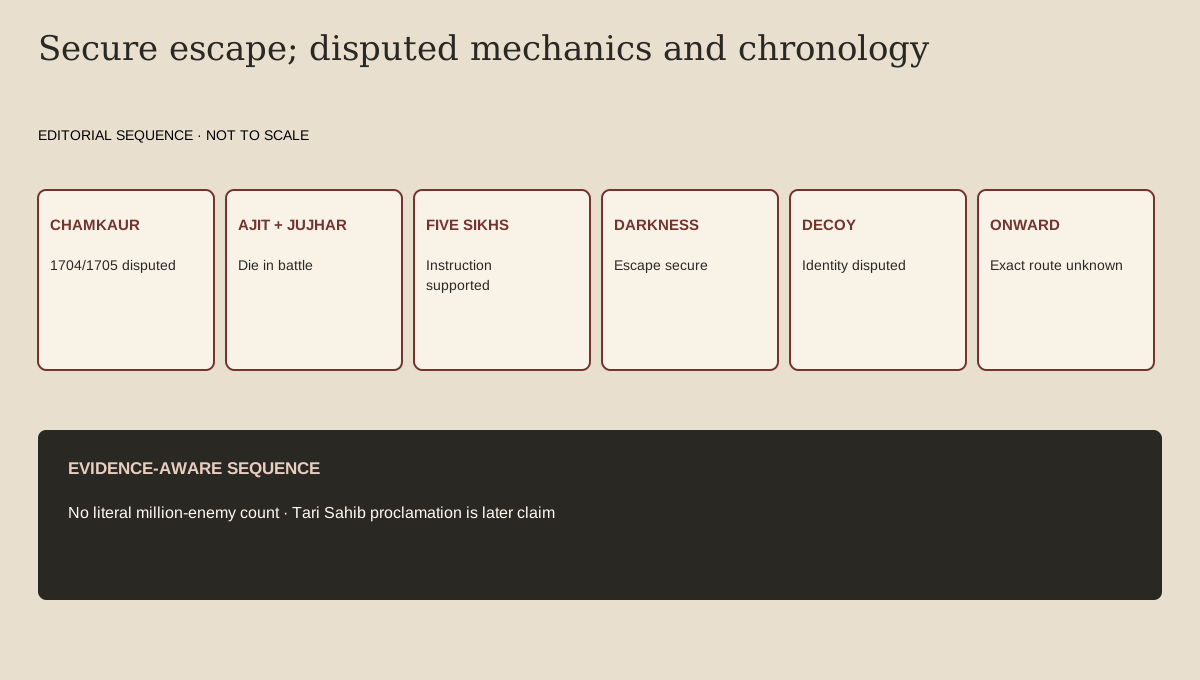
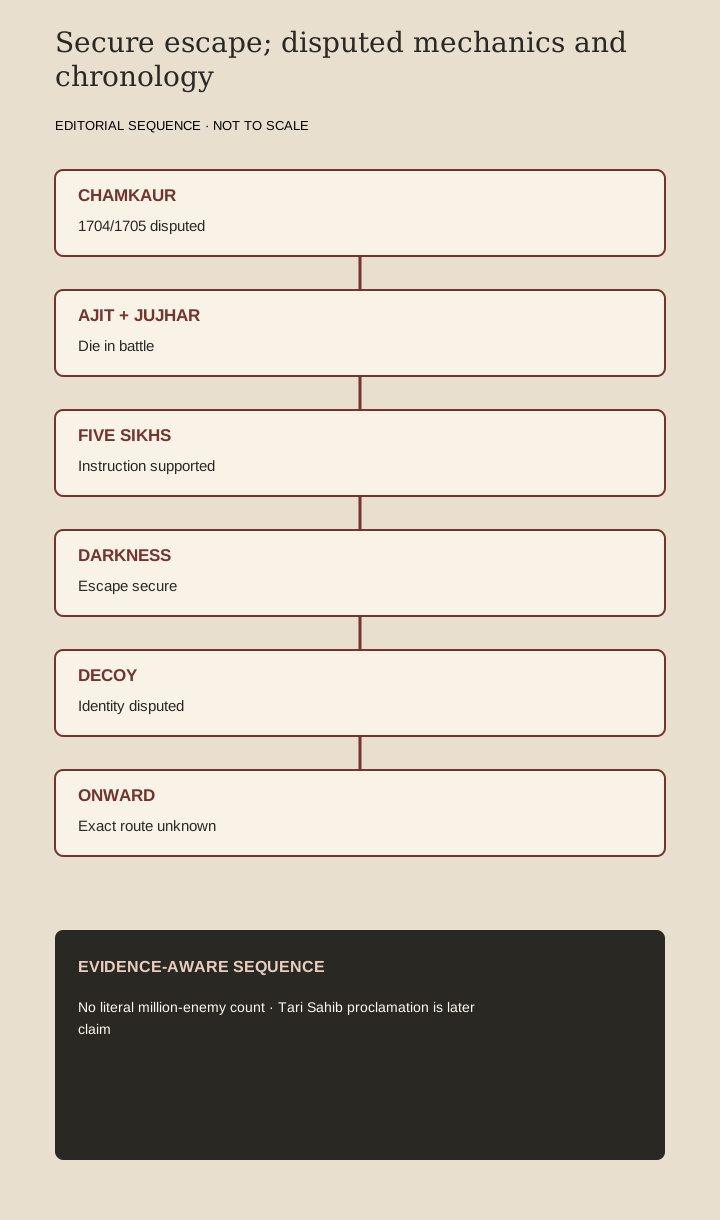
Simplified editorial reconstruction; not to scale. See adjacent text for evidence qualifications and unresolved details.
Evidence discipline
What the record supports
Status labels distinguish secure conclusions from uncertainty and rejected claims. Color is never the only signal.
DOCUMENTED
Guru Gobind Singh escaped from Chamkaur and was not captured there.
The successful departure is supported by the near-contemporary Sri Gur Sobha and by the subsequent documented course of the Guru’s life.
Sources: SRC-001, SRC-002DISPUTED
The Chamkaur battle and escape occurred in 1704.
A major Sikh chronology places the episode in late December 1704, while the Encyclopedia of Sikhism and India’s Ministry of Tourism place it in December 1705. The canonical case identity retains 1704 but the visible date must preserve the dispute.
Sources: SRC-005, SRC-006, SRC-007WELL-SUPPORTED
Roughly forty Sikhs formed the Guru’s reduced Chamkaur force.
The number forty appears in the Zafarnama’s poetic self-presentation and is deeply embedded in later accounts. It should be treated as a strongly rooted figure rather than a modern muster roll.
Sources: SRC-003, SRC-004MYTH
One million enemy soldiers literally attacked forty Sikhs at Chamkaur.
Very large numerical language in the Zafarnama functions rhetorically within Persian heroic poetry. It supports the claim of overwhelming numerical disadvantage, not a literal census of a million troops.
Sources: SRC-003, SRC-004WELL-SUPPORTED
Five surviving Sikhs acting collectively required Guru Gobind Singh to leave Chamkaur.
This is a strong Sikh tradition and accords with modern interpretive discussion of Sri Gur Sobha and the authority of the collective Khalsa. A verbatim battlefield dialogue is not documented.
Sources: SRC-002, SRC-005DISPUTED
A Sikh was dressed in Guru Gobind Singh’s attire to serve as a decoy.
The proxy/disguise tradition is substantial, but the sources disagree on the participant: the Encyclopedia of Sikhism identifies Sangat Singh, while a note in the Institute of Sikh Studies translation identifies Sant Singh. Sainapati’s surviving escape verse itself is much terser.
Sources: SRC-002, SRC-005LATER CLAIM
Guru Gobind Singh clapped and announced his departure from the Tari Sahib site.
This is preserved in commemorative site tradition but is not present in the near-contemporary escape passage used here.
Sources: SRC-005, SRC-002UNKNOWN
The exact route through the encircling forces and the star-guided rendezvous can be reconstructed.
Later tradition supplies a separated-route and rendezvous narrative, but the near-contemporary evidence does not provide enough geometry for a precise route map.
Sources: SRC-002, SRC-005Selected chronology
Selected chronology
Anandpur is evacuated
Guru Gobind Singh leaves Anandpur after prolonged siege pressure and safe-passage assurances. The chronology of the evacuation and subsequent Chamkaur battle is disputed by roughly one year across major sources.
The reduced Sikh party reaches Chamkaur
After attacks and dispersal during the withdrawal, Guru Gobind Singh reaches Chamkaur with his two elder sons and a small remaining force.
Ajit Singh and Jujhar Singh are killed
The two elder Sahibzadas and many Sikh defenders die as the encircled position is gradually depleted.
Guru Gobind Singh escapes the garhi
The Guru leaves the position under darkness and confusion and avoids immediate detection or capture; the precise tactical route is unknown.
Evasion continues toward Machhiwara and Malwa
The escape from the garhi is followed by continued movement, concealment and regrouping rather than immediate safety.
The Zafarnama enters the historical record
A Persian epistle attributed to Guru Gobind Singh rebukes Aurangzeb over broken oaths and frames the recent conflict as a moral rather than merely military contest. Its textual history and authorship have been examined critically by modern scholarship.