Saddam Hussein’s 1966 prison escape has often been told as a compact adventure story: guards escort three Baʿathists to court, the party stops at a Baghdad restaurant, two prisoners slip through a washroom door, and a waiting car carries them away. There is a problem with that neat version. It comes from later biography, and even the biographers who published it warned that Saddam’s underground exploits had become part of a cultivated legend.
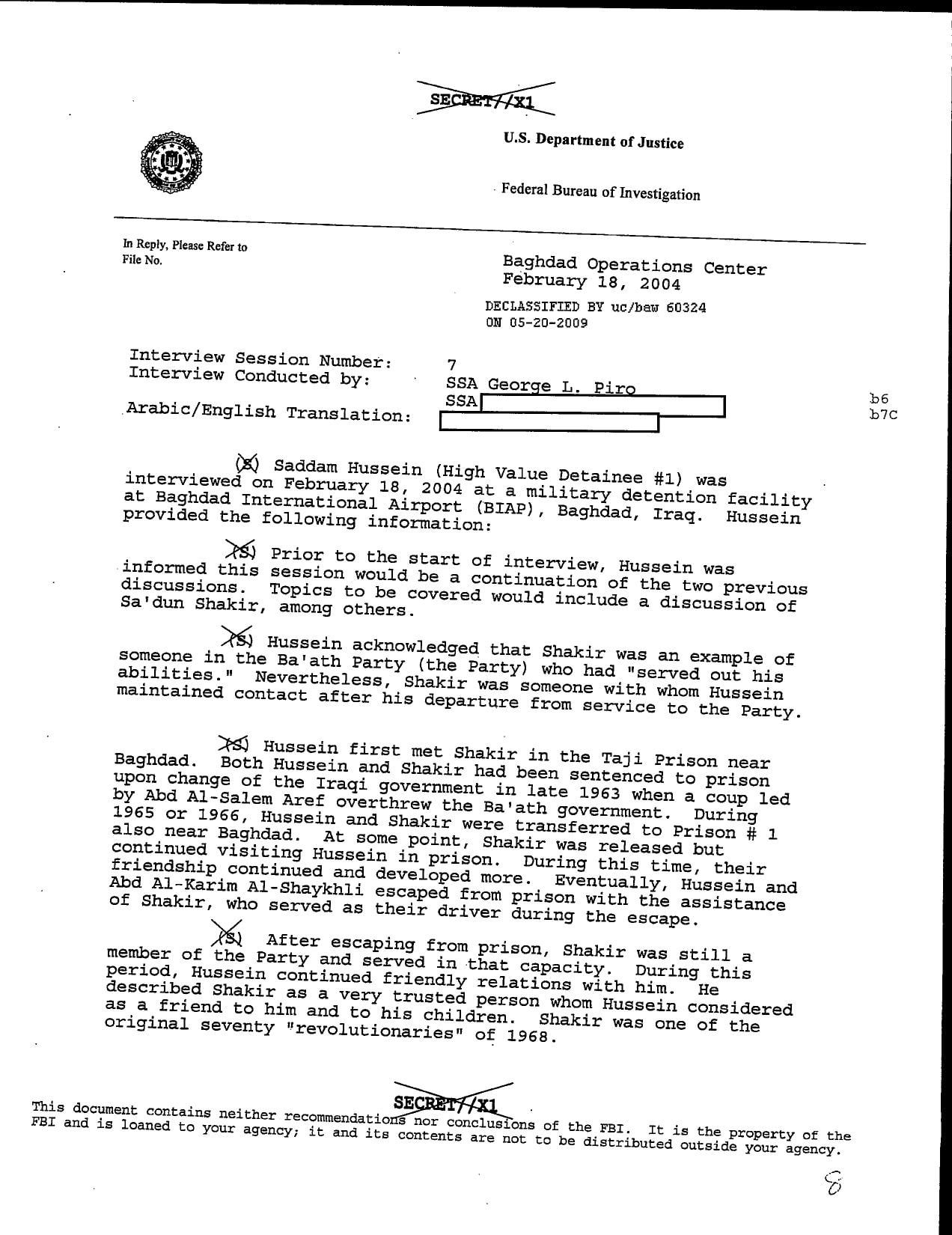
A much later source complicates the story in a different direction. In 2004, while being interrogated by the FBI after his capture by U.S. forces, Saddam discussed the escape himself. He said that he and fellow Baʿathist ʿAbd al-Karim al-Shaykhli escaped together and that Saʿdun Shakir drove the getaway car. In a separate interview, while recalling Shakir, Saddam corrected the language of “fleeing”: according to the FBI report, he said they had an agreement with the guards.
That does not prove every guard was bribed or that the escape was formally authorized. Saddam was recalling an event almost four decades later and had reasons to shape his own political biography. But his statement reinforces something more important than the restaurant anecdote: the escape was assisted.
The best-supported date is July 23, 1966. Saddam had been imprisoned during the anti-Baʿath repression of President ʿAbd al-Salam ʿArif’s government. By the time he escaped, ʿAbd al-Salam was dead and his brother, ʿAbd al-Rahman ʿArif, had succeeded him. Freedom returned Saddam to an underground party that was rebuilding after its disastrous nine months in power in 1963. Less than two years later, the Baʿath would overthrow ʿAbd al-Rahman ʿArif and return to government. The escape matters not because it reveals one ingenious physical trick, but because it returned an ambitious clandestine organizer to political work at a decisive moment in Iraqi history.
At a Glance
- Best-supported escape date: July 23, 1966.
- Regime at the time of escape: President ʿAbd al-Rahman ʿArif, who had succeeded his brother in April 1966.
- Why Saddam was imprisoned: He had been involved in Baʿathist efforts to overthrow President ʿAbd al-Salam ʿArif’s post-1963 government.
- Arrest-date conflict: One scholarly reconstruction gives September 4, 1964; an influential political biography places the arrest in mid-October 1964.
- Prison: Saddam later told FBI interrogators that he was first held at Taji Prison and later transferred to “Prison #1,” also near Baghdad.
- Escaped with: ʿAbd al-Karim al-Shaykhli.
- Outside helper: Saʿdun Shakir, who Saddam said drove the getaway car.
- Guard complicity: Saddam told the FBI in 2004 that there had been an “agreement with the guards.” This is a later first-person claim, not contemporaneous proof.
- Restaurant / washroom escape: A major later biography preserves this detailed sequence, including a third Baʿathist, Hasan al-Amiri, distracting the guards. It is best treated as a later claim rather than an independently documented mechanism.
- Political consequence: Saddam returned to clandestine Baʿath organization during the party’s rebuilding before the July 1968 coups.
From the 1963 Baʿath collapse to underground opposition
Iraq’s Baʿath Party had already experienced power and defeat before Saddam went to prison. The party participated in the February 1963 overthrow of ʿAbd al-Karim Qasim. Its time in government was brief and violent. In November, President ʿAbd al-Salam ʿArif turned against his Baʿathist partners and used the military to remove them from power.
For Iraqi Baʿathists, the loss created an immediate organizational problem. Many members were arrested, purged or forced underground. The party had to rebuild networks while deciding how to challenge an ʿArif government backed by the armed forces.
Saddam, then still a young party activist rather than a national ruler, became involved in that underground effort. Karsh and Rautsi’s political biography gives a detailed account of a 1964 coup conspiracy in which Saddam helped plan alternatives for removing ʿAbd al-Salam ʿArif. One envisioned striking the presidential leadership during a cabinet meeting; another involved attacking the president’s aircraft. The plans failed before execution.
A later U.S. State Department historical study summarizes the episode more cautiously: Saddam returned to Iraq in 1964, took part in a plot against ʿAbd al-Salam ʿArif, and was arrested and imprisoned for roughly two years.
The distinction between the two ʿArif brothers matters. Saddam was arrested under ʿAbd al-Salam ʿArif. He escaped under ʿAbd al-Rahman ʿArif. Describing the episode as taking place “under the Arif regime” is therefore accurate, but treating a single ʿArif presidency as spanning the whole imprisonment would not be.
When was Saddam arrested?
Even the arrest date is not fully stable. Karol Sorby, writing in Asian and African Studies and drawing on Baʿath histories and party records, dates Saddam’s arrest to September 4, 1964. His article also gives the prison escape as July 23, 1966.
Karsh and Rautsi instead place the arrest in mid-October 1964. Their account says security forces surrounded Saddam’s hiding place and that he surrendered after an exchange of gunfire exhausted his ammunition.
Other modern summaries tend to use October without resolving the difference. There is no reason to manufacture certainty where the source traditions diverge. The escape date is considerably firmer than the arrest date. For this case, the strongest structure is that Saddam was arrested in the anti-Baʿath crackdown of autumn 1964, with September 4 the best-supported exact date located in scholarly literature and mid-October retained as a significant competing chronology.
What kind of prisoner was he?
Later dictatorship-era mythology could make almost any episode in Saddam’s youth look harsher, more dramatic and more purposeful than contemporary conditions warranted. Michael Eppel’s study of Iraq between the monarchy and the Baʿath return to power provides an important corrective. He describes the 1964 crackdown as large enough to remove scores of central Baʿath activists, but he also characterizes ʿAbd al-Salam ʿArif’s treatment of Baʿath prisoners as comparatively forgiving.
Party leaders received privileges. Eppel notes that Saddam was permitted to continue his law studies while detained and could leave prison to sit examinations. Other Baʿathists were released before him. Saddam, who had received a longer sentence, remained in custody until his escape.
This was still imprisonment. Saddam was not legally free to leave, and the later FBI record explicitly describes what happened as an escape. But the conditions matter when evaluating the mechanism. The event did not necessarily require defeating a sealed maximum-security institution. Prisoners with educational leave, visitors, party contacts and comparatively permissive routines had opportunities that a more isolated detainee would not have possessed.
Eppel adds another revealing point: after Saddam escaped, the authorities did not appear to make an exceptional effort to return him to prison. That does not mean the escape was staged by the government. It does suggest that the legend of a regime treating Saddam as its most securely guarded enemy can be overstated.
Taji, then “Prison #1”
The most direct surviving first-person account of the prisons comes from Saddam himself, long after the fact. On February 18, 2004, FBI Special Agent George Piro interviewed Saddam in U.S. custody. The discussion turned to Saʿdun Shakir, a longtime associate who later became an important figure in Iraq’s security establishment.
According to the FBI report, Saddam said he first met Shakir in Taji Prison near Baghdad. The report then says that during 1965 or 1966 the two men were transferred to “Prison #1,” also near Baghdad.
Shakir was eventually released but continued visiting Saddam. The same FBI report then gives the core escape relationship plainly: Saddam and ʿAbd al-Karim al-Shaykhli escaped, and Shakir assisted them as the driver.
That is much stronger evidence for the identities of the two escapees and their outside helper than it is for the exact physical route from custody. The FBI summary does not mention a restaurant, a washroom door or Hasan al-Amiri on that page.
It also contains a chronological oddity. Saddam reportedly linked his and Shakir’s imprisonment to the change of government in late 1963, while the stronger historical literature places Saddam’s arrest in 1964. The mismatch is a reminder that the 2004 interrogations are later recollections, not a substitute for contemporaneous arrest records.
Saddam’s own correction: an agreement with the guards
Another FBI interview preserves the most striking line in the evidence. While discussing Shakir, Saddam recalled that his friend had helped him escape. The FBI report records him saying that Shakir was waiting in the car when they fled — then immediately correcting the description and saying that they had an agreement with the guards.
If Saddam’s recollection is accurate, the decisive mechanism was at least partly custodial cooperation, not simply physical evasion. But the source has limitations. Saddam was speaking in 2004. He did not identify the guards in that passage, explain what the agreement involved, state whether money changed hands, or say whether every person escorting the prisoners cooperated. “Agreement” could describe corruption, political sympathy, deliberate laxity or another arrangement.
The correct evidence status is therefore narrower: Saddam later claimed guard cooperation. That claim aligns with the ease implied by some later escape accounts, but it should not be inflated into a fully documented bribery scheme.
The restaurant story
The most famous detailed narrative comes from Efraim Karsh and Inari Rautsi’s Saddam Hussein: A Political Biography. Their account says Saddam planned the escape with two Baʿathist friends, ʿAbd al-Karim al-Shaykhli and Hasan al-Amiri. Guards were supposedly persuaded to stop at a Baghdad restaurant while taking the prisoners to court. Saddam and al-Shaykhli went to a washroom with an exit to the street. Al-Amiri remained with the guards while the other two reached a waiting car driven by Saʿdun Shakir.
It is an excellent story. The authors themselves give the reader a warning. They introduce this portion of Saddam’s underground career as material that became part of the “Saddam legend.”
That does not make the restaurant sequence false. Karsh and Rautsi conducted substantial research and interviews, and several elements of their version match Saddam’s later FBI recollection: al-Shaykhli escaped with him and Shakir drove.
The problem is corroboration. The FBI account strengthens the two-escapee-and-driver core but does not independently establish the court journey, restaurant stop, washroom exit or al-Amiri diversion.
Those details belong in the article because they are historically influential. They should be labeled for what they are: a strong later biographical account, not a verified contemporaneous transcript of the escape.
July 23, 1966
The best-supported exact date is July 23. Sorby’s 2017 study states that Iraqi Baʿathists later identified July 23, 1966 as the date Saddam escaped. His source for that statement includes the Iraqi Baʿath Party’s 1982 central report.
That provenance creates another evidence problem. A Baʿath Party report published while Saddam was already Iraq’s dominant ruler cannot be treated as politically neutral. By then, the regime had every incentive to turn his pre-1968 underground career into a foundational story.
Yet the date fits the wider chronology and is repeated across substantial later literature. No stronger competing exact escape date has emerged from the sources reviewed here. July 23 should therefore be used, with its evidentiary lineage visible in the source registry rather than presented as if drawn from a surviving prison log.
A different ʿArif in the presidential palace
The government Saddam escaped from was not exactly the government that had arrested him. President ʿAbd al-Salam ʿArif died in an aircraft crash in April 1966. His brother, General ʿAbd al-Rahman ʿArif, succeeded him.
This transition came only a few months before the escape. The second ʿArif government was generally weaker. Sorby describes Iraqi political forces increasingly viewing ʿAbd al-Rahman as a leader who allowed events to drift. Baʿathists were still clandestine opponents of the regime, but the political environment was shifting.
Saddam’s escape therefore did not occur at the height of the 1964 crackdown. It came after leadership succession, after some detainees had already been released, and during a period in which the Baʿath was reorganizing itself. That context makes Eppel’s observation that authorities did not mount an extraordinary effort to recapture Saddam more plausible, though it does not prove official acquiescence.
Who escaped?
The secure minimum is two men:
Saddam Hussein and ʿAbd al-Karim al-Shaykhli.
Saddam’s 2004 FBI interview names al-Shaykhli as the man who escaped with him and Shakir as the driver.
Karsh and Rautsi add Hasan al-Amiri to the plan but not to the pair who got away. In their telling, al-Amiri deliberately remained behind to occupy the guards and encourage them to desert.
That distinction matters. Calling the event a three-man prison escape would misstate even the detailed biography. It describes three participants in a plan, but two prisoners leaving custody.
Shakir was an outside helper rather than an escaping prisoner.
Why al-Shaykhli and Shakir mattered
The escape was not simply a story about Saddam acting alone.
ʿAbd al-Karim al-Shaykhli had been associated with Saddam since the underground Baʿath struggle and had also participated in the 1959 attempt against Qasim before exile. His presence in the 1966 escape ties the event to an existing network of conspirators rather than to a spontaneous decision by one prisoner.
Saʿdun Shakir’s later career makes his role equally significant. U.S. intelligence reporting from the 1980s identified him as a longtime member of Saddam’s Tikriti security circle who later held senior intelligence and interior-ministry posts.
The relationships visible in the escape — prison friendship, outside assistance and trusted clandestine networks — prefigure the way Saddam later built political power through overlapping party, family, hometown and security connections.
That does not make the 1966 event a blueprint for his later regime. It does show why the identity of the driver matters more historically than the shape of a restaurant door.
Freedom and party rebuilding
Saddam did not escape into private life.
Sorby writes that Iraqi Baʿathists later remembered his return as strengthening the party while it was dealing with another crisis: the 1966 split in the international Baʿath movement after a radical faction seized power in Syria.
The Iraqi organization increasingly separated itself from the Syrian leadership. Saddam became an important organizer in the rebuilding process.
U.S. State Department historical analysis likewise places him and Ahmad Hasan al-Bakr at the center of the Iraqi party’s reorganization after the 1966 split.
By the autumn of 1966, Saddam had advanced into the Iraqi Regional Command. From there his role in the underground organization continued to expand.
The escape therefore mattered because of what freedom made possible. It returned him to active clandestine politics during the two years immediately preceding the Baʿath’s return to power.
From prison escape to the 1968 coups
On July 17, 1968, the Iraqi Baʿath joined dissatisfied officers in overthrowing ʿAbd al-Rahman ʿArif.
Two weeks later, on July 30, Baʿath leaders eliminated their inconvenient military partners and consolidated control.
Saddam was not yet president. Ahmad Hasan al-Bakr became the head of the new regime. But Saddam rapidly accumulated authority in the party-state and security apparatus, eventually becoming president in 1979.
It is easy in retrospect to transform every episode before 1968 into an inevitable step toward dictatorship. That would give the prison escape too much explanatory power.
In 1966 the Baʿath was still underground, divided and uncertain. Saddam was a significant organizer, but his later supremacy was not predetermined.
The escape changed one variable: he was no longer in custody.
What can actually be reconstructed?
The evidence supports a firm core.
Saddam was imprisoned during the ʿAbd al-Salam ʿArif regime after Baʿathist conspiracy against the government. He was held at Taji and later at another prison near Baghdad according to his own later account. On July 23, 1966, he escaped. ʿAbd al-Karim al-Shaykhli escaped with him. Saʿdun Shakir assisted and drove the getaway car.
Beyond that core, certainty falls away.
Saddam later said there was an agreement with guards. Karsh and Rautsi give the restaurant, washroom, waiting car and al-Amiri distraction. These two traditions overlap enough to suggest an assisted and comparatively low-force escape, but they are not identical and neither is a contemporaneous prison report.
No responsible reconstruction needs to choose a cinematic route and pretend the evidence is better than it is.
That source problem is itself part of the history. Saddam later presided over a political system that cultivated his biography, while opponents and foreign writers also had reasons to turn his life into parable. The 1966 escape sat directly inside that mythmaking terrain.
An escape more important for its aftermath than its mechanics
Measured purely as a prison break, the event is surprisingly spare.
There is no securely documented tunnel, no large manhunt, no body count and no detailed surviving operational file in the source base reviewed here. Even the most colorful sequence comes from later biography.
Measured politically, the escape is much larger.
It links the defeated Baʿath of 1963 to the organization that seized power in 1968. It illuminates the networks around Saddam before he held state office. It shows the relatively permissive and uneven repression of the ʿArif period. And it exposes how a later authoritarian ruler’s youthful history could harden into legend.
The most revealing detail may therefore be the one Saddam added decades later when speaking to the FBI.
He began by saying they fled. Then he said they had an agreement.
Evidence discipline
What the record supports
Status labels distinguish secure conclusions from uncertainty and rejected claims. Color is never the only signal.
WELL-SUPPORTED
Saddam Hussein escaped prison on July 23, 1966.
Sorby gives July 23 using Iraqi Baʿath party records; the year and general chronology are independently consistent across major scholarly and government histories.
Sources: SRC-004, SRC-006, SRC-007DISPUTED
Saddam was arrested on September 4, 1964.
Sorby gives September 4, while Karsh and Rautsi place the arrest in mid-October. No contemporaneous arrest record was located to resolve the conflict.
Sources: SRC-004, SRC-002DOCUMENTED
Saddam and Abd al-Karim al-Shaykhli escaped together.
The FBI’s 2004 interview summary records Saddam identifying al-Shaykhli as the fellow escapee; the later political biography independently gives the same pair.
Sources: SRC-001, SRC-002DOCUMENTED
Saʿdun Shakir drove the getaway car.
Saddam explicitly identified Shakir as the driver in the FBI interrogation, and Karsh and Rautsi’s independent biographical narrative also places Shakir behind the wheel.
Sources: SRC-001, SRC-002, SRC-005LATER CLAIM
The escape was enabled by an agreement with guards.
Saddam told FBI interrogators in 2004 that there had been an agreement with guards, but the statement is a retrospective first-person claim without contemporaneous documentation in the reviewed sources.
Sources: SRC-005LATER CLAIM
The prisoners escaped from a Baghdad restaurant through a washroom door during transport to court.
Karsh and Rautsi provide this detailed sequence while explicitly noting that Saddam’s underground exploits became legendary. The FBI account confirms the escape pair and driver but not this physical sequence.
Sources: SRC-002, SRC-001MYTH
Hasan al-Amiri escaped with Saddam and al-Shaykhli.
The detailed biography describes al-Amiri as part of the plan but says he remained behind with the guards while Saddam and al-Shaykhli left.
Sources: SRC-002MYTH
Saddam escaped from the same Arif president who had ordered his arrest.
He was arrested under Abd al-Salam Arif but escaped after Abd al-Salam’s death, under the presidency of his brother Abd al-Rahman Arif.
Sources: SRC-004, SRC-008Evidence diagram
The secure core and the later escape narratives
The two escapees and driver are secure; guard cooperation and the restaurant account remain retrospective claims.
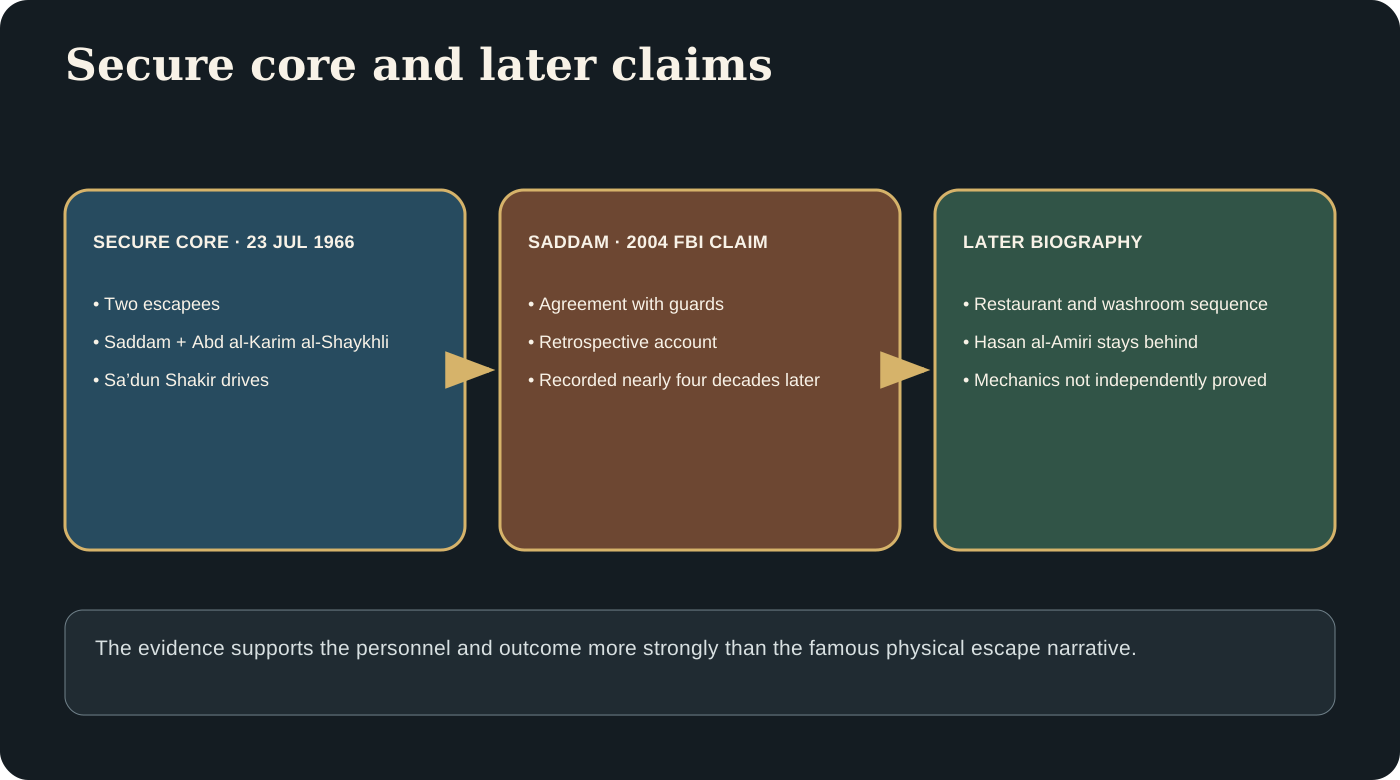
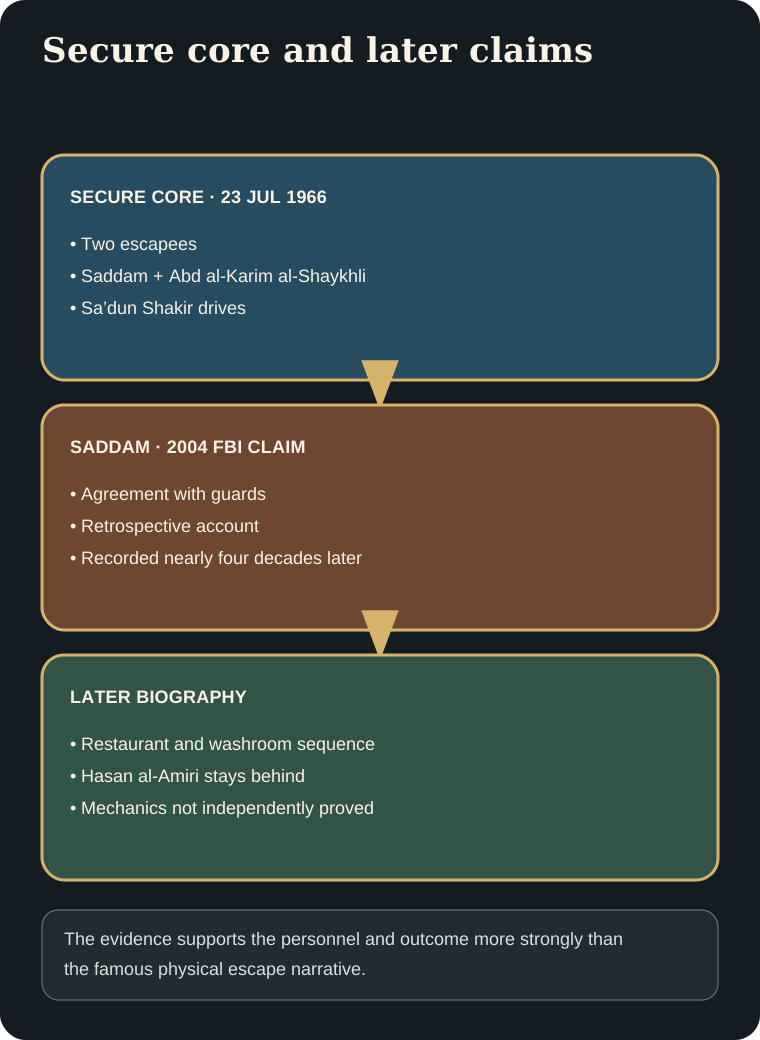
The two escapees and driver are secure; guard cooperation and the restaurant account remain retrospective claims.