
On 14 May 1901, Józef Piłsudski left a psychiatric hospital in St. Petersburg wearing ordinary civilian clothes supplied by a doctor who had taken a job there partly to help him escape.
The walkout was the final stage of a plan that had begun inside the Warsaw Citadel months earlier.
Piłsudski had not been transferred to the hospital because his captors suddenly became lenient. He and his allies in the Polish Socialist Party had worked to make the transfer happen. Their problem was simple: the Citadel was too secure for a conventional breakout. The solution was to change the place of confinement.
At a Glance
- Escape date: 14 May 1901
- Russian-calendar date: 1 May 1901 Old Style
- Escapee: Józef Piłsudski
- Political affiliation: Polish Socialist Party (PPS)
- Original confinement: X Pavilion, Warsaw Citadel
- Escape site: St. Nicholas the Wonderworker psychiatric hospital, St. Petersburg
- Primary deception: Simulated mental illness to obtain medical transfer
- Inside helper: Dr. Władysław Mazurkiewicz
- Outside organizer: Aleksander Sulkiewicz
- Outcome: Piłsudski escaped St. Petersburg and reached Austrian Galicia in June 1901
- Major uncertainty: Exact gate choreography and the precise ordering of the post-escape route
The Łódź Arrest
By 1900 Piłsudski was already one of the leading activists of the Polish Socialist Party. Using the underground name “Wiktor,” he edited and helped print Robotnik, the PPS newspaper that combined socialist politics with a demand for an independent Poland.
He and his wife Maria lived under assumed identities in Łódź. Their apartment at Wschodnia 19 contained the clandestine press.
Tsarist police raided the apartment on 22 February 1900. The arrest was a serious blow to the PPS because Piłsudski was a member of the party leadership and one of the people responsible for keeping its most important publication alive.
After an initial period of detention, he was transferred to the X Pavilion of the Warsaw Citadel in April 1900. That changed the problem facing the party: a direct rescue from the Citadel was extremely difficult.
Selected chronology
Selected chronology
Arrest in Łódź
Tsarist police raid the Piłsudskis’ clandestine PPS printing operation and arrest Józef and Maria.
Piłsudski enters the X Pavilion
He is confined in the Warsaw Citadel as the investigation into PPS underground activity continues.
Transfer to St. Petersburg
After months of simulated psychiatric symptoms and medical evaluation, authorities transfer him to St. Nicholas Hospital.
Mazurkiewicz takes a hospital post
The PPS succeeds in placing Władysław Mazurkiewicz inside the institution as preparations for escape mature.
Hospital escape
Mazurkiewicz brings Piłsudski into his office, supplies civilian clothing and escorts him out of the hospital.
Flight from St. Petersburg
PPS activists move Piłsudski away from the imperial capital through a clandestine network.
Arrival in Austrian Galicia
Piłsudski crosses the green border into the Austrian partition and resumes political work.
Creating a Medical Exit
The plan that emerged depended on deception rather than force.
The Józef Piłsudski Museum states that party colleagues sent him instructions on how to simulate mental illness. Over the following months, he began behaving in ways intended to convince doctors that he required psychiatric observation.
Detailed later reconstructions describe selective refusal of food, fears of poisoning, complaints about electricity and hostility toward men in uniform. Some of those details can be traced to prison correspondence and later recollections, but the larger strategy is much more secure than any single symptom.
Russian physicians examined him repeatedly. One doctor frequently associated with the episode is psychiatrist Ivan Shabashnikov. Later Polish accounts suggest that Shabashnikov may have understood that Piłsudski was malingering and nevertheless supported transfer, but that possibility belongs to the story’s later tradition rather than its most firmly documented layer.
On 15 December 1900, Piłsudski was moved from the Warsaw Citadel to the St. Nicholas the Wonderworker psychiatric hospital in St. Petersburg.
The deception had changed the security environment.
A Hospital Instead of a Fortress
The move did not make Piłsudski free. He remained a political prisoner under guard and psychiatric observation, and the state still expected to keep him under control while determining whether his illness was genuine.
But a hospital operated differently from a fortress prison. Doctors moved between wards and offices, staff had professional reasons to summon patients, and medical routines created opportunities that a prison cell did not.
The PPS recognized the opening immediately.
Aleksander Sulkiewicz, a veteran party organizer, took responsibility for arranging the escape from outside. The key inside role went to Władysław Mazurkiewicz, a young Polish physician and PPS activist.
Mazurkiewicz did not simply happen to be employed at St. Nicholas. Polish institutional sources agree that his placement there was part of the escape plan. Family and professional connections helped him obtain a position, allowing the organization to place its own man inside the institution holding Piłsudski.
The Date: May 14, Not May 15
Even the date of the escape accumulated contradictions.
The strongest modern sources give 14 May 1901. Polski Petersburg states the date in both calendars: 1/14 May 1901. Russia still used the Julian calendar, which was thirteen days behind the Gregorian calendar used in much of Europe.
A general Dzieje.pl biography gives 15 May, while Wacław Sieroszewski’s early biography gives 13 May. The more precise institutional chronology from the Piłsudski Museum, X Pavilion materials, Dzieje’s detailed reconstruction and Polski Petersburg converges on 14 May Gregorian.
The evidence therefore favors 14 May 1901.
Mazurkiewicz Makes His Move
On the escape day, Mazurkiewicz arranged for Piłsudski to be brought to his office. There, Piłsudski changed out of hospital clothing and into civilian dress.
That core mechanism appears across institutional and early biographical sources. The disguise was not an elaborate theatrical costume. Its purpose was to stop him looking like a patient or prisoner being moved under guard.
Mazurkiewicz then left the hospital with him.
Later accounts make the scene more cinematic. Some say they tried one exit and changed to another after encountering an unexpected guard. Some describe Mazurkiewicz addressing the disguised Piłsudski as though he were an important visitor. Others emphasize that clothing had been brought into the hospital in advance.
These details are plausible and recur in serious retellings, but they are not all equally supported by contemporaneous documentation. The important fact is simpler: a doctor employed inside the institution used legitimate access to bring Piłsudski into a private space, change his appearance, and escort him out.
No wall had to be climbed.

Documentary reconstruction
The deception and transfer chain
A case-local visual focused on the spatial, mechanical or evidentiary relationship established by the surviving record.
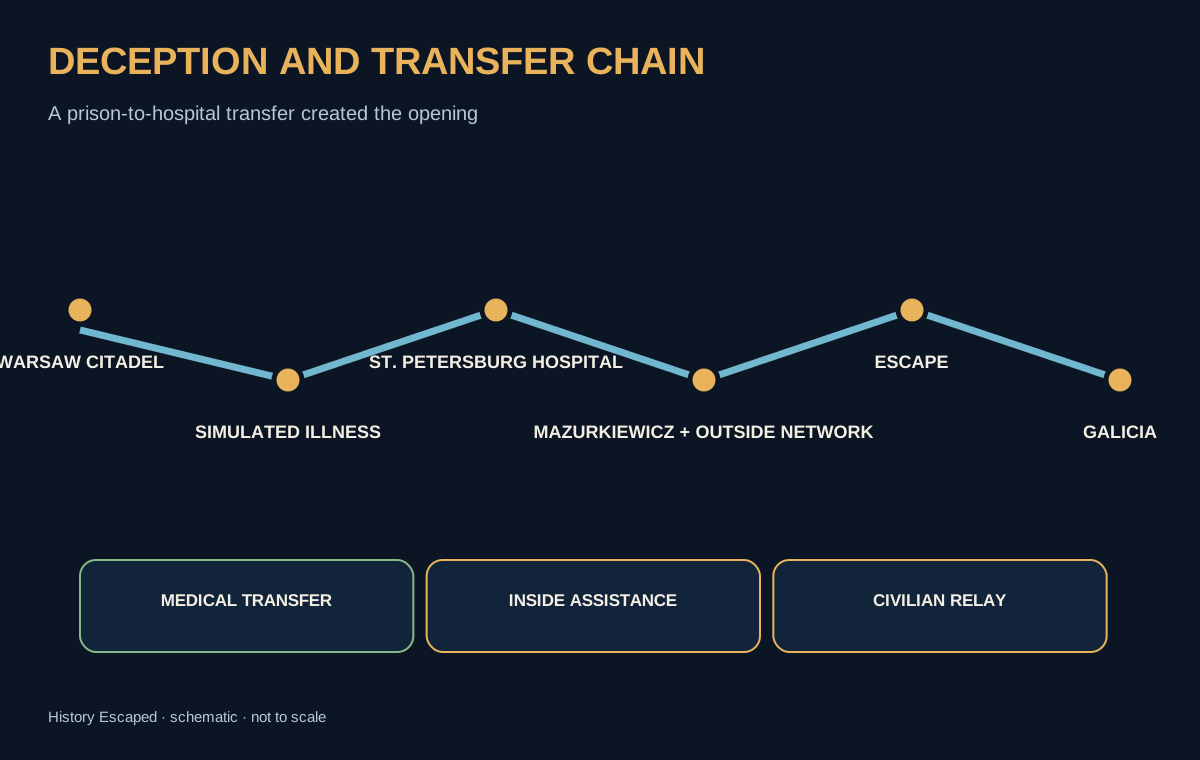
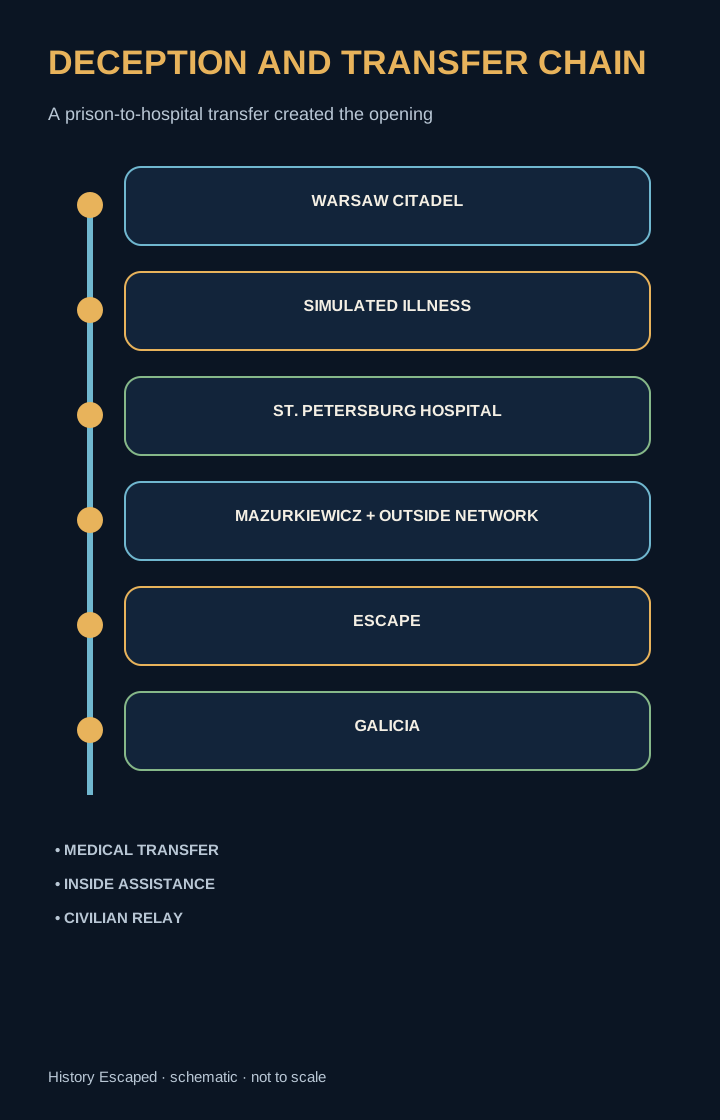
Simplified editorial reconstruction based on the cited historical record; not to scale. Uncertainty is stated directly in the visual and adjacent text.
Beyond the Hospital
Getting through the hospital exit did not end the danger.
Accounts agree that Piłsudski and Mazurkiewicz reached a conspiratorial safe location in St. Petersburg. Some later sources describe changing cabs to make surveillance more difficult.
PPS members then moved Piłsudski out of the imperial capital.
The exact route after St. Petersburg is less tidy than many biographies suggest. Sieroszewski’s early account places Reval, Riga, Kyiv and Polesie in one sequence. A later Dzieje reconstruction gives Tallinn and Riga followed by Polesie, then Kyiv before the crossing into Galicia.
Both versions agree on the broader outcome: Piłsudski was moved through the underground PPS network, reunited with his wife Maria, and eventually crossed out of the Russian Empire’s Polish territories into Austrian-controlled Galicia. The Józef Piłsudski Museum securely places that border crossing in June 1901.
The People Behind the Escape
The later Piłsudski legend often centers everything on his ability to deceive Russian doctors. That understates the organization behind him.
Aleksander Sulkiewicz coordinated the operation. Władysław Mazurkiewicz accepted the dangerous inside role, obtained a hospital post, and personally escorted Piłsudski out.
Other Petersburg PPS activists also appear in specialist accounts. Polski Petersburg associates Mieczysław Michałowicz and Jerzy Iwanowski with the broader escape effort.
Even hospital director Otton Czeczott occupies an ambiguous place in the story. Polski Petersburg states that he knew about the operation and resigned on the day of the escape. That is important evidence, but it is not enough to rewrite the escape as a formally tolerated release. Mazurkiewicz and the PPS engineered the operation; Czeczott’s precise degree of complicity remains less certain.
Evidence discipline
What the record supports
Status labels distinguish secure conclusions from uncertainty and rejected claims. Color is never the only signal.
MYTH
Piłsudski escaped directly from the Warsaw Citadel.
The psychiatric deception was designed to secure transfer from the Citadel to a less secure medical setting. The physical escape occurred from St. Nicholas Hospital in St. Petersburg.
Sources: SRC-001, SRC-002DOCUMENTED
Piłsudski deliberately simulated mental illness to obtain a transfer.
The Piłsudski Museum, X Pavilion museum and IPN all identify deliberate simulation as the strategy used before the hospital transfer.
Sources: SRC-001, SRC-002, SRC-007DOCUMENTED
The escape took place on 14 May 1901 Gregorian, corresponding to 1 May in the Russian calendar.
The Piłsudski Museum and detailed institutional sources give 14 May; Polski Petersburg explicitly records the dual date as 1/14 May 1901.
Sources: SRC-001, SRC-003, SRC-004MYTH
Władysław Mazurkiewicz happened to be working at the hospital and improvised the escape.
Institutional and early biographical accounts agree that PPS organizers arranged his hospital employment as part of the escape plan.
Sources: SRC-003, SRC-004, SRC-006UNKNOWN
The exact hospital exit, guard exchange and carriage sequence are fully documented.
The disguise and escorted departure are well supported, but later accounts differ in the exact door used and add varying guard, porter and cab details.
Sources: SRC-003, SRC-006DISPUTED
Hospital director Otton Czeczott knowingly permitted the escape.
Polski Petersburg states that the escape occurred with Czeczott’s knowledge and that he resigned on the same day, but this production pass did not locate independent primary corroboration sufficient to treat formal complicity as documented.
Sources: SRC-004DISPUTED
The route from St. Petersburg to Galicia can be reconstructed in one uncontested order.
Later accounts vary in the ordering of Reval/Tallinn, Riga, Kyiv and Polesie. The secure point is that Piłsudski left St. Petersburg and reached Austrian Galicia in June.
Sources: SRC-003, SRC-006MYTH
15 May 1901 is the secure escape date.
A general biographical page gives 15 May, but more precise museum and specialist sources converge on 14 May Gregorian / 1 May Julian.
Sources: SRC-001, SRC-004, SRC-009Why the Deception Worked
The escape succeeded because the PPS attacked the security system indirectly.
A conventional prison break would have had to defeat walls, guards and controlled movement inside the Citadel. The psychiatric strategy instead persuaded the authorities to transfer the prisoner into an institution with different routines.
That transfer created new vulnerabilities. Doctors could see Piłsudski in spaces separated from ordinary guards; medical personnel could move through the hospital with less suspicion than political visitors; and the PPS could place a qualified sympathizer inside the institution without openly attacking it.
The apparent mental illness was therefore not the escape itself. It was the mechanism that changed the battlefield.
What Happened Afterward
Piłsudski’s successful escape strengthened his standing inside the PPS.
In Galicia he resumed writing and party work. The region became the main base from which his political strategy increasingly shifted toward armed struggle against the Russian Empire.
That later career should not overwhelm the 1901 event. Piłsudski would eventually become head of state, military leader and one of the most powerful figures in modern Polish history, but the man who left the St. Petersburg hospital was still a socialist underground organizer escaping imperial custody.
The operation that freed him depended on deception, medical bureaucracy and party discipline.
The PPS could not break him out of the fortress. So it persuaded the state to move him somewhere they could.
What He Was Escaping From
The escape is sometimes described as though Piłsudski faced imprisonment simply for possessing an illegal newspaper. His position was more serious.
The Łódź raid exposed one of the PPS’s most important clandestine operations. The Russian authorities had seized the printing equipment, arrested both Piłsudskis and opened a wider political investigation. Detailed Polish historical accounts say the accusations against Józef expanded beyond illegal printing and distribution to include alleged links with violence against police informers. The evidence for those additional accusations was contested, but the possibility of a long sentence or renewed exile was real.
Piłsudski had already spent five years in Siberian exile after his earlier arrest in 1887. He therefore knew what prolonged imperial punishment could mean.
That background helps explain why the PPS invested so much effort in a complicated medical deception. The goal was not merely to spare a party editor a few months in jail. Piłsudski was a senior underground organizer whose imprisonment threatened both the party’s leadership and its communication network.
It also explains why the escape plan had to begin before any final trial outcome. Waiting for conviction would have reduced the options. By persuading the authorities to move him for psychiatric observation, the PPS created an opportunity while the case was still unresolved.