
A prison hospital was supposed to solve one problem for the Russian authorities: Peter Kropotkin was becoming too ill to remain under the conditions in which he had been confined. Instead, the transfer created the opening that his friends needed.
On 30 June 1876 by the Russian calendar then in use—12 July on the Gregorian calendar—Kropotkin stepped into the exercise yard of the prisoner section of St. Petersburg’s Nikolayevsky Military Hospital. Outside, a network of accomplices watched the surrounding streets. A violin served as the final audible cue. When the moment came, Kropotkin threw off his hospital gown, sprinted for an open gate, reached a waiting carriage, and disappeared into the city before the authorities could organize an effective pursuit.
The episode is often compressed into a romantic story about an anarchist prince escaping the Peter and Paul Fortress. That is the first thing to correct. Kropotkin had indeed been imprisoned in the fortress, but he did not escape from it. By the time of the breakout he had been moved through the House of Detention and then into the military hospital’s prisoner ward. The hospital yard—not the fortress—was the point of escape.
From Geographer to Political Prisoner
Kropotkin was already more than a political activist when the imperial authorities arrested him in 1874. Born into the Russian aristocracy and trained in the Corps of Pages, he had served in Siberia and developed a serious reputation in geography. His scientific work included research on the physical geography and glaciation of northern Eurasia. At the same time, he became involved with the revolutionary milieu around the Chaikovsky Circle, which sought to spread socialist ideas among workers and other audiences.
After his arrest, Kropotkin was held for a long period without the kind of public trial that might have brought his case to a quick conclusion. He spent part of that confinement in the Peter and Paul Fortress. His health deteriorated badly. In his later memoir, he described severe digestive illness and rapid physical decline. The authorities eventually moved him to the House of Detention and, after further medical concern, to the prisoner section of the Nikolayevsky Military Hospital.
That transfer changed the physical problem of escape.
Inside the hospital ward Kropotkin was still closely watched. But the institution had a different routine from a fortress cell. He was eventually permitted an hour of outdoor exercise in the afternoon. The yard was enclosed, but its gate had to function as part of a working hospital complex, with carts and people moving through the surrounding space. An escape no longer required breaking through masonry. It required reaching the gate faster than a nearby guard could stop him.
The Opening in the Hospital Routine
Kropotkin later recalled that the first important suggestion came from a guard who indicated that he should ask to be allowed outside for a walk. Once the daily exercise began, Kropotkin could study the yard, the sentry’s movements, the gate, and the traffic beyond it.
His plan was simple in outline and difficult in execution. Friends outside would place a fast carriage near the exit. Other participants would watch the streets and report whether the route was clear. Kropotkin would wait for a signal during his exercise period, discard the loose hospital garment that could slow him, run through the gate, and enter the carriage before the sentry could catch him.
The scheme depended on timing rather than concealment. The guard did not need to miss Kropotkin for minutes. He needed to be facing the wrong way for only long enough to give the prisoner a head start.
Kropotkin’s later recollection says the preparation involved more than twenty people. That exact number is difficult to verify independently, and it should be treated as his retrospective estimate rather than a settled roster. What is much better supported is that the plan was distributed among multiple helpers. Participant Maria Leshern-von-Hertzfeld later described the purchase of a fast black horse named Varvar, the use of an apartment overlooking the hospital area, and the coordination of outside signals. Doctor Orest Eduardovich Weimar became one of the central organizers and was in the getaway carriage.
Another participant, Sofia Lavrova, appears not only in revolutionary recollection but in an archive-based account of the official investigation. Investigators concluded that she had helped pass covert communications, including a tiny message concealed in a watch. This matters because it shows that the escape was not simply a story Kropotkin polished years later. Important parts of the communication network left traces in the police record.
Material evidence
Tools of Escape
The objects used in an escape reveal how a plan worked under constraint.
- 01Covert confirmation
Coded message concealed in a watch
A small written communication was passed to Kropotkin inside a watch, allowing the outside group to confirm arrangements despite prison controls.
- 02Final timing cue
Violin signal
Music from a nearby rented location gave Kropotkin an audible indication linked to whether the outside route was clear.
- 03Immediate mobility
Getaway carriage and the horse Varvar
The outside group acquired a fast black horse and carriage so that Kropotkin could convert a short lead over the sentry into rapid separation from the hospital.
- 04Post-escape concealment
Disguise and false documents
After leaving the hospital, Kropotkin altered his appearance and later used false identity documents while traveling out of the empire.

The Balloon That Failed
The first scheduled attempt was set for 29 June by the Old Style calendar, the eve of the successful escape.
The conspirators intended to use a small red balloon as a visual signal. According to both Kropotkin and Leshern’s later recollection, the plan failed for an almost absurdly ordinary reason: the balloon would not rise properly. There was too little useful wind, and the signal never reached Kropotkin as intended.
The failed signal probably saved the operation.
Kropotkin later wrote that carts were occupying part of the intended getaway line that day. If he had run when originally planned, the carriage might have been blocked. The conspirators therefore shifted to a more flexible system in which people positioned along the route could indicate whether the street was clear.
The red balloon belongs to the escape story, but not in the way some abbreviated retellings imply. It was associated with the failed attempt, not the decisive signal on the successful day.
Escape sequence
Signal, gate, carriage, dispersal
The escape depended on timing and an outside network—not a breakout from Peter and Paul Fortress.
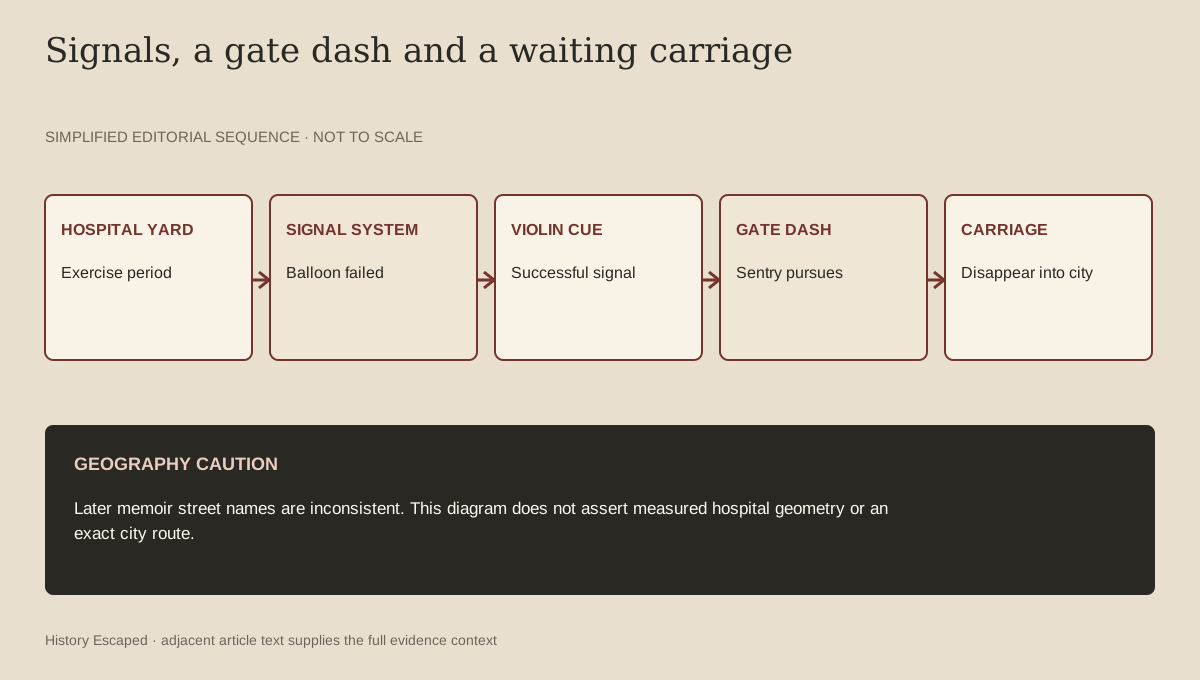
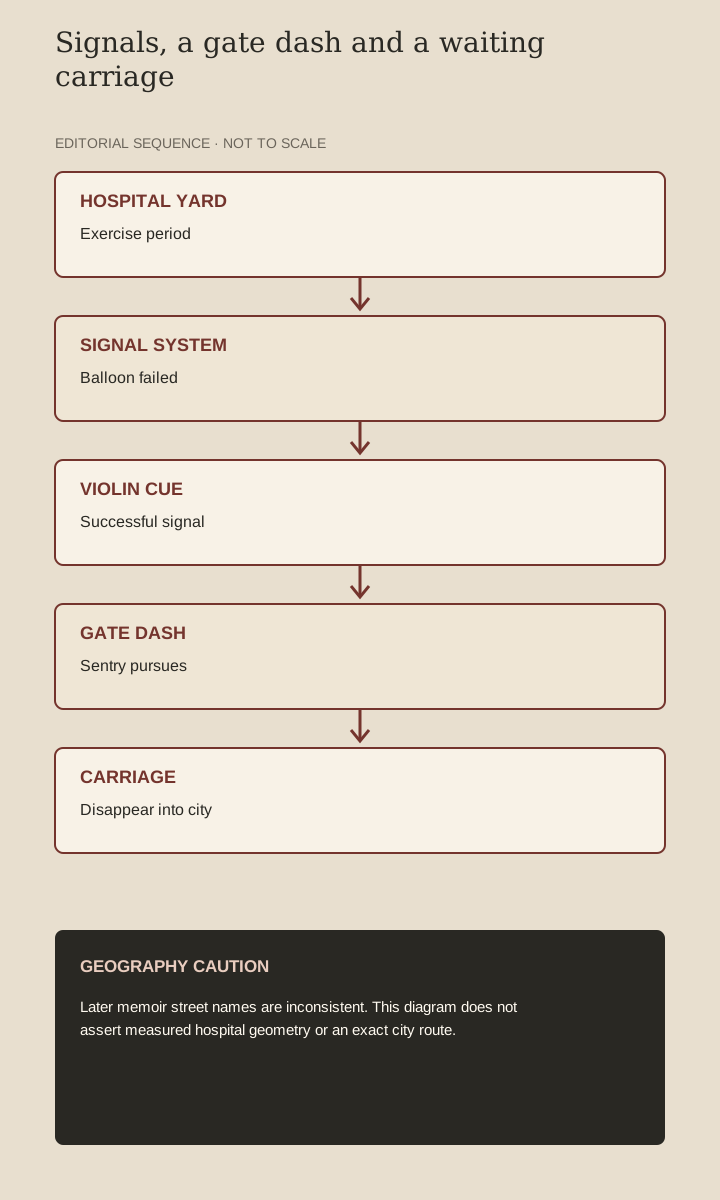
Simplified editorial sequence; not to scale. Later memoir street names are inconsistent, so the graphic avoids a measured street map.
A Watch, a Violin, and a Clear Street
For the next attempt, the outside network needed to tell Kropotkin two things: that the plan was still active and that the route was clear at the exact moment he was walking in the yard.
The conspirators had access to a nearby rented apartment or house from which sound could carry toward the hospital grounds. A violinist was positioned there. Kropotkin’s account describes the music as a cue whose continuation or interruption reflected conditions outside. Other participants were stationed farther along the route to observe traffic and pass information back.
Before the attempt, Kropotkin received a tiny coded communication hidden in a watch. The message confirmed the plan. Then, during the afternoon exercise period, the violin became the signal he could actually hear from inside the yard.
The music began. At one point it stopped because the route was not clear. Later it resumed.
Kropotkin waited until the sentry’s attention shifted, discarded the loose green hospital gown, and ran.
The guard noticed quickly. Kropotkin’s memoir says peasants nearby shouted as the prisoner broke away and the sentry chased him carrying his rifle and bayonet. The guard did not fire before Kropotkin reached the carriage.
That carriage was not an incidental convenience. Leshern’s memoir emphasizes the effort spent acquiring a fast horse for the operation. Orest Weimar was inside the vehicle. Once Kropotkin climbed in, the horse accelerated away hard enough that the carriage nearly overturned at a turn—one of the details independently present in the accounts of both Kropotkin and a participant in the conspiracy.
At the hospital gate and along the route, other helpers had jobs that looked deliberately unremarkable. Kropotkin remembered one man engaging a soldier in conversation about a microscope while the escape unfolded nearby. Another participant posed casually along the road while relaying whether the way was clear.
The successful mechanism was therefore not one clever object. It was a chain: observation, coded communication, an audible cue, a momentary gap in guard attention, a short sprint, and immediate transportation.
Disappearing Into St. Petersburg
Getting through the gate did not guarantee freedom. Kropotkin was an identifiable aristocrat and political prisoner in the imperial capital, and the police could begin searching apartments, railway stations, roads, and known associates as soon as the alarm spread.
The conspirators therefore treated the first minutes after the carriage ride as a second phase of the escape.
Leshern later remembered Kropotkin being taken to an apartment associated with the Kornilov family, where his appearance could be altered, and then to Weimar’s dacha. Kropotkin’s own memoir also describes changing his appearance and moving through the city, and famously recalls dining at the fashionable Donon restaurant because it seemed an unlikely place for police to look for a newly escaped prisoner.
These recollections are not identical in the sequence of locations they emphasize. They do agree on the important point: the organizers did not leave Kropotkin in one obvious revolutionary safe house. He changed his appearance, shifted locations, and used the size and social variety of St. Petersburg as temporary cover while police searches began.
His memoir also claims that friends deliberately hired large numbers of available cabs to make official pursuit more difficult. That detail is vivid but rests primarily on his later account and should not be treated as essential to explaining why the escape succeeded.
The Flight Out of Russia
Kropotkin could not remain safely in the capital. In his later account, he described leaving with false documents and taking an indirect route through Finland rather than simply racing for the nearest border crossing.
He eventually reached a remote port on the Gulf of Bothnia, crossed to Sweden, traveled onward through Scandinavia, and sailed from Christiania—modern Oslo—to Hull in Britain.
The distinction between escaping the hospital and escaping the empire matters. The dramatic sprint and carriage ride got Kropotkin beyond the immediate prison perimeter. Remaining free required a second operation: concealment, false identity, movement away from predictable routes, and international flight.
He succeeded in both.
Kropotkin would spend much of the following decades outside Russia, becoming one of the best-known anarchist writers of the nineteenth century as well as continuing scientific and geographical work. He returned to Russia only after the February Revolution of 1917.
Evidence discipline
What the record supports
Status labels distinguish secure conclusions from uncertainty and rejected claims. Color is never the only signal.
MYTH
Kropotkin escaped from the Peter and Paul Fortress.
He had been imprisoned in the fortress earlier, but the actual 1876 escape occurred from the prisoner section of the Nikolayevsky Military Hospital after intermediate confinement elsewhere.
Sources: SRC-001, SRC-003, SRC-004DOCUMENTED
The escape took place on 30 June 1876 Old Style, equivalent to 12 July Gregorian.
Kropotkin’s account and the archive-based chronology agree on 30 June under the Russian calendar then in use; conversion gives 12 July Gregorian.
Sources: SRC-001, SRC-003MYTH
A red balloon was the decisive signal in the successful escape.
The balloon was intended for the failed first attempt. The successful attempt relied on outside route observation and an audible violin signal.
Sources: SRC-001, SRC-002WELL-SUPPORTED
The successful escape relied on a violin cue coordinated with outside lookouts.
Both Kropotkin and participant Maria Leshern-von-Hertzfeld describe the violin as part of the successful signaling system, with outside observers helping determine when the route was clear.
Sources: SRC-001, SRC-002DISPUTED
Hospital personnel deliberately collaborated in the escape.
The official investigation scrutinized and blamed hospital staff for security failures, but participant evidence points more clearly to an outside revolutionary network. A later site study argues that investigators followed at least one false lead concerning hospital personnel.
Sources: SRC-002, SRC-003, SRC-004LATER CLAIM
More than twenty people took part in the escape operation.
Kropotkin later wrote that more than a score of people were involved. The broader conspiracy is well supported, but this exact participant count is not independently established by the sources used here.
Sources: SRC-001MYTH
Later memoirs preserve completely reliable street names for the exact escape location and route.
Participant recollections contain geographic inconsistencies. Birukov’s later cartographic study used historical plans and hospital records to reconstruct the likely prisoner-building location and carriage route more carefully.
Sources: SRC-002, SRC-004What the Famous Version Gets Wrong
The most persistent error is the location. Kropotkin did not run out of the Peter and Paul Fortress. He had been imprisoned there earlier. The actual escape occurred from the prisoner section of the Nikolayevsky Military Hospital.
That confusion is understandable because the fortress dominates accounts of his imprisonment and because the escape is often retold in shortened biographical form. A later scholarly study by A. V. Birukov used hospital history, participant recollections, and historical city plans to reconstruct the likely location of the prisoner building and the carriage route. Birukov also showed that some street names remembered in later memoirs do not fit the 1876 geography cleanly.
A second correction concerns the red balloon. It was part of the planning, but it failed on the first scheduled attempt. The successful breakout used the violin and the outside observation network.
A third concerns certainty about every conspirator. The outside organization was real and is corroborated by participant and police-related sources, but Kropotkin’s later claim that more than twenty people participated should not be converted into a precise modern roster unless further archival evidence supports each name and role.
Finally, the official investigation explored whether hospital personnel had helped the prisoner. The records show that officials blamed or suspected staff for failures of supervision. That is not the same as proving that the hospital administration deliberately joined the conspiracy. Later evidence points much more clearly to the outside revolutionary network, while leaving open the possibility that individual acts of laxity or sympathy affected the opportunity.
Problem → response
Escape was a sequence of problems
Each response solved a practical obstacle while often creating the next one.
- 01→
Obstacle
A sentry remained close during exercise
Kropotkin could not simply walk away; a guard was positioned to observe and pursue him.
Response
He waited for a moment when the sentry’s attention shifted, discarded the loose hospital gown, and sprinted directly for the gate.
- 02→
Obstacle
Traffic could block the getaway
Carts and ordinary hospital-area traffic could obstruct the carriage route at exactly the wrong moment.
Response
Outside lookouts monitored the route and controlled the audible signal; the first attempt was abandoned rather than forced.
- 03→
Obstacle
The first visual signal failed
The red balloon intended for the first scheduled attempt did not function reliably.
Response
The conspirators shifted to a signal chain centered on outside observation and a violin cue for the successful attempt.
- 04→
Obstacle
A citywide police search could begin quickly
Once the alarm spread, known associates, transport routes, and obvious hiding places were vulnerable to search.
Response
Kropotkin changed his appearance, moved among locations, and later used false papers and an indirect route through Finland and Scandinavia.
Why the Escape Worked
Kropotkin’s escape succeeded because his helpers understood that the hospital’s vulnerability was procedural rather than architectural.
The prisoner was watched closely, but the hospital could not operate exactly like a sealed fortress. Exercise was medically useful. Gates had practical functions. Traffic moved nearby. Guards had routines. The conspirators exploited those ordinary requirements instead of trying to defeat the building itself.
They also built redundancy into the operation after the first failure. When the balloon proved unreliable, they did not force the attempt. They improved the signaling system. When carts blocked the road, observers could stop the cue. When Kropotkin reached the street, the carriage eliminated the guard’s advantage in a prolonged chase. When the carriage ride ended, disguise and multiple hiding places complicated the police response.
The escape was spectacular in retrospect, but its strongest feature was not spectacle. It was coordination.
Selected chronology
Selected chronology
Arrest and political imprisonment
Kropotkin was arrested for revolutionary activity and spent part of his confinement in the Peter and Paul Fortress.
Transferred to the military hospital prisoner ward
An archive-based account places Kropotkin’s transfer to the prisoner section of the Nikolayevsky Military Hospital on this date after serious deterioration in his health.
First attempt is aborted
The planned red-balloon signal failed, and the conspirators did not force the attempt.
Escape from the Nikolayevsky Military Hospital
During his afternoon exercise period, Kropotkin ran through the hospital-yard gate to a waiting carriage after receiving the coordinated violin signal.
Kropotkin leaves the Russian Empire
After hiding and changing his appearance, Kropotkin traveled with false documents through Finland and Scandinavia and ultimately reached Britain.
Aftermath
The authorities reacted immediately. An archive-based account of the Third Section investigation records scrutiny of the hospital staff, searches for suspected accomplices, and new concern over the security procedures used when political prisoners required outside medical treatment.
For Kropotkin, the escape transformed imprisonment into exile. He was no longer inside the Russian penal system, but he was also unable to live openly in his homeland. The years abroad that followed became central to his public career as a geographer, revolutionary thinker, prison critic, and writer.
The hospital escape is worth remembering for a narrower reason as well. It demonstrates how misleading a famous label can become. “Kropotkin escaped from the Peter and Paul Fortress” is a better slogan than history. The documented event was more complicated: a sick political prisoner was transferred into a less fortress-like institution, an outside network learned the institution’s routines, a first attempt failed, a second signal system worked, and a few seconds at an open gate changed the rest of Kropotkin’s life.