Anwar Sadat's 1944 escape was not a breakout through prison walls. By the time he got away, he had already spent roughly two years moving through a chain of wartime detention sites and had deliberately forced a transfer out of the last of them by going on hunger strike.
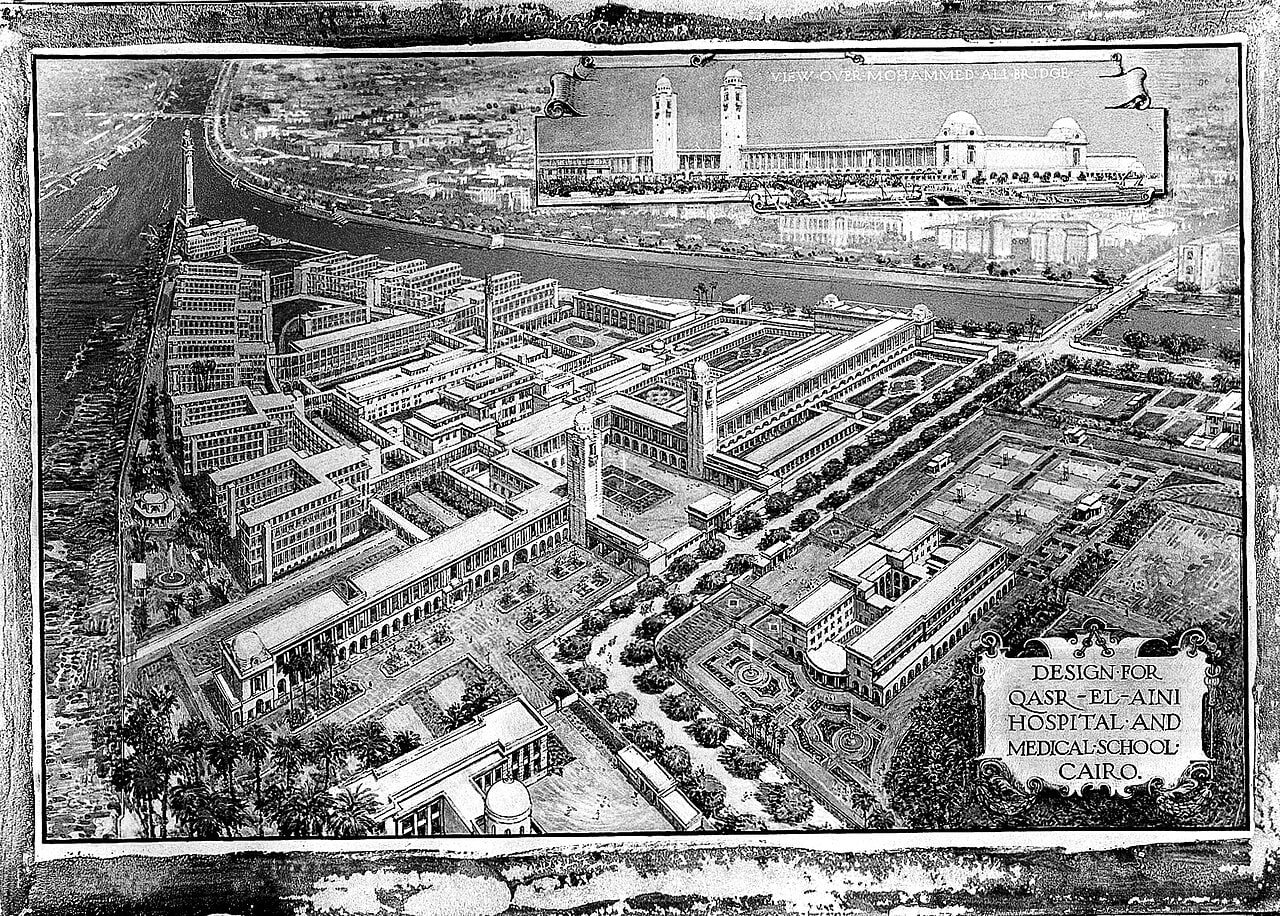
In October 1944, according to Sadat's own later account, he was taken from the Zeitoun detention center near Cairo to Qasr al-Ayni Hospital. His friend Hassan Izzat visited him there, arranged a car, and waited outside at lunchtime. Sadat slipped away from his guard in the hospital crowd, jumped into Hassan's small Austin, and disappeared into Cairo.
The physical escape took minutes. Staying free took almost a year.
The story is usually described as an escape from "British imprisonment." That is broadly understandable but administratively imprecise. British wartime security pressure was central to Sadat's arrest and continued detention, yet the facilities themselves were Egyptian institutions: the Aliens' Jail in Cairo, the Maqusa detention center near Minya, Zeitoun near Cairo, and finally Qasr al-Ayni Hospital.
At a Glance
- Permanent escape: October 1944; exact day not securely established
- Immediate escape site: Qasr al-Ayni Hospital, Cairo
- Previous detention site: Zeitoun detention center
- Principal helper: Hassan Izzat
- Method: Hospital transfer after a hunger strike, followed by slipping away from a guard into a waiting car
- First hideout: Fumm al-Khalij, according to Sadat's memoir
- Fugitive identity: "Hajj Muhammad" in later accounts
- Time underground: October 1944 to September 1945
- Why detained: Wartime anti-British activity and contacts with German agents
- Important distinction: Sadat had participated in an earlier temporary escape from Zeitoun and then voluntarily returned; the October 1944 escape was the one that made him a fugitive
Why the British wanted him out of circulation
Sadat was already an Egyptian army officer and committed nationalist when the Second World War transformed anti-British politics into a security issue. Britain had formally ended its protectorate over Egypt in 1922, but retained enormous military and political power under the Anglo-Egyptian relationship. During the North African campaign, British commanders depended on Egypt's territory, communications, and Suez Canal while German and Italian forces advanced from Libya.
Some Egyptian nationalists hoped an Axis victory would break British power. Sadat was one of the officers willing to explore that possibility.
His later memoir describes contacts with German agents operating in Cairo, including Johannes Eppler. Scholarly accounts likewise place Sadat within a circle seeking German help against the British. His political motive was Egyptian independence rather than a simple declaration of ideological allegiance to Nazism, but the practical fact remains that he tried to collaborate with Britain's wartime enemy.
That activity led to his arrest in 1942, dismissal from the Egyptian army, and detention. Sources disagree on the exact month of the initial arrest. Sadat's own chronology and later biographies variously place key stages in the summer or autumn of 1942. The stable fact is the year and the reason: the German connection brought him into the British-Egyptian wartime security system.
From the Aliens' Jail to Zeitoun
Sadat did not spend the next two years in one prison. His memoir traces a sequence through the Aliens' Jail in Cairo, then Maqusa in Upper Egypt near Minya, and finally the Zeitoun detention center near Cairo. Kirk Beattie's scholarly biography of the Sadat era independently summarizes the same three-site progression.
That matters because popular retellings often compress the entire period into a single prison sentence. Sadat was instead an administrative detainee moving through several institutions while the wartime authorities decided how to contain men they regarded as security risks.
He also was not serving an ordinary criminal sentence imposed after a completed trial. The detention operated under Egypt's wartime emergency framework and British influence over security policy.
Zeitoun was less restrictive physically than the earlier sites. Sadat described it as a house with a large garden, and detainees could receive family visits. The political fact of confinement nevertheless remained: they could not legally walk away.
The escape that ended with a return
The October 1944 episode was not Sadat's first time outside Zeitoun without permission. His memoir describes an earlier protest escape involving several detainees. They got out, went into Cairo, and reached Abdin Palace. Sadat signed the Royal Ceremonies Book and used the visit to protest their treatment and British pressure on the Egyptian government.
He then voluntarily returned to detention. Later accounts disagree slightly over the precise composition of that first group and who returned immediately. Jehan Sadat's memoir, retelling stories she heard from Anwar Sadat and Hassan Izzat, describes six men escaping through the roof and Sadat returning after the palace protest. Beattie's reconstruction also records the unusual episode but differs in how it sorts the participants.
The central point is not disputed: Sadat had already demonstrated that he could get out, but that first departure was political theater rather than a permanent flight. The second time, he intended not to come back.
Why the situation changed in 1944
By late 1944, the strategic situation of the war had changed dramatically. Axis defeat was becoming increasingly certain, and Egyptian politics was shifting with it.
Sadat wrote that other political detainees were being released while his small group remained held on British orders. Whether every political judgment in his later memoir is accepted or not, the continuing detention frustrated him enough that he began a hunger strike.
This was the key procedural move in the successful escape. According to Sadat, regulations required that his deteriorating condition be treated medically. He was transferred from Zeitoun to the new Qasr al-Ayni Hospital in Cairo.
Once inside the hospital, he ended the hunger strike. No independent hospital register has been located in the surviving evidence reviewed for this event to document the transfer. The hunger-strike mechanism therefore rests primarily on Sadat's autobiography, later repeated by Jehan Sadat. Broader scholarly and reference sources independently confirm the October 1944 escape, but usually do not preserve this level of detail.
Hassan Izzat and Qasr al-Ayni
Hassan Izzat was crucial because he was already outside. Sadat wrote that Hassan visited him in the hospital and immediately began planning a permanent escape. The scheme was much simpler than a wall breach: use the hospital's normal daytime movement against the guard system.
At lunchtime Qasr al-Ayni was crowded with people entering and leaving. Hassan drove his small Austin to the hospital and parked among doctors' cars with the engine running.
Sadat's memoir says he then separated from his guard while threading through the crowd, reached the car, and jumped inside. They drove away.
This is one of those escape stories where the most famous detail is plausible precisely because it is so mundane. No tunnel, forged gate order, or armed rescue was required. The security weakness came from moving a detainee into a civilian medical environment where a friend could approach and ordinary foot traffic made continuous visual control more difficult.
That should not be confused with independent documentation of every movement. The lunch crowd, the small Austin, the running engine, and the precise maneuver away from the guard all come from Sadat's later first-person narrative.
The first hideout
Sadat wrote that the drive from the hospital to the first safe place took only a few minutes. The destination was Fumm al-Khalij, where Hassan had arranged an apartment.
At that moment the prison escape itself was complete, but Sadat's legal danger was not. He remained a wanted detainee. Returning home under his own identity could have ended the escape almost immediately.
He therefore disappeared into a different life. Jehan Sadat later wrote that he grew a beard and used the name Hajj Muhammad. She described him taking manual jobs, including work connected to Hassan's truck, and moving among places where a former army officer could blend into working-class life without drawing attention. Sadat himself described the period from October 1944 until September 1945 as a full year living as a wanted fugitive.
A fugitive working ordinary jobs
The stories of Sadat's year underground accumulated colorful detail. Jehan Sadat's account, drawing heavily on Hassan Izzat's recollections, says Sadat worked as a porter on a truck, moved stone for road construction, worked on an irrigation canal, and at one point delivered produce into a British military area while disguised.
Egyptian biographical traditions similarly place him under the Hajj Muhammad identity and describe manual work during his time in hiding. The general picture is credible and consistently repeated: Sadat concealed his identity through appearance, name, location, and work.
The fine itinerary is less secure. Different popular biographies disagree about when he moved to Abu Kabir and in what order he held particular jobs. Those variations make it unwise to turn the fugitive year into an exact day-by-day route.
For the escape case, the key outcome is simpler. British-influenced Egyptian security authorities did not recapture him before the legal conditions underpinning his detention changed.
When the escape became legally durable
Sadat remained underground until September 1945. He later said that when martial law was lifted, the legal basis for his detention ended. He could stop living as a fugitive and resume his public identity.
That did not mean the wartime episode had turned him into a conventional civilian. His anti-British underground activity continued. In the postwar period he became involved with conspirators targeting Egyptian politicians regarded as collaborators with British power. The assassination of former finance minister Amin Osman in January 1946 brought Sadat back into custody, this time in a separate criminal case.
He spent roughly two more years imprisoned while awaiting trial and was ultimately acquitted. The 1946 imprisonment should not be merged into the 1944 escape. They arose from different events, under different legal circumstances, and produced different prison histories.
British imprisonment—or Egyptian detention?
The familiar shorthand deserves one final qualification. Major English-language biographies routinely say that the British arrested and imprisoned Sadat. That reflects the enormous British role in Egyptian wartime security and the fact that his German contacts made him a British security target.
Sadat himself repeatedly said that his group remained confined on British orders. Yet his custody passed through Egyptian police, military, detention, and hospital institutions. Britain did not administer every cell directly.
The most accurate description is therefore British-driven or British-ordered wartime detention carried out through Egyptian institutions. That distinction matters because it prevents the escape from becoming a colonial adventure story in which the administrative structure disappears.
What can actually be proved
The documentary hierarchy is unusually clear. It is well supported that Sadat was detained from 1942 because of his wartime anti-British activity and German contacts; that he passed through several detention sites; that he escaped in October 1944; and that he lived underground until martial law was lifted in September 1945.
The most detailed physical mechanics come from Sadat himself, writing more than three decades later in In Search of Identity. His wife later repeated the hospital escape using stories she had heard from Sadat and Hassan Izzat. Those accounts reinforce the family and participant tradition but do not constitute fully independent official corroboration.
So the strongest reconstruction does not need to choose between skepticism and credulity. Sadat escaped in October 1944. Qasr al-Ayni Hospital is the strongest specific escape site. Hassan Izzat was the central helper. The hunger strike, lunch crowd, waiting Austin, and Fumm al-Khalij apartment are credible participant testimony and should be labeled as such.
The escape mattered because it ended two years of wartime detention and returned Sadat to underground political action. Decades before he became president, he had learned that a system designed to keep him confined could be defeated not by overpowering it, but by getting transferred into a place where its control was weaker.
Evidence discipline
What the record supports
Status labels distinguish secure conclusions from uncertainty and rejected claims. Color is never the only signal.
MYTH
Sadat escaped directly through the walls or perimeter of Zeitoun detention camp in October 1944.
The strongest participant account places the permanent escape after transfer from Zeitoun to Qasr al-Ayni Hospital. Some short biographies compress the sequence and simply say he escaped from the camp.
Sources: SRC-001, SRC-006WELL-SUPPORTED
Sadat escaped from Qasr al-Ayni Hospital in October 1944.
Sadat gives the hospital account directly, Jehan Sadat later repeats it from Sadat and Hassan Izzat, and independent biographies confirm the October 1944 escape after roughly two years' detention.
Sources: SRC-001, SRC-002, SRC-003, SRC-004LATER CLAIM
The hunger strike, lunch crowd, waiting Austin, and Fumm al-Khalij apartment are independently documented official facts.
These mechanics derive principally from Sadat's 1978 autobiography and later family/participant retelling rather than a contemporary police or hospital record located in this research.
Sources: SRC-001, SRC-002MYTH
Sadat was held throughout 1942–1944 in one British-run prison.
His custody moved through multiple Egyptian institutions. British pressure and orders were central, but the physical detention system was not one continuously British-administered prison.
Sources: SRC-001, SRC-003, SRC-006MYTH
Sadat's wartime arrest was unrelated to Axis Germany.
Multiple biographical and scholarly sources connect the arrest to his contacts with German agents and efforts to use Germany against British power in Egypt.
Sources: SRC-003, SRC-004, SRC-005, SRC-007DISPUTED
Sadat's German contacts prove that his politics were simply ideological Nazism.
The practical collaboration with German agents is documented, but major biographical accounts frame his overriding motive as anti-British Egyptian nationalism. Motive should not erase the collaboration itself or be reduced to a single ideological label.
Sources: SRC-003, SRC-007MYTH
October 1944 was Sadat's first unauthorized departure from Zeitoun-era custody.
Sadat had participated in an earlier temporary protest escape and then voluntarily returned. October 1944 was the permanent escape that began his fugitive year.
Sources: SRC-001, SRC-002, SRC-003Evidence diagram
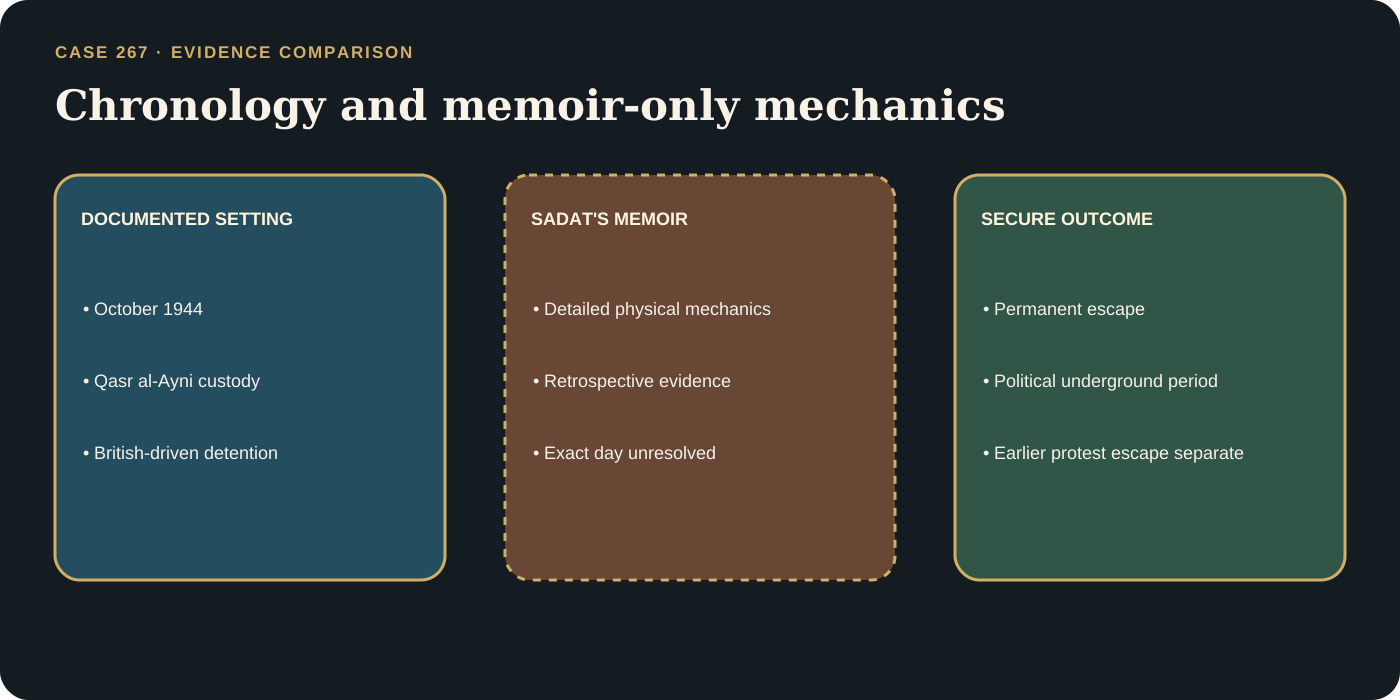
Detention chronology and memoir mechanics
The institutional chronology is stronger than the detailed escape mechanics, which depend substantially on Sadat's later memoir.
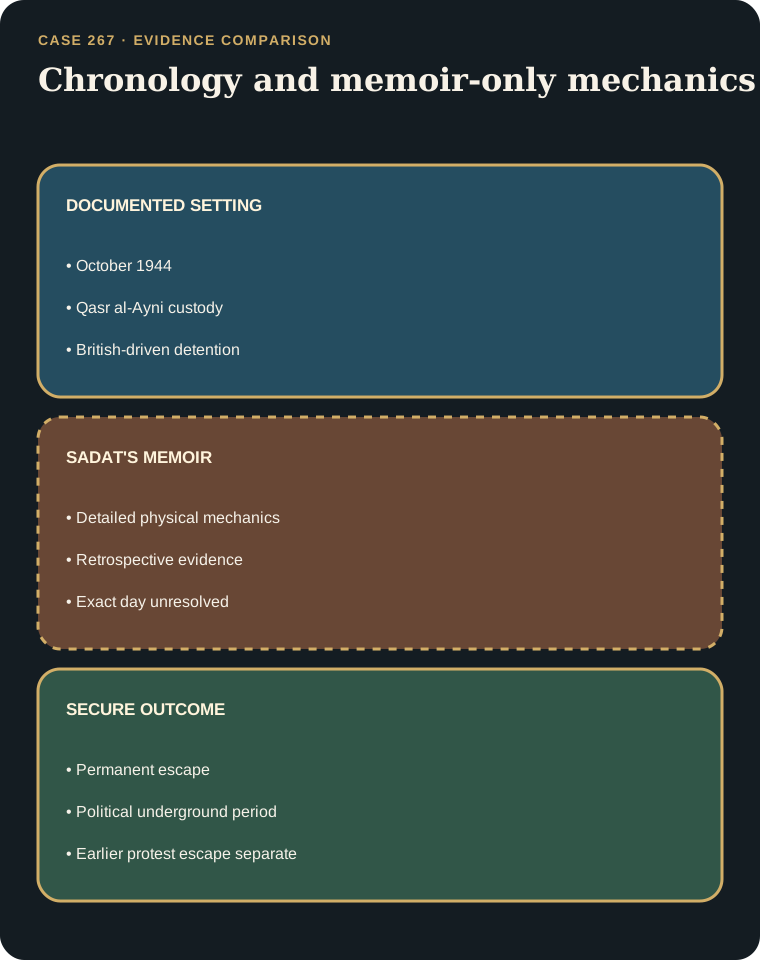
The institutional chronology is stronger than the detailed escape mechanics, which depend substantially on Sadat's later memoir.