
At 7:33 p.m. on 5 December 1961, a scheduled East German passenger train left Oranienburg for the western edge of the German Democratic Republic. Nothing on its timetable said that it would continue into West Berlin.
Its locomotive driver, Harry Deterling, intended to change that.
Deterling had arranged for relatives and friends who wanted to leave the GDR to board along the route. His chosen fireman, 18-year-old Hartmut Lichy, was in on the plan. Other railway staff and ordinary passengers were not. The danger was concentrated at Albrechtshof, the train’s eastern terminus near the border. Beyond the station, one main track still continued toward West Berlin because it was used for interzonal traffic.
Shortly before 9 p.m., Train 2192 did not stop where it was supposed to.
It ran through Albrechtshof, passed a stop signal, continued over the surviving rail connection and crossed into West Berlin. No border guard stopped it. No shot was fired. About half a kilometre inside the West, Deterling brought the train to a halt.
Twenty-five people chose to remain in West Berlin. Seven passengers who had not intended to flee went back.
The next day, East German authorities began closing the railway gap that had made the escape possible.
A railway gap in a newly sealed city
The Berlin Wall was less than four months old.
On 13 August 1961, the East German government had sealed the border around West Berlin. Streets, tram lines and railway links that had once joined the city were blocked or cut. Yet the transformation could not happen everywhere at once. Berlin was still entangled with regional and interzonal transport systems, and some links remained operational under tightly controlled conditions.
One of them ran west from Albrechtshof toward Spandau.
Albrechtshof stood near the western edge of the GDR railway network. The main line beyond it still connected toward West Berlin because interzonal trains between Hamburg and Berlin used the route. An internal Ministry for State Security report written the morning after Deterling’s escape described the weakness plainly: the station had a main track leading toward West Berlin and an overtaking track, but no railway-side technical safeguard capable of preventing a train from forcing its way west.
That vulnerability was not accidental in the sense of being unknown. The same Stasi report said railway officials had discussed additional security measures but had avoided changes that might create hazards for interzonal traffic.
The result was a rare contradiction in the border system. The state wanted the frontier sealed, but the railway still needed a functioning line through it.
Deterling understood the contradiction better than most people because he was a locomotive driver.
The driver who wanted out
Harry Deterling worked for the Deutsche Reichsbahn and lived in Oranienburg with his wife Ingrid and their four children.
The Stasi report gives his date of birth as 6 December 1933. That made him 27 years old on the night of the escape, one day short of his 28th birthday. Contemporary Western reports often called him 28 because the story was published the next day.
Later accounts describe a growing conflict between Deterling and the political demands surrounding railway work after the Wall went up. Family recollections published decades later say he had refused to sign a statement approving the closure of the border and was threatened with transfer away from locomotive duty. These later recollections are valuable, but the strongest evidence for the escape itself comes from the contemporary record.
What is clear is that Deterling and Hartmut Lichy prepared the crossing together and that Deterling used his railway position to get control of the right train.
The Stasi investigation found that neither man was the regular locomotive crew assigned to Passenger Train 2192 that evening. Deterling managed to take the run out of turn. The report states that he sent the scheduled fireman home and substituted the man who escaped with him.
That detail matters because the plan depended on controlling the locomotive cab. An ordinary passenger could not simply decide that a train would keep going beyond Albrechtshof. Deterling needed the engine, a cooperative fireman and a route he knew well enough to exploit.
Escape sequence
A rail corridor—not a concrete-wall collision
The scheduled train crossed a still-connected track into West Berlin; it did not smash through a concrete Wall.
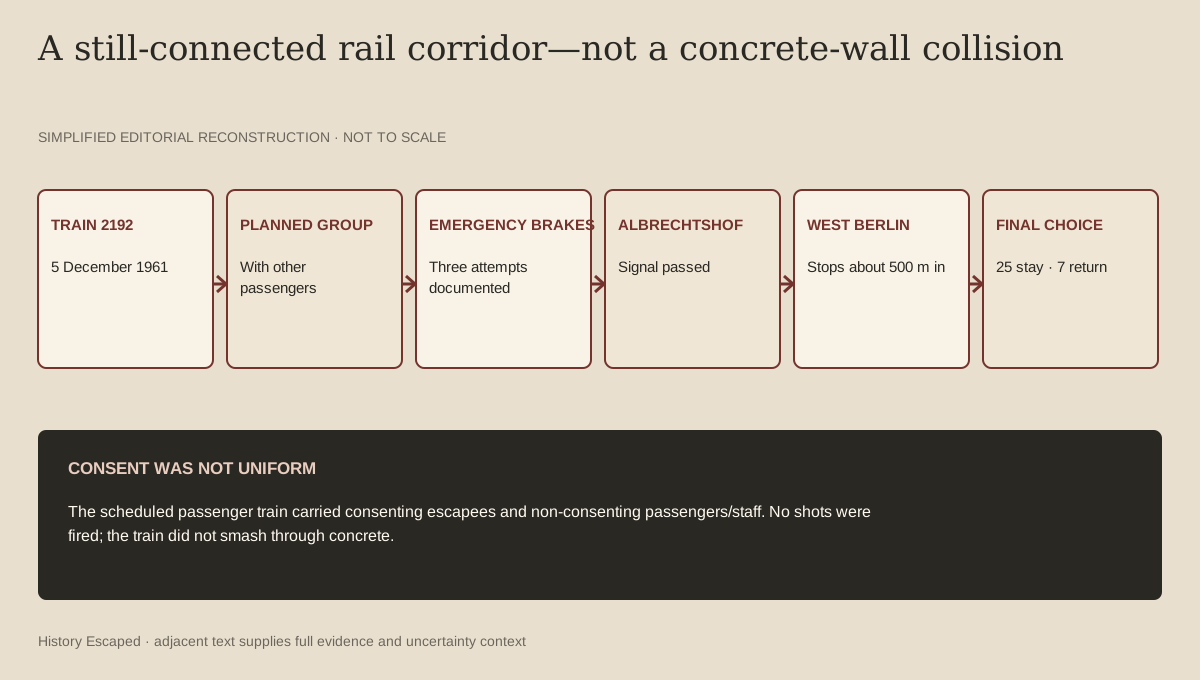
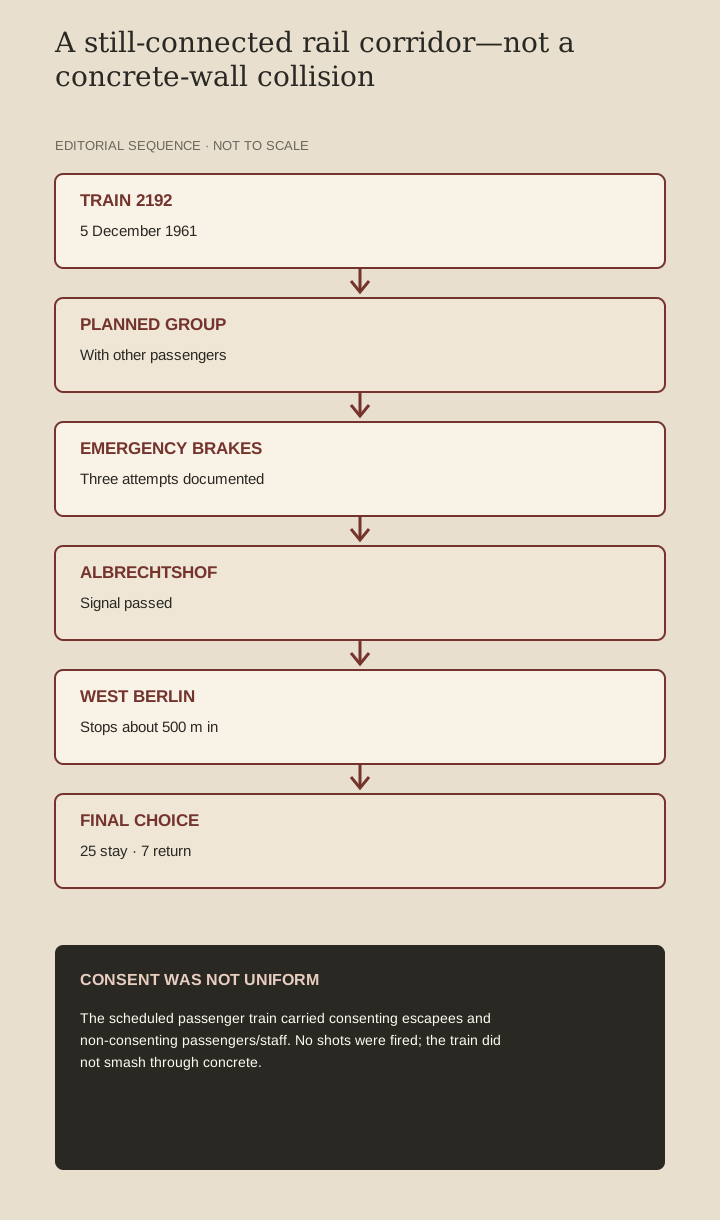
Simplified editorial sequence; not to scale. Exact brake sabotage mechanics are not asserted, and passenger consent was not uniform.
“The last train to freedom”
By early December, word circulated among railway workers that the remaining rail connection toward West Berlin would soon be severed.
Chronik der Mauer, the Berlin Wall historical project, records that Deterling reacted by accelerating his plan. On 5 December he told relatives and friends when the train would leave. The phrase later associated with the escape—“the last train to freedom”—came from that warning.
The scheduled departure from Oranienburg was 7:33 p.m.
People involved in the plan boarded without forming one obvious group. Later retellings describe five families getting on at Oranienburg and another group racing to catch the train farther along the route after initially missing it. The precise boarding pattern is less important than the underlying method: the escapees entered a normal passenger service and tried to avoid revealing that the entire run had a second, secret destination.
Ordinary passengers boarded too. So did railway personnel who had no intention of leaving the GDR.
That made the plan ethically and operationally more complicated than a private vehicle escape. Deterling was not only risking himself and the people who had agreed to go. He was taking a working passenger train across an internationalized Cold War border with people aboard who did not consent to the escape.
The surviving sources make that complication impossible to ignore.
Material evidence
Tools of Escape
The objects used in an escape reveal how a plan worked under constraint.
- 01Decisive transport mechanism
Passenger Train 2192
A scheduled Deutsche Reichsbahn passenger service from Oranienburg to Albrechtshof that Deterling used as the escape vehicle.
- 02Operational advantage
Railway route knowledge
Knowledge of the Albrechtshof track arrangement and the still-connected main line toward West Berlin allowed Deterling to exploit a weakness in the border system.
- 03Prevented an onboard stop
Brake interference
Contemporary and later sources support deliberate interference with the emergency braking system, although the East German investigation could not reconstruct the precise technical condition after the train had been returned and repaired.
The problem of the emergency brake
A train can be controlled from more than the locomotive cab.
Once passengers or railway staff realized that Train 2192 was not stopping, they could try to use the emergency brake. Deterling therefore had to prevent someone in the coaches from stopping the train before it reached the border.
Popular retellings often state this as a clean technical fact: Deterling deliberately disabled the emergency brake system before departure.
There is strong evidence that he interfered with the braking system, but the contemporary Stasi report preserves an important uncertainty. The returning train conductor said three people pulled the emergency brake after realizing the train was heading toward West Berlin. Investigators could not later determine whether the emergency brake had failed completely or responded only weakly because the train’s brake system had been restored to working order before it could be examined.
Contemporary Western reporting, apparently based on Deterling’s own statements, was more definite and said he had made the emergency brakes ineffective.
The safest conclusion is therefore not that the brake story is a myth, but that its exact technical mechanism cannot be independently reconstructed from the surviving East German inspection. The essential operational fact is well supported: people tried to stop the train from the coaches and failed.
Problem → response
Escape was a sequence of problems
Each response solved a practical obstacle while often creating the next one.
- 01→
Obstacle
Uninformed railway staff and passengers
Not everyone aboard had agreed to flee, and some attempted to stop the train when they understood what was happening.
Response
Deterling retained control from the locomotive while attempts to use the emergency brake failed to stop the train.
- 02→
Obstacle
Albrechtshof stop signal
The train was supposed to terminate at Albrechtshof, where the exit signal toward West Berlin showed stop.
Response
Deterling continued through the station and passed the stop signal.
- 03→
Obstacle
Border enforcement
The rail line crossed a fortified and guarded border zone in which the escapees feared armed intervention.
Response
The train used the still-operational rail corridor and crossed before the border system could stop it; institutional accounts state that no shots were fired.
Albrechtshof
The decisive moment came at the station that should have ended the run.
The Stasi’s internal information report places the event at about 8:45 p.m. Chronik der Mauer gives roughly 8:50 p.m. That five-minute difference is typical of fast-moving events reconstructed from separate contemporary records and should not be turned into false precision.
Train 2192 entered Albrechtshof too fast to stop normally.
The report says it passed the station and the exit signal showing “Halt.” The track layout then worked in Deterling’s favor. The train ordinarily used the main line before being moved onto the overtaking track at Albrechtshof. Even if the switch was not set as Deterling wanted, the physical geometry of the relevant switch still led a train approaching from the GDR side onto the main track toward West Berlin.
The border regime had a weakness built into its railway engineering. Deterling exploited it.
Later reconstructions put the train’s speed at roughly 75 kilometres per hour as it made the final run. What the primary Stasi record firmly establishes is that it passed Albrechtshof at excessive speed, ignored the stop signal and continued west.
The people who knew what was happening prepared for the possibility of gunfire. Chronik der Mauer says Deterling and Lichy took cover in the coal bunker/tender area during the crossing and that the informed passengers lay down.
They expected the border guards to shoot. They did not.
That point is especially important because some later summaries sensationalize the escape as a dash through a “hail of bullets.” The more authoritative institutional reconstruction says no shot was fired during the train’s crossing.
The final accounting
Outcome
Remained in West Berlin
The later institutional tally records 25 people choosing to remain in the West, including Deterling and Lichy.
Returned to the GDR
Seven passengers who had not intended to flee voluntarily returned east according to the later institutional account.
Rail connection severed
The East German authorities rapidly dismantled and blocked the track connection used in the escape, removing the opportunity for a repeat.
Across the border
The locomotive and eight passenger coaches continued beyond the GDR boundary.
The Stasi report says the train stopped about 500 metres inside West Berlin. Its preliminary estimate was that the train had been carrying about 50 people. It further estimated that, in addition to the locomotive driver and fireman, roughly 30 passengers left the GDR, while 19 people—including several railway employees, a member of the border police and a customs official—walked back east.
Those numbers were explicitly preliminary.
Later institutional histories give a more settled count: 25 people remained in the West and seven passengers returned voluntarily. Contemporary Associated Press reporting likewise described Deterling, Lichy and 23 passengers choosing the West.
The stronger final tally is 25 escapees and seven returnees; the Stasi report’s larger approximate count reflects incomplete early accounting. The returnees are part of the story.
They demonstrate that this was not a train carrying only a preselected escape group. Some people aboard had been carried across the border without choosing to flee and wanted to go back. Their decision complicates the familiar heroic shorthand without diminishing the courage or desperation of those who had deliberately taken the risk.
A train that had to be returned
The railway problem did not end when the escape succeeded.
Train 2192 was now standing in West Berlin on a line still required for cross-border rail traffic. According to the Stasi report, a Reichsbahn locomotive from the Grunewald depot was sent to recover it. The train was pulled back into the GDR and reached Albrechtshof at about 10:45 p.m.
This was a strange Cold War afterimage: the people who wanted freedom stayed in the West, while the locomotive and coaches went back east. The escape had exposed the route’s vulnerability so clearly that the line could not be left unchanged.
The Stasi report says commuter rail service between Falkensee and Albrechtshof was suspended, with buses substituted temporarily. It also records that interzonal trains between Hamburg and Berlin were due to be rerouted via Griebnitzsee and that the main track from Albrechtshof toward West Berlin would be interrupted.
Chronik der Mauer says the work began the next day: rails were removed and barriers erected. Other institutional accounts describe the permanent severing as completed during the night of 6–7 December.
The exact hour of the demolition matters less than the consequence. Deterling had used the rail connection once. The East German authorities made sure it could not be used that way again.
Why the escape worked
Deterling’s escape depended on a rare combination of professional knowledge, infrastructure and surprise.
He knew how railway operations worked and how Albrechtshof was laid out. He arranged to take control of the locomotive with a trusted fireman. His group boarded an ordinary service rather than assembling at the border. The still-open main line existed because the GDR’s desire for a sealed frontier had to coexist with interzonal railway traffic.
Most importantly, the border defenses were designed around an assumption: scheduled trains would obey railway procedure. Train 2192 did not.
The station’s exit signal could order a stop, but there was no automatic physical system there that guaranteed a locomotive would comply. The Stasi report is unusually revealing on this point. It records that railway officials had considered safeguards but had not implemented them because they feared creating new dangers for legitimate interzonal trains.
The escape therefore succeeded not because the border was unguarded, but because one part of the system—railway operation—still depended on the cooperation of the people running it. Deterling withdrew that cooperation.
Evidence discipline
What the record supports
Status labels distinguish secure conclusions from uncertainty and rejected claims. Color is never the only signal.
WELL-SUPPORTED
Exactly 25 people escaped and seven returned.
Chronik der Mauer and contemporary Western reporting converge on 25 people remaining in the West and seven returning. The first Stasi report gave larger approximate figures—about 30 leaving in addition to the locomotive crew and 19 returning—showing that its initial headcount was preliminary rather than a stable final tally.
Sources: SRC-001, SRC-002, SRC-005WELL-SUPPORTED
Deterling deliberately disabled the emergency brake.
Contemporary Western reports and later accounts say he made the emergency brakes ineffective. The Stasi report confirms that three people pulled the emergency brake without stopping the train but says investigators could not later determine whether it was fully disabled or only weak because the brake system had been restored before examination.
Sources: SRC-001, SRC-005, SRC-007MYTH
Border guards fired on the escape train.
The authoritative Berlin Wall institutional account says the escapees took cover because they expected gunfire, but no shot was fired during the crossing. Later descriptions of a bullet-filled dash are not supported by the strongest reconstruction.
Sources: SRC-002MYTH
The locomotive smashed through the masonry Berlin Wall.
The escape used a surviving rail corridor at Albrechtshof that remained physically connected for interzonal traffic. The train crossed the border through this railway seam; it was not a locomotive ramming through a solid concrete wall section.
Sources: SRC-001, SRC-002DISPUTED
The crossing happened at exactly 20:45.
The Stasi report gives about 20:45, while Chronik der Mauer gives about 20:50. The crossing is best dated approximately rather than assigning false precision to either source.
Sources: SRC-001, SRC-002MYTH
The 1963 film Durchbruch Lok 234 is a literal reconstruction of the escape.
The film is based on the event but changes the protagonist's name and other details for dramatic purposes. It is useful as reception history, not as a primary factual source for the escape mechanism.
Sources: SRC-008, SRC-009What the film changed
The escape was already cinematic. Two years later, it became a film.
Frank Wisbar’s Durchbruch Lok 234, released in West Germany in 1963, fictionalized the event. The central locomotive driver became Harry Dölling rather than Harry Deterling, and the film altered characters and details for dramatic purposes. Film records also show that the production used a different locomotive class from the one later identified with the real escape.
That matters because the film helped preserve the story while also making it easier for later retellings to inherit dramatic details from a reconstruction rather than from the event itself. The real escape does not need those additions. It already contained a scheduled passenger train, an unguarded assumption in the border system, people lying down in anticipation of gunfire, passengers trying to stop the train, a red signal ignored, an international frontier crossed and a train sent back without the people who had escaped on it.
Myth: the train smashed through the Berlin Wall
The phrase “train through the Berlin Wall” is useful shorthand, but literally it is misleading.
Deterling did not ram a locomotive through the masonry structure that most people picture when they hear “Berlin Wall.” The escape used a surviving rail corridor at the western edge of the GDR, where railway tracks still crossed the border for interzonal traffic and were controlled by railway and border barriers.
That distinction is more than pedantry.
It explains why the escape was possible. A locomotive could not simply choose any point on the Wall and crash through it. Deterling needed a specific transport connection that had remained physically continuous after 13 August 1961. His railway knowledge let him find the weak seam created by the conflict between border security and the need to keep trains moving.
Once the seam was exploited, it disappeared.
Selected chronology
Selected chronology
The Berlin border is sealed
East German authorities close the border around West Berlin, cutting numerous transport links while some controlled rail connections remain necessary for interzonal traffic.
Train 2192 leaves Oranienburg
The passenger train departs on its scheduled run toward Albrechtshof with Deterling at the controls and Lichy as fireman.
The train passes Albrechtshof
Train 2192 runs through Albrechtshof at excessive speed, passes the stop signal and continues toward West Berlin.
The train reaches West Berlin
Deterling brings the train to a stop roughly 500 metres beyond the border. Later accounts record 25 people remaining in the West and seven returning east.
The train is returned to Albrechtshof
A Reichsbahn locomotive pulls the passenger train back into the GDR, where it arrives at Albrechtshof at about 22:45.
The rail gap is closed
East German authorities begin removing rail and erecting barriers on the connection used in the escape; permanent severing is completed within the following days.
The escape is dramatized on film
The West German film Durchbruch Lok 234 fictionalizes Deterling's escape, changing names and some operational details.
Aftermath
Deterling, his family and the other people who stayed in the West were taken into West Berlin’s refugee-processing system. Later accounts place the Deterling family first in the Marienfelde reception center and then in West Germany.
He returned to railway work in the West.
Family recollections and later journalism also describe years of threats and police protection, part of the longer shadow cast by a public defection that embarrassed the East German state. Those claims come from later testimony rather than the immediate operational record and should be treated accordingly.
The physical legacy is clearer. The connection at Albrechtshof was severed almost immediately after the escape. Interzonal rail traffic was rerouted. The route that had made the “last train to freedom” possible ceased to exist in that form.
Harry Deterling did not discover a permanent hole in the Berlin Wall. He found a temporary one in the railway system—and used it before the state could close it.