
On the night of 29 June 1974, Mikhail Baryshnikov finished a performance at Toronto’s O’Keefe Centre, emerged into a crowd of admirers, and began to run. He was twenty-six years old, already one of the Soviet Union’s most celebrated male dancers, and officially still part of a touring Soviet company. A few minutes later, he had separated himself from the troupe and the officials watching it. Friends moved him away from downtown Toronto and into temporary seclusion. The next time the Soviet tour saw him, Baryshnikov had chosen not to return.
At a Glance
- Date: 29 June 1974
- Place: O’Keefe Centre, Toronto, Canada
- Defector: Mikhail Baryshnikov
- Home company: Kirov Ballet, Leningrad
- Tour: Soviet company promoted in Canada as the Bolshoi Ballet
- Primary motive stated by Baryshnikov: Artistic freedom and access to Western choreographers
- Method: Private contact network, legal preparation, separation from the Soviet group after the final performance, vehicle pickup and temporary safe house
- Immediate outcome: Baryshnikov remained in Canada and sought permission to stay
- Major correction: He was a Kirov star defecting from a Bolshoi-branded touring group, not a member of the Bolshoi company itself
A Kirov Star on a Bolshoi Tour
Baryshnikov’s institutional affiliation is easy to get wrong because the name on the Canadian tour was not the name of his home company.
He had trained at the Vaganova school in Leningrad and joined the Kirov Ballet in 1967. By the early 1970s, he had become one of the company’s brightest stars, admired for exceptional technique and stage presence.
The 1974 Canadian tour, however, was promoted under the Bolshoi Ballet name. Contemporary and later Canadian sources describe it as a mixed Soviet touring group rather than the full Moscow company. Baryshnikov and ballerina Irina Kolpakova were Kirov artists added as star attractions.
That distinction matters because many later summaries collapse “the tour” and “the company.” Baryshnikov did not transfer from the Bolshoi to the West. He left the Soviet system while appearing with a Bolshoi-branded touring troupe.
Why He Wanted Out
Baryshnikov’s decision was political in consequence, but he resisted describing it as primarily political in motive.
He had received elite training in the Soviet Union and later spoke with gratitude about that education. His frustration centered on what came after training: the repertoire he could dance, the choreographers he could work with, and the degree to which officials controlled international travel.
Western ballet in the 1960s and 1970s was changing rapidly. Baryshnikov wanted access not only to classical productions but to choreographers such as George Balanchine and other artists whose work he could not freely pursue from inside the Soviet system.
In his first Canadian interview after the defection, he described himself as having reached an artistic crossroads. The decision to stay in the West, he said in substance, was about preserving and expanding his art.
That did not make the act apolitical. A famous Soviet cultural representative refusing to return home during the Cold War inevitably became a political event. The important distinction is between what the defection symbolized and why Baryshnikov said he made it.
Selected chronology
Selected chronology
Canadian tour begins
The Soviet touring troupe begins its Canadian engagement in Ottawa before continuing across the country.
Toronto engagement begins
The Bolshoi-branded touring troupe opens at Toronto’s O’Keefe Centre with Baryshnikov as one of its Kirov guest stars.
Canadian immigration officials are contacted
According to the detailed Toronto reconstruction, lawyer James Peterson contacts federal immigration officials as the escape plan takes shape.
Final Toronto performance and defection
After the final O’Keefe Centre performance, Baryshnikov separates from the Soviet group, runs to helpers and leaves central Toronto.
Immigration proceedings remain active
Contemporary Guardian reporting says Baryshnikov is expected to appear before Canadian immigration officers and seek asylum.
Peterson briefs the press
Peterson publicly explains the defection and emphasizes Baryshnikov’s professional and artistic motives.
Baryshnikov gives his first major interview
In his first extended Canadian interview after the defection, Baryshnikov explains the decision primarily in artistic terms.
National Ballet of Canada television appearance
A CBC program records Baryshnikov rehearsing and performing La Sylphide with National Ballet of Canada artists after the defection.
Not a Four-Year Escape Script
Some later retellings claim that Baryshnikov had spent four years carefully planning the Toronto escape. The evidence is less neat.
He had clearly thought for years about the restrictions of Soviet artistic life and had friends in the West. Natalia Makarova’s 1970 defection in London had shown that a Kirov star could remain abroad. Western contacts also knew that Baryshnikov was dissatisfied.
But the detailed Toronto plan appears to have come together during the Canadian tour itself.
TVO’s reconstruction places the crucial discussions in Canada and notes a tradition that he began seriously considering the practical question during the Montreal stop. A Russian retrospective drawing on Alexander Minz says the final decision may have come only a day or two before the Toronto engagement ended.
The safest conclusion is that the desire was longstanding while the operational plan was comparatively late.
Passing the Message
Because Soviet touring artists were monitored, Baryshnikov could not simply arrange his future openly in a hotel lobby.
One of the key intermediaries was John Fraser, then a Toronto ballet critic. Fraser later recalled receiving instructions from New York Times critic Clive Barnes and Barnes’s wife to pass Baryshnikov names and a telephone number connected with trusted friends.
At a reception, Fraser managed to speak with Baryshnikov while diverting the attention of the Soviet official nearby. They settled on limited French as a common language.
The episode has accumulated charming details in later retellings, including the way Fraser hid the number and the difficulty of getting it into Baryshnikov’s hands. The broad point is stronger than the anecdote: a Western dance-world network created a private communications channel that Soviet tour management did not control.
Baryshnikov used it.
The Canadian Helpers
Once Baryshnikov indicated that he might remain, the problem changed from artistic desire to law and logistics.
Toronto lawyer James S. Peterson became one of the most important organizers. The 2024 TVO reconstruction states that Peterson contacted federal immigration officials on 27 June, two days before the final performance.
That timing is significant. Baryshnikov was not simply running into the city and hoping someone would figure out his status afterward. His helpers were trying to understand the Canadian legal process in advance.
American friend Christina Berlin was also part of the private network around him. Later sources differ in how much planning responsibility should be assigned to each helper, but they agree that this was not a solo improvisation.
The exact identity of the first getaway driver is one detail that should remain open. Radio Canada names Peterson; the more detailed TVO reconstruction places Tim Stewart with the waiting car while Peterson handled the legal side.
The escape does not depend on settling that discrepancy.
Documentary reconstruction
The public performance and the private decision
A case-local visual focused on the spatial, mechanical or evidentiary relationship established by the surviving record.
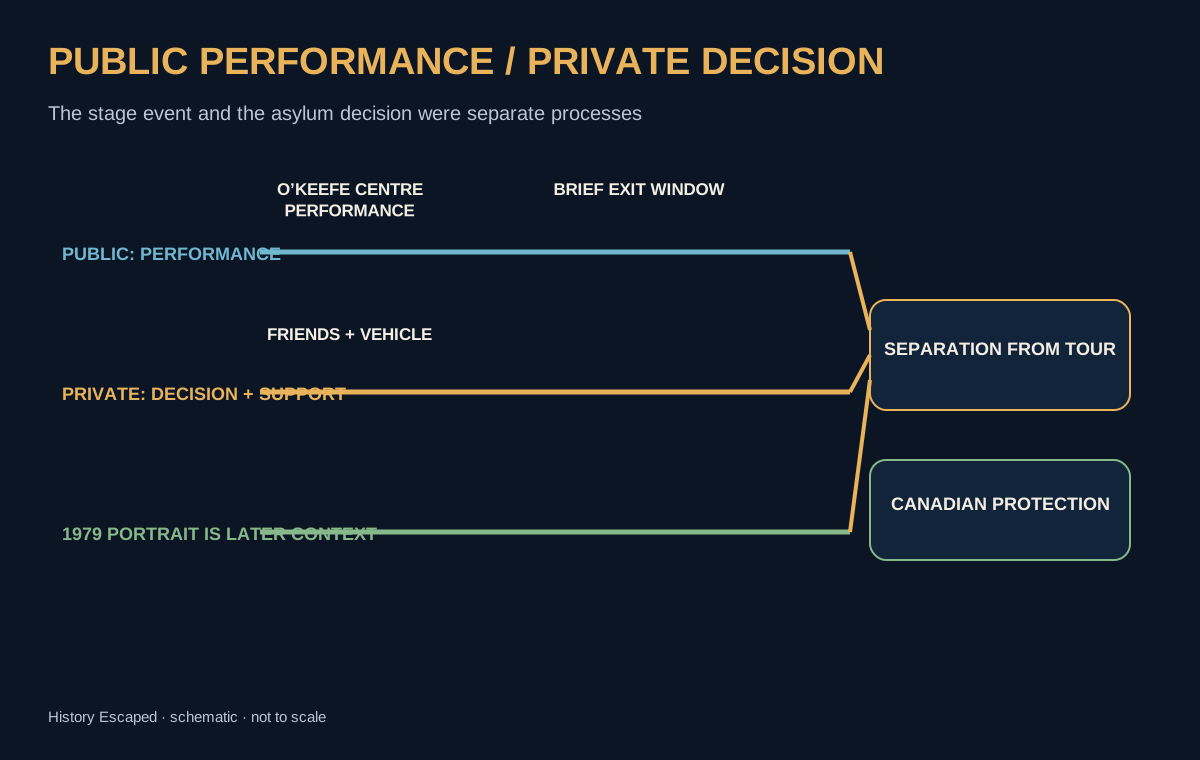
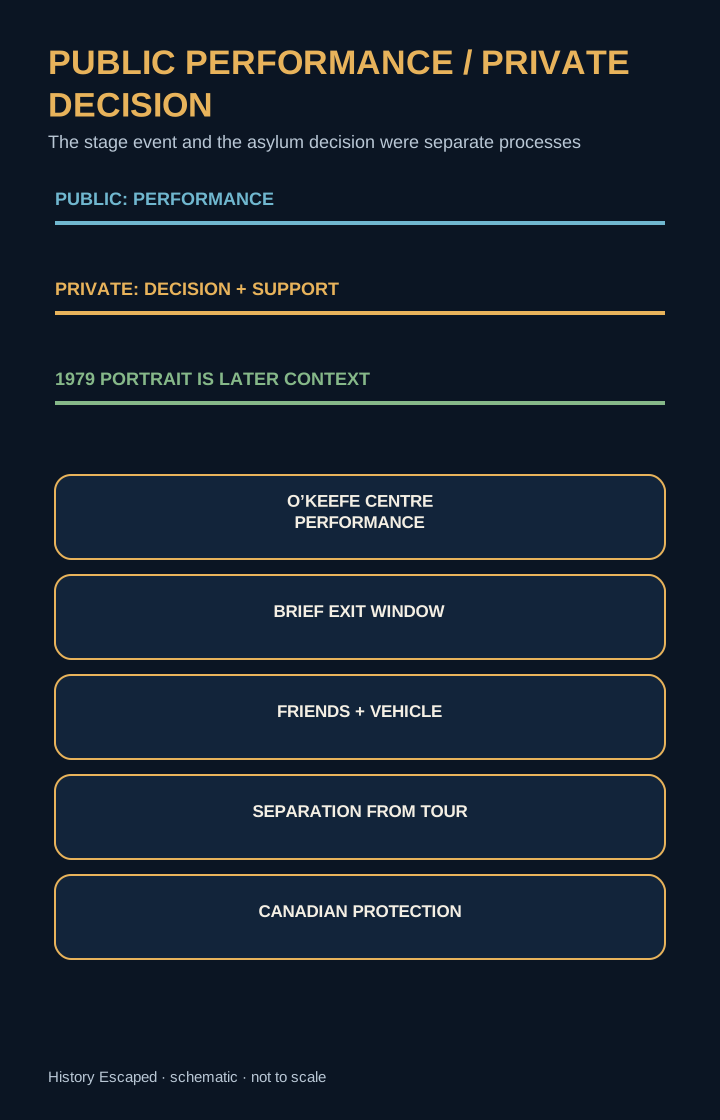
Simplified editorial reconstruction based on the cited historical record; not to scale. Uncertainty is stated directly in the visual and adjacent text.
June 29
The final Toronto performance took place at the O’Keefe Centre.
Later accounts say Baryshnikov met Peterson before the show and signed papers connected with his intention to remain. Peterson reportedly advised him that he did not need to return to the theatre.
Baryshnikov returned anyway.
The reason, as later reconstructed, was professional responsibility. He did not want to leave fellow dancers without a performer at the last moment.
The performance ran late. Curtain calls extended the evening. The Soviet group was expected to leave together for a reception afterward.
Outside the stage door, admirers crowded around the dancers seeking autographs. That crowd created the opening.
The Run
Baryshnikov moved through the people around the theatre and then broke away. Accounts written immediately afterward and in later anniversary reporting agree on the essential image: he turned from the group and ran through the wet Toronto night toward waiting helpers.
The precise route differs slightly across retellings. Modern accounts place the run behind or near the King Edward Hotel and identify a contact point around Wellington Street and Leader Lane before the vehicle pickup.
Those details are useful for orientation, but they should not be converted into a meter-by-meter reconstruction. The historically important threshold came when Baryshnikov no longer moved with the Soviet troupe.
He reached the Canadian helpers, entered a vehicle, and was taken away.
Temporary Seclusion
The first destination was not a press conference.
Baryshnikov was moved through private vehicles to a safe location outside central Toronto. TVO’s reconstruction places him eventually at a Stewart family property in the Caledon area.
For several days, journalists knew that one of the world’s most famous dancers had disappeared but did not know exactly where he was. Toronto police treated him as a missing person but publicly indicated that they had no reason to believe a crime had occurred.
Soviet representatives disputed the circumstances and suggested that Western acquaintances had manipulated or abducted him. Baryshnikov’s later public appearance and statements made clear that he had chosen to remain.
Contemporary reporting also shows that his immigration position was still being worked through after the escape. On 2 July, the Guardian reported that he was expected to appear before Canadian immigration officials and seek asylum.
This is why saying “Canada granted him asylum the moment he ran” is too simple.
Evidence discipline
What the record supports
Status labels distinguish secure conclusions from uncertainty and rejected claims. Color is never the only signal.
MYTH
Baryshnikov was a Bolshoi Ballet dancer when he defected.
He was a star of the Kirov Ballet. The Canadian tour was promoted under the Bolshoi name and included Baryshnikov and Irina Kolpakova as Kirov guest stars.
Sources: SRC-001, SRC-002, SRC-009DISPUTED
Baryshnikov had planned the exact Toronto escape for four years.
His desire for wider artistic freedom was longstanding, but Toronto and Russian retrospective accounts place the specific operational decision during the 1974 Canadian tour, possibly only shortly before the final performance.
Sources: SRC-001, SRC-008MYTH
Baryshnikov described his defection primarily as an ideological anti-communist protest.
He repeatedly framed his personal reason as artistic freedom and the ability to work with a wider range of choreographers and repertoire, while acknowledging the gravity of leaving the Soviet system.
Sources: SRC-001, SRC-004, SRC-007MYTH
Canada granted Baryshnikov political asylum immediately on the night of 29 June.
He went into temporary seclusion first, and contemporary reporting on 2 July said Canadian immigration proceedings were still expected. Later histories use 'political asylum' broadly, but the exact 1974 statutory immigration category was not established in this research pass.
Sources: SRC-002, SRC-006DISPUTED
James Peterson was definitively the driver of Baryshnikov’s first getaway car.
Radio Canada names Peterson as the driver, while TVO’s detailed reconstruction places Tim Stewart with the planned getaway car and Peterson in the legal-organizational role.
Sources: SRC-001, SRC-006MYTH
The autograph seekers outside the theatre were intentionally part of the escape team.
Accounts describe the crowd as an accidental source of cover that disrupted the Soviet group’s orderly departure.
Sources: SRC-001, SRC-006WELL-SUPPORTED
Baryshnikov returned to the theatre for the final performance even after his legal preparations were underway.
Later Canadian and Russian reconstructions agree that he chose to perform rather than abandon his fellow dancers before the last Toronto show.
Sources: SRC-001, SRC-008UNKNOWN
The exact running route, pickup point and vehicle sequence can be reconstructed with complete certainty.
Major features are consistent, but later accounts differ in driver identity and some vehicle/location details. A precise tactical route would overstate the record.
Sources: SRC-001, SRC-006, SRC-007Asylum, Immigration and the Word “Defector”
The language surrounding Baryshnikov’s status is less precise than the physical escape date.
Newspapers and later histories routinely say he requested political asylum in Canada, and that wording accurately captures the public meaning of the event. The accessible source set does not, however, establish the exact statutory immigration category or final administrative instrument used under Canadian law in 1974.
Baryshnikov himself later became uncomfortable with the word defector.
He regarded it as a military or espionage term that did not fit the way he understood his own choice. He had not switched intelligence services or abandoned a battlefield. He had decided where he wanted to work and live.
History still calls the episode a defection because Soviet citizens on official tours were not generally free to make that choice without consequences. Both perspectives can be true at once.
His First Days in Western Ballet
Baryshnikov did not remain hidden for long.
By early July, Peterson was speaking publicly about the defection. On 6 July, the Globe and Mail published Baryshnikov’s first extended post-defection interview, in which he emphasized artistic reasons and thanked Canada for its treatment of him.
He also began working almost immediately.
The National Ballet of Canada records that Baryshnikov appeared with the company repeatedly between 1974 and 1978. Its archives preserve a 1974 rehearsal photograph with Erik Bruhn, and a CBC television special soon showed Baryshnikov dancing La Sylphide with National Ballet artists, including Veronica Tennant.
The New York Public Library preserves the 1974 CBC program and notes that Baryshnikov discussed his Russian training, his reasons for leaving, and the artistic possibilities represented by the West. Canada was the bridge.
New York soon became the center of his career.
From Toronto to American Ballet Theatre
Baryshnikov joined American Ballet Theatre and rapidly became one of the most important dancers in the Western ballet world.
His later career fulfilled the artistic argument he had made in Toronto. He expanded beyond the Soviet classical repertoire, worked with a wide range of choreographers, joined New York City Ballet to work directly with Balanchine and Jerome Robbins, and eventually became artistic director of American Ballet Theatre.
That later success can make the Toronto decision look inevitable. It was not.
On 29 June 1974, Baryshnikov could not know precisely how his Western career would develop. Leaving meant giving up his Kirov position, accepting separation from family and colleagues, and risking the consequences of a decision the Soviet state regarded as a serious betrayal.
What he knew was narrower: if he boarded the tour transport and remained with the Soviet group, the opportunity might disappear. So after the final performance, when the crowd outside the O’Keefe Centre opened a path, he took it.