
On May 21, 1796, Ona Judge left the most politically visible household in the United States.
She was about twenty-two years old, enslaved, and serving as Martha Washington’s personal maid in the President’s House in Philadelphia. Nearly half a century later, Judge remembered that the Washington household was preparing to leave for Virginia. She was preparing too—but for a different destination. She said Black friends in Philadelphia had already taken her belongings, and that she left the house while the family was eating dinner.
Three days later, a newspaper advertisement made clear how completely her disappearance had surprised the household. Frederick Kitt, the president’s steward, offered ten dollars for the return of “Oney Judge” and warned ship captains against carrying her away. The notice claimed there had been “no provocation” for her departure. Judge’s own account would later say otherwise.
What followed was not simply a successful departure from one building. Judge crossed from the household of the first president into a life in which federal officials, family connections, and the law itself could still be used to force her back into slavery. She survived those efforts, married, raised a family, and died in New Hampshire in 1848 without returning to the Washingtons.
Enslaved in the Washington Household
Ona Judge was born at Mount Vernon around 1773 or 1774. Her mother, Betty, was an enslaved seamstress. Her father was Andrew Judge, a white English tailor hired at Mount Vernon. Because Judge’s mother belonged to the Custis estate associated with Martha Washington’s first marriage, Ona was held as part of that dower property. George Washington controlled the labor of the Custis dower enslaved people through his marriage, but they were not simply his property to free by will.
Judge entered Martha Washington’s personal service while still young and became a skilled seamstress and attendant. When George Washington became president, she traveled with the household first to New York and then to Philadelphia. Her work placed her close to the first lady: dressing and assisting Martha Washington, caring for clothing and personal belongings, sewing, and performing other domestic labor.
Philadelphia also placed Judge in a very different environment from Mount Vernon. The city had a substantial free Black population and organized antislavery activity. It was also governed by Pennsylvania laws that created possible paths to freedom for some enslaved people who remained in the state long enough. Washington understood the danger this posed to his control of the people he brought with him.
In April 1791, Washington wrote privately to his secretary Tobias Lear about the possibility that enslaved members of the presidential household might claim freedom after residence in Pennsylvania. He instructed Lear that, if necessary, they should be sent out of the state under a pretext that would conceal the true reason from both the enslaved people and the public. He specifically referred to “Oney.”
That earlier policy matters because Judge’s escape was not an inexplicable act from an otherwise secure household. The Washington administration of the household had already been shaped by fear that exposure to Pennsylvania could give enslaved people both legal opportunities and the “idea of freedom.”
Why Judge Chose to Leave
The reward advertisement published after Judge disappeared said the household knew of “no provocation” for her escape. That statement tells us what the Washingtons said publicly in May 1796. It does not tell us why Judge left.
For that, the strongest evidence comes from Judge herself, though it was recorded decades later.
In the 1845 interview, she gave two reasons. She wanted to be free, and she had learned that Martha Washington intended for her eventually to become the property of a granddaughter in the Custis family. Judge said she was determined never to become that woman’s slave. She also remembered the immediate pressure of the household’s planned return south: if she went back to Virginia, she believed she would lose her chance at liberty.
A second interview published in 1847 repeated the central point. Judge said that even if she had been “well enough used” in material terms, she did not want to remain enslaved.
Those interviews were given roughly fifty years after the escape, so details must be handled carefully. But on the central issue of motive, they are consistent with a remarkable piece of near-contemporary evidence from one of Washington’s own agents. Joseph Whipple, the customs collector in Portsmouth who spoke directly with Judge later in 1796, reported that he did not believe she had been decoyed away. He described her motive as a desire for complete freedom.
Escape sequence
Two threats, three years apart
The diagram keeps the 1796 escape distinct from the renewed 1799 seizure threat.
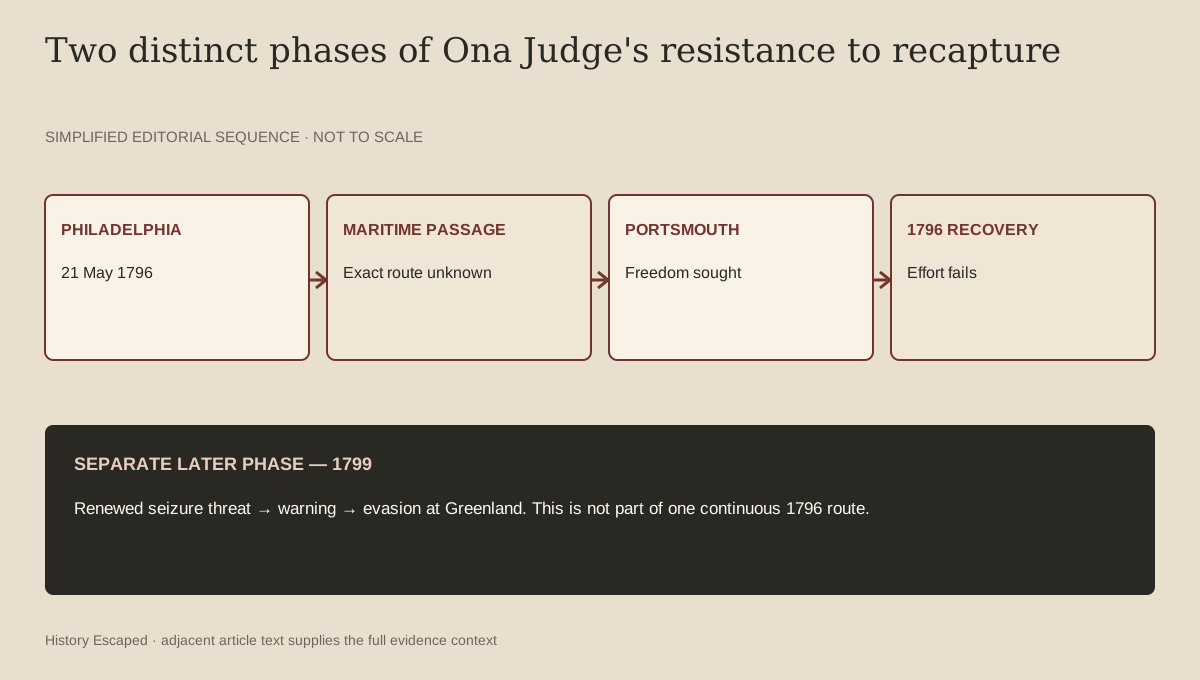
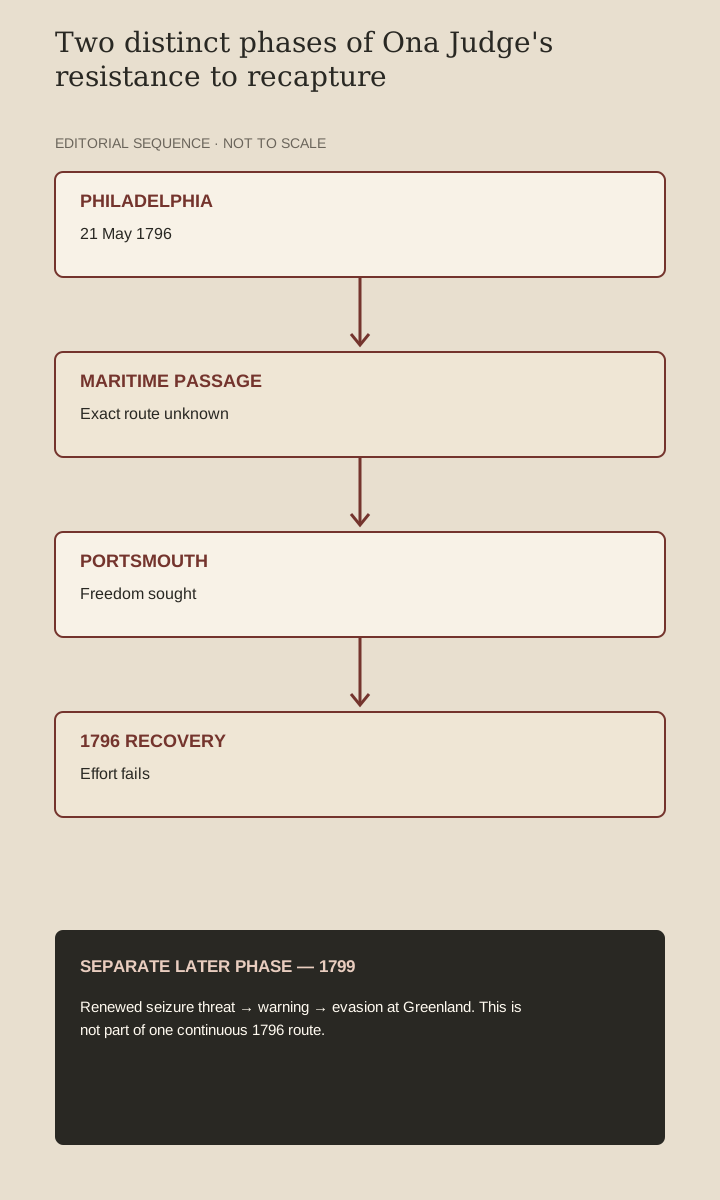
Simplified editorial sequence based on documentary records and Judge’s later testimony; exact maritime routing is unknown.

The Escape
Judge’s own account describes preparation rather than impulse.
She said she had friends “among the colored people of Philadelphia” and had sent her belongings to them in advance. Their names are not securely preserved in the surviving record. That absence matters: the escape depended on a network of assistance, but the evidence does not justify inventing identities or turning that network into a fully mapped organization.
She then left the President’s House while the Washington household was eating dinner. The dinner detail comes from her later recollection. The contemporary newspaper advertisement confirms the household had not expected her to leave and quickly considered the possibility that she might escape by water.
Judge later said she took passage aboard a ship commanded by Captain John Bolles and traveled to Portsmouth, New Hampshire. She claimed she kept Bolles’s name secret until after his death because she feared he could be punished for helping her.
The broad outline is strongly supported: Judge disappeared from Philadelphia, and by September Washington had credible information that she was in Portsmouth. The exact route is less certain. Washington had also heard an unverified report that she had been seen in New York, and he acknowledged uncertainty about whether she traveled by land or water during part of the journey. For that reason, a modern reconstruction should not draw an exact voyage line or claim every stop is known.

Washington Tries to Bring Her Back
Once Washington learned where Judge was, the escape became a contest over whether distance, community, and public resistance could protect her from the reach of an extraordinarily powerful enslaving household.
On September 1, 1796, Washington asked Treasury Secretary Oliver Wolcott Jr. to enlist the federal customs collector at Portsmouth. He suggested that Judge might be seized and placed aboard a vessel returning south. He also insisted that she had probably been enticed away by someone else.
Joseph Whipple found Judge and spoke with her. His report sharply complicates Washington’s theory. Whipple concluded that she had not been decoyed. He believed her central motive was freedom. According to his account, Judge was willing to consider returning only if she could receive a promise that she would be freed after the deaths of George and Martha Washington. She would not accept a return that left her liable to be sold, given away, or held indefinitely.
Washington rejected the condition.
In November, he told Whipple that rewarding Judge with an early path to freedom would create a dangerous example for other enslaved people. If she would not return voluntarily, he asked Whipple to arrange her shipment to Virginia or the federal city—so long as doing so would not provoke a mob, riot, or serious public unease.
This correspondence is one of the clearest windows into why Judge stayed free. Washington possessed immense political influence, but using it openly against an individual freedom seeker in New Hampshire carried reputational and practical risks. Whipple himself worried about local reaction. By December he still had not recovered her.
There is also an important legal distinction. The Fugitive Slave Act of 1793 gave enslavers a federal process for reclaiming people who escaped across state lines. But the Washington Papers editors note that Washington’s proposed shortcut—placing Judge directly on a ship without first taking her before a magistrate with proof—would have bypassed the procedure required by the statute.
A Life in New Hampshire—and Another Threat
Judge married John “Jack” Staines, a free Black sailor, in New Hampshire in early 1797. Whipple attempted to interfere with the Portsmouth marriage certification process, but Judge and Staines obtained the necessary registration in Greenland. They had three children.
Her marriage and distance from Virginia did not end the danger.
In August 1799, Washington contacted Martha Washington’s nephew Burwell Bassett Jr. and asked him to try again to recover Judge. The surviving letter is partly illegible, but its purpose is unmistakable: Washington still wanted her returned and still refused to promise the freedom she had demanded.
Judge’s later interviews supply the dramatic end of this episode. She said Bassett came to Portsmouth and tried to persuade her to return. When that failed, she learned he intended to take her by force. According to her recollection, John Langdon—or someone in his household—warned her. With her husband away at sea and a child with her, Judge left Portsmouth and traveled to the home of Nancy Jack in Greenland, about eight miles away.
This episode is broadly accepted in institutional histories, but its most detailed version comes from Judge’s later testimony. That distinction is important because her 1845 interview compresses the earlier recovery campaign and describes Bassett as if he were involved in two attempts. The contemporaneous correspondence shows a different chronology: federal official Joseph Whipple handled the principal 1796 effort, while Bassett belongs to the renewed 1799 effort.
Evidence discipline
What the record supports
Status labels distinguish secure conclusions from uncertainty and rejected claims. Color is never the only signal.
DOCUMENTED
Ona Judge escaped from the President’s House on May 21, 1796.
The date is supported by contemporary recovery records and the reward notice published three days later; NPS institutional history gives May 21 explicitly.
Sources: SRC-003, SRC-010LATER CLAIM
Judge escaped because she wanted freedom and feared being transferred to Martha Washington’s granddaughter.
This motive comes from Judge’s own 1845 retrospective testimony. It is highly important evidence of her perspective but was recorded nearly five decades after the event.
Sources: SRC-001, SRC-009LATER CLAIM
Black friends in Philadelphia helped Judge prepare by holding her belongings.
Judge herself described this assistance in 1845. The helpers are not securely identified in surviving contemporaneous records.
Sources: SRC-001LATER CLAIM
Captain John Bolles carried Judge from Philadelphia to Portsmouth.
Judge named Bolles in her 1845 interview and said she had kept his name secret until after his death. Contemporary records confirm her presence in Portsmouth but do not independently document every leg of the voyage.
Sources: SRC-001, SRC-005, SRC-009DISPUTED
A Frenchman seduced or enticed Judge into escaping.
Washington repeatedly advanced this theory, but he offered no proof. After speaking with Judge, Joseph Whipple reported that she did not appear to have been decoyed and that her motive was a desire for complete freedom; Judge’s later interviews likewise centered her own decision.
Sources: SRC-005, SRC-006, SRC-001DOCUMENTED
Washington attempted to use official and personal networks to return Judge to slavery.
Washington’s letters to Wolcott, Whipple, and Bassett directly document multiple recovery efforts from 1796 through 1799.
Sources: SRC-005, SRC-006, SRC-008MYTH
Washington’s proposed direct shipment of Judge without a magistrate would have followed the Fugitive Slave Act of 1793.
The Washington Papers editors note that his directive to place Judge directly aboard a vessel would have bypassed the act’s required procedure of bringing an apprehended freedom seeker before a magistrate with proof of ownership.
Sources: SRC-006, SRC-011DISPUTED
Burwell Bassett made both of Washington’s recovery attempts described in Judge’s 1845 interview.
Judge’s late-life account compresses the chronology. Contemporaneous correspondence shows that the principal 1796 attempt was handled through Treasury Secretary Oliver Wolcott Jr. and customs collector Joseph Whipple; Bassett entered the documented recovery effort in 1799.
Sources: SRC-001, SRC-005, SRC-006, SRC-008What the Evidence Corrects
One persistent misconception is that Judge’s escape happened because someone else “seduced” or tricked her into leaving. Washington believed a Frenchman had enticed her. The surviving evidence does not support treating that belief as fact. Whipple, after speaking with Judge, concluded that she had not been decoyed, and Judge’s own later testimony presented the decision as hers.
Another simplification is that reaching New Hampshire made her legally safe. It did not. Federal law still recognized claims for the return of people who escaped slavery across state lines. Judge’s freedom therefore existed in practice because the attempts to recover her failed—not because the Washingtons formally emancipated her or because crossing into New Hampshire automatically erased the claim.
The record also does not support an exact map of her journey from Philadelphia to Portsmouth. Her later statement about Captain John Bolles is valuable and credible enough to use with attribution, but contemporary correspondence contains uncertainty about the route.
Why the Escape Worked
Judge’s success did not depend on a single hidden door, disguise, or piece of equipment. It depended on social and political conditions.
She prepared quietly. She had Black friends in Philadelphia who could hold her belongings. She used the mobility of a major port. She reached a northern community where free Black residents and antislavery sentiment made a forced removal more difficult. When a federal official approached her, she refused to surrender the central point: she would not voluntarily return to a condition in which others could continue to own or transfer her.
Washington’s own caution also mattered. He wanted Judge back, but he repeatedly worried about the public consequences of a violent seizure. That concern created space in which local reluctance, delay, and warning could become decisive.
Judge’s escape therefore belongs to a category of self-emancipation that cannot be explained only by the physical act of leaving. The first departure created an opportunity. Her continued freedom required resisting pressure afterward.
Selected chronology
Selected chronology
Washington plans to prevent Philadelphia freedom claims
George Washington instructed Tobias Lear to send enslaved members of the presidential household out of Pennsylvania under a pretext if necessary, explicitly mentioning Oney.
Ona Judge leaves the President’s House
Judge escaped from the Washington household in Philadelphia as the family prepared to return to Virginia.
A reward advertisement appears
Frederick Kitt published a notice offering ten dollars for Judge’s return and warning ship captains not to carry her.
Washington mobilizes federal contacts
After learning Judge had been seen in Portsmouth, Washington asked Treasury Secretary Oliver Wolcott Jr. to have the local customs collector try to recover her.
Washington rejects Judge’s condition for return
After Joseph Whipple reported that Judge wanted eventual freedom, Washington rejected the proposed compromise and asked that she be shipped south if that could be done without public disturbance.
Judge and Jack Staines marry
After interference with the Portsmouth marriage process, the couple obtained the necessary registration in Greenland, New Hampshire.
Washington renews the recovery effort
Washington asked Burwell Bassett Jr. to recover Judge if it could be done by what he called easy and proper means.
Judge leaves Portsmouth to evade Bassett
Judge later recalled receiving warning of Bassett’s purpose and traveling to Nancy Jack’s home in Greenland with her child.
Judge’s first known newspaper interview appears
The Granite Freeman published a retrospective account preserving Judge’s reasons for escaping and key details of her flight.
Ona Judge Staines dies
Judge died in Greenland, New Hampshire, having never returned to slavery.
Aftermath
Jack Staines died in 1803. Judge’s later life was difficult, and by the 1840s she was poor and dependent on local support. She had also learned to read after reaching New Hampshire and spoke openly about her religious faith.
In 1845 and 1847, abolitionist interviewers recorded her story. Those interviews are imperfect historical documents: they were produced long after the events, and the interviewers had their own political purposes. Yet without them, the archive would be dominated by the people trying to recover her. The interviews preserve Judge’s explanation of the escape in her own terms.
When asked whether she regretted leaving a materially easier life in the Washington household, Judge’s answer was direct: she did not. Freedom mattered more.
Ona Judge Staines died in Greenland, New Hampshire, on February 25, 1848. She had spent nearly fifty-two years outside the Washington household.
Her story endures not because she escaped from a uniquely impenetrable prison, but because she escaped from a system supported by household authority, property law, federal power, and the prestige of the nation’s first president—and then kept refusing to go back.