
On Friday, 25 May 1951, Donald Maclean left the Foreign Office carrying a large cardboard box. MI5 surveillance followed him to Victoria Station, where he boarded the 6:10 p.m. train. Before the weekend was over, Maclean and fellow diplomat Guy Burgess had left Britain by sea and disappeared into continental Europe.
The British government did not yet know publicly where they had gone. Within days, however, the disappearance was becoming one of the defining intelligence scandals of the early Cold War. Maclean had been identified inside a secret Anglo-American investigation as a Soviet agent. Burgess, who was not under suspicion before the flight, had helped him get away and vanished with him.
The broad route to the Soviet Union is now clear. The warning that triggered it, and Burgess’s original intention, remain less certain.
At a Glance
- Departure: 25 May 1951
- Escapees: Donald Duart Maclean and Guy Francis de Moncy Burgess
- Starting point: Britain
- First foreign landfall: St-Malo, France
- Broad continental route: France → Switzerland → Czechoslovakia → Soviet Union
- Destination: Moscow / USSR
- Immediate trigger: Maclean had become the principal suspect in the VENONA/HOMER investigation and was due to be questioned
- Key uncertainty: The exact warning chain and whether Burgess originally intended to remain in the Soviet Union
- Public Soviet confirmation: February 1956
The Search for HOMER
The flight began with intercepted Soviet communications rather than a visible act of suspicion inside the Foreign Office.
During and after the Second World War, American and British cryptanalysts worked on encrypted Soviet messages in the program later known as VENONA. The traffic revealed that Soviet intelligence had received highly sensitive British diplomatic information from an agent codenamed HOMER, including material originating in Washington.
Identifying HOMER took years. By the spring of 1951, the field had narrowed sharply, and Donald Maclean had become the principal suspect. Maclean had served at the British Embassy in Washington and had held positions giving him access to Anglo-American diplomatic and atomic-policy material. He was now back in London as head of the Foreign Office’s American Department.
The National Archives’ released MI5 material confirms that Maclean was under surveillance by May. It also shows how limited that surveillance was. MI5 watched him in London, but the government’s priority was to question him unexpectedly and try to obtain evidence strong enough for prosecution. Officials feared that a more conspicuous security operation could alert him.
That calculation proved costly.

The Warning
Maclean did not wait to be questioned.
Modern National Archives interpretation states that he was tipped off through the efforts of Kim Philby and Guy Burgess. Philby was then the senior British intelligence liaison in Washington and was himself a Soviet agent. His position gave him access to information about the Anglo-American search for HOMER. Burgess, another Soviet agent and a friend of both men, had recently returned from the British Embassy in Washington.
The broad warning chain is persuasive and supported by later intelligence files. Its exact mechanics are harder to reconstruct.
Philby’s post-defection statements were self-protective. He tried to push responsibility for warning Maclean toward Burgess. Anthony Blunt, another Soviet agent who remained unsuspected at the time, was later shown to have assisted the pair and to have removed potentially incriminating material from Burgess’s flat after the disappearance. Soviet records and later British investigations filled in parts of the network only gradually.
The result is a familiar intelligence-history problem: the overall operation can be reconstructed more confidently than the exact conversation that set it in motion. What can be said securely is that Maclean learned enough to understand that he was in danger before British authorities confronted him.
May 25
The date carried a private significance: 25 May was Maclean’s thirty-eighth birthday.
MI5 surveillance saw him leave the Foreign Office after work and take the train from Victoria. He went toward his home in Kent. Burgess then joined him, and the two men travelled to Southampton.
Late that night they boarded a cross-Channel vessel for St-Malo, on the Brittany coast.
The choice removed them quickly from British jurisdiction without using an airport. By the time investigators understood that the disappearance was not an ordinary weekend absence, the two diplomats were already on the Continent.
Contemporary public accounts would spend years trying to reconstruct what happened next.
France: The Last Immediate Trail
St-Malo is the first continental point that can be stated with confidence.
Later accounts add that Burgess and Maclean avoided the most obvious onward connection and moved through Brittany before reaching Paris. Some versions describe a taxi to Rennes and a less conspicuous train onward. Those details are plausible and recur in serious retellings, but the modern National Archives summary is more useful for the publication’s evidentiary line: from St-Malo, the pair made their way through Paris, Switzerland and Prague toward Moscow.
That route did more than carry them east. It moved them through jurisdictions where Soviet intelligence could assist the transit and where the British search was operating with incomplete information.
The exact trains, border stations, accommodation and escort arrangements are not equally well documented in open files. A map should therefore show the major waypoints without pretending to trace a precise rail itinerary.
Why Burgess Went Too
Maclean had an obvious reason to disappear. Burgess’s presence is harder to explain.
Before 25 May, MI5 did not suspect Burgess of Soviet espionage. His Foreign Office career had become unstable because of his drinking, indiscretion and misconduct, and he had recently been recalled from Washington. None of that had yet identified him as a Soviet agent.
His immediate usefulness was clear: Maclean needed help leaving Britain, and Burgess could reach him without the same level of surveillance directed at the suspected HOMER. Whether Burgess was supposed to remain abroad is a different question.
Later biographical and intelligence reconstructions disagree. One possibility is that Soviet handlers always intended both men to disappear. Another is that Burgess was originally expected to escort Maclean through the first stages and then return, but circumstances or orders carried him onward. Burgess himself never supplied an account that resolves the issue beyond doubt.
The uncertainty matters because the paired phrase “Burgess and Maclean” can make the escape look like a symmetrical decision by two equally endangered men. It was not. Maclean was the man the British investigation was closing in on. Burgess became the unexpected second defector.
A Search Without a Confirmed Destination
The disappearance was announced publicly in early June.
At first, officials could not responsibly state that the men had reached Moscow. A U.S. State Department telegram from 15 June captures how uncertain the public position remained: officials discussed defection, kidnapping and other possible explanations while trying to coordinate their response with London.
British authorities increasingly treated the case as a premeditated defection, but proving where the men had gone was another matter. Rumours placed them across Europe. Sightings accumulated and contradicted one another.
The Soviet Union did not clarify the issue.
For several years, Burgess and Maclean remained absent from public view. The disappearance itself had become evidence of Soviet affiliation, but their physical location was not publicly demonstrated.
Later intelligence releases make the destination clear. The National Archives now describes the pair as having travelled through Switzerland and Prague to Moscow. After reaching the Soviet Union, they were kept away from Western attention while Soviet authorities debriefed and resettled them.
The Damage in London and Washington
Their flight had consequences beyond the loss of two diplomats.
Maclean’s identification confirmed that Soviet intelligence had penetrated a particularly sensitive part of British foreign policy. His earlier Washington service meant the scandal also affected American confidence in British security. A contemporary U.S. assessment recorded that the affair had severely shaken State Department trust in the integrity of the Foreign Office.
The disappearance also turned suspicion toward the people around them.
Philby’s close connection to Burgess and access to the HOMER investigation made him an obvious target. British investigators lacked evidence sufficient for prosecution, but he was recalled and eventually left the Secret Intelligence Service. Anthony Blunt remained protected by his public standing and did not confess until the 1960s. John Cairncross’s role emerged through a separate trail of evidence.
The investigation therefore did not end when Maclean and Burgess crossed the Channel. Their escape destabilized the British intelligence establishment for years.
What the 1955 Inquiry Could—and Could Not—Explain
In 1955 the British government published a White Paper on the disappearance, and Parliament debated why the security system had failed.
By then, officials acknowledged that Maclean had become the principal suspect before 25 May. Critics asked the obvious question: why had he not been watched continuously, including at ports?
The official answer was that the Security Service wanted to preserve surprise. Ministers hoped interrogation might produce admissible evidence and believed that alerting ports or widening the circle of officials who knew about the inquiry risked warning Maclean.
That explanation became one of the most controversial aspects of the affair.
The White Paper could reconstruct the failure of surveillance more easily than it could identify the leak that defeated it. In 1955, parliamentary allegations focused heavily on Philby, but there was still not enough public evidence to prove the case against him. One MP who had accused Philby of being the “third man” formally withdrew the charge after the Foreign Secretary’s statement.
Later releases changed the historical judgment. They did not turn the 1951 investigators into people who already possessed evidence they only acquired afterward.
Moscow, Finally
The mystery ended publicly in February 1956.
Nearly five years after the disappearance, Burgess and Maclean appeared before a small group of journalists in Moscow. They issued a prepared political statement explaining their decision in ideological terms and confirming what British and American authorities had long suspected.
Their emergence transformed the case from a disappearance into an acknowledged defection.
The appearance also revealed how long the Soviet government had managed the information around them. Western officials had repeatedly asked about the missing diplomats. Moscow had provided no useful confirmation.
For readers looking backward, the destination now seems obvious. It was not obvious in June 1951, and a source-led reconstruction should preserve that distinction.
What Remains Unresolved
The most important facts no longer depend on speculation. Maclean was a Soviet agent. Burgess was also a Soviet agent. Maclean was under investigation. He was warned. The two men left Britain on 25 May, crossed to St-Malo, moved across continental Europe and reached the Soviet Union.
The open questions are narrower but still meaningful.
Exactly how did Philby’s knowledge move through Burgess, Soviet handlers and possibly Blunt before reaching Maclean? How much did Maclean know about the timetable for his questioning? Was Burgess always meant to defect, or did an escort mission become permanent exile? Which details of the continental route come from direct records and which were reconstructed after intelligence archives began to open?
Those uncertainties do not weaken the story. They define the limits of what an intelligence archive can recover.
Burgess and Maclean succeeded because the British state knew enough to suspect Maclean but had not yet converted suspicion into control. Once the warning reached him, the gap between investigation and arrest was wide enough for two men to cross the Channel and disappear into a Soviet network prepared to receive them.
Documentary reconstruction
The continental route and its two unresolved questions
A case-local visual focused on the historical question that the surviving evidence can answer.
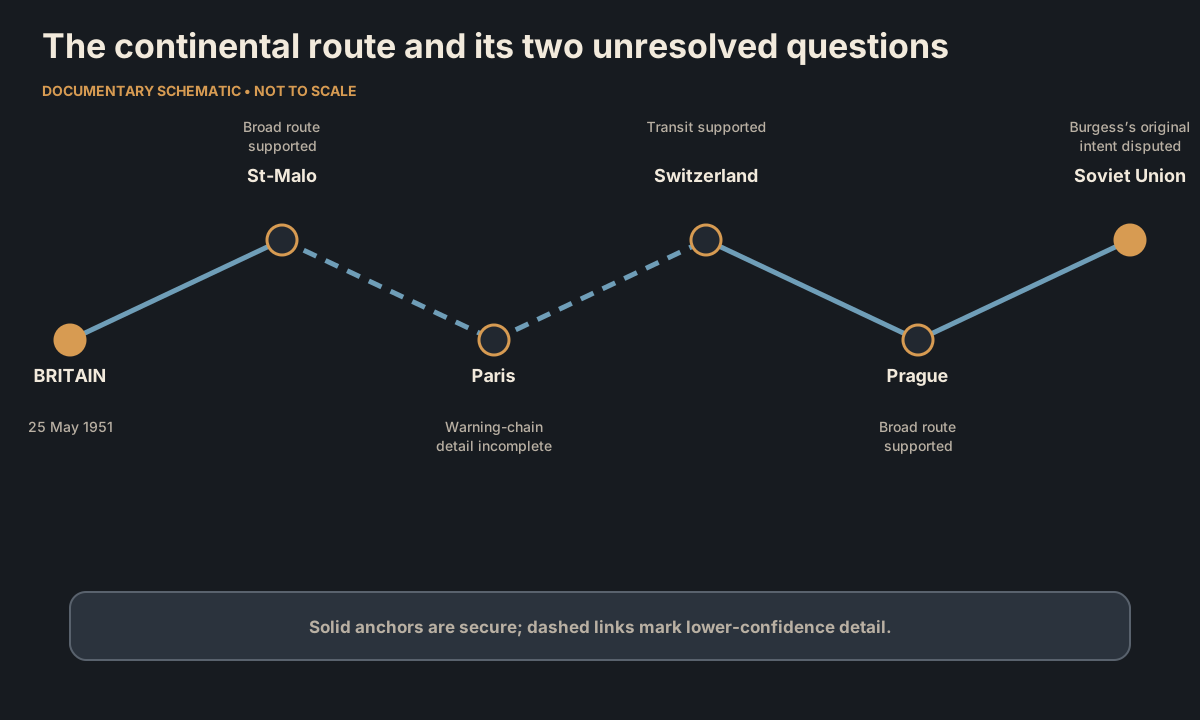
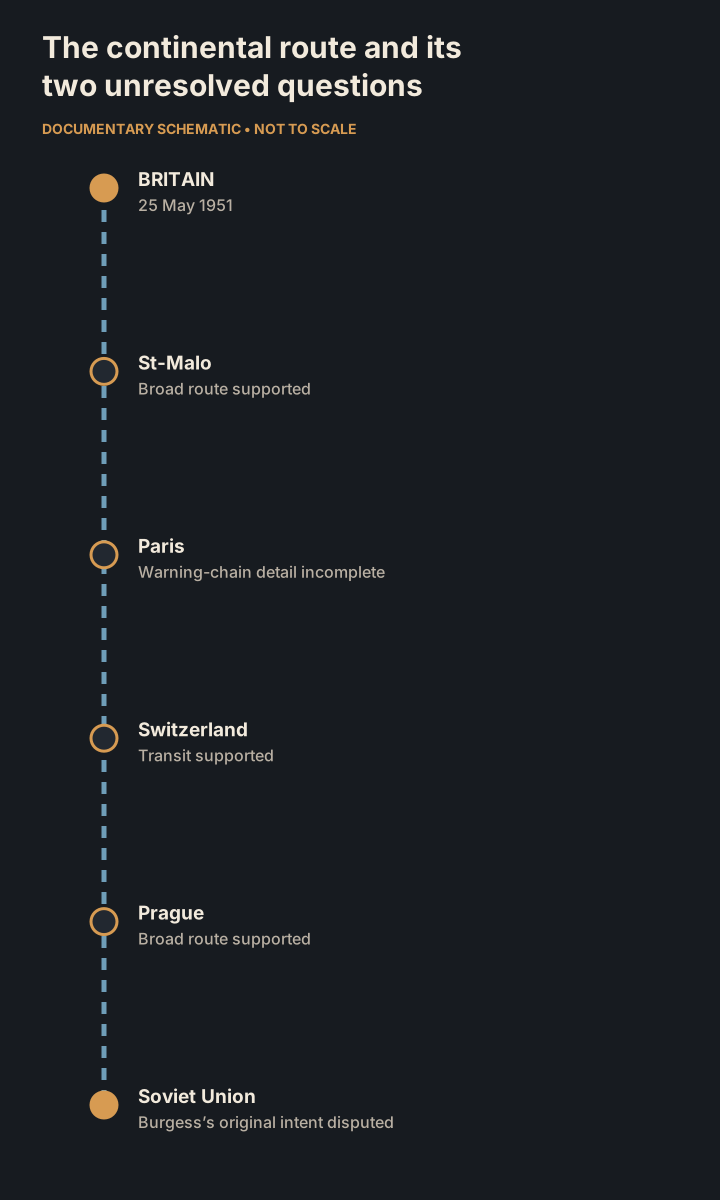
Simplified documentary reconstruction; not to scale. Evidence qualifications are written directly into the visual and explained in the adjacent text.
Evidence discipline
What the record supports
Status labels distinguish secure conclusions from uncertainty and rejected claims. Color is never the only signal.
DOCUMENTED
Donald Maclean had been identified as the Soviet agent HOMER before he fled.
Released MI5 material and VENONA documentation establish that Maclean had become the principal suspect before 25 May 1951.
Sources: SRC-001, SRC-002, SRC-006WELL-SUPPORTED
Kim Philby and Guy Burgess were involved in warning Maclean.
The National Archives states that Maclean was tipped off through the efforts of Philby and Burgess. The precise message path remains less complete because later participants gave self-protective accounts and the open files do not preserve one definitive warning message.
Sources: SRC-001, SRC-003, SRC-004WELL-SUPPORTED
Anthony Blunt assisted Burgess and Maclean’s escape.
Current National Archives material states that Blunt assisted the escape and later cleared compromising material from Burgess’s flat, although his exact pre-departure role is not fully specified in the sources used here.
Sources: SRC-003, SRC-004DISPUTED
Burgess always intended from the outset to remain permanently in the Soviet Union.
Maclean was the endangered agent and Burgess was not under suspicion. Later biographical reconstruction disputes whether Burgess was always intended to defect or initially expected only to escort Maclean.
Sources: SRC-002, SRC-009UNKNOWN
The route after St-Malo can be reconstructed exactly.
Major waypoints—Paris, Switzerland, Prague and the Soviet Union—are supported by released British intelligence files, but exact trains, crossings, hotels and handoffs are not consistently documented in the open record.
Sources: SRC-001, SRC-002MYTH
British and American authorities publicly knew in June 1951 that Burgess and Maclean were already in Moscow.
Contemporary U.S. diplomatic documents still considered several explanations in June, including defection and kidnapping. The Soviet destination became increasingly evident but was not publicly demonstrated by the men themselves until 1956.
Sources: SRC-007, SRC-011MYTH
Burgess was already an MI5 espionage suspect before he disappeared.
The National Archives states that Burgess was not under suspicion for Soviet espionage before the defection, despite his misconduct and indiscretions.
Sources: SRC-001, SRC-002