
On the evening of March 6, 1967, Svetlana Alliluyeva left the Soviet Embassy compound in New Delhi with one suitcase and took a taxi to the American Embassy. She was not fleeing a guarded prison, and her Soviet passport and Indian travel papers were still valid. What she was breaking away from was a system that had repeatedly decided where she could travel, whom she could marry, and whether she could remain abroad—and from the expectation that, as Joseph Stalin’s daughter, even her private life belonged partly to the state.
Her decision was neither a prearranged American intelligence operation nor a sudden rejection of everything Russian. The archival record shows a sequence of choices made over months: first to remain in India with the family of Brajesh Singh, then to resist Soviet demands that she return, and finally to seek help from a third country when India would not let her stay without Moscow’s consent. American officials then had to decide how to help a politically explosive defector whom Washington initially preferred not to bring directly to the United States.
At a Glance
- Who: Svetlana Iosifovna Alliluyeva, writer and daughter of Joseph Stalin
- What: A voluntary political defection begun at the U.S. Embassy in New Delhi
- Key date: March 6–7, 1967
- Route: New Delhi → Rome → Switzerland → New York
- Immediate result: She left India legally on her own Soviet documentation with a U.S. visitor visa and refused to return to the USSR
- Longer result: After six weeks in Switzerland, she entered the United States on April 21, 1967
India was supposed to be temporary
Brajesh Singh had been an Indian Communist living in Moscow, and Alliluyeva regarded him as her husband even though Soviet authorities had refused to recognize their proposed marriage. When Singh died in late October 1966, she fought for permission to carry his ashes to India. The journey mattered to her for reasons that were intensely personal: it allowed her to honor Singh, meet his family in their own country, and for the first time experience life outside the Soviet Union.
She arrived in India on December 20, 1966. Five days later, Singh’s ashes were immersed in the Ganges near his family’s home in Uttar Pradesh. U.S. diplomatic records later described her original permission as temporary, although the records themselves disagree on the exact term: one says a one-month visa, while a later embassy memorandum says her initial permission was for two weeks. The disagreement does not change the central point that she remained in India well beyond the stay Moscow expected.
Alliluyeva told American diplomats that India had affected her deeply and that her first choice was not the United States but to remain with Singh’s family. She stayed in Uttar Pradesh for roughly two months while requests from the Soviet Embassy hardened into orders to return. Her resistance was already a form of defiance before she ever approached an American official.
The decision narrowed
Remaining in India required political consent that Indian officials were unwilling to give on their own. Alliluyeva spoke with T. N. Kaul and Dinesh Singh, Brajesh Singh’s nephew and an Indian government minister. According to the American embassy’s reconstruction of what she told its officers, she was informed that India would allow her to stay only if the Soviet government approved; Dinesh Singh said he had taken the issue to Prime Minister Indira Gandhi and that the answer was effectively no.
That left her with one last effort inside the Soviet system. On March 6 she lunched with Soviet ambassador Ivan Benediktov and again asked to remain in India. The request was refused, and she understood that she was expected to be on an Aeroflot flight to Moscow on March 8. She also believed that if she returned after defying the embassy’s orders, she would never again be allowed to travel abroad.
Her own explanation to American officers was broader than a dispute over one marriage or one trip. She said her disillusionment with Communism had begun much earlier, while recent interference in her personal life had supplied both the incentive and a rare opportunity to act. She also described the special burden attached to her name: in addition to the restrictions faced by other Soviet citizens, she felt treated as a kind of state possession or national relic whose movements and relationships could be managed from above.
March 6: the American Embassy
At about 7:30 p.m., Alliluyeva appeared at the main door of the U.S. Embassy in New Delhi carrying a small suitcase. Her passport identified her as Svetlana Iosifovna Alliluyeva. She told embassy personnel that she could not return to the Soviet Union and signed a formal request for political asylum in the United States.
The Americans did not immediately grant asylum. Embassy officers questioned her, considered the possibility that the approach could be a Soviet provocation, and warned her that they could not guarantee that she would ultimately be admitted to the United States. They also made clear that she could still go back to the Soviet compound before anyone there necessarily knew she had left.
She refused that option. According to the embassy memorandum, she repeatedly said she would not return to the USSR and, if the United States would not help, intended to tell her story to the press and seek public support. That insistence matters because it places the decisive act with Alliluyeva herself rather than with the diplomats and intelligence officers who then helped manage the consequences.
Ambassador Chester Bowles and his staff considered several possibilities, including keeping her inside the chancery while consulting India, assisting her to leave openly, refusing assistance, or moving her out covertly. Bowles rejected both sending her back and a clandestine extraction. The embassy concluded that the least inflammatory option was to let her leave India through normal immigration and customs controls using her valid Soviet passport.
At about 11:30 p.m., Bowles authorized a single-entry B-2 visitor visa. The visa made it possible for a commercial airline to carry Alliluyeva westward, but it was not the same thing as a final grant of political asylum. She was told that Rome would be an interim destination while Washington decided what to do next, and she chose to proceed despite having no guaranteed permanent destination.
Out of India
Shortly after midnight, American personnel drove Alliluyeva to Palam Airport. She went through Indian immigration and customs in the ordinary way, using her own documentation. The Qantas flight was delayed by a hydraulic problem, and she finally departed New Delhi at about 2:45 a.m. on March 7 with an American officer accompanying her.
This was a diplomatic rescue in the sense that U.S. officials made the departure possible at a critical moment, but it was not a secret removal from Indian territory. The distinction became important almost immediately. Moscow accused the United States of organizing her departure through hostile and underhanded methods, while American officials emphasized that she had approached them on her own and had exited through normal legal channels.
Washington, meanwhile, was not eager to turn the defection into a propaganda triumph. A State Department telegram sent that night said it would be politically and physically preferable for Alliluyeva not to proceed directly to the United States. Officials explored Italy, Switzerland, Spain, and other possibilities, hoping to find a safe third-country haven that would reduce the damage to U.S.-Soviet relations.
Rome, then Switzerland
Rome became the first stop, but Italy was not prepared to make her presence permanent. American diplomats urgently approached Switzerland, whose government agreed to admit her temporarily as a tourist for “rest and recuperation,” not as a political refugee. The arrangement required discretion, avoidance of political publicity, and an American commitment to arrange her onward travel.
Alliluyeva reached Geneva by chartered aircraft on March 11. Swiss authorities moved her first to Beatenberg in the Bernese Oberland and later to more secluded accommodations as reporters converged on the area. She lived under assumed names, while Swiss officials tried to balance her liberty against their desire not to provoke either superpower.
The Swiss episode adds an uncomfortable complication to any simple “East versus freedom” narrative. A Swiss official later complained that both Washington and Moscow were effectively being served by keeping Alliluyeva quiet, even though she had accepted the restrictions because she had few alternatives. George F. Kennan, the former U.S. ambassador to the Soviet Union, eventually visited her and helped negotiate arrangements surrounding her memoir and her next move.
The State Department also tried to reassure Soviet ambassador Anatoly Dobrynin that the United States did not intend to exploit her. On March 10, American officials told him that Alliluyeva’s future depended on her and that Washington had no desire to force her toward the United States. Moscow rejected the broader American explanation later that month, insisting that U.S. officials had deliberately organized an anti-Soviet provocation.
America was the final choice
After six weeks in Switzerland, Alliluyeva decided to go to the United States. She boarded a Swissair flight for New York on April 21 under the name “Frau Staehelin,” a device intended to preserve privacy during the transfer rather than disguise the fact of her defection from governments already aware of it. When she landed at Kennedy Airport, the quiet handling ended: reporters were waiting.
In a written statement circulated on her arrival and soon reprinted in the Congressional Record, Alliluyeva explained the decision in personal as well as political terms. She described the Soviet government’s refusal to recognize her relationship with Brajesh Singh and its intrusion into decisions about marriage and travel. She wanted her departure understood as a choice about how to live, not simply as a daughter’s posthumous rebellion against Stalin.
A formal New York press conference followed on April 26. By then, her identity had made her one of the most famous defectors of the Cold War, but the archival record resists treating her as merely a trophy passed from one intelligence service to another. U.S. officials unquestionably assisted her, intelligence personnel were involved in handling the case, and Western governments tried to manage the political fallout. Yet the repeated decision not to return—to remain in India, to seek a third country, to enter the American embassy, to accept uncertain transit, and finally to come to the United States—was hers.
What the defection did and did not prove
The Soviet government had reason to resent the propaganda value of the episode, and American officials had reason to minimize their role after helping Alliluyeva leave India. Neither side’s public framing can be accepted without qualification. The strongest contemporary American record was written by participants who wanted to demonstrate that the departure had been legal and voluntary, while Soviet diplomats characterized the same assistance as a hostile operation.
Even so, several points are unusually secure. Alliluyeva was already in India legally; she tried first to stay there; the Soviet ambassador insisted on her return; she approached the U.S. Embassy on her own on March 6; she repeatedly rejected the chance to go back; and she passed through Indian exit controls with valid documents. The United States then facilitated her movement and searched for a third-country solution before she ultimately chose America.
Her later life also warns against turning 1967 into a tidy ending. Alliluyeva wrote about the defection in Only One Year, became financially independent from her books, and eventually made the United States her principal home, but she remained divided by family, homeland, and identity. In 1984 she returned to the Soviet Union, only to leave again in 1986.
That later reversal does not erase the agency visible in New Delhi. The historical importance of the 1967 defection lies precisely in the fact that the most famous name attached to it was not the only force at work. Beneath the diplomatic crisis was a woman who had tried to choose a partner, a place to live, and a future for herself—and who used the narrow opening of a trip abroad to make that choice irreversible.
Evidence discipline
What the record supports
Status labels distinguish secure conclusions from uncertainty and rejected claims. Color is never the only signal.
DOCUMENTED
Alliluyeva approached the U.S. Embassy in New Delhi on March 6, 1967.
The contemporary embassy memorandum records her arrival at about 7:30 p.m. on March 6; later references that give March 9 conflict with this primary chronology.
Sources: SRC-001, SRC-002DISPUTED
The United States immediately granted Alliluyeva political asylum in New Delhi.
She signed an asylum request, but the embassy told her asylum could not be guaranteed and instead issued a B-2 visitor visa to enable her legal departure. U.S. officials later emphasized that she entered America as a visitor rather than through a completed asylum adjudication.
Sources: SRC-001, SRC-002, SRC-005DISPUTED
Alliluyeva’s initial authorized stay in India was exactly two weeks.
One contemporary U.S. telegram describes a one-month visa, while a later embassy memorandum says her initial permission was for two weeks. The temporary nature of the trip is secure; the exact original term is not.
Sources: SRC-001, SRC-002UNKNOWN
The U.S. government planned Alliluyeva’s defection before she entered the embassy.
The available U.S. diplomatic record says officials did not know she was outside the Soviet Union until she appeared at the embassy, and later reporting identifies intelligence officers who helped handle her after the approach. No evidence used here establishes a prearranged American plan.
Sources: SRC-001, SRC-005, SRC-009WELL-SUPPORTED
Alliluyeva’s own choice was central to the defection.
Contemporary records repeatedly document her efforts to remain in India, her refusal to return to the Soviet compound, and her decision to proceed even without a guaranteed permanent destination. Her later memoir and public statement are consistent with that core sequence.
Sources: SRC-001, SRC-007, SRC-008, SRC-010DISPUTED
American officials used underhanded methods to remove Alliluyeva from India against Soviet interests.
Soviet diplomats made this accusation. The American record confirms active U.S. assistance but also documents a normal Indian exit process using Alliluyeva’s valid passport and her repeated voluntary choice to leave.
Sources: SRC-001, SRC-004Documentary reconstruction
Choice, jurisdiction and diplomatic transfer
A case-local editorial visual separates the documented sequence from uncertainty without implying exact modern geography or operational detail.
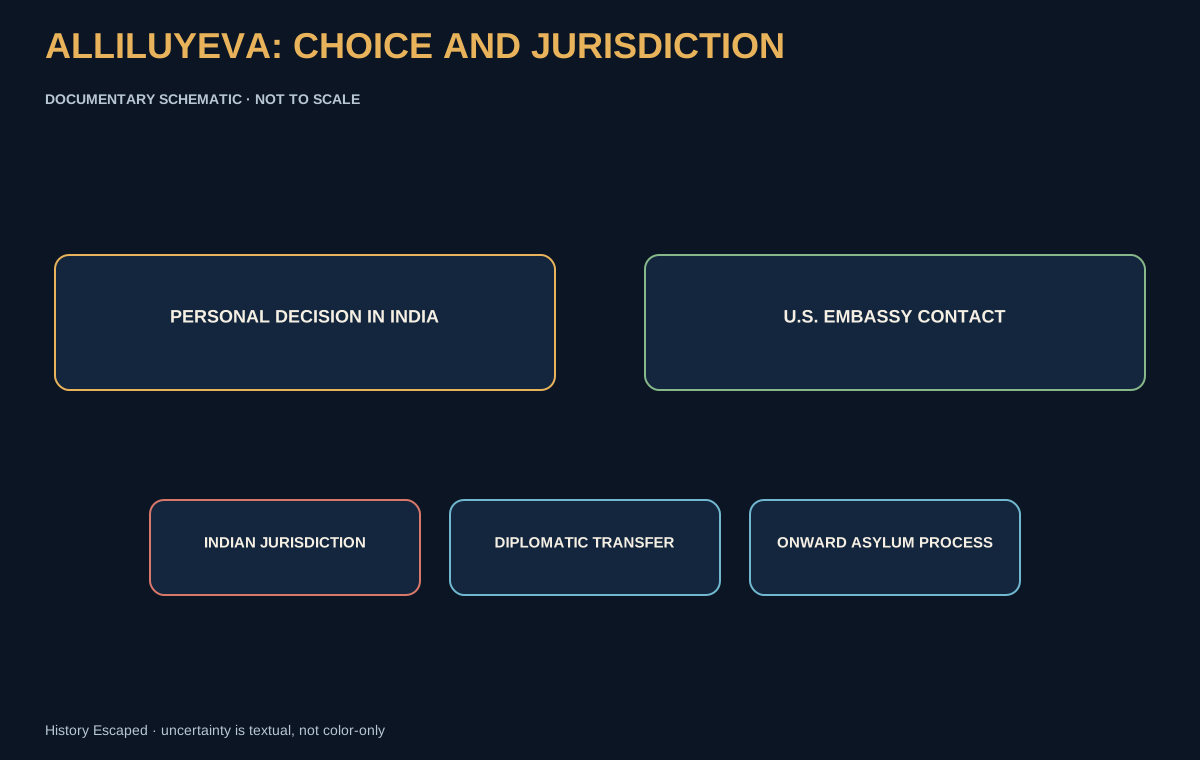
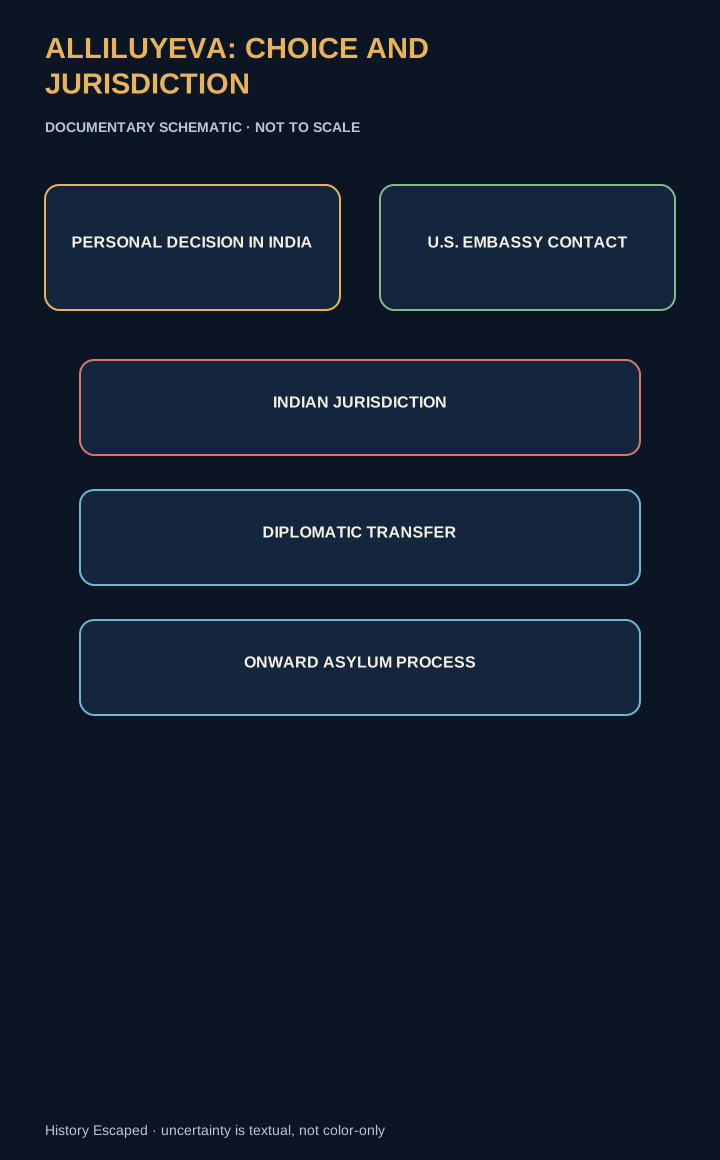
Simplified editorial reconstruction based on the cited historical record; not to scale. Uncertainty is stated directly in the visual and adjacent text.