
The East German border did not end where the land met the Baltic Sea. At Kühlungsborn, the water opened toward West Germany, Denmark, and international shipping, but the coast was watched and the sea patrolled. Anyone trying to leave the German Democratic Republic that way had to get past state surveillance and then survive a second barrier that no government had built: cold open water, distance, wind, currents, darkness, and exhaustion. In July 1971, physician Peter Döbler chose that route anyway. He entered the Baltic at Kühlungsborn and kept swimming until a West German boat found him off Fehmarn roughly a day later.
At a Glance
- Escape: July 1971
- Best-supported start: 25 July 1971
- Start: Kühlungsborn, East Germany
- Destination: Fehmarn, West Germany
- Recovery area: waters near Staberhuk
- Reported distance: approximately 45–48 km
- Reported duration: approximately 24–25 hours
- Method: open-water swimming
- Navigation: compass and natural/celestial cues
- Core equipment: wetsuit, fins, flotation support, food, compass, waterproofed documents
- Outcome: successful escape to West Germany
- Evidence caution: institutional sources disagree on the exact date, distance, and duration
A border made of water
The Berlin Wall became the dominant symbol of East Germany's efforts to stop its citizens from leaving, but the Baltic coast was another part of the same closed-border system. The sea offered something the land border did not: no continuous concrete wall or fence stretched across the horizon. That apparent openness could be deceptive. Coastal areas were monitored, suspicious movements attracted attention, and boats and observation systems extended border control onto the water.
Thousands nevertheless tried. The preserved Ostsee-Grenzturm project at Kühlungsborn records more than 5,600 Baltic escape attempts after 1961 and just over 900 successful outcomes to the West, Denmark, or rescue beyond East German control. Other public-history sources use slightly different totals, but they agree on the central fact: Baltic escape was dangerous, uncommon, and sometimes fatal. Peter Döbler understood that risk better than most.
A doctor who no longer wanted to stay
Döbler was born in Rostock in 1940 and eventually trained as a physician. His later explanation for leaving East Germany was not a single dramatic arrest. It was an accumulation of restrictions and political conflicts.
The Hessische Landeszentrale für politische Bildung records that his path into medical study had already been shaped by the social classification of his family. His father was a self-employed tax adviser, a background that worked against Döbler's university prospects under policies favoring applicants from politically preferred social groups. After his father's death, his classification changed and he was able to study medicine. The experience stayed with him.
As his medical career developed, Döbler became increasingly critical of the SED state. Institutional and later participant accounts describe professional difficulties, pressure over political conformity, housing problems, and restrictions on ordinary choices such as changing work. None of those experiences made him unique within the GDR. What was unusual was the solution he began to prepare.
Choosing the Baltic
Döbler considered several ways out. Later accounts say he thought about leaving through Poland, attempting a different maritime route, or swimming from another part of the East German coast. Each option required balancing border security against physical distance. He eventually settled on Kühlungsborn to Fehmarn.
The choice looks irrational if measured only in kilometres. It required one person to remain in the Baltic for about a day and a night. But border escape was never simply a shortest-route problem. A shorter route could be watched more heavily or bring a swimmer close to patrol concentrations for longer. Döbler believed the Kühlungsborn direction offered a chance to move away from the shoreline and then turn toward West Germany.
The sea would become his concealment and his greatest danger at the same time.
Two years of preparation
Döbler did not treat the crossing as an improvised burst of courage. Both the Hessian political-education authority and a 2009 Konrad-Adenauer-Stiftung event report describe roughly two years of preparation. Later accounts vary on how long the most intensive phase lasted, but the general pattern is consistent. He trained for long periods in the water.
He practiced endurance swimming in the Baltic and around Rostock. He learned to think about wind, currents, navigation, darkness, and the physical effects of prolonged exposure. He also tried to understand how the maritime border was watched. The point of that research was not to defeat the entire East German security system. It was to survive long enough to move beyond the zone where coastal observation and patrol response were most effective.
An attempt abandoned
The final swim was not the first time Döbler went to the coast intending to leave. At a 2009 event, he recalled an earlier attempt that ended before he entered the escape phase. Border guards checked him on the beach. He explained that he was there to fish and was allowed to continue, but the encounter left him too shaken to proceed.
He abandoned the attempt. The episode is a useful correction to the legend of flawless preparation. Döbler had trained for years, but a routine encounter with guards could still collapse the plan before the first long-distance stroke. The date of that aborted attempt is not securely established and does not resolve the separate dispute over whether the successful swim began on 24 or 25 July.
24 or 25 July?
Most detailed participant-centered accounts place the successful start on Sunday, 25 July 1971. The Hessische Landeszentrale gives 25 July. Regional reporting based on later interviews with Döbler gives the same date and places him at Kühlungsborn through the afternoon before entering the sea. Two institutional calendars differ.
MDR's historical calendar says 24 July. The Bundesstiftung zur Aufarbeitung der SED-Diktatur also places the escape on the 24th. Without the original rescue or border file, neither institutional date can be dismissed outright. The stronger detailed chronology supports 25 July, with the disagreement retained rather than hidden.
Late afternoon at Kühlungsborn
Participant-centered accounts place Döbler's entry into the Baltic around late afternoon. He had spent time at the beach rather than behaving like someone rushing toward a border crossing. The successful plan depended partly on making the period before departure look ordinary. His equipment was compact because everything had to remain with a swimmer for many hours.
He wore a neoprene or diving suit. He used fins. He carried a compass. He had flotation support, food, and waterproofed professional papers that might help him re-establish his medical career if he survived.
Later accounts also describe hand fins or paddles. This was not a swimmer entering the sea with nothing. It was still a swimmer entering the sea alone.
The stimulant detail
Döbler also carried appetite-suppressant stimulant medication. The Hessian political-education authority describes amphetamines; other later sources specify an amphetamine-based appetite suppressant and quote Döbler retrospectively acknowledging that he had used a form of performance enhancement. That fact belongs in the history because it shaped how he tried to endure the crossing. Exact dose, timing, or supposed performance benefit is unnecessary to the history and potentially misleading outside the very specific context of Döbler's own 1971 decision.
Not a straight line
Modern maps can create a false impression of precision. One can draw a line from Kühlungsborn to Fehmarn in seconds. Döbler could not follow a digital route, and the distance he actually covered was not simply the straight-line separation between two points. Later reconstructions describe him moving offshore before turning more decisively toward the northwest.
That makes sense as historical context: staying close to the East German coast for as little time as possible reduced one category of danger. But a longer offshore path increased another. Every additional kilometre meant more time exposed to the Baltic. The route therefore changed the problem rather than eliminating it.
Why sources say 45, 48, or 50 kilometres
The distance has become one of the most repeated numbers in Döbler's story. Unfortunately, it is not one number. The Hessian political-education authority and several later accounts use about 45 kilometres. The Konrad-Adenauer-Stiftung and MDR use 48 kilometres.
Some journalistic retellings round the feat to about 50 kilometres. The disagreement does not undermine the escape. It reflects the difference between a direct geographic distance, a swimmer's actual track through moving water, later reconstruction, and journalistic rounding. The most responsible formulation is therefore simple: Döbler swam approximately 45–48 kilometres. An exact track has not been reconstructed.
Course northwest
For navigation, Döbler relied on a compass and the night sky. He had trained himself for prolonged swimming, but endurance alone was not enough. A strong swimmer moving in the wrong direction could remain in the sea longer without getting closer to safety. The title later given to the best-known book about his escape—Kurs NordWest—captures the basic navigational logic without proving every turn of his route.
He needed to get offshore and then keep working toward the Fehmarn side of the Baltic. That was difficult even before East German authorities knew someone was missing.
The search begins
Later accounts place the discovery of Döbler's abandoned clothing late on the evening of the successful swim. At that point, he had already been in the Baltic for hours. East German forces searched for a suspected escapee using maritime assets and searchlights. Preserved oral-history and later participant accounts describe boats and combat swimmers moving into the search.
Döbler remembered seeing searchlights during the night and avoiding detection. The broad sequence is credible and well supported. The dramatic details are harder to certify. Claims about an exact number of metres between him and a patrol boat, or the precise geometry of a searchlight beam, belong to later narrative reconstruction unless a contemporaneous operational file is produced.
The sea becomes the main enemy
Once Döbler was far enough offshore, the balance of danger changed. East German coastal surveillance still mattered. So did shipping. But cold, dehydration, fatigue, disorientation, and changing weather increasingly became the forces most likely to stop him.
This is what separates Döbler's case from a tunnel or car escape. There was no instant moment when a barrier was crossed and the main physical danger ended. The escape remained uncertain for hour after hour.
A night and another day
Sources usually describe Döbler as swimming through one night and much of the following day. The reported duration is another number with two main versions. MDR and the Federal Foundation historical calendar use about 24 hours. The Konrad-Adenauer-Stiftung, drawing directly on Döbler's appearance as a witness, gives 25 hours.
Later participant-centered journalism usually follows the twenty-five-hour version. There is little historical value in pretending the difference can be resolved to the minute. Approximately 24–25 hours is precise enough.
The sight of Fehmarn
Fehmarn was the intended West German destination, but reaching its surrounding waters did not mean Döbler had enough strength to walk onto the beach. He was severely exhausted. Participant-centered accounts describe dehydration and cold despite the wetsuit. What happened next was not another feat of swimming. It was rescue.
A civilian boat
A West German civilian vessel found Döbler off Fehmarn, commonly described near Staberhuk on the southeastern side of the island. Sources disagree over whether to call the vessel a sport boat, sailboat, yacht, or motor sailer. That distinction is far less important than the role it played. The people aboard pulled Döbler from the Baltic.
Later accounts say he asked to be taken to the police. After almost a day of self-propelled escape, the final movement into West German custody depended on strangers noticing a swimmer in open water.
The border had finally changed sides
Once aboard the West German vessel, the political problem changed immediately. Döbler was no longer trying to stay invisible to East German maritime security. He was an East German refugee in West Germany. He initially stayed with a relative in Kiel.
An August 1971 photograph preserved by the Stadtarchiv Kiel shows him being welcomed there only weeks after the crossing. It is one of the most useful visual records of the case because it is not a later reenactment of the swim. It documents the immediate social aftermath of successful escape. Within a short period, Döbler was working as a doctor again. The professional papers he had carried across the Baltic had survived with him.
The record claim
Döbler's crossing is often described as a record. The Konrad-Adenauer-Stiftung calls it the longest distance swum by a refugee from the GDR. MDR makes the same essential claim. The Kühlungsborn border-tower museum preserves him as one of the outstanding Baltic escape cases.
That evidence supports a careful superlative: Döbler is widely documented as having made the longest known successful swimming escape by a GDR refugee. It does not justify claiming that no human being had ever swum farther in the Baltic or that the swim was an international open-water record. Those are different claims.
More than nine hundred successes
Döbler's crossing can look so extreme that it seems detached from the wider history of the Baltic border. It was not. The Ostsee-Grenzturm project records 5,609 registered attempts to flee across the Baltic after 1961 and 913 successes to the West, Denmark, or rescue beyond East German control. MDR gives a comparable figure of more than 900 successful Baltic escapes and reports at least 174 deaths.
The exact totals depend on definitions and continuing research. The larger pattern is clear. The sea was a major escape frontier. Most people did not attempt Döbler's distance by swimming alone.
A different East German escape mechanism
Other East German escapes used tunnels, trains, cars, aircraft, balloons, and improvised devices. Döbler's method was fundamentally different. His principal machine was his own body. The wetsuit and fins mattered.
The compass mattered. Food and flotation support mattered. But there was no engine, hidden compartment, false wall, or vehicle carrying him across the border. The escape depended on maintaining movement for roughly a day while the border system and the environment each tried, in different ways, to stop him.
Preparation was not certainty
Later retellings sometimes make Döbler sound almost mechanically confident. He had trained. He had studied the coast. He had planned his equipment.
He had reduced contact with people who might be accused of helping him. He even instructed his mother, according to institutional accounts, to report his flight so she could more convincingly deny prior knowledge when questioned. All of that reduced risk. None of it guaranteed survival.
An aborted attempt after a routine border check had already shown how easily the plan could collapse. The successful crossing depended on preparation meeting favorable conditions and extraordinary endurance.
Why the equipment does not explain the escape
Döbler's equipment and preparation do not form a reproducible survival formula. Patrol behavior changed. The preserved Kühlungsborn watchtower landscape changed.
Weather and currents are variable, and the drugs mentioned in the story carried medical risk rather than providing a reproducible endurance strategy. The historical question is why this particular escape worked in July 1971.
Why it worked
Several factors converged. Döbler had trained himself to remain in the water for very long periods. He chose a route that aimed to reduce exposure to coastal surveillance even though it increased physical distance. He carried navigation equipment.
He had protection against cold that a normal swimmer would not. He entered the sea before authorities understood that an escape attempt was underway. By the time the search began, he had already created distance from the coast. Then he kept moving long enough to reach West German waters. Finally, a civilian boat found him before exhaustion or exposure ended the attempt.
The sea replaced the wall
The Baltic was sometimes called an escape route because it did not look like a border. For Döbler it functioned as both border and crossing. East Germany could watch the coast, search the water, and criminalize unauthorized departure. It could not build a wall across the entire Baltic.
The open space that remained was physically unforgiving enough to serve as its own deterrent. Döbler turned that deterrent into his route. He did not break through a barrier. He outlasted one.
Evidence discipline
What the record supports
Status labels distinguish secure conclusions from uncertainty and rejected claims. Color is never the only signal.
WELL-SUPPORTED
The successful crossing began on 25 July 1971.
The Hessische Landeszentrale and detailed participant-centered later accounts use 25 July, but MDR and the Federal Foundation historical calendar give 24 July.
Sources: SRC-001, SRC-007, SRC-009, SRC-010DISPUTED
The successful crossing began on 24 July 1971.
Two institutional calendars use 24 July, but the stronger detailed participant-centered chronology places Döbler at Kühlungsborn and entering the sea on 25 July.
Sources: SRC-009, SRC-010DISPUTED
Döbler swam exactly 48 kilometres.
Credible sources use 45 km and 48 km, while others round to roughly 50 km. These figures do not represent a securely measured GPS track.
Sources: SRC-001, SRC-002, SRC-006, SRC-007, SRC-009WELL-SUPPORTED
Döbler spent exactly 25 hours in the water.
A 2009 eyewitness event report and later participant-centered accounts use about 25 hours, while MDR and Federal Foundation calendar material use 24 hours.
Sources: SRC-002, SRC-006, SRC-009, SRC-010WELL-SUPPORTED
Döbler made an earlier attempt that he abandoned after a border-guard check.
The Konrad-Adenauer-Stiftung recorded Döbler recounting the aborted attempt as an eyewitness in 2009.
Sources: SRC-002UNKNOWN
The earlier aborted attempt definitely occurred on 24 July and explains the conflicting 24/25 July dates.
The accessible eyewitness report does not date that prior attempt, so connecting it to the 24 July calendar tradition would be inference rather than sourced fact.
Sources: SRC-002, SRC-009, SRC-010WELL-SUPPORTED
East German forces searched the sea after Döbler's departure was detected.
Later participant interviews and the Kühlungsborn border-tower oral-history tradition consistently describe a maritime search.
Sources: SRC-003, SRC-005, SRC-007LATER CLAIM
A searchlight passed within an exact documented distance of Döbler.
Precise proximity figures appear in later narrative accounts but are not corroborated here by a contemporaneous operational record.
Sources: SRC-007DOCUMENTED
Döbler was recovered by a West German civilian vessel off southeastern Fehmarn.
Institutional and participant-centered sources agree on civilian recovery near Fehmarn, commonly associated with Staberhuk, despite varying vessel labels.
Sources: SRC-001, SRC-005, SRC-007WELL-SUPPORTED
Döbler's crossing was the longest successful swimming escape by a GDR refugee.
KAS and MDR state the superlative, and the Baltic-border museum preserves the case as a record swimming escape. Stronger world-record claims are not supported.
Sources: SRC-002, SRC-004, SRC-009MYTH
Döbler's swim was the longest open-water swim ever completed by any person in the Baltic.
Sources support a GDR-refugee superlative, not a universal open-water world record.
Sources: SRC-002, SRC-009Documentary reconstruction
Baltic corridor and measured distances
A case-local editorial visual separates the documented sequence from uncertainty without implying exact modern geography or operational detail.
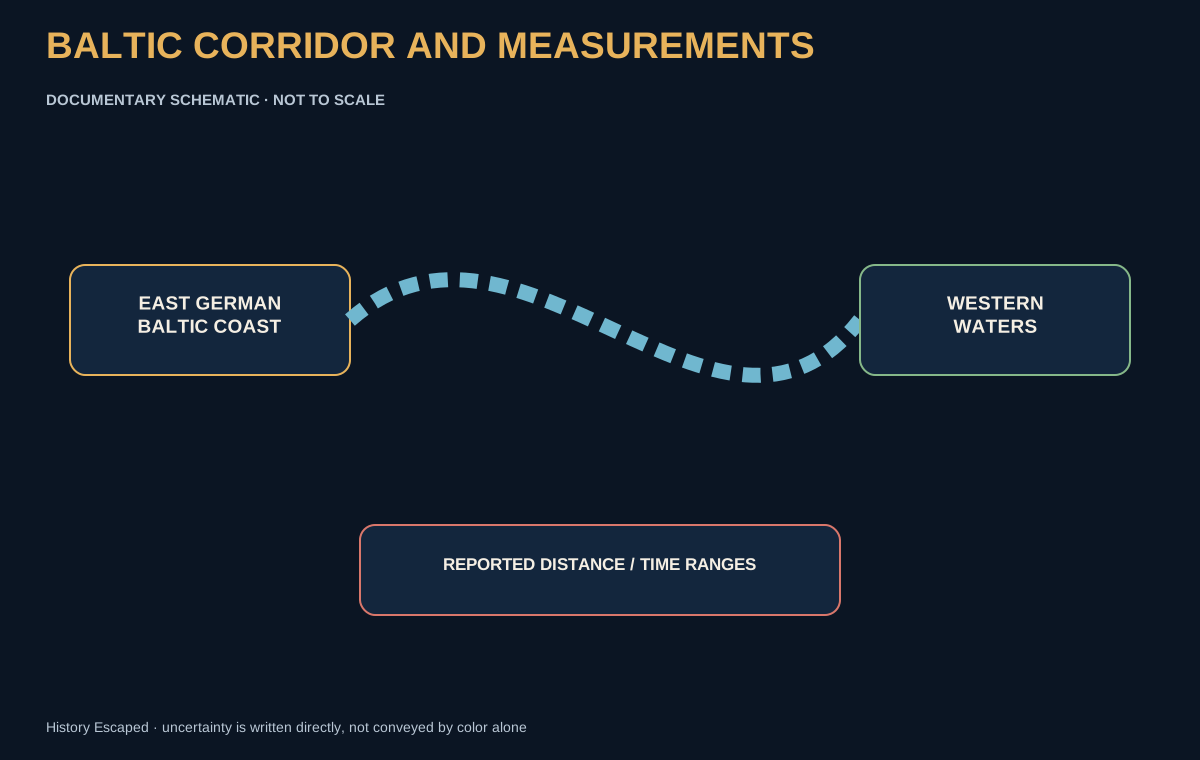
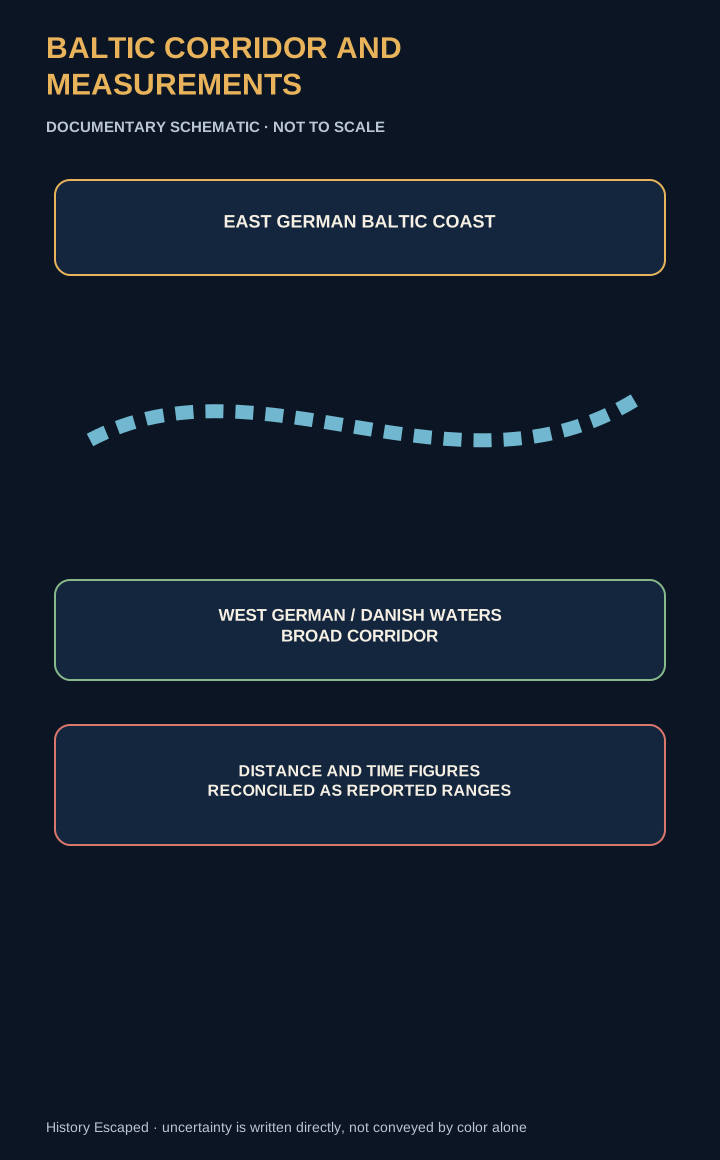
Simplified editorial reconstruction based on the cited historical record; not to scale. Uncertainty is stated directly in the visual and adjacent text.

